Table of contents
An introduction email is a short message that opens a professional relationship by making three things obvious inside the first two lines: who you are, why you are reaching out to this specific person, and what happens next. Everything else — the greeting, the context, the signature — exists to support those three jobs.
This guide covers the anatomy of a working introduction email, subject lines that get opened, eight templates you can copy for the most common scenarios, how to introduce two parties without wasting anyone's time, and the follow-up cadence the data actually supports.
Key Takeaways
- The average cold introduction email reply rate is 3.43% across a platform dataset of more than 20 million sales emails, down from 5.1% in 2024 — an untargeted introduction is now close to invisible.
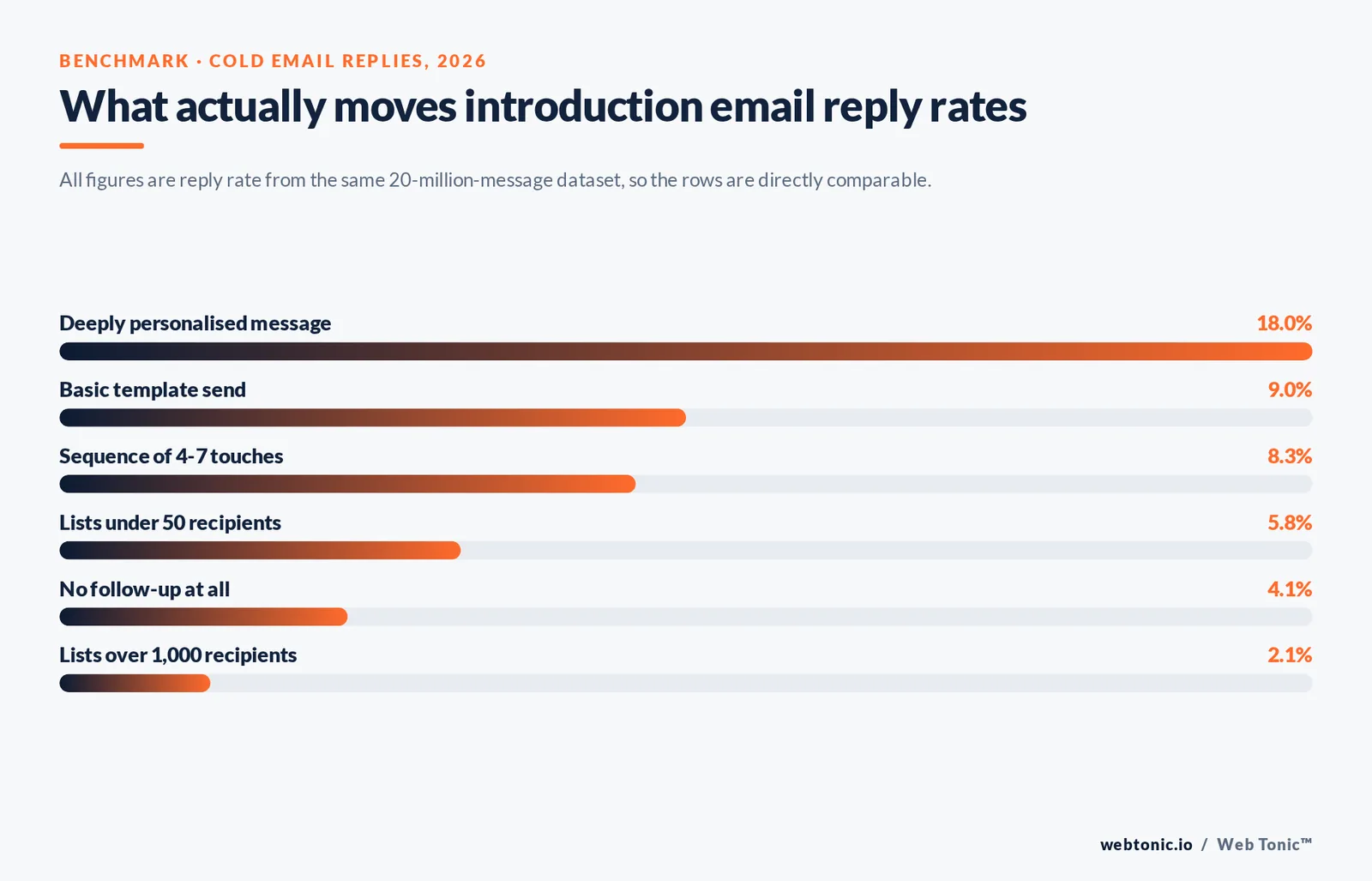
- Genuine personalisation roughly doubles the outcome: 18% reply rate for deeply personalised messages versus about 9% for basic template sends.
- Small, deliberate lists win. Campaigns to fewer than 50 recipients average a 5.8% reply rate against 2.1% for lists of 1,000+.
- Follow-up is where the replies live: 42% of all replies arrive from follow-ups, yet 48% of reps never send a single one. Sequences of 4 to 7 touches reach 8.3% reply rates versus 4.1% with no follow-up.
- For opt-in business audiences the all-industry open rate is 39.64%, click-through 3.25% and click-to-open 8.62%; North America runs highest at 45.30% / 4.77% / 10.53%.
- Treat open rate as directional only — Apple Mail Privacy Protection pre-loads tracking pixels, which is why reported cold-email opens span a wide 27.7% to 44% band.
- Deliverability is a prerequisite, not a detail: average cold bounce rate is 5.1%, and anything above 2% signals a list-quality problem before it signals a copy problem.
- Write for scanners. Eyetracking research found 79% of readers scan any new page and only 16% read word by word, so the ask belongs above the fold, not in a closing paragraph.
- Length discipline pays: keep the body to 90 to 150 words, one clear call to action, and a signature block that answers "who is this?" without a click.
What an introduction email is — and the five situations that need one
An introduction email is the first message in a relationship where no prior thread exists. That makes it structurally different from a follow-up: there is no shared context to lean on, so the message has to manufacture context in a sentence. The most common failure is not rudeness or length — it is ambiguity. The recipient finishes reading and still cannot tell what they are being asked to do.
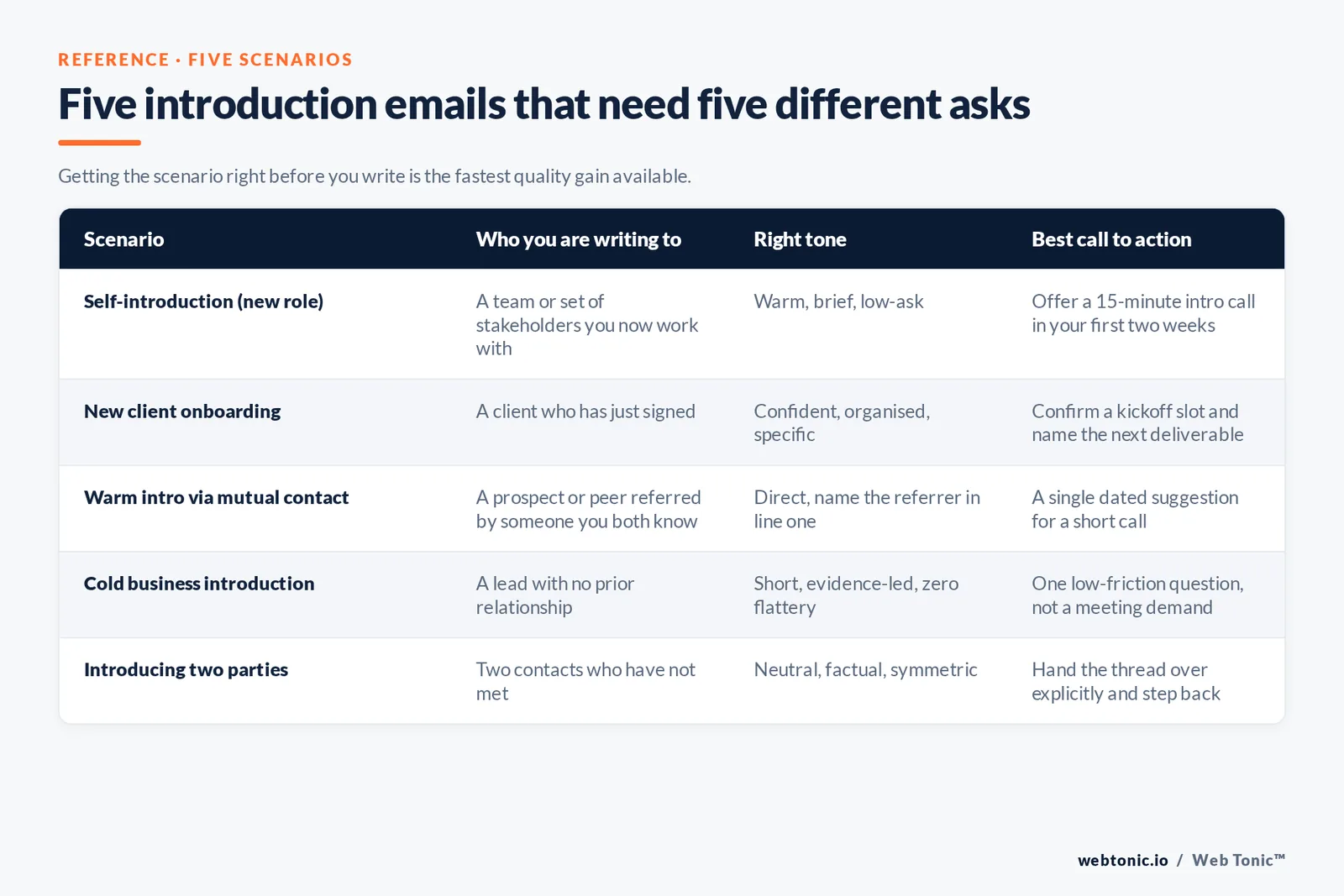
Five distinct scenarios sit under the same label, and they need different tone, length and calls to action. Getting the scenario right before you write is the fastest quality gain available.
| Scenario | Who you are writing to | Right tone | Best call to action |
|---|---|---|---|
| Self-introduction (new role) | A team, department or set of stakeholders you now work with | Warm, brief, low-ask | Offer a 15-minute intro call in your first two weeks |
| New client onboarding | A client who has just signed | Confident, organised, specific | Confirm a kickoff slot and name the next deliverable |
| Warm introduction via a mutual contact | A prospect or peer referred by someone you both know | Direct, name the referrer in line one | A single dated suggestion for a short call |
| Cold business introduction | A potential lead with no prior relationship | Short, evidence-led, zero flattery | One low-friction question, not a meeting demand |
| Introducing two parties | Two contacts who have not met | Neutral, factual, symmetric | Hand the thread over explicitly and step back |
The cold case is by far the hardest, and the numbers say so. Woodpecker's analysis of over 20 million sent messages puts the current platform-wide reply rate at 3.43%, with well-run B2B programmes reaching 10% to 18% — the gap between average and elite has never been wider (Woodpecker, 2026 benchmarks). Permission-based lists behave completely differently: GetResponse's benchmark study of 4.4 billion messages reports a 39.64% all-industry open rate, a figure broadly echoed in Mailchimp's industry benchmarks and a 0.15% unsubscribe rate. Comparing your cold introductions to newsletter benchmarks is the most common way teams talk themselves into thinking a broken sequence is fine.
The anatomy of a professional introduction email
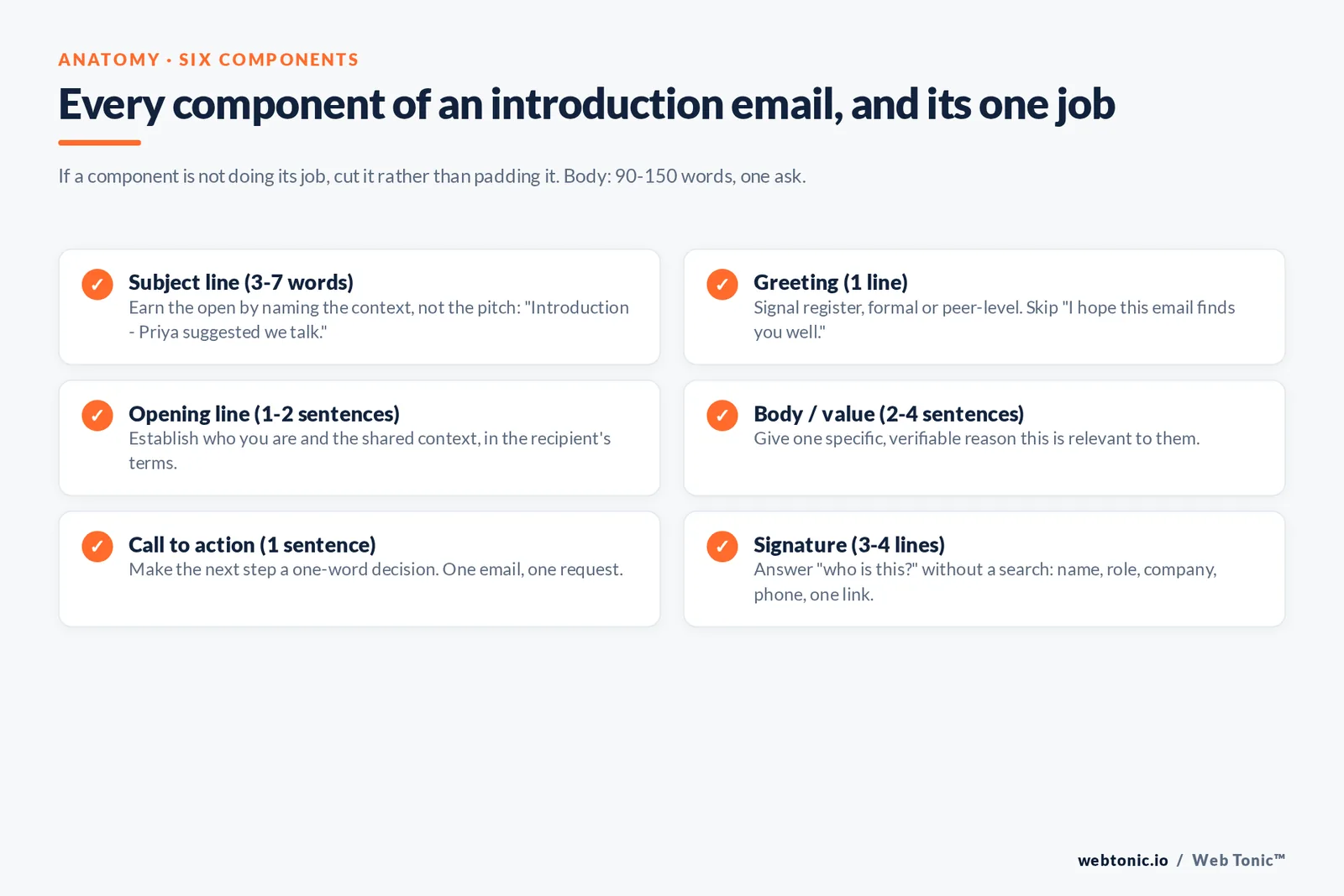
Six components, each with one job. If a component is not doing its job, cut it rather than padding it.
| Component | Its one job | Target length | Example |
|---|---|---|---|
| Subject line | Earn the open by naming the context, not the pitch | 3–7 words | Introduction — Priya suggested we talk |
| Greeting | Signal register: formal or peer-level | 1 line | Hi Daniel, / Dear Dr Okafor, |
| Opening line | Establish who you are and the shared context | 1–2 sentences | I'm Maya, the new performance lead on the Northwind account. |
| Body / value | Give the recipient a reason this is relevant to them | 2–4 sentences | Your team ships 40 landing pages a quarter; we cut review time on similar volumes by half. |
| Call to action | Make the next step a one-word decision | 1 sentence | Would 20 minutes on Thursday work, or is next week better? |
| Signature | Answer "who is this?" without a search | 3–4 lines | Name · role, company · phone · one link |
Two structural rules do most of the work. First, the ask goes high — Nielsen Norman Group's eyetracking research found 79% of readers scan rather than read, and only 16% read word by word (NN/g), a scanning habit later mapped as the F-shaped reading pattern across 232 test users. Second, one email carries one request. A message that asks for a call, a document and an internal forward gets none of the three.
Skip "I hope this email finds you well" entirely. It consumes the highest-value line in the message and tells the recipient nothing. Practical phrasing guidance for both openers and closers is well covered by Grammarly's self-introduction guide and the classic Mind Tools guide to writing effective emails. If your signature is still three lines of legal boilerplate and a stock photo, our breakdown of professional email signature examples shows what to keep.
Subject lines for introduction emails that actually get opened
An introduction subject line has a narrower job than a marketing subject line: it must be instantly legible as a real message from a real person. Clever gets filtered; specific gets opened. Because Apple Mail Privacy Protection inflates reported opens, judge subject lines on replies over a few dozen sends rather than on a single day's open rate.
| Scenario | Subject line | Why it works |
|---|---|---|
| Mutual contact | Priya Raman suggested I reach out | Borrowed trust in four words; the strongest opener available |
| New role, internal | Hello from your new account lead | Sets the relationship before the name |
| New client | Kickoff: next steps for [Company] | Names a deliverable, so it reads as work, not admin |
| Cold prospect | Question about your Q4 landing pages | Specific to their world, implies a short read |
| Event follow-on | Following our chat at SaaStock | Converts a weak memory into shared context |
| Introducing two people | Intro: Daniel (Northwind) <> Maya (Web Tonic) | Both parties see the purpose in the preview pane |
| Job or partnership | Content partnership — two specific ideas | Quantified promise beats a vague "collaboration" |
| Re-introduction | Picking this back up after 6 months | Honest about the gap, which removes awkwardness |
Three patterns to avoid outright: all-caps urgency, a subject line longer than the preview window on a phone, and the word "opportunity" used as a noun. If you send at any volume, also make sure the mechanics are compliant — the FTC's CAN-SPAM compliance guide is the authority on accurate headers, honest subject lines and opt-out handling for commercial messages.
Eight introduction email templates and samples
Copy these, then change the second sentence — that is the line carrying the specific context, and it is the one that decides whether the message reads as written for a person or fired at a list.
1. Self-introduction to a new team. "Hi all — I'm Maya, joining as performance lead from today. I'll be looking after paid search and reporting for the Northwind and Lumen accounts. I've booked 15 minutes with each of you over the next two weeks, and I've asked for the current reporting pack so I arrive with questions rather than a blank page. If there's one thing you'd fix about how campaigns get reviewed today, tell me before we meet."
2. New client welcome. "Hi Daniel — great to be working with you. I'm your day-to-day contact for the Northwind programme, alongside Sam on creative. Kickoff is Thursday at 10:00 and I've sent an agenda; the two things we need from you before then are analytics access and last quarter's spend by channel. First deliverable, the 90-day plan, lands on the 14th."
3. Warm introduction via a mutual contact. "Hi Rachel — Priya Raman suggested I get in touch after you two spoke about your reporting backlog. I lead the analytics team at Web Tonic; we rebuilt exactly that reporting stack for a client with a similar setup and cut manual reporting time from two days to two hours a month. Worth a 20-minute call next week to see whether the same approach fits?"
4. Cold business introduction. "Hi Tomas — I noticed Northwind is running paid search on branded terms only. I'm Maya at Web Tonic; we work with three companies in adjacent categories and non-brand search is usually where their cheapest incremental leads sit. Is non-brand something you've tested, or deliberately parked?"
5. Introducing two parties (double opt-in). "Daniel, Maya — connecting you two. Daniel leads growth at Northwind and is rebuilding their attribution model this quarter. Maya runs data intelligence at Web Tonic and has shipped the same project twice this year. I'll step out; over to you both."
6. Introduction after meeting at an event. "Hi Chen — we spoke briefly at the SaaStock lunch about creative testing volume. You mentioned four concepts a month feels like a ceiling. Here's the testing calendar we use to get to twelve without adding headcount. Happy to walk you through it if it's useful."
7. Partnership or guest-content introduction. "Hi Elena — I read your piece on retention benchmarks and think our audiences overlap almost exactly. Two ideas I could write for you: a teardown of onboarding email sequences with real open and reply data, or a piece on why segmented sends outperform blanket sends. Interested in either?"
8. Re-introduction after a long gap. "Hi Sofia — we talked in March about your website migration, and you said the timing was wrong. Circumstances have probably changed on both sides, so: is that project live again this quarter? If not, I'll check back in the new year rather than keep guessing."
Notice what none of them contain: an attachment, a calendar link before the recipient has agreed to anything, or more than one question. Structured template libraries such as Pipedrive's sales email templates and Yesware's introduction email breakdowns follow the same discipline, and for formal correspondence the Purdue OWL business writing reference is still the cleanest guide to register and structure.
How to introduce two people without wasting either party's time
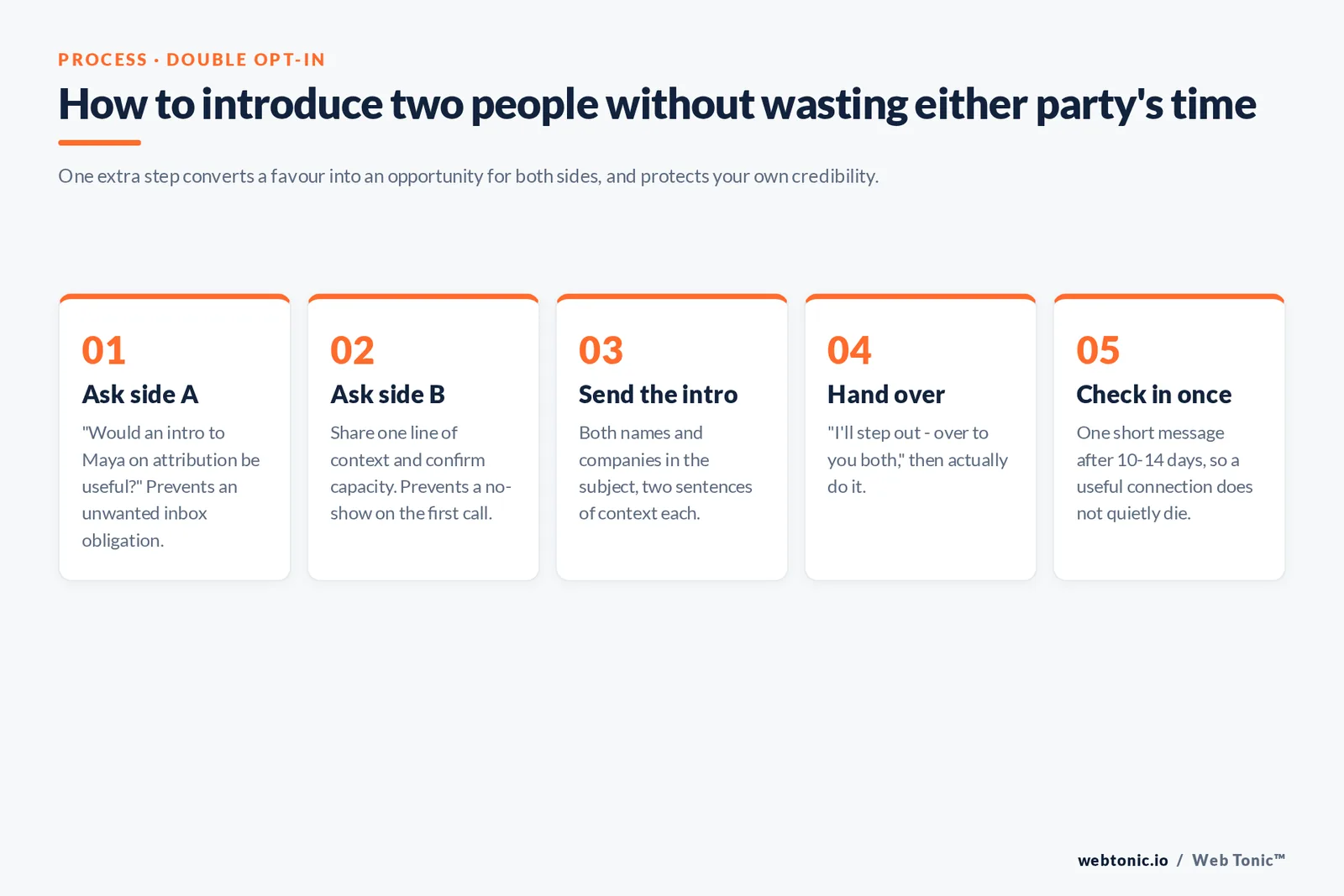
The double opt-in introduction is the professional standard, and it takes one extra step: ask both sides privately before you connect them. It converts a favour into a genuine opportunity for both parties, and it protects your own credibility, which is the actual currency being spent.
The mechanics matter. Put both names in the subject line with the companies. Give each person two sentences of context — role, and the specific reason this connection is useful now. State explicitly that you are stepping out of the thread, then actually do it. Never CC a third party into a sales conversation and call it an introduction.
| Step | What you do | What it prevents |
|---|---|---|
| 1. Ask side A | "Would an intro to Maya on attribution be useful?" | An unwanted inbox obligation |
| 2. Ask side B | Share one line of context and confirm capacity | A no-show on the first call |
| 3. Send the intro | Both names in the subject, two sentences each | Either party having to ask "who is this?" |
| 4. Hand over | "I'll step out — over to you both" | You becoming the bottleneck in their thread |
| 5. Check in once | One short message after 10–14 days | A useful connection quietly dying |
Timing, personalisation and the follow-up cadence the data supports
Personalisation is not a first-name merge tag. The measurable difference sits between messages that reference something specific and verifiable about the recipient's situation and messages that do not: 18% reply rate versus roughly 9% in Woodpecker's dataset. The same dataset shows why restraint beats reach — under 50 recipients averages 5.8% replies against 2.1% for lists over 1,000.
On timing, send introductions mid-morning in the recipient's timezone, Tuesday to Thursday, and treat send-time optimisation as a second-order lever compared with relevance. Then follow up, because that is where most replies are: 42% of replies come from follow-ups while 48% of senders never send one, and sequences of 4 to 7 touches hit 8.3% replies versus 4.1% with no follow-up at all.
| Touch | When | What changes |
|---|---|---|
| 1 — Introduction | Day 0 | Who you are, why them, one question |
| 2 — Add value | Day 3–4 | Same thread, new evidence: a benchmark or a short example |
| 3 — Reframe | Day 8–10 | Different angle on the problem, shorter than touch 1 |
| 4 — Close the loop | Day 14–18 | Explicit permission to say no, plus a date to revisit |
Two hygiene items decide whether any of it lands. Keep the bounce rate under 2% — the cold-send average of 5.1% is a list problem, and it damages domain reputation for every future send. And verify that your signature and reply-to details render correctly across clients; Google's own Gmail signature documentation covers the per-account settings most people get wrong. The full cadence logic, including what to write when nobody replies, is in our guide to the follow-up email.
Common mistakes to avoid in introduction emails
| Mistake | Why it costs you replies | Fix |
|---|---|---|
| Opening with your own company history | The first line is spent on information the reader did not ask for | Lead with the shared context or the referrer's name |
| Multiple calls to action | Choice creates delay, and delay becomes archive | One question per message, always |
| 300-word first message | Scanners abandon before the ask | Cap the body at 90–150 words |
| Generic personalisation | "Love what you're building" reads as automated | Reference one verifiable specific about their business |
| Attachments in a cold intro | Hurts deliverability and raises suspicion | Link instead, or send after the first reply |
| No follow-up plan | Forfeits the 42% of replies that come from follow-ups | Schedule touches 2–4 before you send touch 1 |
| Judging results on opens | Privacy features inflate opens by design | Optimise on reply rate and booked calls |
How to write an introduction email in seven steps
Treat writing an introduction email as a short process rather than a blank page. These seven steps take about ten minutes per prospect and are the difference between a template send and a message that earns a quick reply.
| Step | What to do | What it ensures |
|---|---|---|
| 1. Define the goal | Write the one outcome you want before you start the email | A clear call to action instead of a vague sign-off |
| 2. Research the contact | Spend five minutes on their role, company and current project | Context that is specific and relevant to this recipient |
| 3. Find the warm route | Check for a mutual contact, a shared event or a client in common | A warm introduction beats a cold one every time |
| 4. Write the subject line last | Draft the body first, then name its single best idea | Subject lines that reflect the message, not the pitch |
| 5. Keep the body to 90–150 words | Cut every sentence that does not carry context or the ask | A message a busy professional can read in 20 seconds |
| 6. End with one specific question | Offer a quick call with a named day, or ask a yes/no question | The next step is a one-word decision |
| 7. Schedule the follow-up | Book touches two to four before the first email goes out | You capture the 42% of replies that follow-ups generate |
Two habits separate people who are good at this from people who are merely busy. The first is keeping a personal library of introduction email templates, organised by scenario — new client, new colleague, warm referral, cold prospect — so the writing time goes into the one sentence that changes. The second is logging what happened. Reply rates on 20 sends tell you more about your market than any generic best-practice list, and after 50 sends you will know which subject line pattern your prospects actually open.
Before you start a batch, ensure the basics are in place: the sending address matches the company you claim to represent, the signature carries a real phone number and role, and the reply-to address is a monitored inbox. A cold business introduction that lands from a no-reply address is dead on arrival regardless of how good the copy is.
Tone: how casual or professional should an introduction email be?
Tone is the question people agonise over most, and the answer is simple: mirror the recipient. Read one thing they have written publicly — a company blog post, a LinkedIn update, a support doc their team maintains — and match that register. A casual opening works with a peer in a startup marketing team; a professional, formal greeting is the safer choice for a potential client in legal, healthcare or finance, and for anyone whose title starts with "Chief".
| Context | Greeting | Register | Closing |
|---|---|---|---|
| New client, first email | Hi [First name], | Professional, organised, specific about the project | "Don't hesitate to reach out before Thursday if anything's unclear." |
| New colleague or team | Hi all, | Warm and casual; it is fine to say you are excited to start | "Looking forward to working with you." |
| Cold prospect, senior title | Hi [First name], | Direct and evidence-led, no flattery, no filler | "Worth a quick call, or is this the wrong time?" |
| Formal or regulated industry | Dear [Title] [Surname], | Neutral, precise, complete sentences | "Kind regards" plus a full signature block |
| Warm referral from a mutual contact | Hi [First name], | Peer-level; the referrer's name does the work | "Happy to connect whenever suits you." |
Whatever register you choose, three phrases are worth retiring. "I hope this email finds you well" burns your best line. "Just reaching out" tells the recipient the email has no purpose. And "let me know if you have any questions" is not a call to action — it hands the work back to them. Replace all three with one specific question about their business, their project or their timeline.
Finally, remember that tone includes formatting. A professional introduction email is one short paragraph, one line of context, one question and a clean signature. No coloured text, no three-line disclaimers, no images in the first message. The best introduction emails look like they were typed by a person who respects the reader's time, because that is exactly what they are.
If introduction emails are a core part of how your business gets in front of new clients, the sequence is a system, not a writing exercise — targeting, deliverability, copy and measurement all move together. That is the same discipline our growth marketing team applies to outbound and lifecycle programmes, supported by the reporting side of data intelligence. See the full service range, or talk to us about your current sequence.
FAQ
What should the subject line of an introduction email say?
Name the context, not the pitch, in three to seven words. If a mutual contact exists, their name is the strongest subject line available — "Priya Raman suggested I reach out" outperforms anything clever. For internal introductions, state the relationship: "Hello from your new account lead". Avoid urgency language and anything longer than a phone preview window.
How formal should an introduction email be?
Match the recipient's own register. Client-facing and academic contexts justify "Dear [Name]"; peer-to-peer and most internal contexts read better with "Hi [Name]". Formality lives in the greeting and closing, not in the sentence length — a formal email can and should still be 120 words.
How do I introduce two people who have not met?
Use a double opt-in: ask both parties privately first, then send one email with both names and companies in the subject line, two sentences of context for each person, and an explicit hand-off — "I'll step out, over to you both". Check in once after 10 to 14 days.
How long should I wait before following up on an introduction email?
Three to four business days for the first follow-up, then day 8–10, then day 14–18. Four to seven total touches produces the best measured reply rates (around 8.3%), and each follow-up should add new information rather than repeat the original message.
What is a good reply rate for a cold introduction email?
The platform-wide average is 3.43%; 5% to 10% is good and 10%+ is excellent. Deeply personalised campaigns to small, tightly targeted lists reach 18%. Judge performance on replies rather than opens, since privacy features make open rates unreliable.
Should I include an attachment or a calendar link?
Not in the first message. Attachments hurt deliverability in cold sends, and a booking link before the recipient has agreed to a conversation shifts the work onto them. Send both after the first reply.
Sources: Woodpecker cold email benchmarks (20M+ emails, 2026) · GetResponse Email Marketing Benchmarks (4.4B messages) · Mailchimp email marketing benchmarks · Nielsen Norman Group reading and F-pattern eyetracking studies · FTC CAN-SPAM Act Compliance Guide · Grammarly self-introduction guide · Mind Tools writing effective emails · Pipedrive sales email templates · Yesware introduction email guide · Purdue OWL business letters · Google Gmail signature documentation.