Table of contents
Meta-description: Capture more search traffic by dominating Google's PAA boxes. Master the exact content structure needed to rank in People Also Ask and boost visibility.
URL: /blog/how-to-rank-in-people-also-ask
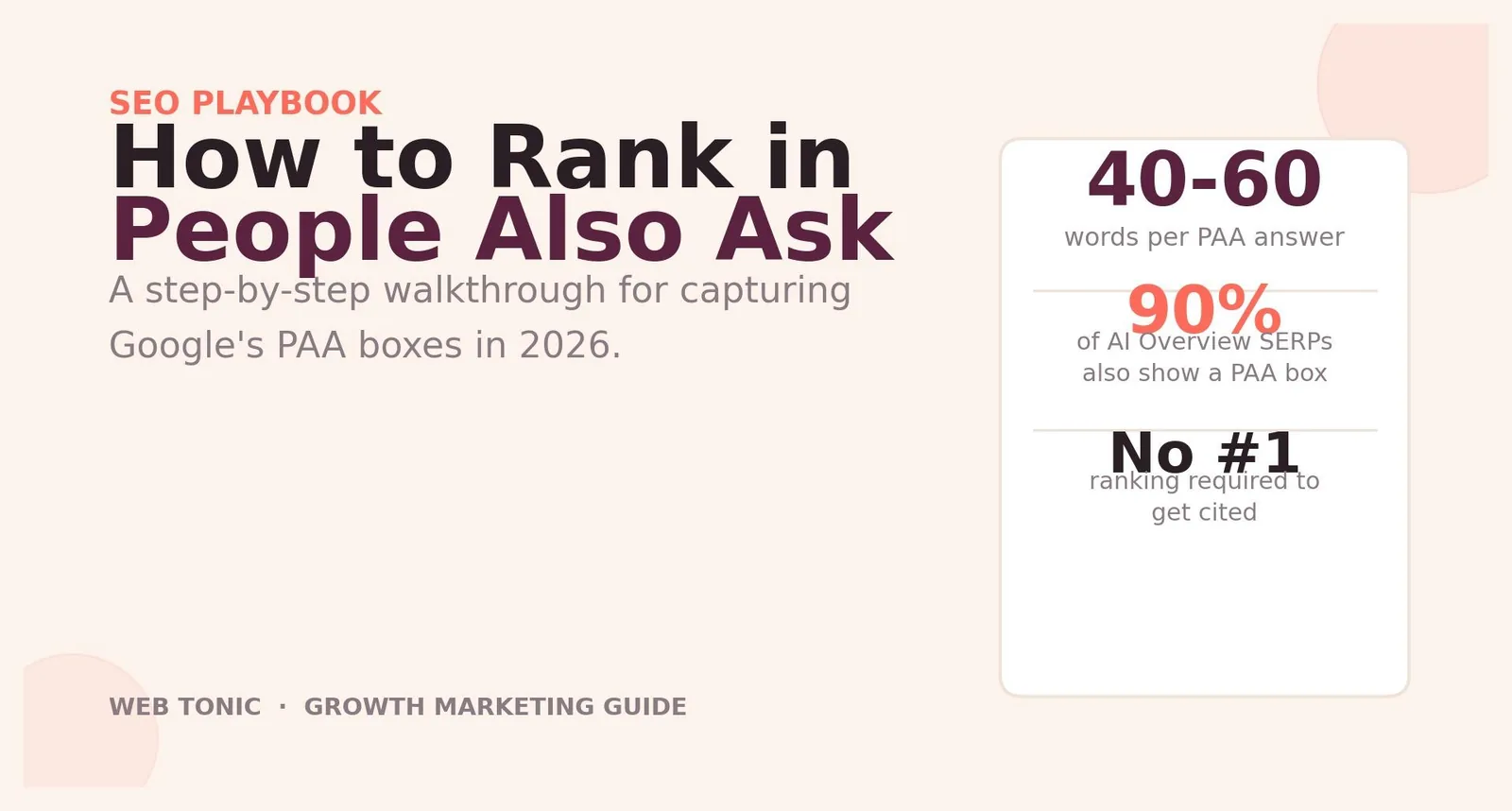
People Also Ask boxes sit right in the middle of the search results page, and most sites never appear in them, even when they rank well for the main keyword. Rank position isn't the deciding factor here; structure is. Google introduced People Also Ask back in April 2015, and this guide covers what triggers a People Also Ask box today, the factors Google weighs when picking an answer, and the exact content pattern that wins placements in 2026.
Key Takeaways
- People Also Ask doesn't require a top-three organic ranking. A page sitting on page one anywhere can get cited if the answer is structured correctly.
- The winning pattern is consistent: a question-based H2 or H3 matching the query, followed by a 40 to 60 word direct answer.
- FAQPage schema markup isn't required to appear in PAA, but it's close to it. It makes your question-answer pairs explicit instead of leaving Google to infer them.
- Related searches and PAA boxes both show up on the large majority of AI Overview SERPs, so PAA optimization and AI visibility are no longer separate projects.
- Content freshness matters. PAA questions and their cited answers rotate as Google reassesses sources, so a static answer written once and never revisited will eventually lose its placement.
- Tools like Ahrefs, Semrush, and AlsoAsked can surface PAA questions at scale, but a manual Google search for your target keyword is still the fastest free starting point.
What Is the People Also Ask Box?
People Also Ask is a Google search results feature that shows a small set of related questions under or near the main organic results. Click a question and it expands into a short answer with a source link, then loads more related questions underneath. Each expansion pulls from natural language processing that maps question and answer patterns across the web, not just from the page ranking number one for the original query.
The mechanic that makes PAA valuable for SEO is that answer sourcing runs on its own rules. A page ranking as low as seventh for the parent keyword can still be the one Google cites in the PAA box, as long as the content answers that specific sub-question clearly. Organic ranking position and PAA visibility run on separate tracks, a rare split in search engine optimization.
Terminology varies across teams, so a quick note on naming. Some people call the whole feature the Google People Also box; others shorten it to the Also box, or refer to individual entries as Also boxes or Also questions. Also PAA volume keeps climbing regardless of what you call it, and that's exactly why a single well-optimized page on your website can win multiple placements over time. Google's own natural language processing (NLP) systems parse your content into these question-and-answer pairs in the first place. That same structured data is increasingly what feeds AI tools like ChatGPT (built on GPT models) when they summarize a topic.
Why Ranking in PAA Matters for SEO
A People Also Ask citation gives you a second visible spot on the same search engine results page: one from your organic listing, one from the PAA answer. That double exposure builds brand recognition even among users who don't click, and it compounds across every question your content answers well. PAA appearances carry an average CTR of around 3% per box
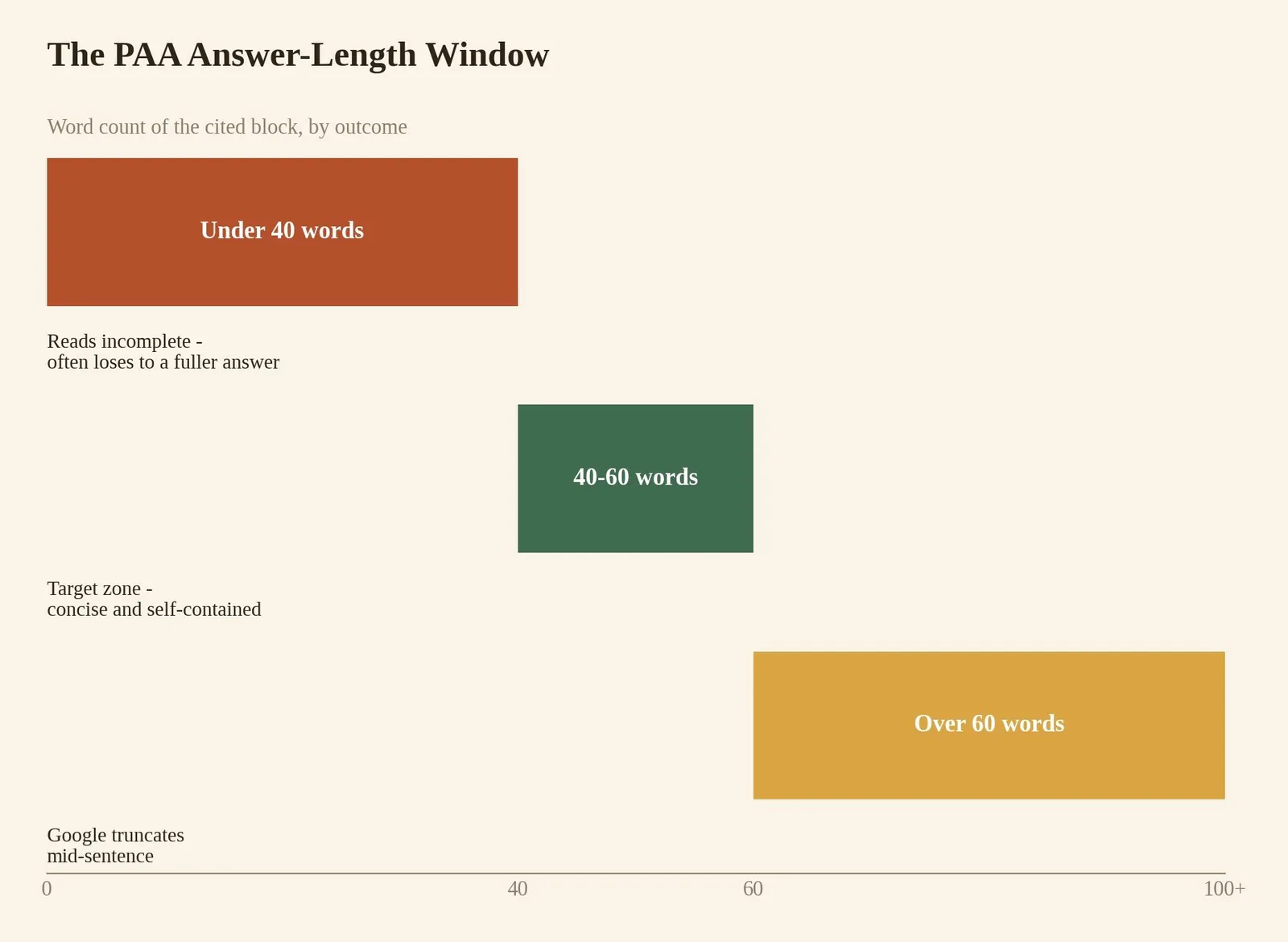
seoClarity's own February 2025 analysis found PAA prevalence increased 37.5% on desktop and 34.7% on mobile in the U.S. between February 2024 and January 2025. For local-intent searches specifically, keeping your Google Business Profile accurate and current remains good local SEO practice, independent of PAA, since it's your Business Profile data rather than PAA that typically drives map-pack visibility. PAA also matters more than it used to because of how it intersects with AI Overviews. Semrush's own study of the feature found that related searches and PAA both appear on the large majority of AI Overview SERPs. The same structured, question-and-answer content that wins a PAA box is also the content most likely to feed an AI-generated answer. PAA optimization belongs in a broader digital marketing strategy now, not filed away as a narrow SEO tactic. Google's PAA selection process looks mechanical once you see the pattern. Four things matter most. Question match. The heading on your page should match the PAA question as closely as possible, ideally word for word. Google does account for close variations, but an exact match tends to win when multiple pages could answer the same question. Answer length. The cited block runs 40 to 60 words in nearly every example worth studying. Shorter reads as incomplete. Longer gets cut off mid-sentence, which looks worse on the results page than a competitor's clean answer. Every step here serves one goal: answer question intent directly instead of writing around it. Structure. A clear heading followed immediately by the answer, with no throat-clearing or scene-setting first, wins over a buried answer even if the buried version is more thorough. Schema markup. FAQ schema doesn't guarantee a PAA placement, but it removes the guesswork Google would otherwise do to identify your question and answer pairs, and it can also trigger separate FAQ rich results below your normal listing. Search your target keyword directly on Google and expand every question in the PAA box. Each click reveals more related questions, so a single search can surface a dozen or more real, current queries. Tools like AlsoAsked visualize this branching structure at scale, and most keyword platforms let you export a full question list to CSV for planning. Google Search Console is worth checking too: its query report can show you which pages already earn impressions for question-shaped searches, a strong signal that a PAA box is showing on that query. This is one of the more reliable seo tips in this guide precisely because it costs nothing and uses data you already have. Google PAA selection behaves fairly consistently across major English-language markets like the US and UK, though the exact visible questions still vary by query, location, and device. Search engines generally treat PAA as a discovery layer rather than a ranking signal, so structure beats domain authority here. Take the exact PAA question and use it as an H2 or H3 on your page. Don't rephrase it into something that sounds more natural to write. Google's matching favors the literal question text, and ties between competing pages usually go to whichever one used the closer wording. Open with the answer itself, not context. A reader who sees only that first sentence should understand the answer completely. Add one or two more sentences with the most useful qualifier or example, then stop. Save deeper explanation for the paragraph after the cited block, since Google rarely pulls content beyond it. Mark up every question and answer pair on the page with FAQPage schema. This gives Google an explicit map of your content instead of one it has to infer, and it's one of the few PAA-adjacent tactics that also produces a visible SERP benefit on its own, in the form of FAQ rich results. One well-optimized answer might win one PAA box. Building topical authority through interconnected content clusters goes further: a page that answers ten to fifteen related questions, each with its own heading and schema, can win several placements from a single URL. This is also where keyword research pays off: cluster related PAA questions together instead of scattering single answers across separate pages. PAA questions and their cited sources rotate. Freshness is one of the signals Google weighs when choosing which source to cite. The set that shows for your keyword today may include different questions next month, and the cited answer for a question you already won can shift to a competitor if their content gets fresher or clearer. Recheck your priority keywords periodically and update answers that have gone stale. These three SERP features get confused constantly, but they behave differently enough to need separate strategies. Table 1: PAA vs. Featured Snippets vs. AI Overviews Table 2: PAA Research Tools Compared A heading rephrased to "sound better" instead of matching the question word for word. Google's matching rewards the literal question text, and a clever rewrite usually loses that tie. A 20-word answer written because it feels punchy. Short answers read as incomplete to Google's selection process, and a fuller competitor answer wins the citation instead. FAQ schema skipped because it feels like busywork. It's not required, but on competitive queries it's close to a prerequisite, since it removes ambiguity about which text is the answer to which question. PAA treated as a one-time project: publish the content, add schema, never look at it again. The placement quietly goes to a fresher competitor within a few months. PPC and paid search data ignored when picking which questions to target. Questions with strong commercial intent, the kind PPC teams already bid on, often make excellent PAA targets because the traffic converts, not just clicks. PAA tool Paste the answer block you're planning to put under your H2 or H3. We'll tell you if it's in the 40-60 word window Google tends to favor. Waiting for text Start typing or paste your draft answer above. No. PAA sourcing runs independently of your organic ranking position for the main keyword. A page on page one, even outside the top three, can still be the cited source for a specific sub-question if the answer is structured well. Not strictly, but it functions as a near-required signal for competitive queries. Schema markup makes your question-and-answer structure explicit for Google instead of something it has to infer from your HTML, and it can also unlock separate FAQ rich results. Aim for 40 to 60 words for the block you want Google to cite. Shorter answers often read as incomplete, and longer ones get truncated mid-sentence, which looks messier on the results page than a competitor's clean, complete block. A featured snippet is a single highlighted answer at the top of the search results page, tied to the main query. PAA is a set of three to four expandable related questions, each potentially sourced from a different page, and a PAA placement usually skips the top-10 organic requirement that snippets carry. Frequently. The visible question set can rotate between search refreshes, and the source Google cites for a given question can shift within days if a competitor publishes fresher or clearer content. Treat PAA tracking as an ongoing task, not a one-time check. PAA is the most accessible SERP feature in modern SEO precisely because it doesn't reward domain authority or backlink count the way organic ranking does. It rewards structure: the right question as a heading, a 40 to 60 word answer directly beneath it, and schema markup that makes the pairing explicit for Google. A page one ranking isn't a prerequisite for any of that, which makes PAA one of the fastest visibility wins available to any site with the discipline to format for it. Pick one keyword where you already rank on page one, expand every PAA question tied to it, and rebuild just one section of that page around the pattern in this guide. That single test will tell you more about PAA than any amount of reading. Structuring content for PAA takes a different discipline than writing a normal blog post: shorter answers, exact question matching, and schema markup applied consistently across every page. Web Tonic's growth marketing team builds that structure into on-site SEO and content work from the start, so PAA visibility isn't an afterthought bolted onto content that was never built for it. More from Web Tonic: growth marketing services, data & analytics. Sources: nightwatch.io · intelegencia.com · seoclarity.net · semrush.com · cloro.dev · rankcrown.com · originality.ai · myseoconsult.com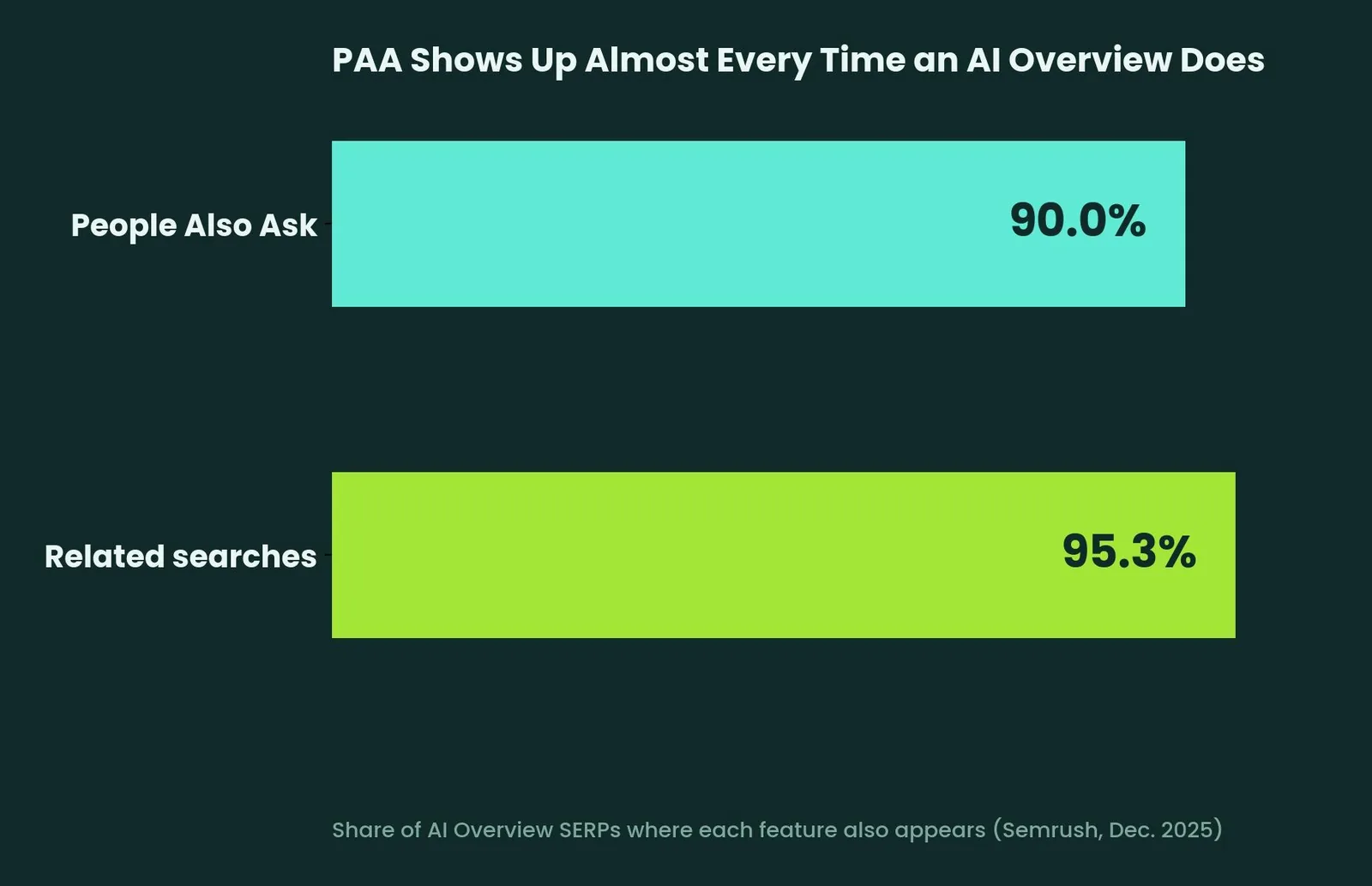
The Factors That Decide Who Gets Cited in PAA
How to Rank in People Also Ask, Step by Step
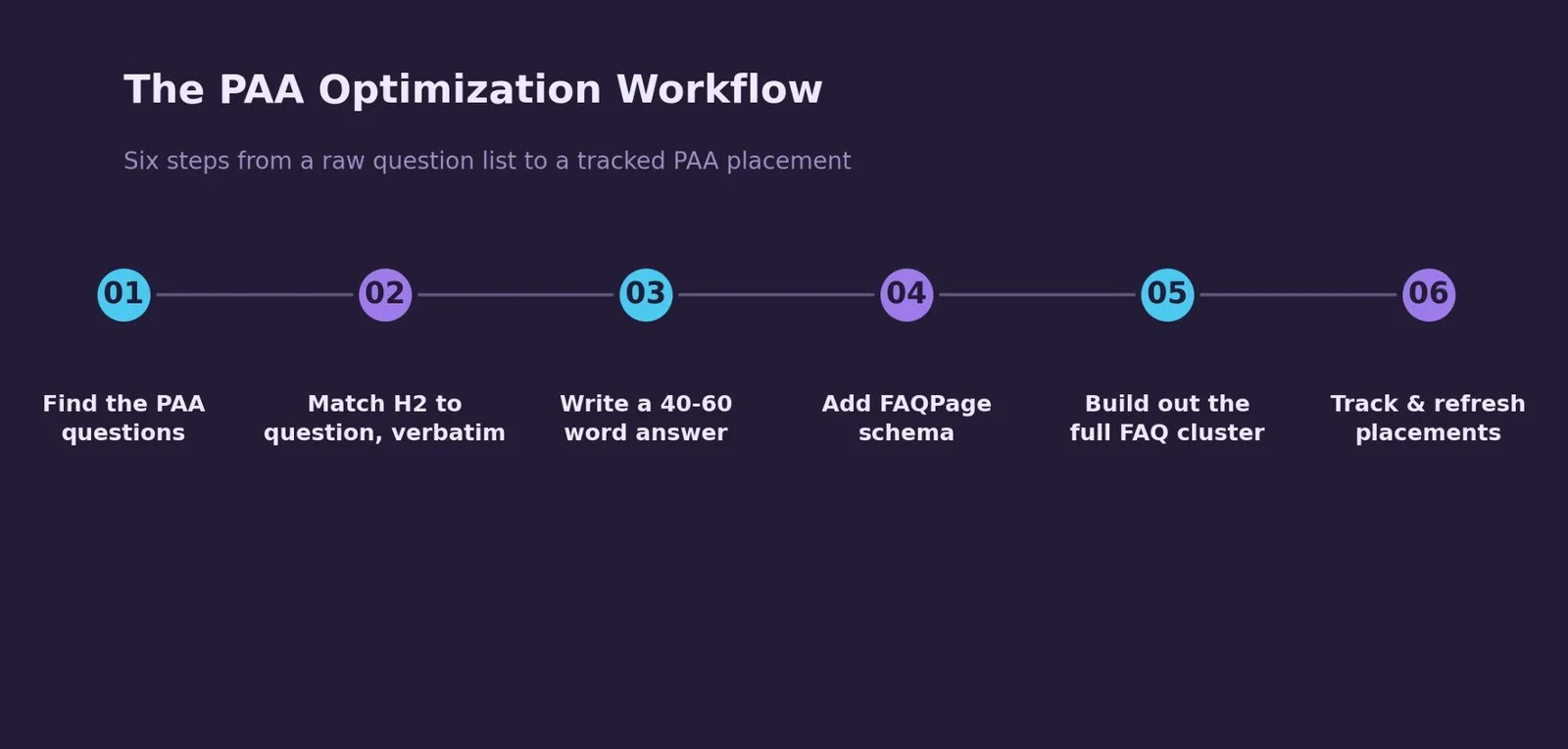
Step 1: Find Your Target PAA Questions
Step 2: Match the Question to a Heading, Word for Word
Step 3: Write a 40 to 60 Word Direct Answer
Step 4: Add FAQPage Schema Markup
Step 5: Build Topical Authority With a Full FAQ Section
Step 6: Track and Refresh Your PAA Placements
PAA vs. Featured Snippets vs. AI Overviews
p style="padding:0;margin:0;color:#000000;font-size:11pt;font-family:"Arial";line-height:1.15;orphans:2;widows:2;text-align:center">Feature/p> p style="padding:0;margin:0;color:#000000;font-size:11pt;font-family:"Arial";line-height:1.15;orphans:2;widows:2;text-align:center">What it shows/p> p style="padding:0;margin:0;color:#000000;font-size:11pt;font-family:"Arial";line-height:1.15;orphans:2;widows:2;text-align:center">Ranking position needed/p> p style="padding:0;margin:0;color:#000000;font-size:11pt;font-family:"Arial";line-height:1.15;orphans:2;widows:2;text-align:center">Best content format/p> p style="padding:0;margin:0;color:#000000;font-size:11pt;font-family:"Arial";line-height:1.15;orphans:2;widows:2;text-align:left">People Also Ask/p> p style="padding:0;margin:0;color:#000000;font-size:11pt;font-family:"Arial";line-height:1.15;orphans:2;widows:2;text-align:left">3-4 expandable questions with short answers/p> p style="padding:0;margin:0;color:#000000;font-size:11pt;font-family:"Arial";line-height:1.15;orphans:2;widows:2;text-align:left">None; page one is enough/p> p style="padding:0;margin:0;color:#000000;font-size:11pt;font-family:"Arial";line-height:1.15;orphans:2;widows:2;text-align:left">Question heading + 40-60 word answer/p> p style="padding:0;margin:0;color:#000000;font-size:11pt;font-family:"Arial";line-height:1.15;orphans:2;widows:2;text-align:left">Featured snippet/p> p style="padding:0;margin:0;color:#000000;font-size:11pt;font-family:"Arial";line-height:1.15;orphans:2;widows:2;text-align:left">One highlighted answer above position one/p> p style="padding:0;margin:0;color:#000000;font-size:11pt;font-family:"Arial";line-height:1.15;orphans:2;widows:2;text-align:left">Usually top 10/p> p style="padding:0;margin:0;color:#000000;font-size:11pt;font-family:"Arial";line-height:1.15;orphans:2;widows:2;text-align:left">Direct answer, list, or table/p> p style="padding:0;margin:0;color:#000000;font-size:11pt;font-family:"Arial";line-height:1.15;orphans:2;widows:2;text-align:left">AI Overview/p> p style="padding:0;margin:0;color:#000000;font-size:11pt;font-family:"Arial";line-height:1.15;orphans:2;widows:2;text-align:left">AI-generated summary with inline citations/p> p style="padding:0;margin:0;color:#000000;font-size:11pt;font-family:"Arial";line-height:1.15;orphans:2;widows:2;text-align:left">Varies; not tied to organic rank/p> p style="padding:0;margin:0;color:#000000;font-size:11pt;font-family:"Arial";line-height:1.15;orphans:2;widows:2;text-align:left">Well-structured, extractable content/p> PAA Research Tools Compared
p style="padding:0;margin:0;color:#000000;font-size:11pt;font-family:"Arial";line-height:1.15;orphans:2;widows:2;text-align:center">Tool/p> p style="padding:0;margin:0;color:#000000;font-size:11pt;font-family:"Arial";line-height:1.15;orphans:2;widows:2;text-align:center">Best for/p> p style="padding:0;margin:0;color:#000000;font-size:11pt;font-family:"Arial";line-height:1.15;orphans:2;widows:2;text-align:center">Cost/p> p style="padding:0;margin:0;color:#000000;font-size:11pt;font-family:"Arial";line-height:1.15;orphans:2;widows:2;text-align:center">Exports to CSV/p> p style="padding:0;margin:0;color:#000000;font-size:11pt;font-family:"Arial";line-height:1.15;orphans:2;widows:2;text-align:left">Google (manual search)/p> p style="padding:0;margin:0;color:#000000;font-size:11pt;font-family:"Arial";line-height:1.15;orphans:2;widows:2;text-align:left">Real, current questions for one keyword at a time/p> p style="padding:0;margin:0;color:#000000;font-size:11pt;font-family:"Arial";line-height:1.15;orphans:2;widows:2;text-align:left">Free/p> p style="padding:0;margin:0;color:#000000;font-size:11pt;font-family:"Arial";line-height:1.15;orphans:2;widows:2;text-align:left">No/p> p style="padding:0;margin:0;color:#000000;font-size:11pt;font-family:"Arial";line-height:1.15;orphans:2;widows:2;text-align:left">AlsoAsked/p> p style="padding:0;margin:0;color:#000000;font-size:11pt;font-family:"Arial";line-height:1.15;orphans:2;widows:2;text-align:left">Visualizing PAA question trees and clusters/p> p style="padding:0;margin:0;color:#000000;font-size:11pt;font-family:"Arial";line-height:1.15;orphans:2;widows:2;text-align:left">Free tier + paid/p> p style="padding:0;margin:0;color:#000000;font-size:11pt;font-family:"Arial";line-height:1.15;orphans:2;widows:2;text-align:left">Yes/p> p style="padding:0;margin:0;color:#000000;font-size:11pt;font-family:"Arial";line-height:1.15;orphans:2;widows:2;text-align:left">Ahrefs/p> p style="padding:0;margin:0;color:#000000;font-size:11pt;font-family:"Arial";line-height:1.15;orphans:2;widows:2;text-align:left">PAA presence filtering inside Keywords Explorer/p> p style="padding:0;margin:0;color:#000000;font-size:11pt;font-family:"Arial";line-height:1.15;orphans:2;widows:2;text-align:left">Paid/p> p style="padding:0;margin:0;color:#000000;font-size:11pt;font-family:"Arial";line-height:1.15;orphans:2;widows:2;text-align:left">Yes/p> p style="padding:0;margin:0;color:#000000;font-size:11pt;font-family:"Arial";line-height:1.15;orphans:2;widows:2;text-align:left">Semrush/p> p style="padding:0;margin:0;color:#000000;font-size:11pt;font-family:"Arial";line-height:1.15;orphans:2;widows:2;text-align:left">PAA and SERP feature filtering inside Keyword Magic Tool/p> p style="padding:0;margin:0;color:#000000;font-size:11pt;font-family:"Arial";line-height:1.15;orphans:2;widows:2;text-align:left">Paid/p> p style="padding:0;margin:0;color:#000000;font-size:11pt;font-family:"Arial";line-height:1.15;orphans:2;widows:2;text-align:left">Yes/p> p style="padding:0;margin:0;color:#000000;font-size:11pt;font-family:"Arial";line-height:1.15;orphans:2;widows:2;text-align:left">AnswerThePublic/p> p style="padding:0;margin:0;color:#000000;font-size:11pt;font-family:"Arial";line-height:1.15;orphans:2;widows:2;text-align:left">Question-format queries beyond just PAA/p> p style="padding:0;margin:0;color:#000000;font-size:11pt;font-family:"Arial";line-height:1.15;orphans:2;widows:2;text-align:left">Free tier + paid/p> p style="padding:0;margin:0;color:#000000;font-size:11pt;font-family:"Arial";line-height:1.15;orphans:2;widows:2;text-align:left">Yes/p> Common Mistakes That Keep Content Out of PAA
PAA answer length checker
Frequently Asked Questions
Do I Need to Rank in the Top Three to Appear in People Also Ask?
Is FAQPage Schema Markup Required to Rank in PAA?
How Long Should a PAA Answer Be?
What's the Difference Between PAA and a Featured Snippet?
How Often Do PAA Questions and Their Cited Answers Change?
The Bottom Line on Ranking in People Also Ask
Ready to Capture More PAA Real Estate?