Table of contents

No 2026 survey prices video marketing spend by industry, so there is no honest single number for "the hospitality and travel video budget." What exists is Wyzowl's cross-industry spend and ROI data, and a set of travel-specific consumption studies that should shape where that cross-industry number gets spent. This page treats both as what they are and does not blend them into a fabricated travel-only figure.
Key Takeaways
- No published study prices video marketing spend specifically for hospitality or travel - the numbers below are cross-industry unless labeled otherwise.
- 91% of businesses across all industries use video as a marketing tool (Wyzowl, 2026).
- 93% of video marketers call it an important part of their strategy.
- 46% of marketers allocate a third of their budget or less to video.
- 41% have spent money on video ads this year, up from 36% the year before.
- 92% plan to spend the same or more on video in 2026.
- 82% of video marketers say video delivered a good ROI, down from 93% the prior year.
- 67% of marketers not using video plan to start in 2026.
- Two-thirds of watch time on top travel YouTube videos happens on mobile (Think with Google) - this one is travel-specific.
- 61% of travelers now find trip inspiration on social media, up from 35% in 2022 (Expedia Group Traveler Value Index).
- 73% of travelers say influencer recommendations affected a booking decision.
- 62% of global travelers are now familiar with AI trip-planning tools (Skift State of Travel 2026).
- 88% of consumers plan a leisure trip in the next 12 months, per the same Expedia study.
- 68% are likely to book international travel, a 19% increase since 2022.
- The global travel industry is sized at USD 11 trillion by Skift's Travel Stack framework.
Why there is no per-industry video budget figure to quote
Wyzowl's Video Marketing Statistics 2026, based on 266 respondents surveyed in late 2025 and now in its 12th consecutive year of the same questions, is the closest thing to an industry-standard video-spend survey - and it reports figures across every industry pooled together, never broken out by vertical. Any "hospitality video marketing budget is X% of revenue" claim you find elsewhere is not sourced to this survey, because the survey does not produce that cut of the data. The honest move is to use Wyzowl's pooled figures as the floor and adjust upward using what is actually known about travel-specific video consumption.
| Wyzowl 2026 metric (cross-industry, 266 respondents) | Figure | YoY direction |
|---|---|---|
| Businesses using video as a marketing tool | 91% | Back to prior all-time high |
| Marketers calling video strategically important | 93% | Slight dip from last year |
| Marketers allocating a third of budget or less to video | 46% | n/a |
| Marketers who spent money on video ads this year | 41% | Up from 36% |
| Marketers planning same-or-more video spend in 2026 | 92% | n/a |
| Marketers reporting good ROI from video | 82% | Down from 93% |
| Non-users planning to start video in 2026 | 67% | Down 1 point |

The travel-specific evidence that should shape where the budget goes
What travel does have, unlike a spend percentage, is real data on where and how people watch. Google's smartphone-journey research (part of the Think with Google travel infographic series) found that two-thirds of watch time for top travel videos on YouTube happens on mobile, and that 60% of destination-information searches already come from mobile devices. Expedia Group's 2025 Traveler Value Index, a custom survey of 11,000 consumers across 11 markets run with Wakefield Research, found 61% of travelers now finding trip inspiration on social media, up from 35% in 2022, and 73% saying influencer recommendations affected a booking decision.
That combination - mobile-first viewing plus influencer-driven discovery - argues for a portfolio of shorter, creator-adjacent clips feeding a smaller number of longer destination or property films, rather than one glossy annual brand video.
| Travel-specific video/discovery signal (dated) | Figure | Source |
|---|---|---|
| Watch time on top travel YouTube videos happening on mobile | ~66% | Think with Google, smartphone journey research |
| Destination-information searches from mobile | 60% | Think with Google |
| Travelers finding trip inspiration on social media (2025) | 61%, up from 35% in 2022 | Expedia Group Traveler Value Index |
| Travelers influenced by influencer recommendations | 73% | Expedia Group Traveler Value Index |
| Global travelers familiar with AI trip-planning tools (2026) | 62% | Skift State of Travel 2026 |

Reading the ROI number honestly
Wyzowl's 82% good-ROI figure for 2026 is down from an all-time high of 93% the year before - a real drop, not noise, and it is a judgment call by respondents rather than a shared revenue formula. It still means a strong majority of marketers across all industries consider video worth the spend, which is the most defensible cross-industry signal available for a hospitality operator deciding whether to start. Pair it with the fact that 67% of non-users plan to start video in 2026: the market is moving toward video adoption from a position where most holdouts already intend to close the gap themselves.
The travel industry itself is not short of scale to justify the investment: Skift's State of Travel 2026 report sizes the global industry at USD 11 trillion, and Expedia's research found 88% of consumers planning a leisure trip in the next 12 months and 68% likely to book international travel, a 19% jump since 2022. A growing, inspiration-driven market is exactly the environment where video's discovery role compounds.
| Market-size and demand context (2026) | Figure | Source |
|---|---|---|
| Size of the global travel industry | USD 11 trillion | Skift State of Travel 2026 |
| Consumers planning a leisure trip in next 12 months | 88% | Expedia Group Traveler Value Index |
| Consumers likely to book international travel | 68%, up 19% since 2022 | Expedia Group Traveler Value Index |
| Global travelers familiar with AI trip-planning tools | 62% | Skift State of Travel 2026 |
The market-wide video-ad budget travel spend competes inside
Whatever share a travel marketer earmarks for video, it competes against a fast-growing pool of cross-industry demand. The 2026 IAB Digital Video Ad Spend and Strategy Report, built from Guideline's billing and market data plus a custom Advertiser Perceptions survey of nearly 400 US ad-spend decision-makers, found US digital video ad spend surpassing USD 80 billion in 2026 - double its volume five years earlier - and growing 11% year over year, almost 20% faster than the overall ad market. Social video, which includes YouTube, grew 13% and overtook connected-TV spend for the first time, driven by AI-powered personalization tools and the maturing creator economy. This is cross-industry ad-spend data, not a travel-specific figure, but it explains why competition for video ad inventory - and video talent - keeps intensifying regardless of vertical.
| US digital video ad market (2026, cross-industry) | Figure | Source |
|---|---|---|
| Total US digital video ad spend | USD 80B+ | IAB 2026 Digital Video Ad Spend and Strategy Report |
| Growth vs. 5 years earlier | 2x volume | IAB |
| Year-over-year digital video growth | 11% | IAB |
| Social video (incl. YouTube) growth | 13% | IAB |
| Connected-TV growth | 11% | IAB |
What travelers are actually watching, once the budget is spent
Spend and attention are not the same thing, and travel's attention data is worth stating on its own. Expedia's Traveler Value Index survey also found that 42% of consumers are planning "bleisure" trips (blending business and leisure) and 45% are planning "flexcations," both up sharply from 2022 - patterns that argue for video content built around flexible, work-friendly destinations rather than pure-leisure messaging alone. Meanwhile Skift's State of Travel 2026 report frames the whole industry around a new "travel stack" of four layers - consumers, commerce, operations and experiences - and finds AI trip-planning familiarity already mainstream at 62% of global travelers, meaning video content increasingly needs to be structured so an AI assistant can summarize it accurately, not just so a human enjoys watching it.
| Emerging travel-content angle (2026) | Figure | Source |
|---|---|---|
| Consumers planning a bleisure trip | 42%, up from 29% in 2023 | Expedia Group Traveler Value Index |
| Consumers planning a flexcation | 45% | Expedia Group Traveler Value Index |
| Global travelers familiar with AI trip-planning tools | 62% | Skift State of Travel 2026 |
A defensible way to set the video line item
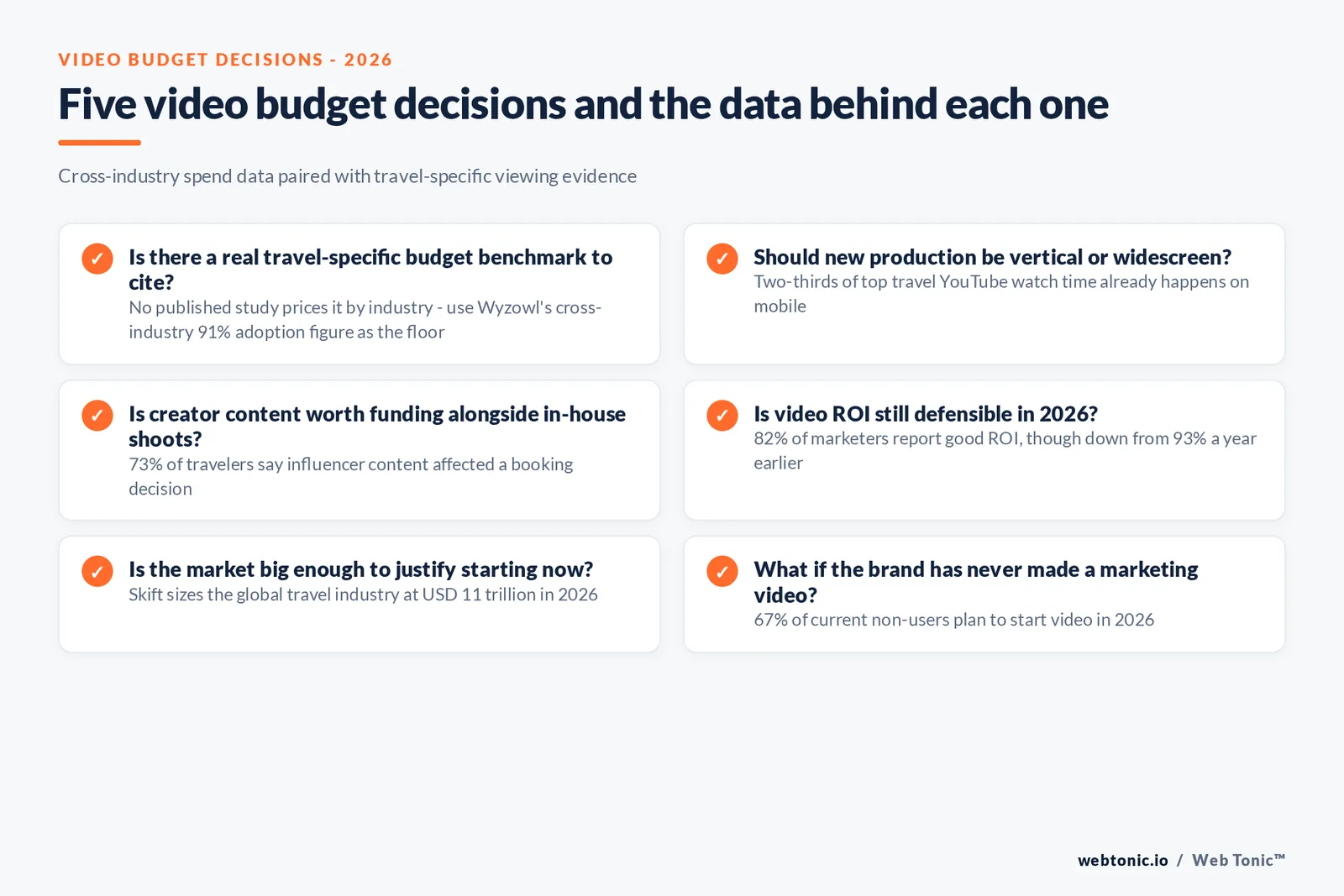
- Start from Wyzowl's cross-industry allocation (a third of budget or less for most marketers) as the floor, and state that it is cross-industry when you present it internally.
- Weight new production toward mobile-native formats. Two-thirds of top-video watch time on YouTube is already mobile; vertical and short-form should not be an afterthought.
- Fund creator and influencer partnerships alongside owned production. 73% of travelers say influencer content affected a booking decision - a channel most video budgets under-fund relative to in-house shoots.
- Do not chase a fabricated travel-specific percentage. Until a named study publishes one, cite Wyzowl's pooled figure and travel's consumption data separately, exactly as this page does.
Our performance creative team builds video test plans against this exact evidence base, and our Meta Ads practice can turn the resulting assets into a paid distribution plan. Talk to us about scoping a first video slate.
Frequently Asked Questions
Is there an actual hospitality-or-travel-specific video marketing budget benchmark?
No, and it is worth saying plainly. Wyzowl's annual State of Video Marketing survey, now in its 12th year with 266 respondents surveyed in late 2025, reports adoption and spend intent across all industries combined, not broken out by vertical. Any number claiming to be 'the travel industry's video budget' is either a private agency estimate or a misreading of the cross-industry figure. What genuinely exists at the travel level is consumption and platform-behavior data, which this page uses to size where that budget should go.
What share of the marketing budget should go to video?
Wyzowl's 2026 survey found 46% of marketers allocating a third of their budget or less to video, with 7% unsure how much they spend on it at all - a cross-industry figure, not a travel one. What is travel-specific is where the attention already sits: two-thirds of watch time on the top travel videos on YouTube happens on mobile (Think with Google), which should set the format and length decisions even before the percentage is finalized.
Does video marketing actually pay off for travel brands specifically?
The direct evidence is cross-industry: Wyzowl reports 82% of marketers overall call their video marketing ROI good, down from 93% the prior year but still a strong majority. The travel-specific corroboration is indirect but real - Expedia Group's 2025 Traveler Value Index (11,000 consumers, 11 markets, with Wakefield Research) found 61% of travelers now finding trip inspiration on social media, up from 35% in 2022, and 73% saying influencer recommendations affected a booking decision. Video is the format carrying most of that shift.
Should the video budget go to YouTube, short-form social, or both?
Both, for different jobs. Think with Google's smartphone-journey research found two-thirds of watch time on top travel YouTube videos happening on mobile, which favors longer destination and property content that survives a small screen. Skift's State of Travel 2026 report found 62% of global travelers now familiar with AI trip-planning tools, a signal that short, searchable, caption-heavy video (the kind AI search systems can parse and cite) is becoming as important as the polished brand film.
What is the honest floor for a small hospitality operator's video spend?
Wyzowl's figure that 67% of marketers who do not currently use video plan to start in 2026 suggests the real floor is not a dollar amount, it is having any owned video asset at all. A single well-shot property or destination video, distributed across YouTube and a booking-engine landing page, captures the two data points this page can verify - mobile-heavy watch time and social-driven inspiration - without requiring the ad-spend commitment this article makes no claim to price.
Sources
Wyzowl - Video Marketing Statistics 2026
Wyzowl - Original video marketing data and statistics archive
Think with Google - How mobile shapes the travel customer journey
Expedia Group - 2025 Traveler Value Index
Expedia Group Investor Relations - 2025 Traveler Value Index key findings
Skift Research - State of Travel 2026
Skift - State of Travel 2026 summary
IAB - 2026 Digital Video Ad Spend and Strategy Report