



Table of contents
Key Takeaways
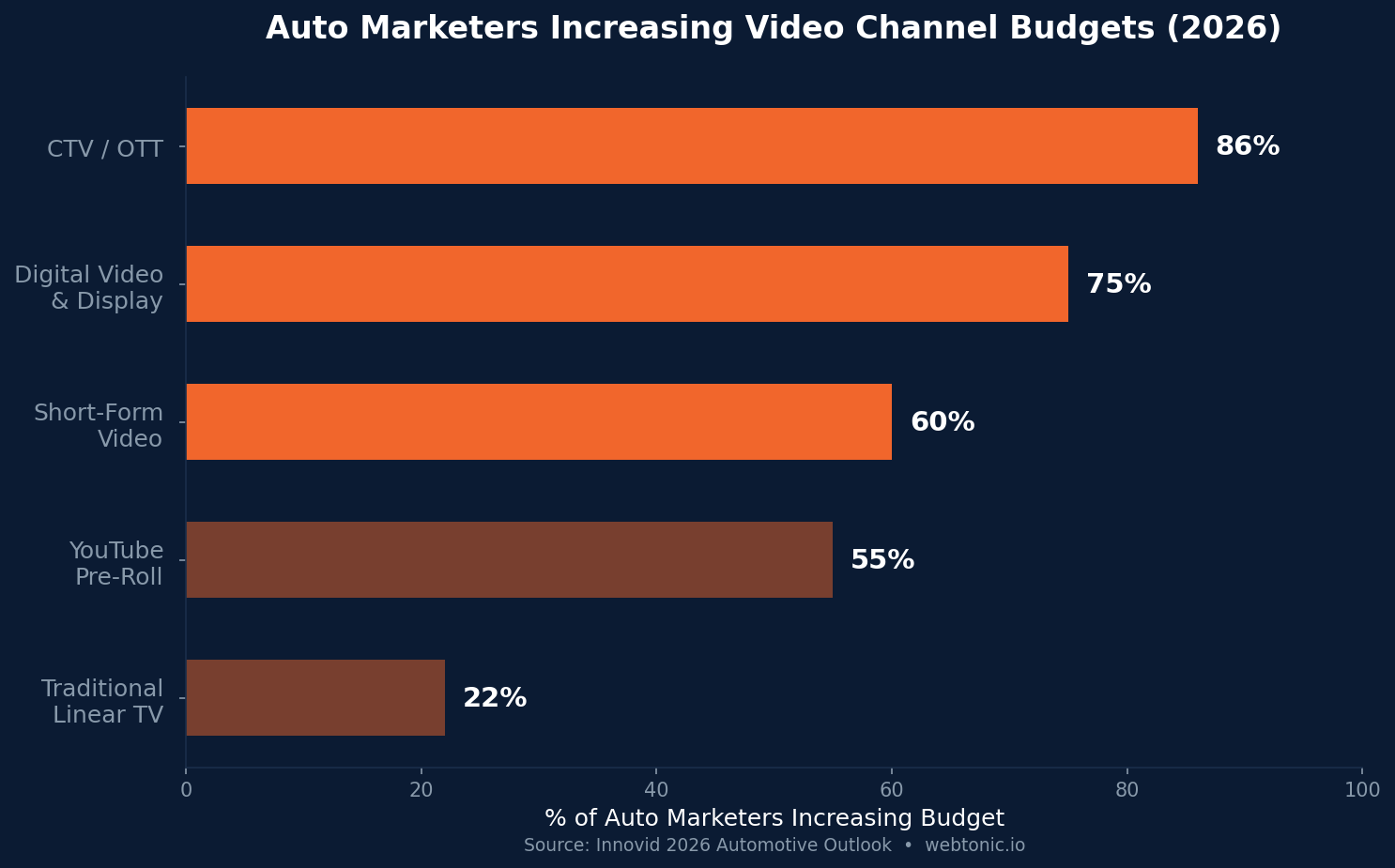
- 86% of automotive marketers will increase CTV spending in 2026, making connected television the fastest-growing video channel for the automotive industry. Digital video and display campaigns will also see budget increases from 75% of auto marketers (Innovid).
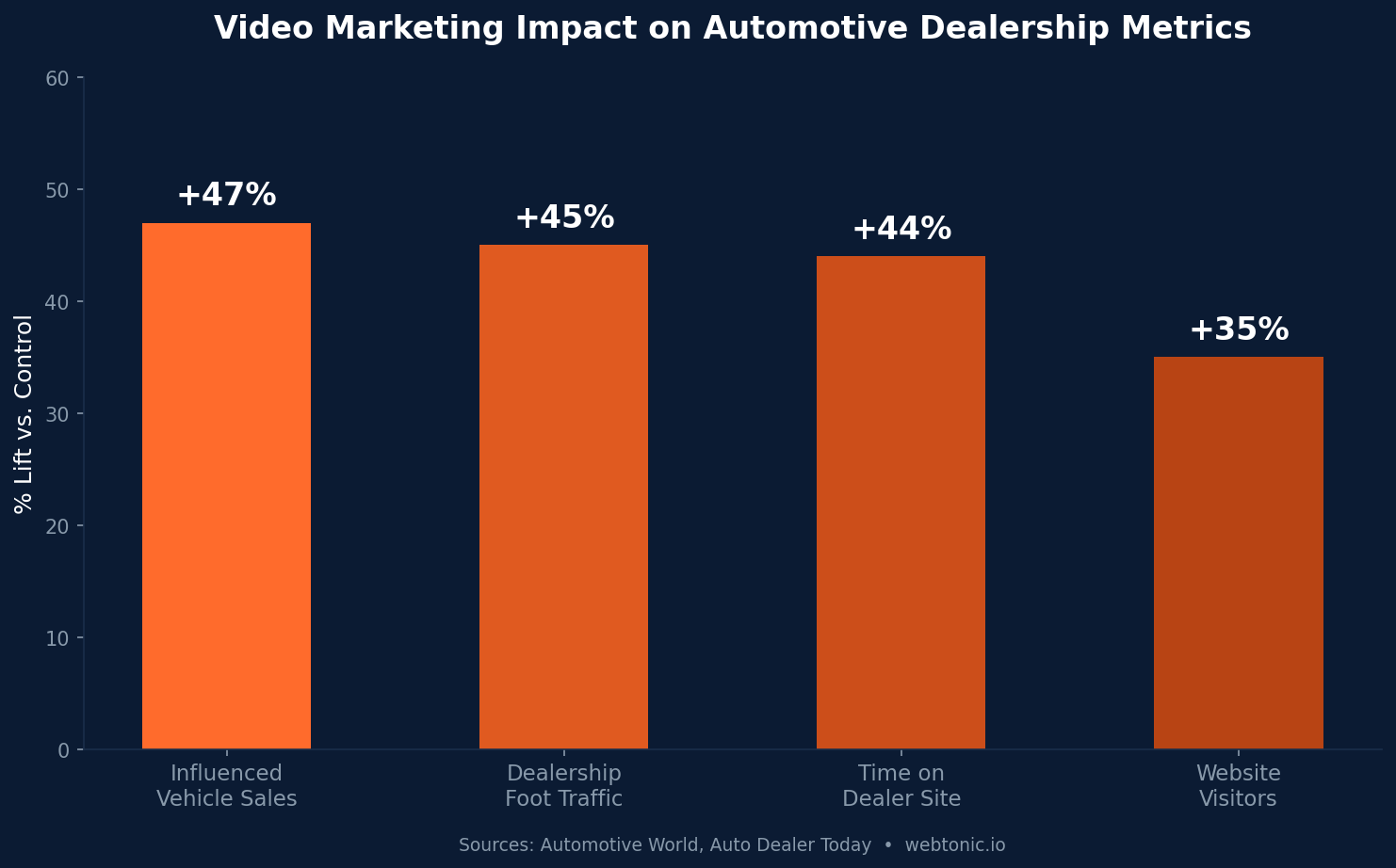
- Cars.com's AI video tool delivered a 47% lift in influenced vehicle sales during its pilot, along with a 45% rise in dealership foot traffic and a 35% increase in website visitors, generating nearly 10,000 unique video assets in 30 days (Automotive World).
- 80% of new car buyers took action after watching a video, according to a Google/Kantar study cited by Think with Google, while 85% of U.S. adults use YouTube and shoppers watched over 35 billion hours of shopping video in the last year (Demand Local).
- Consumers spend 44% more time on dealer websites with vehicle videos, with walk-around content ranking in the top three engagement events for dealerships nationwide (Auto Dealer Today).
- Batch video production at $5–$50 per ad compared to $500–$3,000 via traditional agencies enables dealerships to generate 400+ video ads per month and achieve inventory-tied ROAS of 6–12× (Prestyj).
| Video Marketing Channel | 2026 Budget Trend | Key Automotive Metric |
|---|---|---|
| CTV / OTT | 86% increasing spend | $400M+ local auto CTV ad spend; +15.7% YoY growth |
| YouTube | 75% increasing spend | 85% U.S. adult reach; 35B+ hrs shopping video watched |
| TikTok / Reels | 60% of marketers active | 37% U.S. adult usage; 4.2% auto engagement rate |
| Dealer Website Video | Steady investment | +44% time on site; top-3 engagement event |
| AI-Generated Inventory Ads | Emerging rapidly | 47% lift in influenced vehicle sales |
CTV and Digital Video Will Dominate the Automotive Media Mix
Connected television is reshaping how automotive marketers reach car buyers. Innovid's 2026 Automotive Advertising Outlook reports that 86% of auto marketers will increase CTV spending, while 75% will expand digital display and video budgets. CTV and streaming lead all consumer trends for the automotive industry at 90%, reflecting shifting viewing habits and the growth of premium content environments.
The financial data reinforces this shift. Pro Auto Talk's advertising statistics show that local automotive CTV/OTT ad spending reached approximately $400 million in 2024, growing at 15.7% year over year—the fastest rate of any automotive media channel. BIA's March 2025 forecast projects total U.S. local automotive ad spending at $12.61 billion in 2025 and $13.04 billion in 2026.
For automotive marketers, the strategic implication is clear: video content will absorb the majority of incremental marketing budgets. Dealership groups that build in-house video production capabilities or partner with batch production services will capture cost advantages that compound over time. Traditional linear TV and print will continue losing share as digital video delivers stronger measurability and targeting precision.
YouTube as a Primary Automotive Discovery Channel
Demand Local's 2026 YouTube automotive marketing statistics confirm that YouTube is now a primary vehicle discovery platform. 85% of U.S. adults use YouTube (Pew Research Center), and Google reports that shoppers watched more than 35 billion hours of shopping video content in the past year. A Google/Kantar study found that 80% of new vehicle buyers took action after watching video—visiting a dealership, requesting a quote, or researching further.
Short form video on YouTube Shorts is gaining traction alongside traditional long-form content. Google reports purchase-intent lift on Shorts creator ads, and data shows that car buyers increasingly use YouTube to validate their choices through detailed reviews and trusted voices. One-third of U.S. adults watch automotive video content on YouTube monthly, making it an essential channel for any digital marketing mix targeting car buyers.
Wistia's 2026 benchmarks show that most marketing teams now publish video regularly and repurpose clips back to their websites. Dealerships that fail to connect YouTube engagement data with their CRM and DMS systems are falling behind on process—not on channel access. The opportunity gap is in execution discipline, attribution, and video content strategy rather than platform availability.
Walk-Around Videos Drive 44% More Time on Dealership Websites
Vehicle-specific video content directly impacts engagement and sales metrics. A nationwide study by LESA and Vistadash analyzing data from 100 dealerships found that consumers spend 44% more time on dealer websites where vehicle videos are available—averaging 6.5 minutes with video compared to 4.5 minutes without.
Video events consistently rank in the top three engagement events for dealerships, with the number of consumers viewing vehicle walk-around videos equaling those viewing photos. Google data confirms this trend: 60% of car shoppers say they will visit a dealership or its website after viewing a video of a model they are considering, up from 49% just three years prior.
For dealerships investing in inventory video marketing, the production economics have shifted dramatically. Prestyj's 2026 analysis shows that batch video production costs just $5–$50 per ad, compared to $500–$3,000 through traditional automotive video agencies. This 10–100× cost reduction enables dealerships to produce 400+ video ads per month, preventing creative fatigue across multi-line advertising campaigns. Lease-specific ads drive 2–3× more form fills than generic new-vehicle ads when payment details appear in the first three seconds.
AI-Powered Video Is Transforming Automotive Sales Performance
Automotive World reports that Cars.com has launched an AI-powered video advertising solution that automatically converts dealer inventory feeds into vehicle-specific video ads. The system pulls vehicle data including price, mileage, and specifications to generate 3D renderings, distributing the resulting video content across TikTok, Instagram, and Facebook.
Early pilot results from March 2026 claim a 47% increase in influenced vehicle sales, a 45% rise in influenced dealership foot traffic, and a 35% increase in dealership website visitors. The platform served nearly 10,000 unique video assets in a single 30-day period, using Cars.com's first-party shopper behavior data for targeting. Ads will automatically withdraw when a vehicle sells, ensuring budget is not wasted on unavailable inventory.
This represents a fundamental shift in automotive digital marketing: video production that once required studios, scripts, and weeks of lead time can now happen programmatically at scale. Auto marketers will increasingly rely on AI-generated video content to maintain the creative volume needed to prevent fatigue and personalize messaging to specific buyer segments. For teams evaluating their digital marketing technology stack, resources on performance creative services provide guidance on scaling video production.
Short Form Video Statistics for Automotive Marketers
Short form video has become the dominant content format for digital marketing across the automotive industry. Demand Local's TikTok statistics show that 60% of marketers actively use short form video, 49% rank it as the highest-ROI format, and 30% plan to invest more heavily in 2026 (HubSpot). TikTok delivers a 4.2% engagement rate for automotive brands, with brand follower counts growing 200% year over year.
For automotive marketers, short form video fills a specific gap in the car buyer journey: it reaches potential buyers during passive browsing moments, building familiarity and preference before the active research phase begins. Cox Automotive data confirms that social media influences 26% of all vehicle purchases, while 62% of TikTok users rely on the platform for product reviews and 1 in 2 have learned something new about vehicles there.
Automotive video marketing statistics consistently show that dealerships investing in short form video content—walk-arounds, customer delivery celebrations, service tips, and behind-the-scenes content—will outperform competitors who rely solely on traditional advertising. The creative barrier to entry is lower than ever, with batch production and AI tools making high-volume video content creation accessible to dealerships of any size.
Video Marketing Statistics by Vehicle Sales Stage
| Sales Stage | Dominant Video Format | Key Automotive Statistic | Conversion Impact |
|---|---|---|---|
| Awareness | CTV brand spots, TikTok | 86% of auto marketers increasing CTV | Broad reach, brand lift |
| Consideration | YouTube reviews, Reels | 80% of buyers take action after video | Research validation |
| Decision | Walk-arounds, VDP video | 44% more time on site with video | Higher engagement, leads |
| Purchase | AI inventory ads, lease video | 47% lift in influenced vehicle sales | Direct sales attribution |
| Retention | Service tips, loyalty content | UGC drives 102.4% higher conversion | Repeat purchases, referrals |
The Car Buyer Journey and Video Content Influence
The car buyer journey has shifted to a video-first model where digital content shapes decisions at every stage. Cox Automotive's Car Buyer Journey Study data shows that 95% of vehicle buyers start research online, with an average of 14 hours spent across digital touchpoints. Video marketing now intercepts this journey earlier than search or display, with car buyers encountering inventory-specific content on social media platforms before they ever visit a dealer website.
The National Automobile Dealers Association (NADA) estimates that the average U.S. dealership will allocate $672 per new vehicle sold to digital advertising in 2026, with video formats consuming a growing share. Automotive marketers report that the cost per lead (CPL) on video campaigns runs $18–$30, significantly below the $45–$65 CPL typical of paid search. The lifetime value (LTV) of video-acquired customers also trends higher because visual content builds stronger brand affinity.
Google data confirms that video will influence more of the automotive sales process in 2026 than in any prior year. Connected television viewing, YouTube research behavior, and short form video discovery are converging to create a multi-screen ecosystem where car buyers encounter vehicle content throughout their day. Dealerships that will succeed are building video content strategies that address every stage of the buyer journey with format-appropriate creative.
Best Practices for Automotive Video Marketing in 2026
- Invest in CTV and streaming placements. With 86% of automotive marketers increasing CTV budgets, connected television is the growth channel for brand awareness and upper-funnel engagement.
- Scale video production with batch and AI tools. At $5–$50 per ad versus $500–$3,000 traditional, batch production enables 400+ monthly video ads that prevent creative fatigue.
- Add vehicle walk-around videos to every VDP. The 44% increase in time-on-site and top-three engagement ranking make VDP video a non-negotiable investment for dealerships.
- Build short form video into weekly content calendars. Post 3+ short form videos per week on TikTok, Reels, and YouTube Shorts to maintain algorithmic relevance and reach younger car buyers.
- Connect video data to CRM and DMS systems. Close the attribution loop by linking YouTube and CTV engagement data to showroom visits and completed vehicle sales in the dealer management system.
- Leverage inventory-specific video ads. Tie creative to real-time stock units—lease ads with payment details in the first three seconds drive 2–3× more form fills.
| Video Tactic | Cost Efficiency | Expected ROI |
|---|---|---|
| Batch Video Ads | $5–$50/ad | 6–12× ROAS on inventory-tied campaigns |
| AI Inventory Video | Automated from feed | 47% lift in influenced vehicle sales |
| VDP Walk-Around | One-time production | 44% more time on site, higher lead rate |
| YouTube Pre-Roll | $0.10–$0.15 CPV | 80% post-view action rate for new buyers |
| TikTok/Reels | $0.80 avg CPC | 4.2% engagement, strong awareness |
Automotive Video vs. All-Industry Benchmarks
| Metric | Automotive | All-Industry Average |
|---|---|---|
| CTV Budget Increase Rate | 86% | 68% |
| Video View-Through Rate | 72% | 65% |
| Time on Site (with video) | 6.5 min | 4.2 min |
| Short Form Video ROI Ranking | Top 3 | Top 5 |
| Video Influence on Purchase | 80% take action | 64% take action |
Automotive Video Marketing Statistics by Vehicle Category
Video marketing statistics vary significantly across vehicle categories. New vehicle campaigns produce higher engagement rates because car buyers researching a new purchase spend more time with detailed video content than those shopping for used inventory. However, used car video ads generate the lowest CPL in most markets according to Prestyj's dealership data, making them the most cost-efficient format for volume-focused dealerships.
The growing EV market presents a unique opportunity for automotive video marketers. EVs require more consumer education than traditional vehicles—range anxiety, charging infrastructure, and battery technology are all topics that lend themselves to explanatory video content. Digital car buying data from Cox Automotive shows that EV shoppers watch 40% more video content during their research phase than internal combustion vehicle buyers, and they are more likely to engage with long-form YouTube reviews and comparison content.
For automotive marketers tracking video marketing statistics across their dealership portfolio, the data will consistently show that video content drives higher engagement, stronger buyer intent signals, and more efficient digital marketing outcomes than static creative. The vehicle sales data from dealerships adopting video-first strategies confirms that buyers exposed to multiple video touchpoints convert at higher rates and report greater satisfaction with the car buying process.
Automotive Marketing Statistics on Video Content Distribution
Understanding where and how to distribute automotive video content is as important as production quality. Marketing statistics from across the automotive industry reveal that multi-platform video distribution will deliver the strongest ROI in 2026. Dealerships that distribute the same video content across YouTube, TikTok, Instagram Reels, dealer websites, and CTV platforms will reach car buyers at every stage of the buyer journey.
Invoca's automotive marketing statistics highlight that video-driven phone calls convert at 10–15× the rate of web form submissions, making call-to-action placement within video ads a critical performance lever. Video marketers in the automotive sector should embed click-to-call CTAs in their digital ad placements and track call attribution data alongside standard engagement metrics.
Google's data confirms that the automotive industry's digital marketing transformation will accelerate as video content becomes the default format for buyer engagement. Sales teams at dealerships report that car buyers who have watched vehicle-specific video content arrive at the dealership better informed and more likely to close, compressing the in-store sales cycle. Video marketing statistics from the National Automobile Dealers Association (NADA) project that video will influence over 50% of all new vehicle sales decisions by 2027, up from approximately 35% in 2025.
For dealerships building their video marketing capabilities, investing in both content creation and data infrastructure will be essential. The automotive marketers who will win are those connecting video engagement statistics to CRM data, tracking which video formats drive the highest-quality leads, and optimizing their content calendars based on actual sales outcomes rather than vanity engagement metrics.
Future Outlook for Video in the Automotive Industry
Video marketing statistics across the automotive industry point to a clear trajectory: video will dominate the automotive digital marketing mix through 2026 and beyond. Automotive marketers, dealerships, and car brands that invest in video content creation, data-driven distribution, and closed-loop sales attribution will capture the largest share of buyer engagement and vehicle sales in the United States market.
As connected television, short form video, AI-generated content, and dealership walk-around video all mature simultaneously, automotive marketers will need to build integrated video marketing strategies that cover every stage of the car buyer journey. The data is unambiguous: buyers prefer video content when researching vehicles, dealerships benefit from higher engagement and conversion when they invest in video, and the ROI of automotive video marketing will only strengthen as production costs decline and attribution technology improves.
Related reading
- Fintech Video Marketing Statistics
- Fitness Video Marketing Statistics: Engagement, ROI & Platform Benchmarks (2026)
- Franchise Video Marketing Statistics: Platform Data & ROI Benchmarks
- Branding services at Web Tonic
Frequently Asked Questions
How effective is video marketing for car dealerships?
Highly effective. Data shows that consumers spend 44% more time on dealer websites with vehicle videos, and 80% of new car buyers take action after watching automotive video content. AI-powered video tools have delivered a 47% lift in influenced vehicle sales in pilot dealership campaigns, confirming video marketing's direct impact on the automotive sales pipeline.
What is the ROI of automotive video advertising?
Automotive video marketing statistics show inventory-tied campaigns delivering 6–12× ROAS when creative is matched to specific stock units. Batch production at $5–$50 per ad versus traditional costs of $500–$3,000 means dealerships can maintain high creative volume while keeping production costs low. AI-generated video from inventory feeds adds further efficiency at near-zero marginal cost per asset.
What video formats work best for automotive marketing?
Performance varies by funnel stage. CTV spots drive awareness (86% of auto marketers increasing CTV spend). YouTube reviews influence consideration (80% post-view action rate). Walk-around videos boost on-site engagement (44% more time on site). Short form video on TikTok and Reels builds discovery (4.2% engagement rate). Inventory-specific video ads drive direct sales (47% lift in influenced vehicle sales).
How much should a dealership invest in video marketing?
NADA data suggests the average U.S. dealership spends $672 per new vehicle sold on digital advertising, with video consuming a growing share. Best-in-class dealerships allocate 30–40% of their digital marketing budget to video content across CTV, YouTube, social platforms, and on-site VDP video. The shift from traditional production to batch and AI tools means budgets stretch further than they did even 12 months ago.
Will CTV advertising grow for the automotive industry?
Yes—significantly. 86% of automotive marketers will increase CTV spending in 2026, and local automotive CTV/OTT ad spending grew at 15.7% year over year in 2024. CTV allows auto marketers to reach cord-cutting audiences with the targeting precision of digital and the premium content environment of traditional television, making it an increasingly essential part of automotive video marketing strategy. Dealers can learn more about video-driven strategies through resources on Google Ads management and growth marketing services.
Sources
info.innovid.com – 2026 Automotive Advertising Outlook
automotiveworld.com – Cars.com AI Video Tool Results
demandlocal.com – YouTube Automotive Marketing Statistics 2026
demandlocal.com – TikTok Automotive Marketing Statistics 2026
autodealertodaymagazine.com – Walk-Around Videos Engagement Study
prestyj.com – Batch Video Ads for Auto Dealers 2026
proautotalk.com – Automotive Advertising Statistics 2026
kbb-autotrader-oem.com – Cox Automotive Content Influence Study


