Table of contents

A SMART goal turns a vague ambition into a sentence you can measure on a calendar. Below are 21 written-out smart goals examples for work, sales, marketing, customer service, and students — each one specific, measurable, achievable, relevant, and time bound.
Key Takeaways
- SMART is an acronym for Specific, Measurable, Achievable, Relevant, and Time-bound — five tests every goal must pass before it goes on a plan.
- The term first appeared in the November 1981 issue of Management Review, in an article by George T. Doran, and traces back to Peter Drucker's Management by Objectives.
- All 21 examples below follow the same 4-part sentence pattern: action + metric + baseline-to-target + deadline.
- Weak goals fail on the measurable test — if you cannot name the number and the source of that number, the goal is a wish.
- Business units with engaged, goal-aligned teams show 21% higher profitability in Gallup's workplace research, which is why goal setting sits inside performance reviews rather than beside them.
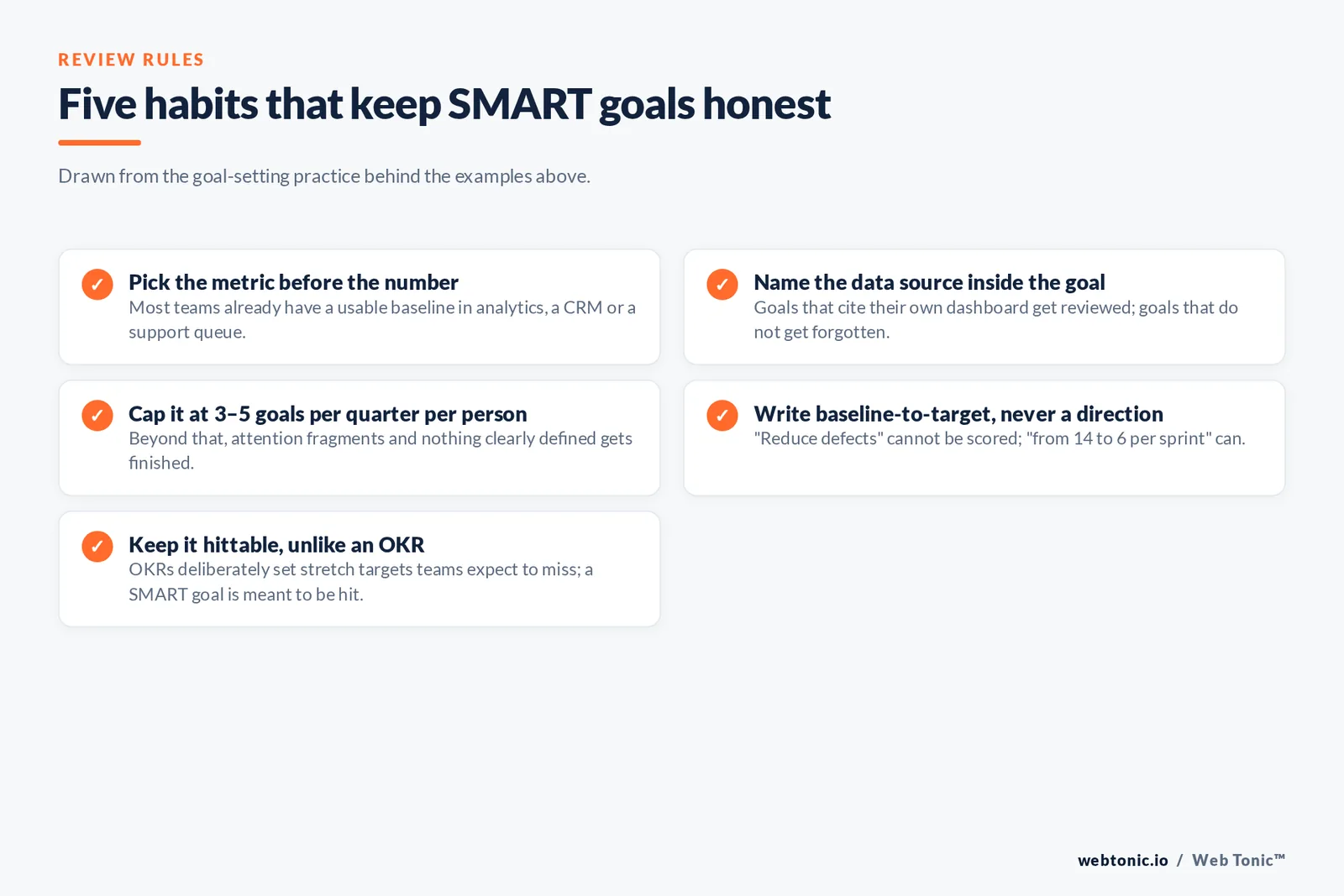
- Use 3–5 SMART goals per quarter per person; beyond that, attention fragments and nothing clearly defined gets finished.
What Are SMART Goals?
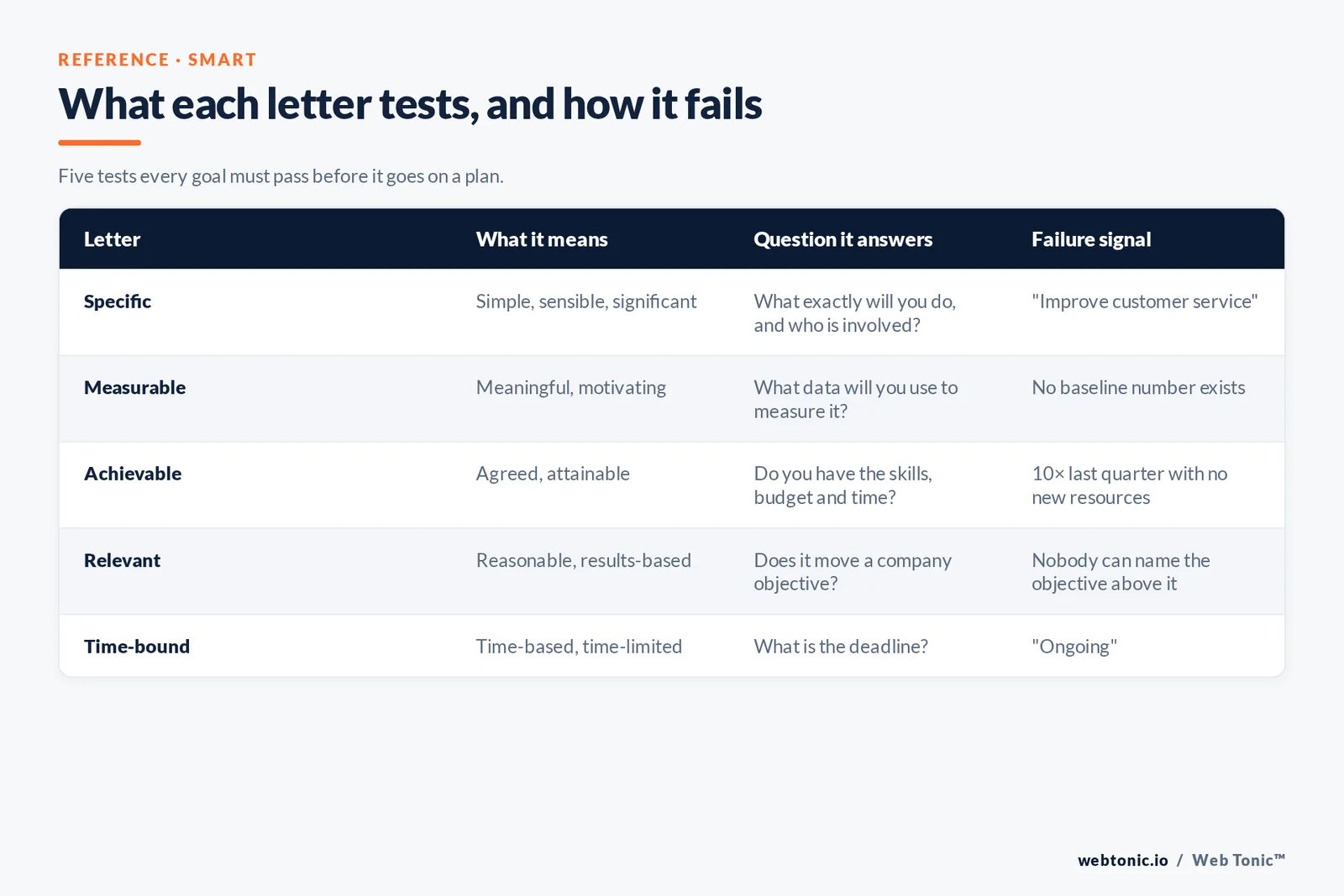
SMART goals are objectives written so that anyone reading them can tell what will be done, by how much, and by when. The smart acronym stands for specific, measurable, achievable, relevant, and time bound. Each letter removes one common way goal setting falls apart: ambiguity, unmeasurable progress, fantasy targets, work that does not matter, and deadlines that never arrive.
The criteria are commonly attributed to Peter Drucker's Management by Objectives concept, and the first known use of the term came in the November 1981 issue of Management Review. Since then the letters have been stretched — "A" is read as achievable, attainable, or agreed; "R" as relevant or realistic — but the working test has not changed. Some teams extend it to SMARTER, adding 2 extra steps: Evaluated and Reviewed.
| Letter | What it means | The question it answers | Failure signal |
|---|---|---|---|
| Specific | Simple, sensible, significant | What exactly will you do, and who is involved? | "Improve customer service" |
| Measurable | Meaningful, motivating | What data will you use, and how will you measure it? | No baseline number exists |
| Achievable | Agreed, attainable | Do you have the skills, budget, and time? | Target is 10x last quarter with no new resources |
| Relevant | Reasonable, results-based | Does it move a company objective? | Nobody can name the objective above it |
| Time-bound | Time-based, time-limited | What is the deadline? | "Ongoing" |
The five-part structure is why the framework survived four decades of management fashion. Corporate Finance Institute makes the same point about the T: without a time frame there is no sense of urgency, and without urgency there is less motivation to finish. And unlike OKRs, which deliberately set stretch targets that teams expect to miss, a SMART goal is meant to be hit.
How to Write a SMART Goal in One Sentence
Every example in this article uses the same pattern, which keeps the writing fast and the review process honest:
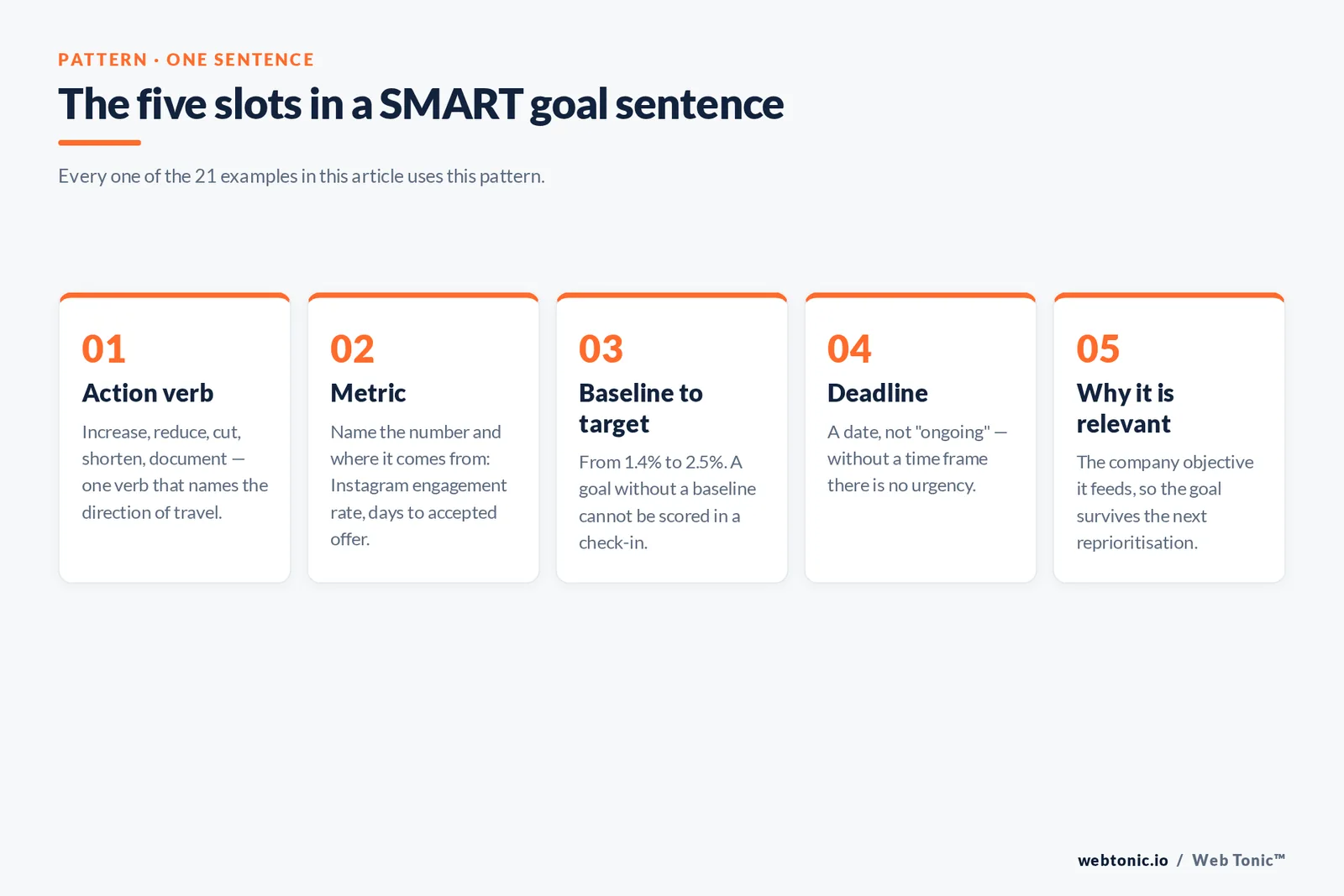
[Action verb] + [metric] + [from baseline to target] + [by deadline] + [why it is relevant].
Take a vague draft — "get better at social media" — and run it through the four slots: Increase + Instagram engagement rate + from 1.4% to 2.5% + by 31 December + to reduce paid acquisition cost. That is a smart goal. The rewrite takes about 90 seconds once the baseline is on hand, which is why the measurable step should come before the ambitious one. Smartsheet's goal-writing guide recommends naming the data source in the goal itself, and it is good advice: goals that cite their own dashboard get reviewed, and goals that do not get forgotten.
Pick the metric before the number. Most teams already have the raw material sitting in analytics, a CRM, or a support queue — a short data and analytics review usually surfaces a usable baseline in an afternoon. Key performance indicators (KPIs) measure progress between check-ins; the goal only states where the KPI should land.
SMART Goals Examples for Work
These smart goals examples work for individual contributors and managers writing quarterly objectives. Each one names the metric, the time frame, and the reason it matters.
| # | SMART goal | Metric | Time frame |
|---|---|---|---|
| 1. Productivity | Reduce average meeting time from 52 minutes to 30 minutes by moving status updates to a written Monday recap, starting this quarter. | Calendar minutes/week | 1 quarter |
| 2. Skills | Complete the 4 required analytics certification modules and pass the final assessment by 30 November, so I can own campaign reporting. | Modules completed | 4 months |
| 3. Hiring | Cut time-to-hire for engineering roles from 48 days to 35 days by pre-screening with a scored take-home, by end of Q3. | Days to accepted offer | 1 quarter |
| 4. Retention | Raise the team's engagement survey score from 3.6 to 4.1 out of 5 by running monthly one-on-ones with a written follow-up, within two quarters. | Survey mean | 6 months |
| 5. Process | Document the top 10 recurring workflows in the team handbook by 15 December so onboarding drops below one week. | Documented workflows | 5 months |
| 6. Leadership | Delegate 2 recurring reports to a direct report and review only exceptions, by the end of next month. | Reports reassigned | 30 days |
| 7. Quality | Reduce post-release defects from 14 to 6 per sprint by adding a peer review gate, over the next 3 sprints. | Defects per sprint | 6 weeks |
Notice how each goal names a baseline. A goal that says "reduce defects" cannot be scored; a goal that says from 14 to 6 can be scored in a five-minute check-in. That is the whole practical value of the measurable criterion, and it is why HR practitioners tie performance appraisal conversations to written targets rather than impressions.
SMART Goals Examples for Sales Teams
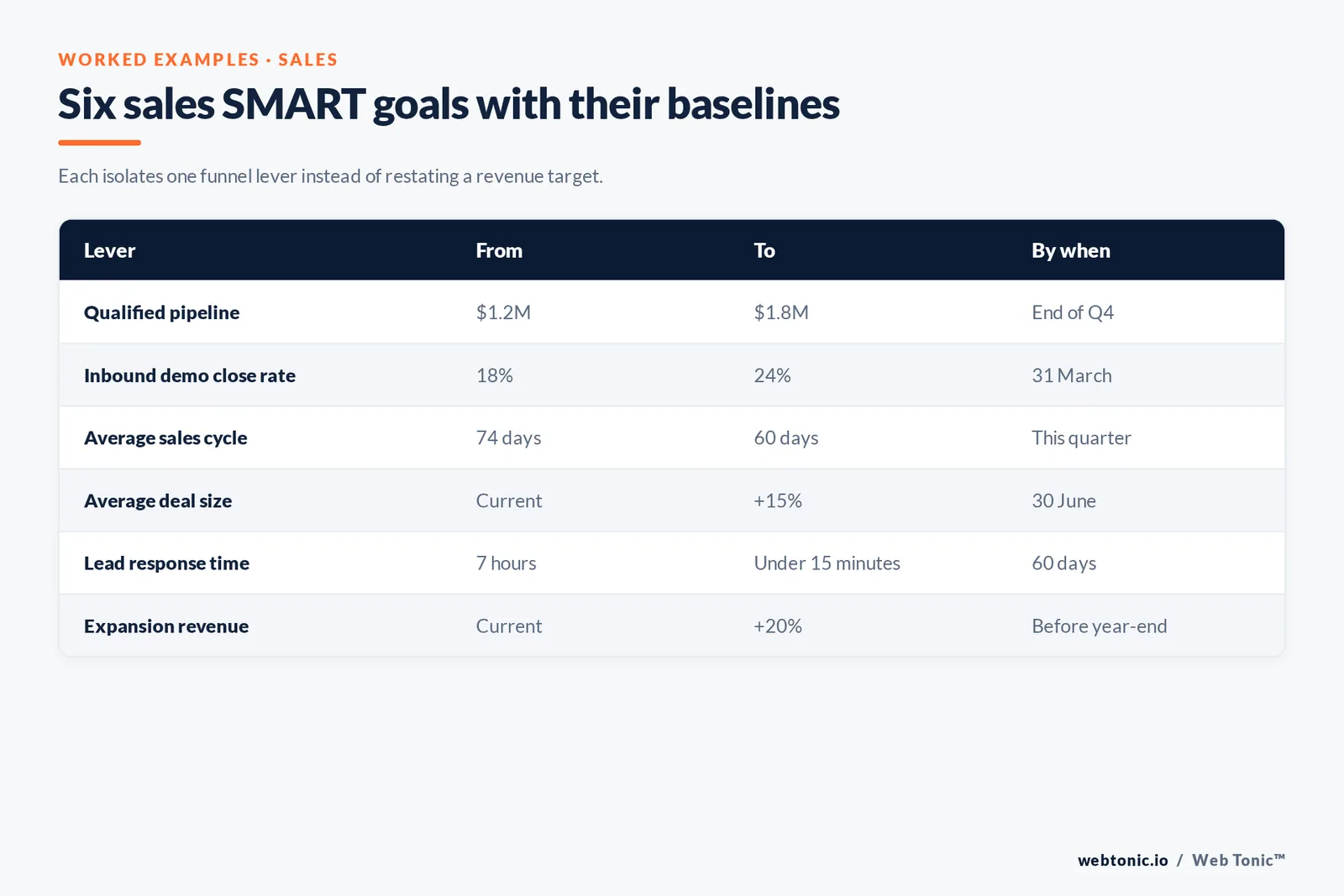
Sales goals live and die on the denominator. Revenue targets alone hide whether the number came from more pipeline, better conversion, or discounting, so each of these smart goals examples isolates one lever.
- 8. Increase qualified pipeline from $1.2M to $1.8M in Q4 by booking 12 discovery calls per rep per week.
- 9. Improve close rate on inbound demos from 18% to 24% by 31 March using a two-step mutual action plan.
- 10. Shorten the average sales cycle from 74 days to 60 days this quarter by involving a technical buyer before the proposal stage.
- 11. Grow average deal size 15% by 30 June by attaching an onboarding package to every new logo proposal.
- 12. Cut lead response time from 7 hours to under 15 minutes within 60 days by routing form fills to a shared queue.
- 13. Lift expansion revenue from existing accounts by 20% before year-end through a quarterly business review with the top 25 accounts.
Response time deserves the emphasis it gets: it is one of the few sales inputs a team can change this week rather than next quarter, and it compounds with every other conversion step downstream. When several of these goals point at the same funnel, a coordinated demand generation program keeps the pipeline goal and the conversion goal from fighting each other.
SMART Goals Examples for Marketing and Customer Service
Marketing and customer service goals share a trap: both are easy to state as activity ("publish more", "answer faster") and hard to state as outcomes. These versions do the harder thing.
| Function | SMART goal | Why it is relevant |
|---|---|---|
| 14. SEO | Grow non-brand organic sessions from 18,000 to 27,000 per month by 30 June by publishing 24 briefed articles and fixing 40 internal link gaps. | Lowers blended acquisition cost |
| 15. Email | Raise click-through rate from 1.9% to 3.0% across the nurture sequence within 2 months by segmenting on last product viewed. | More pipeline from the same list |
| 16. Paid media | Reduce cost per qualified lead from $140 to $95 by 30 September by cutting the bottom 20% of placements weekly. | Frees budget for testing |
| 17. Website | Improve landing page conversion from 2.2% to 3.5% this quarter by shipping 6 A/B tests on the hero and form. | Compounds every traffic gain |
| 18. Customer service | Raise the net promoter score from 32 to 45 by 31 December by resolving 90% of tickets within one business day. | Retention and referral revenue |
| 19. Support ops | Deflect 25% of tier-1 tickets within 90 days by publishing the 15 most-requested help articles. | Headcount efficiency |
The net promoter score example shows how a relationship metric becomes measurable: it pairs the outcome (NPS) with the operational driver (first-day resolution) in one sentence. Conversion goals behave the same way — a 1.3-point lift in landing page conversion is worth more than a 30% traffic increase for most sites, and it is usually cheaper, which is why site and landing page work often deserves the first quarter of attention.
SMART Goals Examples for Students
Students get the same benefit teams do, with shorter time frames. A semester is a natural deadline, and grades, practice hours, and submitted applications are already measurable.
- 20. Raise my statistics grade from a B− to an A− by the end of the semester by completing every problem set 48 hours early and attending office hours weekly.
- 21. Submit 8 internship applications and complete 3 mock interviews before 15 March to secure a summer placement.
Student goals fail most often on the achievable test. Committing to 4 hours of daily revision alongside a part-time job is not attainable; 45 minutes on five weekday mornings is. Research on progress and motivation found that the single strongest driver of engaged, productive days is the sense of making progress on meaningful work — an argument for smaller, clearly defined milestones rather than one heroic target.
Common Mistakes When Setting SMART Goals
Most broken goals fail on one of five predictable points. The table below is the review checklist we use before any goal gets committed to a quarter.
| Mistake | What it looks like | The fix |
|---|---|---|
| Activity as outcome | "Publish 20 posts" | State the result the activity should produce |
| No baseline | "Increase conversions" | Pull last 90 days first, then set the target |
| Too many goals | 11 priorities per person | Cap at 3–5 per quarter |
| Sandbagged targets | 100% hit rate every quarter | Target roughly a 70–80% hit rate on stretch items |
| No review rhythm | Goals opened twice a year | Monthly check-in against the named KPI |
Rigidity is the other risk. A goal locked in January against a market that changed in March creates busywork; management researchers and Gallup's engagement data both point the same direction — goals work when they are revisited, not when they are enforced. Review quarterly, retire what no longer matters, and rewrite the rest.
A Reusable SMART Goal Template
Copy this structure into a doc or spreadsheet and fill one row per goal. Six columns is enough; anything more turns goal setting into paperwork.
| Column | What goes in it | Example entry |
|---|---|---|
| Goal statement | The one-sentence version | Increase trial-to-paid conversion from 7% to 10% by 31 March |
| Metric & source | KPI plus where it is read | Trial conversion, billing dashboard |
| Baseline | Current value and date | 7.0% (last 90 days) |
| Target & deadline | Number and date | 10% by 31 March |
| Owner | One named person | Head of lifecycle |
| Check-in | Review cadence | Monthly, first Tuesday |
Working templates from HubSpot and Asana follow the same logic with more formatting; the columns matter more than the tool. If several of your goals depend on one channel performing, it is worth pressure-testing the plan behind them — that is usually a conversation about capacity and sequencing rather than ambition, and it is a good reason to talk it through with a specialist before the quarter starts. More frameworks and worked examples live in our marketing resource library.
FAQ
What does the SMART acronym stand for?
SMART stands for Specific, Measurable, Achievable, Relevant, and Time-bound. Some versions read the A as "attainable" or "agreed" and the R as "realistic" or "results-based", but the five tests are functionally identical: define the work, attach a number, keep it possible, connect it to something that matters, and give it a deadline.
What is a good example of a SMART goal for work?
"Reduce time-to-hire for engineering roles from 48 days to 35 days by the end of Q3 by pre-screening candidates with a scored take-home exercise." It names the metric, the baseline, the target, the deadline, and the method — so at the end of the quarter it can only be scored as hit or missed.
How many SMART goals should I set at once?
Three to five per person per quarter. Beyond that, weekly attention splinters and the lowest-priority items quietly absorb time without producing results. If you have more than five, some of them are tasks belonging under an existing goal rather than goals in their own right.
What is the difference between a SMART goal and a KPI?
A KPI is a metric you watch continuously — conversion rate, NPS, cost per lead. A SMART goal is a commitment about where that metric should be by a specific date. KPIs measure progress; the goal defines the destination and the time frame.
Are SMART goals still useful compared with OKRs?
Yes, and they work together. OKRs set an ambitious direction with key results that teams expect to only partly achieve; SMART goals are written to be achieved and are better suited to operational commitments, individual development plans, and anything tied to performance appraisal.
Sources: Mind Tools – SMART Goals (mindtools.com, 2025); George T. Doran, Management Review, November 1981; Corporate Finance Institute – SMART Goals (corporatefinanceinstitute.com); Smartsheet – Essential Guide to Writing SMART Goals (smartsheet.com); HubSpot – SMART Goal Examples (blog.hubspot.com); Asana – SMART Goals (asana.com); Gallup – Employee Engagement and Business Outcomes (gallup.com); Harvard Business Review – The Power of Small Wins (hbr.org, 2011); IBM – What Are OKRs (ibm.com); MIT Sloan Management Review (sloanreview.mit.edu); SHRM – HR Magazine (shrm.org).