Table of contents
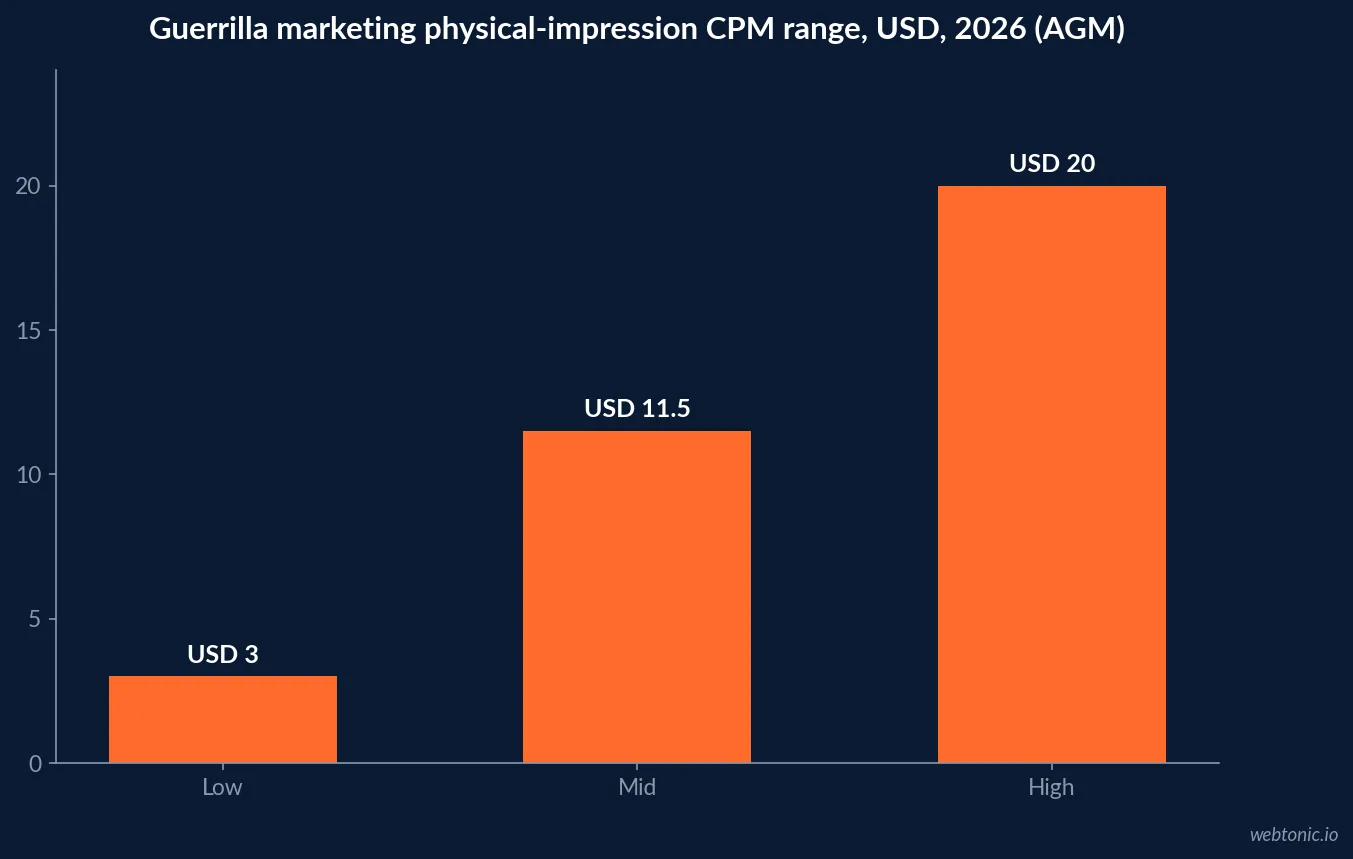
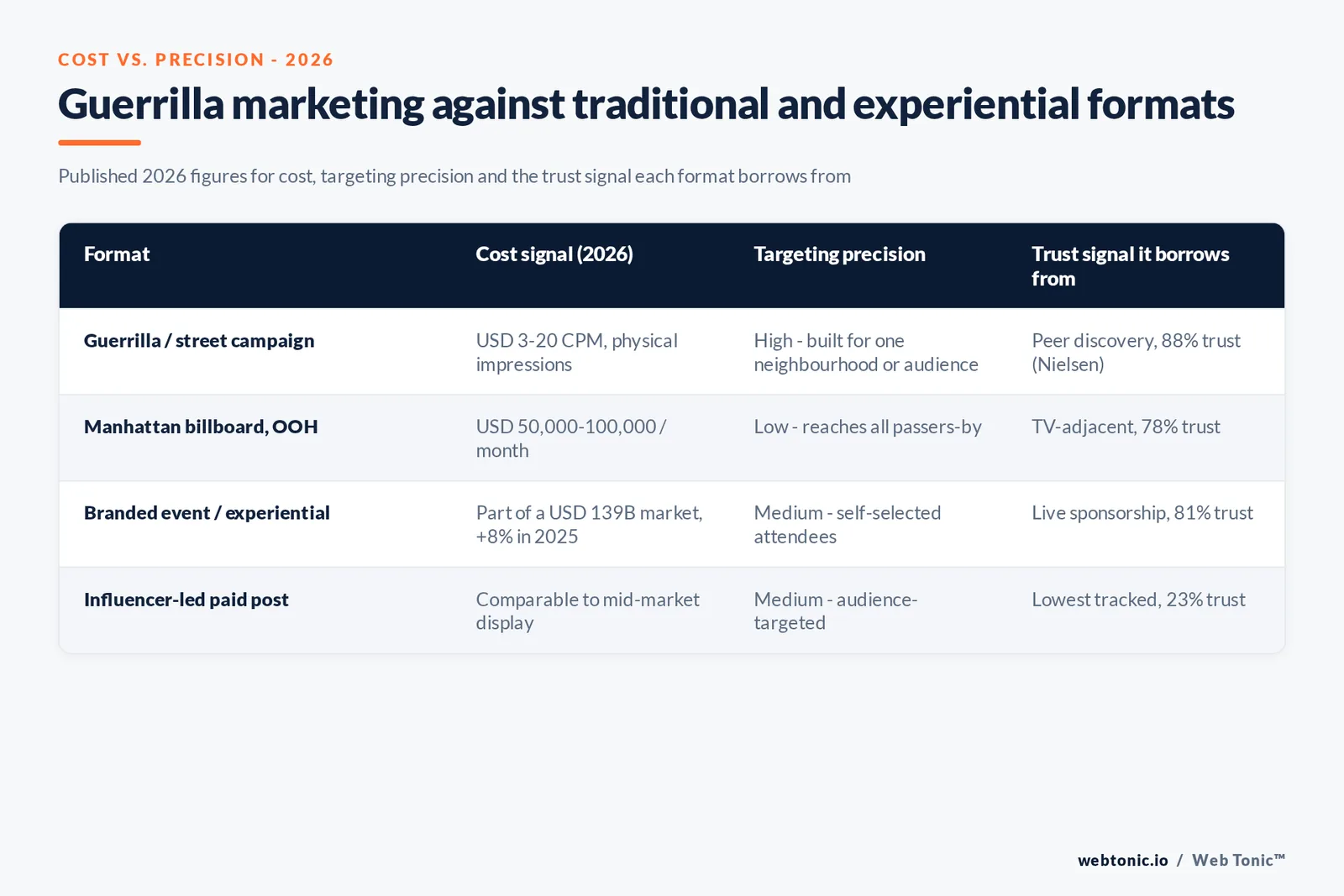
A guerrilla marketing campaign runs a physical-impression cost of roughly USD 3 to 20 per thousand, against USD 50,000 to 100,000 a month for a single Manhattan billboard - and a hand-collected study of 803 campaigns found the tactic moves stock price about as much as a celebrity endorsement does. That is the rare part of guerrilla marketing that has actual measurement behind it, not just case-study anecdote.
Key Takeaways
- Guerrilla campaign CPMs run USD 3 to 20 per thousand impressions.
- A Manhattan billboard costs USD 50,000-100,000 a month by comparison.
- 803 guerrilla campaigns (2007-2017) showed positive abnormal stock returns.
- Those returns matched other advertising activity like celebrity endorsements.
- Emotional appeals, especially joy, drove significantly positive returns.
- Humor and quality-claim appeals drove significantly negative returns.
- Global experiential marketing grew 8% to USD 139 billion in 2025.
- It is forecast to surge 10% further in 2026, on major sporting and political events.
- 34% of event attendees met a brand they didn't already know, per EventTrack 2026.
- Average small business marketing budget sits at USD 4,200 a month.
- 38% of that budget goes to digital advertising alone.
- 88% of consumers trust recommendations from people they know most (Nielsen).
- That is the single most trusted format Nielsen tracks, globally.
- Only 23% of consumers trust ads from influencers, near the bottom of Nielsen's scale.
- Brand sponsorships at live events reach 81% trust globally.
- TV ads reach 78% trust, still ahead of most paid digital formats.
What guerrilla marketing actually costs, measured
Most guerrilla marketing write-ups sell the tactic on anecdote. American Guerrilla Marketing's 2026 ROI analysis instead prices it: physical impression CPMs - cost per thousand physical impressions at documented placement locations - typically run USD 3 to 20 depending on market, format and location quality, which is directly competitive with mid-market digital display. Compare that with a single billboard in a high-traffic Manhattan location, which can run USD 50,000 to 100,000 a month in production and placement cost before any creative spend.
The honest trade-off is reach versus precision. A billboard reaches everyone who drives or walks past regardless of relevance; a guerrilla campaign covering a specific neighborhood reaches only that neighborhood's demographic mix - which for a campaign with a defined target audience is frequently the better trade, not a limitation. When earned media amplification is factored into effective reach, the blended CPM often falls further below the billboard comparison.
| Format (2026) | Typical cost | What it buys |
|---|---|---|
| Guerrilla campaign, physical impressions | USD 3-20 CPM | Documented placements, precise audience |
| Manhattan billboard, one location | USD 50,000-100,000/mo | Undifferentiated mass reach |
| Guerrilla campaign + earned amplification | Below USD 3-20 CPM blended | Social share, press pickup |
| Mid-market digital display | Comparable CPM range | Benchmark American Guerrilla Marketing cites |
Does it move a share price? One study actually measured it
The academic evidence is thin but real. A study published in the Journal of Advertising Research, analyzing a hand-collected sample of 803 guerrilla marketing campaigns from 2007 to 2017, used event-study and cross-sectional analysis to test abnormal share-price performance around each campaign. It found event-period abnormal returns that were positive and in line with the returns generated by other advertising activities, including celebrity endorsements - a genuinely rare data point for a tactic usually justified on engagement metrics alone.
The tone of the campaign mattered more than its existence. Emotional appeals, particularly joy, were associated with significantly positive company returns, while humor and rational, quality-claim appeals were associated with significantly negative returns - the opposite of what many creative briefs assume about what makes a stunt land.
| Guerrilla campaign appeal type (803-campaign study) | Effect on abnormal stock return |
|---|---|
| Emotional appeal, especially joy | Significantly positive |
| General advertising activity (comparison baseline) | Positive, comparable to celebrity endorsement |
| Humor appeal | Significantly negative |
| Rational / quality-claim appeal | Significantly negative |
The category it lives inside is growing fast
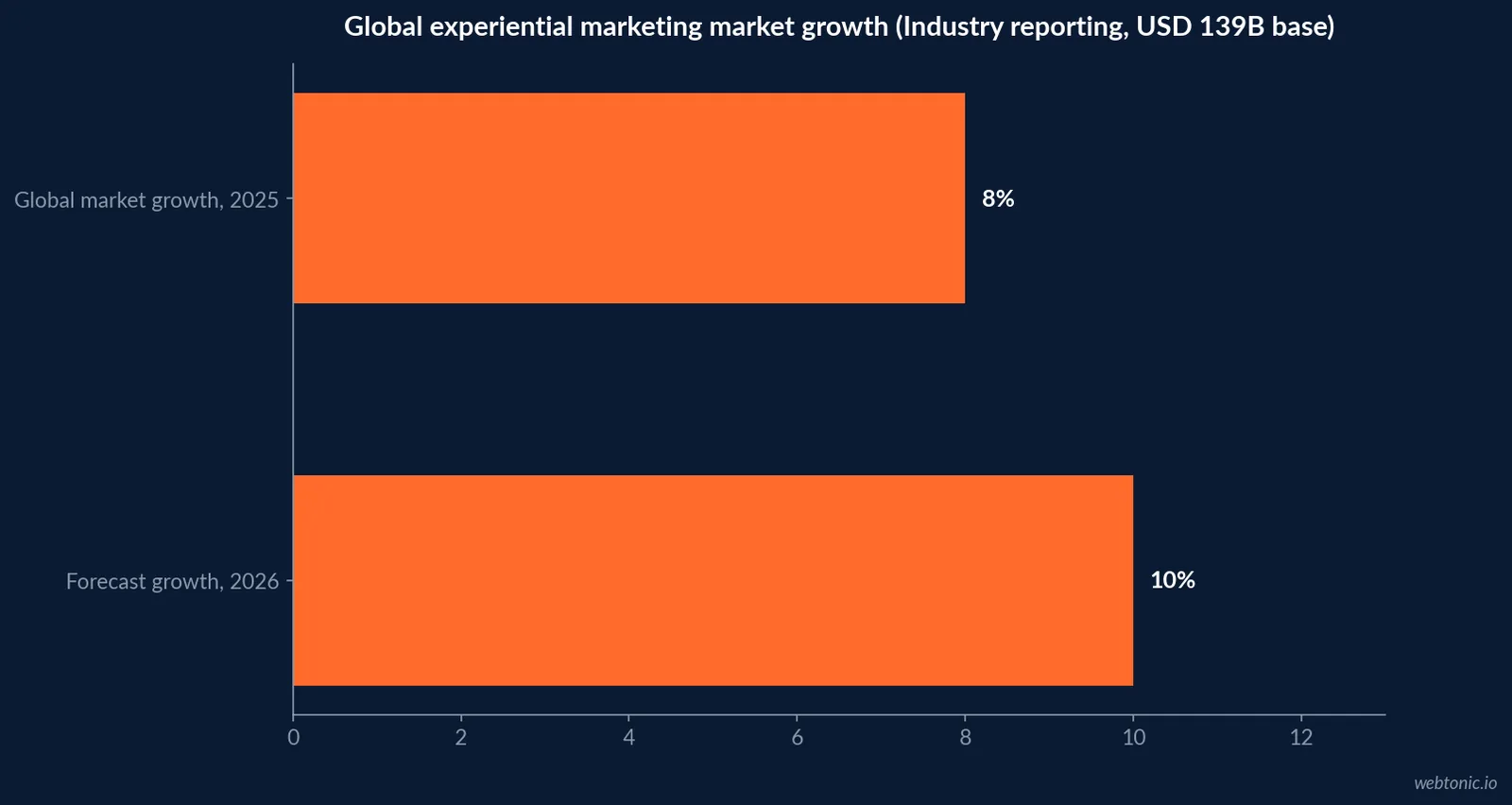
Global experiential marketing - the wider category guerrilla and street tactics sit inside - grew 8% to USD 139 billion in 2025 and is forecast to surge a further 10% in 2026, fueled by the Winter Olympics, the World Cup and political spend across 13 top markets, according to industry reporting on the category. Event Marketer's EventTrack 2026 report, surveying more than 1,000 US corporate marketers and event attendees, found live experiences increasingly treated as the lead discipline in the marketing mix - a platform that advertising, content, social and PR are built around, rather than a standalone tactic.
The acquisition case is measurable too: EventTrack found 34% of surveyed consumers said their most recent brand interaction at an event was with a brand they didn't previously know or use, meaning experiential and street-level tactics are pulling in new audiences, not only deepening relationships with existing ones.
| Experiential marketing category, 2025-2026 | Figure | Source |
|---|---|---|
| Global market size, 2025 | USD 139 billion (+8%) | Industry reporting on the category |
| Forecast growth, 2026 | +10% | Winter Olympics, World Cup, political spend |
| US corporate marketers surveyed (EventTrack 2026) | 1,000+ | Event Marketer |
| Attendees meeting a new-to-them brand at an event | 34% | Event Marketer, EventTrack 2026 |
Why small businesses reach for it more than big brands do
Budget structure explains most of the gap. A 2026 survey of more than 500 US small business owners and marketing decision-makers found the average small business marketing budget sits at USD 4,200 a month, with 38% of it already committed to digital advertising and 24% to content and SEO - leaving little room for a traditional media buy at any scale. Wikipedia's framing of the discipline is explicit about who it is built for: guerrilla marketing "has the potential to be effective for small businesses, especially if they are competing against bigger companies," trading media spend for imagination, energy and time.
That is also why the tactic keeps showing up in case studies from regional retailers and challenger brands rather than category leaders - a leader with a national media budget has less reason to trade reach for precision than a local business does.
The trust backdrop that makes street tactics work
Guerrilla marketing borrows most of its persuasive power from word of mouth and earned attention, and Nielsen's Trust in Advertising study - still the reference dataset on format-level trust, surveying more than 40,000 consumers across 56 countries - found recommendations from people consumers know the single most trusted format worldwide, at 88%, far ahead of any paid channel. Brand sponsorships at live events reached 81% trust and TV ads reached 78%, both ahead of most digital paid formats, while influencer ads sat near the bottom at just 23%.
A well-executed guerrilla stunt sits closer to the peer-recommendation and live-event end of that trust spectrum than to a paid banner, because it is discovered and shared rather than served. That is the mechanism behind the positive abnormal stock returns in the 803-campaign study above - the market is pricing in earned attention, not impressions bought.
| Advertising format (Nielsen Trust in Advertising, global) | Trust level |
|---|---|
| Recommendations from people I know | 88% |
| Brand sponsorships at live/sporting events | 81% |
| TV ads | 78% |
| Influencer ads | 23% |
Measuring a campaign after the fact
The two data sets that make guerrilla marketing defensible - the 803-campaign share-price study and American Guerrilla Marketing's CPM range - both depend on measurement discipline most campaigns skip. A documented placement location, a counted or estimated impression figure, and a tracked earned-media pickup are what let a campaign be compared against the CPM range at all; without them, a guerrilla stunt is a cost with no denominator. The EventTrack 2026 methodology above - surveying attendees directly about whether the brand was new to them - is a template worth copying at a smaller scale for a single street activation.
Our growth marketing team builds that measurement layer before a stunt ships, not after, specifically so a campaign's cost-per-impression and earned-reach numbers can be benchmarked against the ranges in this article rather than reported as a single unverifiable engagement count.
| What to instrument before a street campaign | Why it matters | What it lets you benchmark against |
|---|---|---|
| Documented placement locations and dates | Turns the stunt into countable impressions | The USD 3-20 CPM range |
| Attendee or passerby survey on brand familiarity | Separates new-audience reach from repeat exposure | EventTrack's 34% new-to-brand figure |
| Tracked earned media and social pickup | Captures amplification a paid buy would not show | Blended CPM below the billboard comparison |
| Campaign emotional tone, logged at brief stage | Tone predicted stock-return direction in the 803-campaign study | Joy-based vs. humor/rational appeal outcomes |
What this means for planning a street campaign
Three implications follow from the measured data above rather than case-study folklore. First, the cost advantage over traditional out-of-home is real and large - CPMs an order of magnitude below a billboard - which is why small businesses lean on it disproportionately. Second, tone is not a creative afterthought: the only academic study to test this found joy-based emotional appeals produce positive stock returns while humor and rational quality claims produce negative ones. Third, the category is riding a broader experiential marketing wave - up 8% in 2025, forecast up another 10% in 2026 - so competing for earned attention is getting harder even as the underlying tactic stays cheap.
If you want a street or experiential concept stress-tested against these benchmarks before it ships, our performance creative practice can review it, or talk to our team about where a guerrilla push fits your channel mix.
Frequently Asked Questions
What counts as guerrilla marketing versus a regular event or ad?
Guerrilla marketing is any campaign built on surprise, unconventional placement or interaction rather than paid reach, a term popularized by Jay Conrad Levinson's 1984 book of the same name. Wikipedia's definition anchors it as reach-over-frequency: rather than buying repeated exposure, a guerrilla campaign spends imagination and time to earn a single high-impact moment, which is why it scales down to small budgets in a way traditional media buying does not.
Is it actually cheaper than traditional out-of-home advertising?
By a wide margin on cost per impression. American Guerrilla Marketing's 2026 ROI analysis puts physical impression CPMs for guerrilla campaigns at USD 3 to 20, against a Manhattan billboard running USD 50,000 to 100,000 a month in production and placement cost alone. The trade-off is reach: a billboard reaches everyone who passes regardless of relevance, while a guerrilla campaign reaches a smaller, more demographically precise audience - which for a targeted campaign is frequently the better trade.
Does guerrilla marketing actually move the stock price?
There is at least one peer-reviewed study that tried to measure exactly that. A hand-collected sample of 803 guerrilla marketing campaigns from 2007 to 2017, published in the Journal of Advertising Research, found event-period abnormal stock returns that were positive and comparable to other advertising activities such as celebrity endorsements. Emotional appeals - particularly joy - produced significantly positive returns, while humor and quality-claim appeals were linked to significantly negative returns, which argues for testing tone before scale.
Why do small businesses lean on it more than big brands?
Budget structure. A 2026 survey of more than 500 small business owners found the average monthly marketing budget sits at USD 4,200, split mostly across digital advertising and content, which leaves little room for traditional media buys. Guerrilla and street tactics are built for exactly that constraint: Wikipedia's own framing of the discipline is that it lets a small or mid-sized business compete against a bigger rival's budget using creativity instead of media spend.
Does earned amplification really replace paid reach?
It supplements it rather than replacing it outright. Event Marketer's EventTrack 2026 report, surveying over 1,000 US corporate marketers and event attendees, found that 34% of consumers said their most recent brand interaction at a live event was with a brand they didn't already know or use - meaning experiential and street tactics are a genuine acquisition channel, not just a retention play for an existing audience. Whether the resulting social share and press pickup convert that exposure into revenue is the part every campaign still has to measure for itself.
Sources
American Guerrilla Marketing - Guerrilla Marketing ROI in 2026
Journal of Advertising Research - The Effect of Guerrilla Marketing on Company Share Prices
Event Marketer - EventTrack 2026
PRWeb - Global experiential marketing grew 8% to USD 139 billion in 2025
Designloud - 2026 Small Business Marketing Report
Nielsen - Beyond martech: building trust with consumers
Nielsen - 2021 Trust in Advertising Study
Wikipedia - Guerrilla marketing