Table of contents
Consumer demand for sustainable products is still growing, but consumer belief in green marketing claims is collapsing at the same time - 62% now say companies are greenwashing, roughly double the 2023 rate. That split between real behavior and real skepticism is the whole story behind where green marketing budgets are going this year.
Key Takeaways
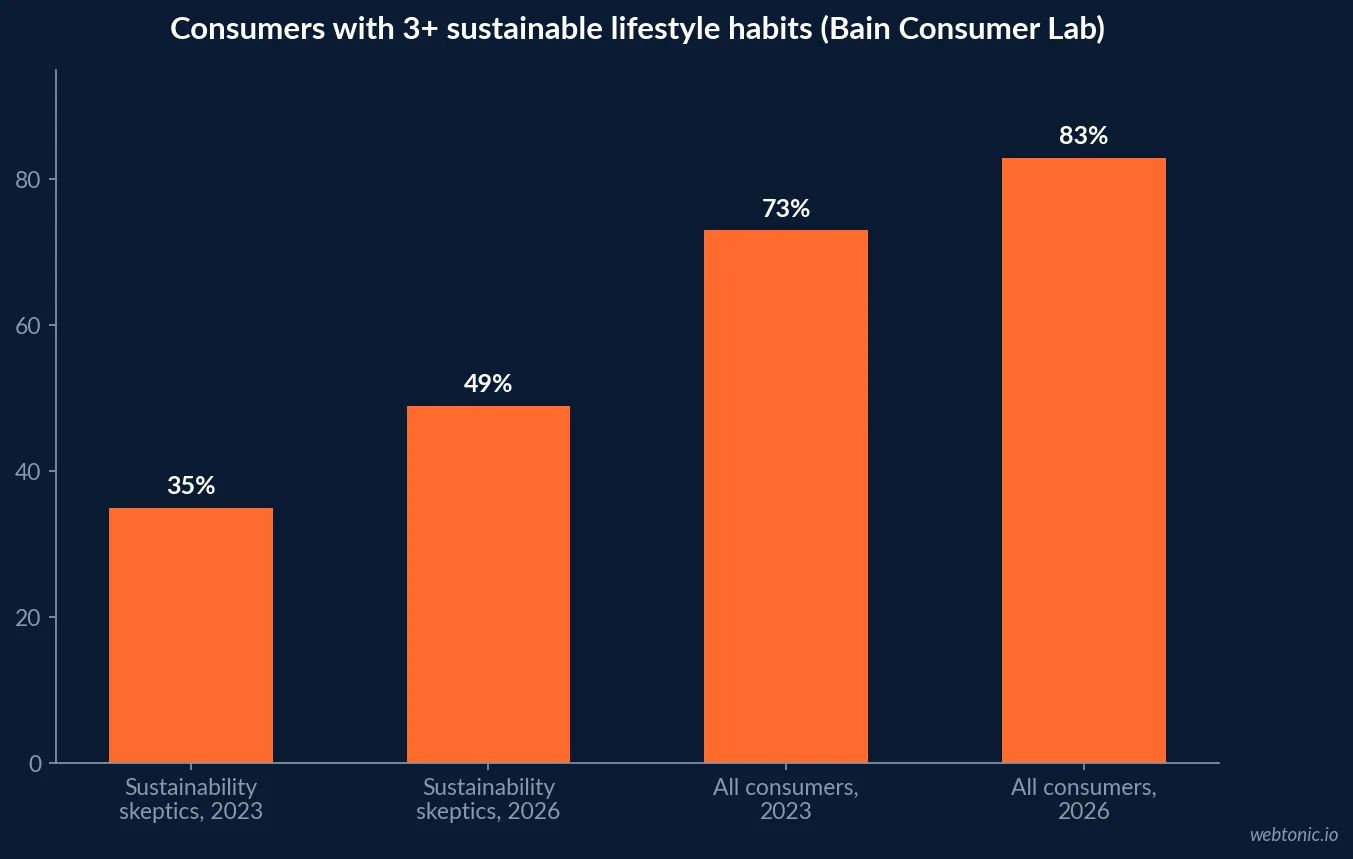
- 83% of consumers have adopted 3+ sustainable habits, up from 73% in 2023.
- Even sustainability skeptics went from 35% to nearly 50% adoption of those habits.
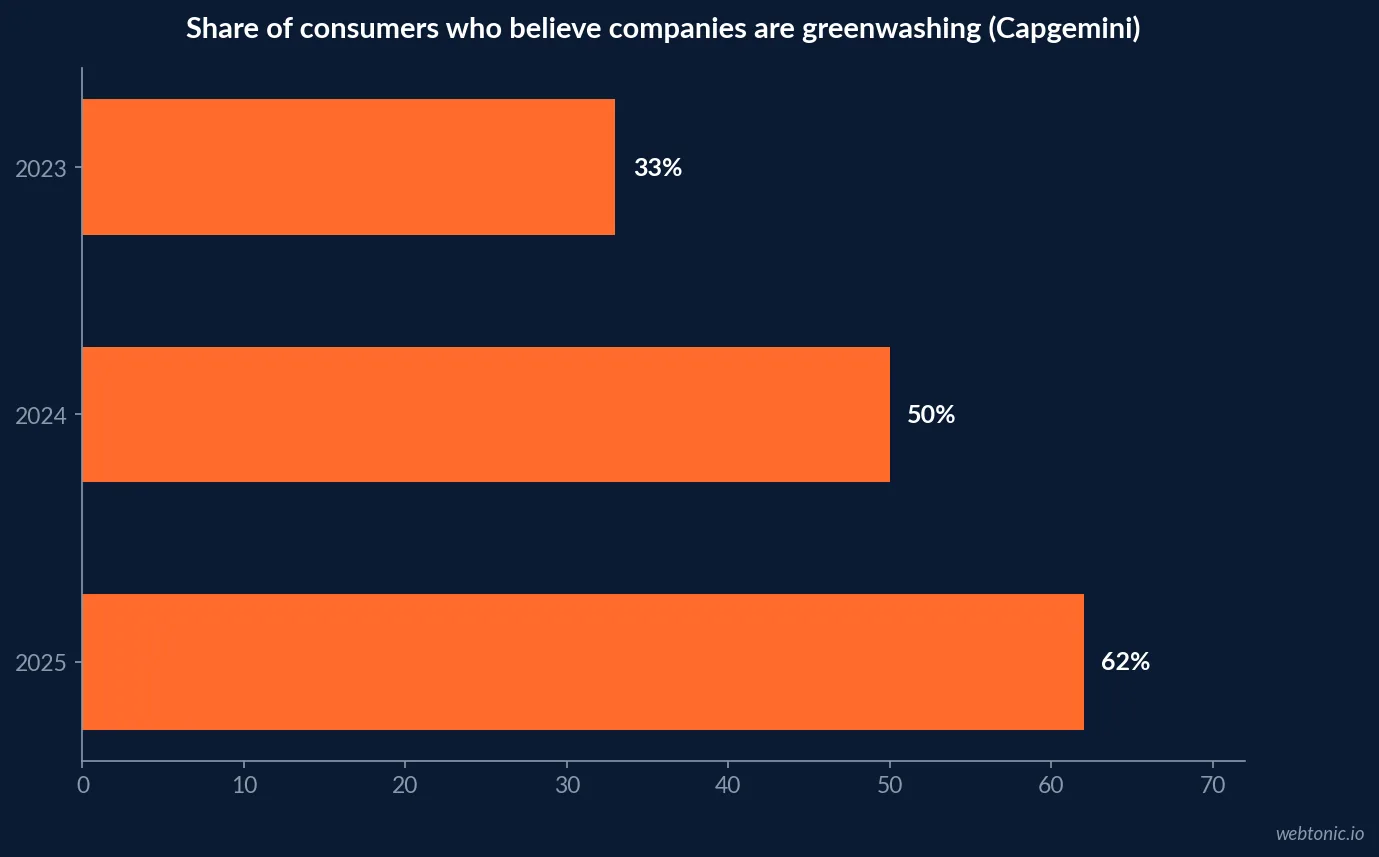
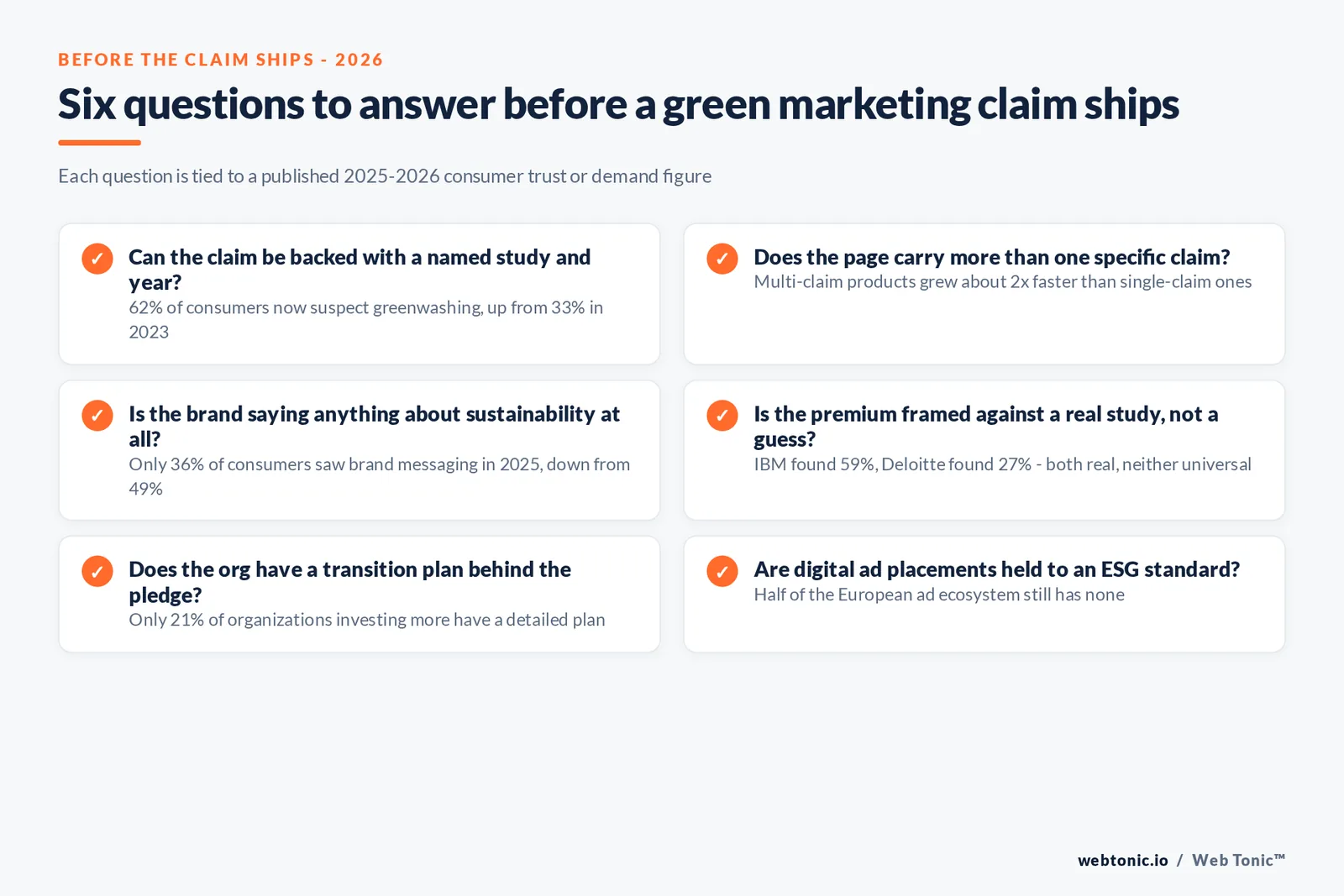
- 62% of consumers now believe companies are greenwashing, up from 33% in 2023.
- 82% of organizations plan to increase sustainability investment.
- Only 21% of those organizations have a detailed transition plan.
- Only 36% of consumers saw brand sustainability messaging in 2025, down from 49% in 2023.
- Trust in that messaging fell from 79% (2022) to 65% (2025).
- ESG-claim products grew 28% cumulatively from 2017-2022, vs. 20% without claims.
- Multi-claim products grew about 2x faster than single-claim products.
- The ESG-claim growth edge is about 1.7 points of compound annual growth.
- 49% of consumers say they've actually paid a green premium, averaging 59% more (IBM).
- Deloitte separately found a 27% average willingness-to-pay premium.
- 46% of consumers bought at least one sustainable good in 2023 (Deloitte, 23 countries).
- The green technology and sustainability market hits USD 28.82B in 2026, +24.0% CAGR.
- Environmental ESG actions in digital ad ops outpace social actions by about 10 points.
- Half of ad ecosystem respondents lack internal ESG standards for digital advertising.
- Only a quarter of consumers consider sustainable products affordable.
- Just 16% feel they have access to enough sustainability information to judge claims.
The demand side is not the problem
Bain's 2026 Consumer Lab ESG Survey, running 7,499 respondents across the US, UK, Italy, Brazil and Indonesia, found 83% of consumers have adopted three or more sustainable lifestyle habits, up from 73% in 2023, and that 81% believe their individual actions have a meaningful environmental impact. The habits that are growing fastest - limiting home energy use at 59%, recycling at 56% - are practical and mainstream, not aspirational.
The most telling data point is what happens among people who say they do not care about sustainability at all: in 2023, only 35% of that group had adopted three or more sustainable habits; by 2026 that had climbed to nearly 50%. Sustainable behavior is spreading through convenience and cost logic even where the environmental motivation is absent.
| Bain Consumer Lab ESG Survey | 2023 | 2026 | Change |
|---|---|---|---|
| Consumers with 3+ sustainable habits | 73% | 83% | +10 points |
| Sustainability skeptics with 3+ habits | 35% | ~50% | +15 points |
| Consumers who limit home energy use | n/a | 59% | Top-ranked habit |
| Consumers who recycle regularly | n/a | 56% | Second-ranked habit |
| Belief that personal action matters | n/a | 81% | Majority conviction |
Brands are talking less about it - greenhushing
GlobeScan's Healthy & Sustainable Living research, based on a representative survey of more than 30,000 consumers across 31 markets, found that only 36% of consumers reported seeing at least "some" sustainability messaging from brands in 2025, down sharply from 49% in 2023. Trust in the messaging that does reach consumers has fallen in step: 65% say they trust it at least somewhat in 2025, against 74% in 2023 and 79% in 2022. The pattern held across eight product categories, from cars to packaged food.
GlobeScan's read is that brands pulling back on sustainability communication - "greenhushing" - is itself accelerating the decline in consumer engagement, not just responding to climate fatigue or economic pressure. Silence has a cost, and the cost compounds.
| GlobeScan, 31 markets | 2022 | 2023 | 2025 | Direction |
|---|---|---|---|---|
| Consumers who saw brand sustainability messaging | n/a | 49% | 36% | -13 points |
| Trust in sustainability messaging reached | 79% | 74% | 65% | -14 points since 2022 |
The credibility gap driving greenwashing distrust
Capgemini Research Institute's 2025 global survey of 2,146 senior executives from 716 organizations, paired with a survey of 6,566 consumers, found 62% of consumers now believe companies are greenwashing, up from 33% in 2023 and over half in 2024 - almost doubling in two years. The organizational side shows why: 82% of organizations plan to increase environmental sustainability investment and 92% are holding firm on net zero timelines, but only 21% have a detailed transition plan behind those commitments.
Consumers are also reporting a practical barrier layered on top of the trust problem: only about a quarter consider sustainable products affordable, and just 16% feel they have access to sufficient sustainability information to evaluate a claim for themselves. A brand cannot out-message a credibility gap that specific.
Do sustainability claims still sell product
Yes, modestly and unevenly. A joint NielsenIQ and McKinsey study covering 600,000 SKUs and 44,000 brands found products making ESG-related claims grew 28% cumulatively in the US from 2017 to mid-2022, against 20% for products making no such claim - an advantage of roughly 1.7 percentage points of compound annual growth once brand size, price tier and product age are controlled for. Products carrying multiple ESG claims grew about twice as fast as those with only one.
On willingness to pay, the studies genuinely disagree by methodology, not by market direction. IBM's Institute for Business Value, surveying 16,000 consumers across 10 economies, found 49% said they had actually paid a green premium, averaging 59% more. A separate Deloitte study across 23 countries found 46% of consumers had purchased at least one sustainable good, with a stated willingness to pay a premium of about 27% on average - roughly half of IBM's figure, because it asks a hypothetical rather than a recalled purchase.
| Study (year, geography) | What it measured | Reported figure |
|---|---|---|
| NielsenIQ + McKinsey (2017-2022, US) | Cumulative sales growth, ESG-claim products | +28% vs. +20% |
| NielsenIQ + McKinsey | Multi-claim vs. single-claim product growth | ~2x faster |
| IBM IBV (2022, 10 countries) | Consumers who recall paying a green premium | 49%, averaging +59% |
| Deloitte (2023, 23 countries) | Stated willingness to pay a premium | 27% average, 46% purchased |
What is actually funding green marketing right now
The market backdrop is still expanding: the global green technology and sustainability market is forecast to grow from USD 25.44 billion in 2025 to USD 28.82 billion in 2026, a 24.0% compound annual growth rate, according to market research covering the category. Inside advertising specifically, IAB Europe's 2026 State of Readiness survey of the European digital ad ecosystem found environmental ESG actions consistently outpacing social ones by roughly 10 percentage points, always-on campaign-level environmental measurement doubling year on year, but half of respondents still lacking internal ESG standards for digital advertising altogether.
Purpose-driven positioning has its own, separately measured payoff: Kantar's BrandZ data has found brands seen as having high positive social impact growing at more than double the rate of low-impact brands over a 12-year window - a much longer-horizon signal than any single-year survey above.
| Green marketing budget signal, 2026 | Figure | Source |
|---|---|---|
| Organizations increasing sustainability investment | 82% | Capgemini Research Institute |
| Organizations with a detailed transition plan | 21% | Capgemini Research Institute |
| Green tech & sustainability market size | USD 28.82B, +24.0% CAGR | Market research (2026) |
| Ad ecosystem respondents doubling environmental measurement | 2x YoY | IAB Europe (2026) |
| Ad ecosystem respondents lacking ESG ad standards | ~50% | IAB Europe (2026) |
The affordability barrier sits underneath the trust problem
Capgemini's consumer survey adds a practical detail that trust numbers alone miss: only about a quarter of consumers consider sustainable products affordable at all, and just 16% feel they have access to enough sustainability information to judge a claim for themselves. That combination - a price barrier plus an information gap - means a brand can publish a perfectly accurate claim and still lose the sale, because the shopper cannot verify it standing in the aisle or on a product page.
The practical fix is putting the evidence where the decision happens rather than in a separate sustainability report. Our data and analytics practice has found that claims cited with a named source directly on a product or landing page convert differently than the same claim stated as marketing copy alone - which is really the IBM-versus-Deloitte gap above playing out at the page level.
| Consumer barrier to acting on a sustainability claim | Share affected | Source |
|---|---|---|
| Do not consider sustainable products affordable | ~75% | Capgemini Research Institute, 2025 |
| Lack enough information to judge a claim | ~84% | Capgemini Research Institute, 2025 |
| Believe companies are greenwashing | 62% | Capgemini Research Institute, 2025 |
| Saw no brand sustainability messaging in 2025 | 64% | GlobeScan, 31 markets |
What this means for a green marketing plan
Three things follow from the data. First, the audience for sustainability marketing has not shrunk - it has gotten harder to earn, because trust fell twice as fast as demand rose. Second, specificity beats volume: multi-claim, evidence-backed positioning outperforms single vague claims by roughly 2x on sales growth, and greenhushing has shown that silence carries its own trust cost. Third, the internal ESG standard gap - half the digital ad ecosystem has none - is the credibility risk most likely to surface in an audit before it surfaces in a campaign.
Our growth marketing team treats a sustainability claim the same way it treats a performance claim: sourced, dated, and defensible before it goes into a brief. If you want that audit run against your own green marketing copy, talk to us.
Frequently Asked Questions
Are consumers actually still buying into sustainability?
Yes, more than the headlines about fatigue suggest. Bain's 2026 ESG Survey of 7,499 consumers across five markets found 83% have adopted three or more sustainable lifestyle habits, up from 73% in 2023, and that even among people who say they do not personally care about sustainability, adoption of those habits jumped from 35% to nearly 50% in the same period. Half the time the stated reason is affordability or convenience rather than the environment, but the behavior itself keeps growing.
Then why does it feel like brands are saying less about it?
Because they are. GlobeScan's Healthy & Sustainable Living research, surveying over 30,000 consumers across 31 markets, found that only 36% of consumers reported seeing at least some sustainability messaging from brands in 2025, down from 49% in 2023 - a phenomenon researchers call greenhushing. Trust in the messaging that does get through has also fallen, from 79% in 2022 to 65% in 2025, so brands are communicating less and being believed less when they do.
Is greenwashing distrust actually getting worse?
Sharply. Capgemini Research Institute's 2025 global survey of 716 organizations and 6,566 consumers found 62% of consumers believe companies are greenwashing, up from 33% in 2023 and over half in 2024 - a near-doubling of skepticism in two years. At the same time, 82% of organizations plan to increase environmental sustainability investment, but only 21% have a detailed transition plan, which is exactly the credibility gap consumers are reacting to.
Do sustainability claims still move sales?
Selectively. A joint NielsenIQ and McKinsey study of 600,000 SKUs and 44,000 brands found products making ESG-related claims grew 28% cumulatively in the US from 2017 to mid-2022, against 20% for products without such claims, and that products carrying multiple ESG claims grew roughly twice as fast as those with only one. The advantage is real but modest - about 1.7 percentage points of compound annual growth once brand size, price tier and product age are controlled for.
What is the actual premium consumers say they'll pay?
It depends entirely on which study and which question. IBM's Institute for Business Value found 49% of consumers in a 10-country survey said they had actually paid a premium for sustainable products, averaging 59% more - well above the roughly 27% premium Deloitte found consumers were willing to pay in a separate 23-country study a year later. The gap between IBM's 59% and Deloitte's 27% is a methodology difference, not a market crash, but it is a reminder never to quote a single 'willingness to pay' figure without naming the source.
Sources
Bain & Company - Consumer Lab ESG Survey 2026
GlobeScan - Greenhushing is eroding consumer trust in sustainability claims
Capgemini Research Institute - A world in balance, 2025
Deloitte UK - The Sustainable Consumer
NielsenIQ and McKinsey - Consumers care about sustainability, and back it up with their wallets
IBM Institute for Business Value - 2022 sustainability consumer research
Kantar - The four-step journey to purpose-led growth
IAB Europe - State of Readiness Sustainability Report 2026
The Business Research Company - Green Technology and Sustainability Global Market Report 2026