



Table of contents
Google RLSA (Remarketing Lists for Search Ads) lets you adjust bids and tailor ad copy for people who have already visited your site — delivering conversion rates up to 240 % higher than standard search campaigns.
Key Takeaways
- Starwood Hotels achieved a 240 % higher conversion rate, 165 % higher CTR, and 160 % ROI increase using this approach compared to non-RLSA search traffic.
- these campaigns outperform cold search by 3–4× on conversion rate while running at 20–30 % lower CPCs when properly segmented.
- Google requires a minimum of 1,000 active users in your remarketing list before it can be applied to Search campaigns.
- RLSA now accounts for 15 % of Starwood's total paid search conversions and revenue, demonstrating the channel's scalability beyond a niche tactic.
- The feature works in both observation mode (bid adjustments on existing campaigns) and targeting mode (audience-restricted campaigns with unique keywords).
What Is Google RLSA and How It Works
RLSA is a paid search feature that lets you customize your search campaigns for people who have previously interacted with your website or app. Instead of treating every searcher the same, the feature lets you bid more aggressively for returning visitors, show different ad copy, and even target broader keywords that would be too expensive for cold audiences.
The mechanism is straightforward: Google places a cookie on visitors to your site via the Google Ads tracking tag or GA4. When those users later search on Google, your campaigns can recognize them and apply different settings. According to Google's documentation, you can create visitor segments that include people who have left your website without buying, completed a purchase, or visited specific pages.
Google has updated terminology since RLSA's original launch: "remarketing" is now officially called "your data" segments, and "audience types" are now "visitor segments." The functionality remains the same, but the naming reflects a broader privacy-conscious framework.
RLSA Performance Benchmarks
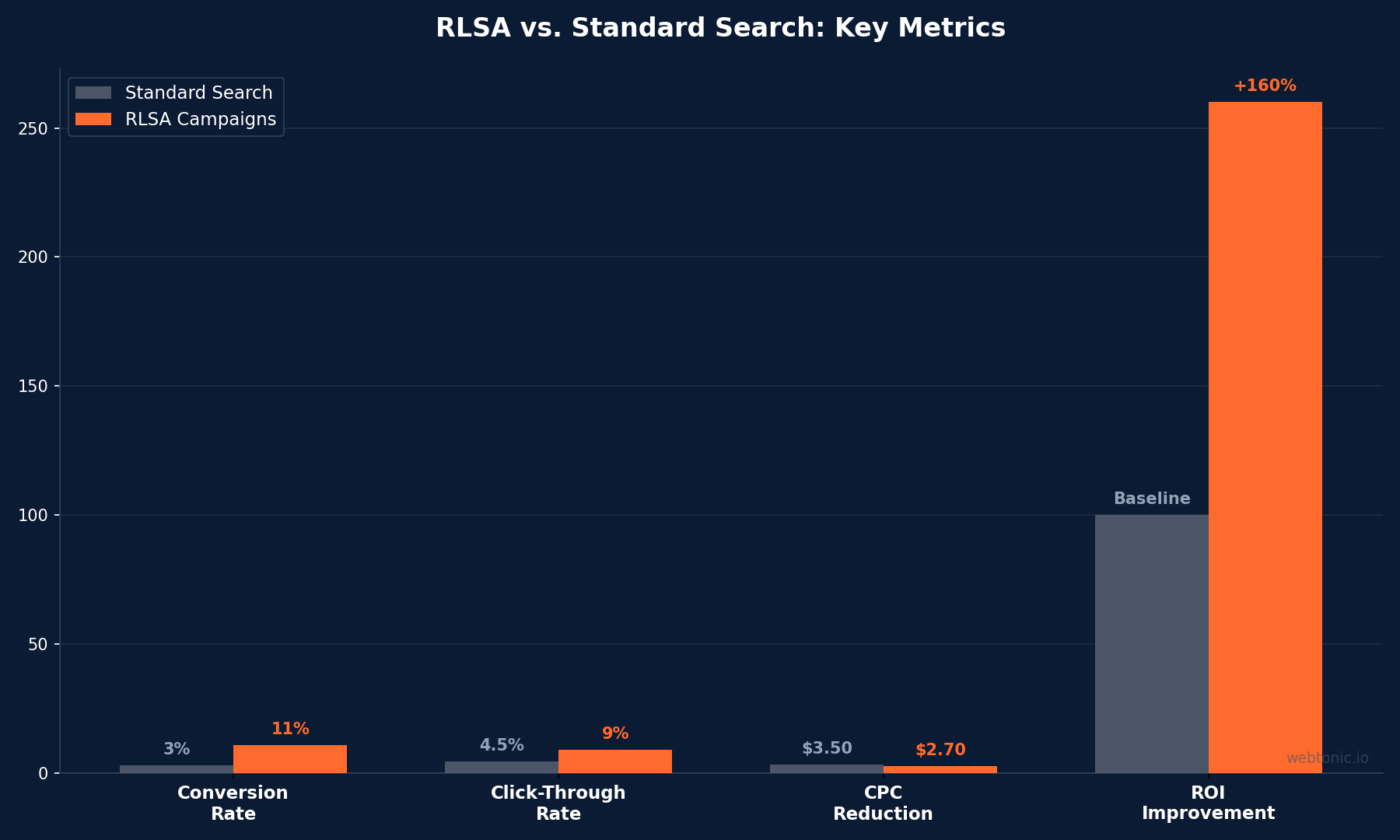
The performance lift from visitor-based search targeting is one of the most consistent findings in paid search. The data consistently shows that returning visitors convert at dramatically higher rates than first-time searchers because they have already demonstrated interest in your product or service.
| Metric | Standard Search | RLSA Ad groups | Improvement |
|---|---|---|---|
| Conversion Rate | 2–4 % | 6–16 % | +200–400 % |
| Click-Through Rate | 3–6 % | 6–12 % | +100–165 % |
| Cost Per Click | $2–$5 | $1.40–$4 | −20–30 % |
| Return on Investment | Baseline | 1.5–2.6× | +60–160 % |
| Revenue Share of Paid Search | 85–90 % | 10–15 % | Growing as lists mature |
These benchmarks align with the COREPPC this method guide, which reports that these campaigns outperform cold search by 3–4× on conversion rate while running at 20–30 % lower CPCs. The WordStream this approach resource also confirms that retargeting lists for search ads remain one of the most powerful and underused tools in Google Ads.

Setting Up RLSA: Step by Step
Implementation requires three components: a tracking tag, audience lists, and campaign configuration. Here is the complete setup process:
Step 1 — Install the retargeting tag. Add the Google Ads tracking tag or enable re-engagement in GA4. The tag creates a cookie that identifies returning visitors. For GA4, enable Signals and link your GA4 property to your Google Ads account.
Step 2 — Build audience lists. Create segments based on user behavior. The minimum list size for Search is 1,000 active users (versus 100 for Display). Start with broader lists — all visitors, all converters — and add more specific segments as volume allows.
Step 3 — Choose your mode. Apply audiences in either observation mode (adds bid adjustments without limiting reach) or targeting mode (restricts ads to list members only). Observation is safer to start; targeting enables this capability-exclusive strategies.
Step 4 — Set bid adjustments. Start with a +20–50 % bid adjustment for your returning visitor list in observation mode. Monitor performance for 2–4 weeks, then optimize based on actual conversion data.
Visitor Segmentation Strategies
The biggest mistake in implementation is using a single "All Visitors" list. Effective segmentation separates audiences by intent signals and funnel stage, enabling differentiated bidding and messaging for each group.
| Visitor segment Segment | Definition | Bid Adjustment | Strategy |
|---|---|---|---|
| Cart Abandoners | Visited checkout but did not convert (7-day window) | +80–150 % | Aggressive bidding on branded + product keywords |
| Product Page Viewers | Viewed product/service pages without adding to cart (14 days) | +40–80 % | Bid up on category keywords, tailored ad copy |
| Blog/Content Visitors | Read content but never visited product pages (30 days) | +10–30 % | Observation mode on broad keywords to gauge intent |
| Past Converters | Completed a purchase or lead form (90–180 days) | +30–60 % | Upsell and cross-sell keyword targeting |
| High-Value Customers | Multiple purchases or high AOV (365 days) | +50–100 % | Target broader competitor and category terms |

Advanced RLSA Strategies
Broad keyword conquest with the feature targeting. Keywords that are too expensive or broad for cold audiences can become highly profitable when restricted to your visitor recapture audience. A term like "running shoes" might cost $4–$8 per click with a 1 % conversion rate for cold traffic, but that same keyword with audience-based targeting might convert at 4–8 % — making the economics viable.
Competitor keyword targeting. Bidding on competitor brand names is expensive and typically low-converting for cold audiences. With the tool, you are reaching people who already know your brand and are comparison shopping — conversion rates jump significantly because the user has pre-existing awareness and affinity.
Customer Match integration. Upload your CRM data (email lists, phone numbers) to create visitor segments based on customer value tiers. High-value customer lists paired with this strategy let you bid aggressively for your best customers when they search for anything in your category.
Cross-device reach. Cross-device matching means your these lists work across mobile, desktop, and tablet. A user who browses on mobile during their commute and converts on desktop at home is still captured by your visitor segment-based search targeting audience.
Seasonal and promotional layering. Create time-sensitive return-visitor targeting lists for users who visited during a specific promotional period. During Black Friday or back-to-school seasons, you can increase bids for users who browsed your sale pages but did not convert — North Country Growth notes that matching your strategy to your budget stage separates high-performing accounts from average ones.

RLSA vs. Other Remarketing Options
Understanding where this method fits in the broader audience re-engagement landscape helps allocate budget effectively. Each remarketing type serves a different role in the conversion funnel.
Display retargeting builds awareness by showing banner ads to past visitors as they browse the web. Lower intent than RLSA but useful for staying top-of-mind during long consideration periods. YouTube retargeting uses video to re-engage past visitors with brand storytelling and product demonstrations. this approach (Search re-engagement) captures the highest-intent moment — when a past visitor actively searches for your product category. This is why RLSA typically delivers the best conversion rates and ROI of any remarketing type.
The strategic framework from North Country Growth recommends matching your strategy to your budget stage: at $5,000/month, focus on observation-mode bid adjustments on your existing ad groups; at $50,000/month, build dedicated this capability campaigns with segmented audiences and custom ad copy tailored to each returning visitor segment.
Privacy Changes and the Future of RLSA
Cookie deprecation and privacy regulations have changed how visitor recapture works, but the strategy remains viable through first-party data strategies. Google's push toward privacy-preserving advertising means three key shifts for paid search practitioners:
Enhanced conversions use hashed first-party data (email, phone) to maintain measurement accuracy as cookies decline. Customer Match lists based on CRM data provide cookie-independent audience targeting. Google's Consent Mode v2 uses conversion modeling to fill gaps when users decline tracking — maintaining directional accuracy even with reduced cookie coverage.
The practical impact: first-party data collection is now the most critical input for the feature success. Brands with strong email capture, loyalty programs, and account creation flows will maintain larger, more accurate returning visitor lists as third-party cookies disappear. The advertisers who invest in first-party data infrastructure today will have the strongest return-visitor targeting capabilities tomorrow.
Common RLSA Mistakes to Avoid
Even experienced advertisers make implementation errors that limit the tool performance. The most common mistakes — and their fixes — include:
Using a single "All Visitors" list treats a blog reader the same as a cart abandoner. Fix: create at least three to five visitor segments based on funnel depth and recency. Setting bid adjustments too low (under +10 %) produces statistically insignificant results. Fix: start at +25–50 % and optimize from there based on actual conversion data. Ignoring membership duration settings means your lists include users who visited once six months ago and have zero remaining intent. Fix: set durations that match your sales cycle — 7 days for e-commerce, 30–90 days for B2B. Not excluding recent converters wastes budget showing ads to customers who just purchased. Fix: create an exclusion list for users who converted in the last 7–14 days (or longer for non-repeat purchase products). Getting these fundamentals right before scaling budgets ensures that every dollar of RLSA spend reaches the highest-intent audiences in your funnel.
Related reading
- Google Ad Sizes: Complete Display Dimensions Guide with Performance Data
- Google PPC Explained: Auction, Costs and Campaign Types
- Immigration Law Google Ads Benchmarks: CPL, CTR and Conversion Rates
- Paid Search services at Web Tonic
FAQ
What is Google visitor segment-based search targeting?
RLSA stands for Remarketing Lists for Search Ads. It is a the ad platform feature that lets you customize search campaigns for people who have previously visited your website. You can adjust bids, tailor ad copy, and target specific keywords only for past visitors, resulting in higher relevance and conversion rates compared to standard search ad groups.
How much do this method campaigns improve conversion rates?
Well-segmented these campaigns typically improve conversion rates by 2–4× compared to standard search. Starwood Hotels reported a 240 % higher conversion rate and 160 % higher ROI with this approach. The improvement comes from targeting people who already know your brand.
What is the minimum audience size for this capability?
Google requires a minimum of 1,000 active users in your audience re-engagement list for Search ad groups. For Display retargeting, the minimum is 100 users. Lists can include website visitors, app users, YouTube viewers, and customer match uploads.
Should I use this capability with observation or targeting mode?
Start with observation mode to collect data without restricting reach — this adds your retargeting visitor segment as a bid modifier on existing campaigns. Switch to targeting mode when you have enough data to create audience-restricted campaigns with different keywords or ad copy.
How does the strategy work with privacy changes?
RLSA remains viable through first-party data strategies. Enhanced conversions, Customer Match lists, and Google's Consent Mode v2 maintain audience accuracy as third-party cookies decline. Brands with strong email capture and loyalty programs maintain the largest, most accurate returning visitor lists.
Sources
Think with Google — Starwood Hotels the feature Case Study
Google Ads Help — About Your Data Segments for Search Ads
Google Ads Help — About Your Data Segments
COREPPC — the ad platform RLSA Guide
North Country Growth — Google Ads re-engagement List Strategies
WordStream — Remarketing Lists for Search Ads Guide


