Table of contents

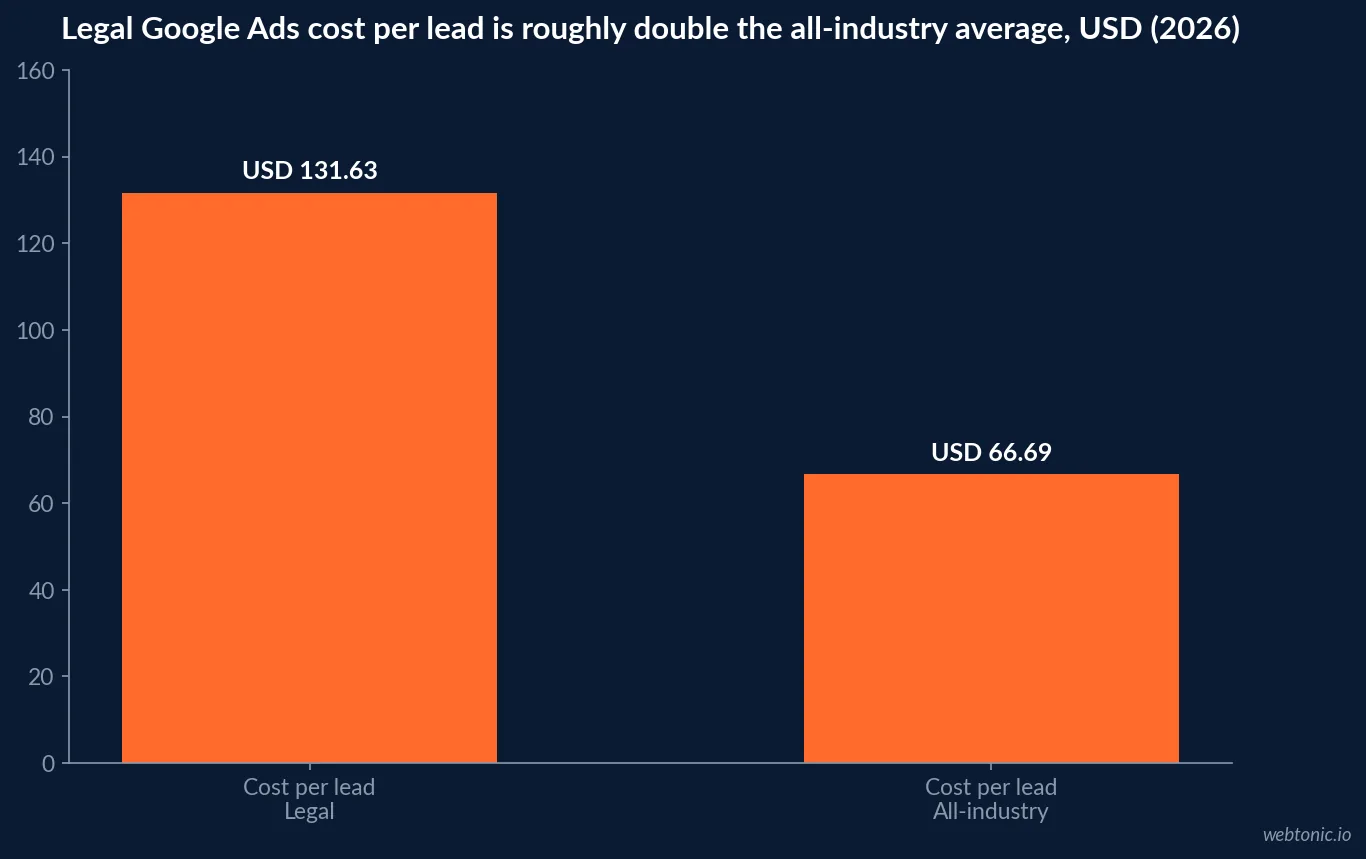
No published report breaks out immigration law from the general "Attorneys & Legal Services" Google Ads category, so this page states that gap plainly and applies the category benchmark: a USD 131.63 cost per lead against a USD 66.69 all-industry average. The USCIS backlog and Google's lawyer-verification rules are what actually differentiate an immigration account from the category average.
Key Takeaways
- No Google Ads report publishes an immigration-specific benchmark; every figure below is the general legal-category number.
- Attorneys & Legal Services carries a USD 9.87 cost per click in 2026, the highest of any tracked category.
- That is nearly double the USD 5.42 all-industry average cost per click.
- The category's click-through rate is 5.87%, below the 6.64% all-industry average.
- Conversion rate is 5.55%, versus an 8.18% all-industry average.
- Cost per lead reaches USD 131.63, versus a USD 66.69 average - roughly double.
- Overall Google Ads CPL fell industry-wide in 2026 for the first time in five years.
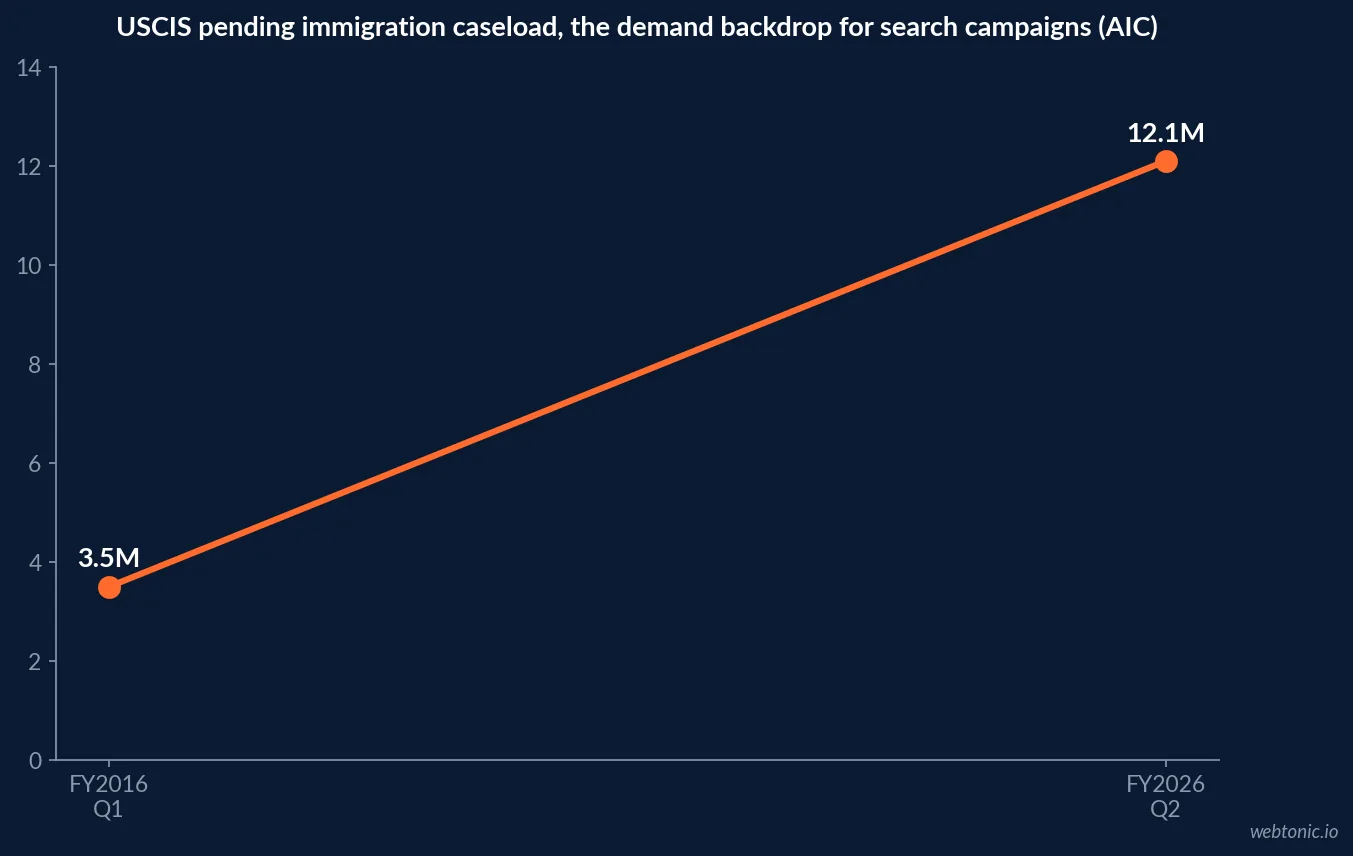
- USCIS had 12.1 million cases pending as of FY2026 Q2, up 7.2% year over year.
- The USCIS pending caseload has more than tripled since FY2016 (about 3.5M to 12.1M).
- High-performing law firms report paid search as critical for new business at 63%, vs. 53% overall.
- 54% of law firms plan an SEO investment increase in 2026, competing with the same paid budget pool.
- Lawyers on Google's Local Services Ads face a 30-day identity-verification window.
- The FTC has run repeated public alerts that notarios are not licensed attorneys.
State the limitation before the numbers
WordStream by LocaliQ's 2026 Google Ads Benchmarks report, built from a large sample of US search campaigns, tracks a single "Attorneys & Legal Services" category. It does not split personal injury from family law from immigration law, and no other widely-cited PPC benchmark source does either. Any article claiming a specific "immigration lawyer Google Ads CPL" figure is either quoting this general legal-category number without saying so, or citing an unsourced estimate. This page uses the category figure and says so at every step.
| Metric (Google Ads 2026) | Attorneys & Legal Services | All-industry average | Gap |
|---|---|---|---|
| Cost per click | USD 9.87 | USD 5.42 | +82%, highest of any category |
| Click-through rate | 5.87% | 6.64% | -0.77 pts |
| Conversion rate | 5.55% | 8.18% | -2.63 pts |
| Cost per lead | USD 131.63 | USD 66.69 | +97% |
The one piece of good news in the category data
WordStream's 2026 report notes that overall average cost per lead across Google and Microsoft Ads actually declined for the first time in five years, after a run of years that included a 12% CPC increase and a 25% CPL increase in earlier editions. Conversion rate also increased for 87% of industries year over year. Legal wasn't singled out as a category driving that improvement - the report attributes the CPL categories that rose specifically to tariff-exposed sectors like automotive and retail - but the general cost environment for search ads did ease slightly across the board in 2026.
| Google Ads 2026 trend (all industries) | Figure | Source |
|---|---|---|
| Direction of overall average CPL | Down, first time in 5 years | WordStream 2026 Google Ads Benchmarks |
| Industries with a CVR increase | 87% | WordStream 2026 Google Ads Benchmarks |
| CPC increase cited from an earlier edition | 12% | WordStream 2026 Google Ads Benchmarks |
| Average CPC, 2016 vs. 2026 | USD 2.32 -> USD 5.42 | WordStream 2026 Google Ads Benchmarks |
What's actually different about an immigration account: the demand side
USCIS's own reporting, analyzed by the American Immigration Council, shows pending cases rising from about 3.5 million in FY2016 Q1 to 12.1 million in FY2026 Q2, a 7.2% year-over-year increase most recently. That volume shapes keyword strategy in a way the general legal-category benchmark doesn't capture: a large share of the realistic search intent here is case-status and processing-time driven, not "hire a lawyer today" commercial intent, which changes both the expected click-through rate and the landing page a campaign should point to.
| USCIS caseload measure | Figure | Source |
|---|---|---|
| Pending cases, FY2016 Q1 | ~3.5 million | American Immigration Council |
| Pending cases, FY2026 Q2 | 12.1 million | American Immigration Council |
| Year-over-year change | +7.2% | American Immigration Council |
Where paid search actually sits in a law firm's channel mix
The 2026 CallRail Legal Marketing Outlook Report found that high-performing, growing firms (those reporting a 20% or greater revenue increase) rate paid search as a critical channel for new business at 63%, compared with 53% among firms overall - a meaningful gap that suggests paid search is more central to the firms actually growing. At the same time, 54% of firms plan an SEO investment increase in 2026, competing for the same marketing budget line as paid spend, which is worth factoring into any conversation about immigration PPC budget as a share of total acquisition spend.
| Channel priority signal | Growing firms | Firms overall | Source |
|---|---|---|---|
| Rate paid search as critical for new business | 63% | 53% | CallRail 2026 Legal Marketing Outlook |
| Plan an SEO investment increase in 2026 | - | 54% | CallRail 2026 Legal Marketing Outlook |
What the keyword mix probably looks like, based on the caseload
Without a published immigration-specific keyword report, the most defensible approach is to reason from the caseload composition itself. USCIS's data shows the backlog concentrated in family- and employment-based petitions rather than any single visa category, which means an account built only around "immigration lawyer [city]" head terms is likely missing a large share of realistic search volume around specific petition types, RFE (request for evidence) responses, and status-check questions. Building separate ad groups and landing pages for case-status-adjacent intent, versus commercial "hire an attorney" intent, is a structural decision the general legal benchmark can't make for you, but the caseload data at least tells you that split matters more here than in most legal verticals.
What a realistic launch budget looks like
Using the category cost per lead as the planning anchor, a firm targeting 20 leads a month at the USD 131.63 category benchmark should plan for roughly USD 2,600 a month in media spend before accounting for platform fees, agency management, or landing-page testing costs - and that estimate assumes performance in line with the category average, not better or worse. A firm with LSA verification complete and a dedicated case-status funnel may beat that number; a firm running a single generic "immigration lawyer" campaign with no landing-page segmentation should expect to sit at or above it, based on how the category's below-average conversion rate (5.55% versus 8.18%) behaves in practice.
| Planning input | Value used | Basis |
|---|---|---|
| Target leads per month | 20 | Illustrative, not a benchmark |
| Cost per lead applied | USD 131.63 | WordStream 2026 legal-category benchmark |
| Implied monthly media spend | ~USD 2,632 | 20 x USD 131.63 |
| Conversion rate assumption | 5.55% | WordStream 2026 legal-category benchmark |
The compliance layer that shapes account setup
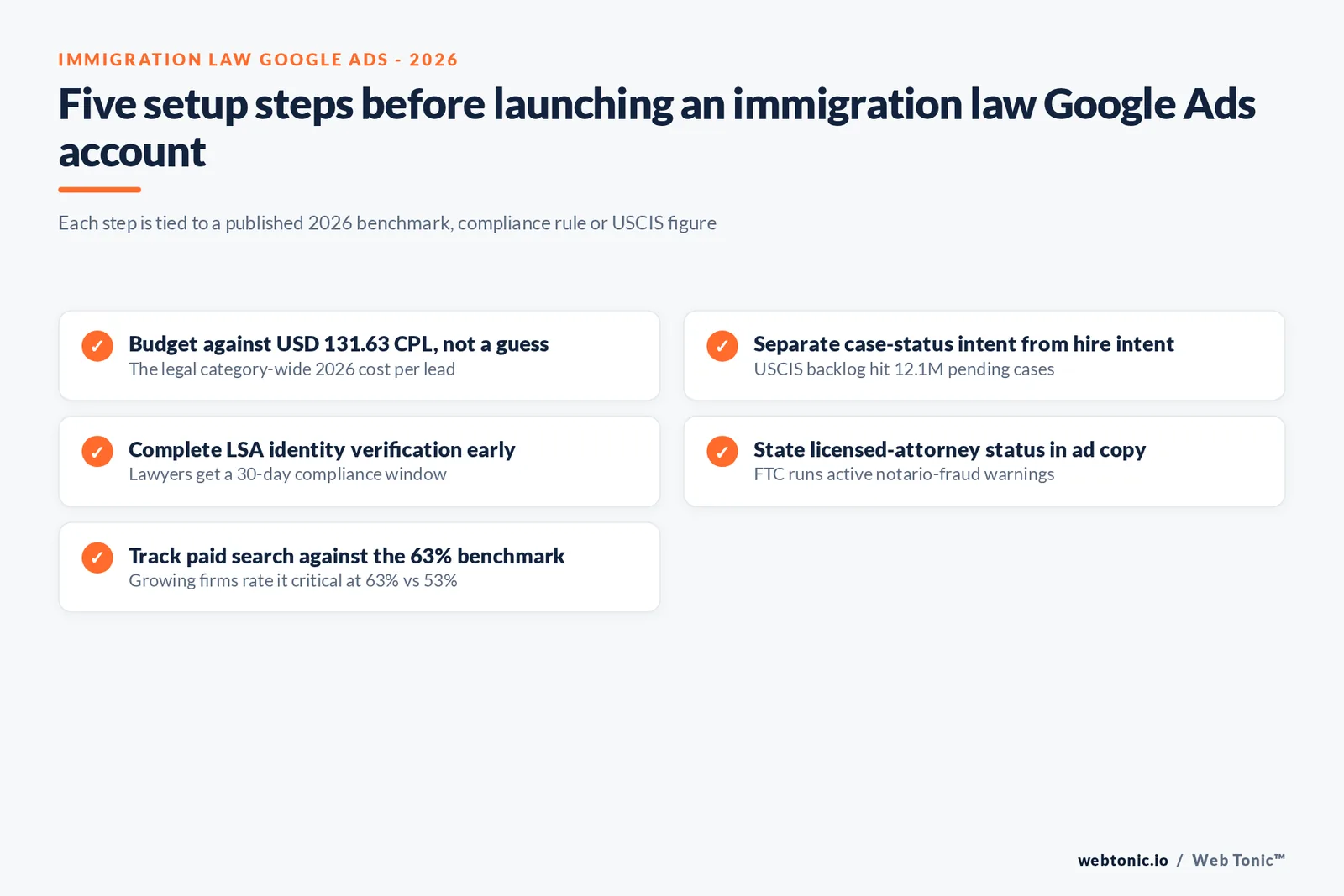
Two rules matter more here than the CPL number. First, Google's Local Services Ads program requires license and identity verification for lawyers, and tightened that process through its partner Evident starting in 2024, giving affected lawyers a 30-day window to complete verification or lose LSA eligibility - a separate track from standard Search campaign setup. Second, the FTC's sustained consumer-alert campaigns warning that notarios and unlicensed "immigration consultants" are not attorneys reflect a real competitive environment: legitimate immigration ads are often served alongside or near scam-adjacent content, which makes ad copy that clearly states licensed-attorney status and jurisdiction a trust-building necessity, not just a compliance checkbox.
Building the budget conversation around the honest number
The defensible planning number for a new immigration Google Ads account is the category-wide USD 131.63 cost per lead, not a discounted immigration-specific guess. A firm should expect to beat or miss that figure based on its own landing page conversion setup, its LSA verification status, and how well its keyword structure separates case-status search intent from commercial "hire an immigration lawyer" intent - all factors this data can inform but not substitute for. Our growth marketing practice builds that account structure against a firm's own numbers rather than a category average.
Want your account's actual cost per lead benchmarked against these 2026 figures? Talk to us, or read our breakdown of what Google Ads actually costs across industries before setting a launch budget.
Frequently Asked Questions
Is there a Google Ads benchmark specifically for immigration lawyers?
No. WordStream by LocaliQ's 2026 Google Ads Benchmarks report, the industry's most-cited source for this data, tracks a single 'Attorneys & Legal Services' category covering all practice areas. There is no published immigration-specific split for cost per click, click-through rate, conversion rate, or cost per lead. Every figure in this article is the cross-industry legal benchmark, applied to immigration law with that limitation stated plainly.
What does the legal category cost per lead actually look like in 2026?
USD 131.63, per WordStream's 2026 report, against a USD 66.69 all-industry average - legal carries roughly double the average cost per lead. Cost per click for the category is USD 9.87, the highest of any industry the report tracks, versus a USD 5.42 all-industry average. Conversion rate sits at 5.55%, below the 8.18% all-industry average, meaning legal ad accounts are paying the most per click for a below-average conversion rate.
Does the USCIS backlog change how immigration PPC should be run?
It changes what the searches behind the clicks look like, which matters for keyword and landing-page strategy even without a backlog-specific bid benchmark. USCIS's pending caseload reached 12.1 million in FY2026 Q2, up 7.2% year over year, and a caseload that size generates real volume around case status, processing-time, and 'why is my case delayed' queries - intent that a generic 'immigration lawyer' campaign structure often doesn't capture or convert.
What compliance issues are specific to immigration Google Ads?
Two, mainly. First, Google's Local Services Ads program requires license and identity verification for lawyers, tightened via its partner Evident starting in 2024 with a 30-day compliance window. Second, the FTC has run sustained public warnings that notarios and unlicensed 'immigration consultants' are not attorneys, which means legitimate immigration firms are competing in a search and ad environment where scam and unauthorized-practice content is a documented, active risk - not a theoretical one.
Should an immigration firm expect a lower cost per lead than the legal average?
There's no published figure to confirm or deny that either way, since immigration isn't broken out from the general legal category. What can be said honestly is that the general legal category already carries the highest cost per click of any tracked industry, so budgeting against the USD 131.63 category-wide cost per lead, rather than assuming a discount, is the more defensible starting point until a firm has its own account data to work from.
Sources
WordStream by LocaliQ - Google Ads Benchmarks 2026
American Immigration Council - USCIS backlog grows even as filings fall
USCIS - Immigration and Citizenship Data
CallRail - 2026 Legal Marketing Outlook Report
Google - How providers qualify for Local Services Ads
Search Engine Land - Google tightens lawyer LSA verification
Federal Trade Commission - Avoiding scams that target immigrants