Table of contents

Global advertising investment is forecast to cross USD 1 trillion for the first time in 2026, even as the average company's own marketing budget falls to its lowest share of revenue in years. The market is growing because the base of advertisers is widening - AI-native companies, retail media networks, new regional spenders - not because existing marketing departments are getting more money.
Key Takeaways
- Global ad spend is forecast to grow 5.1% in 2026, per dentsu.
- That crosses USD 1 trillion for the first time on record.
- WPP Media's midyear forecast is higher still: 8.9% growth to USD 1.3 trillion.
- Digital advertising is forecast to grow 6.7% and reach 68.7% of total spend.
- Retail media is the fastest-growing digital channel, up 14.1%.
- The global retail media market is forecast at USD 200.4 billion in 2026.
- Retail media will be 15.2% of all worldwide ad spend by 2027.
- Programmatic is expected to be over four fifths of digital investment.
- Marketing budgets fell to 9.0% of company revenue in 2026, the lowest in years.
- Marketing spend grew only 1.7% year over year, the smallest rise since 2021.
- 53.1% of executives cut expenses first when profits disappoint.
- Marketing gets cut 45.4% of the time in that scenario, more than other lines.
- Acquisition spend now runs 26% larger than retention spend.
- Global martech spend is forecast at USD 714.56 billion in 2026.
- That is a 21.3% compound annual growth rate.
- Martech is forecast to exceed USD 1.5 trillion by 2030.
- The top three ad sellers outside China control 57.6% of the market.
- Generative Search ad spend is forecast to jump from USD 5.1B to over USD 100B by 2030.
The headline number: a trillion-dollar market
dentsu's Global Ad Spend Forecasts put 2026 growth at 5.1%, pushing worldwide investment past USD 1 trillion for the first time on record and outpacing the 3.1% growth projected for the global economy itself. WPP Media's separate midyear forecast is more bullish, projecting 8.9% growth to USD 1.3 trillion excluding US political spend, an upward revision from the 7.1% it forecast in December. The gap between the two houses is scope and methodology, not disagreement on direction.
eMarketer adds the concentration detail: the US still provides over 40% of the world's ad spending, but the growth from here is coming from elsewhere.
| Forecaster (2026) | Growth | Total forecast | Scope note |
|---|---|---|---|
| dentsu | +5.1% | Over USD 1 trillion | First time crossing the trillion-dollar line |
| WPP Media (midyear) | +8.9% | USD 1.3 trillion | Excludes US political spend |
| eMarketer | Modest bounce | US >40% of world spend | US still the largest single market |
| WARC (retail media only) | +11.5% (2027) | USD 200.4B (2026) | One channel inside the total |
Where the growth is actually landing
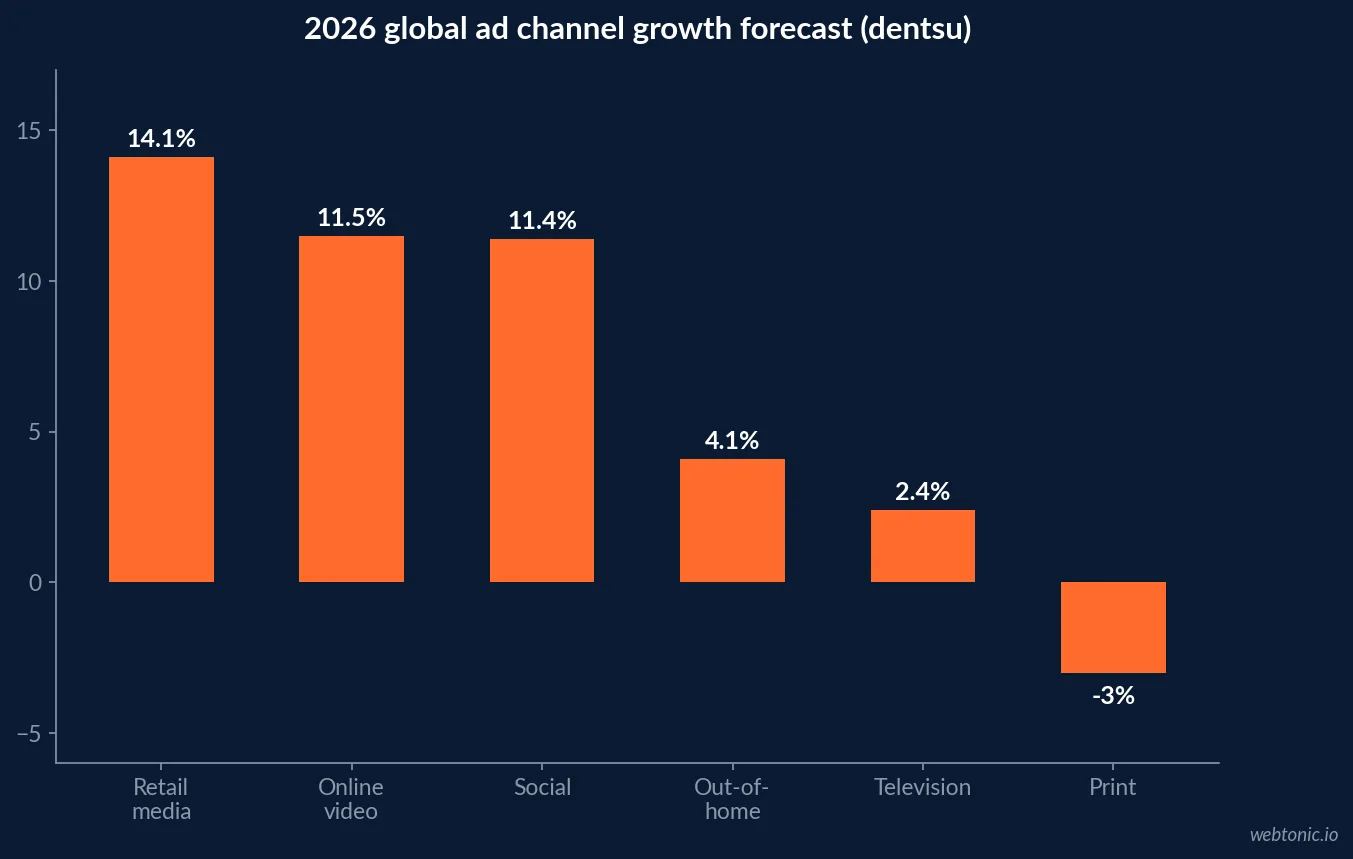
dentsu's forecast shows digital advertising growing 6.7% in 2026 to reach 68.7% of total investment, with retail media the fastest-growing digital format at 14.1%, ahead of online video at 11.5% and social at 11.4%. Programmatic buying is expected to account for more than four fifths of all digital investment. Traditional channels are not disappearing either: television is forecast up 2.4% and out-of-home up 4.1%, while print alone is expected to keep declining, down 3.0%.
WARC Media's separate retail media forecast puts that single channel at USD 200.4 billion in 2026, rising to USD 223.4 billion in 2027, when it will represent 15.2% of total worldwide ad spend. Strip out Amazon specifically and retail media's own growth rate for 2027 drops to 9.8%, the slowest WARC has recorded since it started tracking the category - a sign the channel is maturing, not slowing down entirely.
| Channel (dentsu, 2026 forecast) | Growth rate | Direction |
|---|---|---|
| Retail media | +14.1% | Fastest-growing digital format |
| Online video | +11.5% | Second-fastest digital format |
| Social | +11.4% | Close behind video |
| Out-of-home | +4.1% | Traditional format still expanding |
| Television | +2.4% | Modest but positive |
| -3.0% | The only channel dentsu forecasts shrinking |
Regional split: Asia Pacific pulls ahead
dentsu names Asia Pacific as the fastest-growing region for 2026, with India and China providing significant momentum, even as eMarketer notes the US still supplies more than 40% of the world's ad spending on a base level. WPP Media adds that global ad revenue is reaching its highest share of GDP since 1999 - surpassing the dot-com-era peak of 2000, but this time through performance-driven results rather than speculative branding - and that market power remains concentrated, with the top three sellers outside China (Alphabet, Meta and Amazon) controlling 57.6% of the market.
Looking further out, WPP Media projects Generative Search advertising - ads embedded in AI chat and answer interfaces - to become the fastest-scaling ad channel ever recorded, growing from USD 5.1 billion in 2026 to over USD 100 billion by 2030. Our breakdown of what search advertising costs today is worth reading before that shift changes the unit economics again.
The budget squeeze inside individual companies
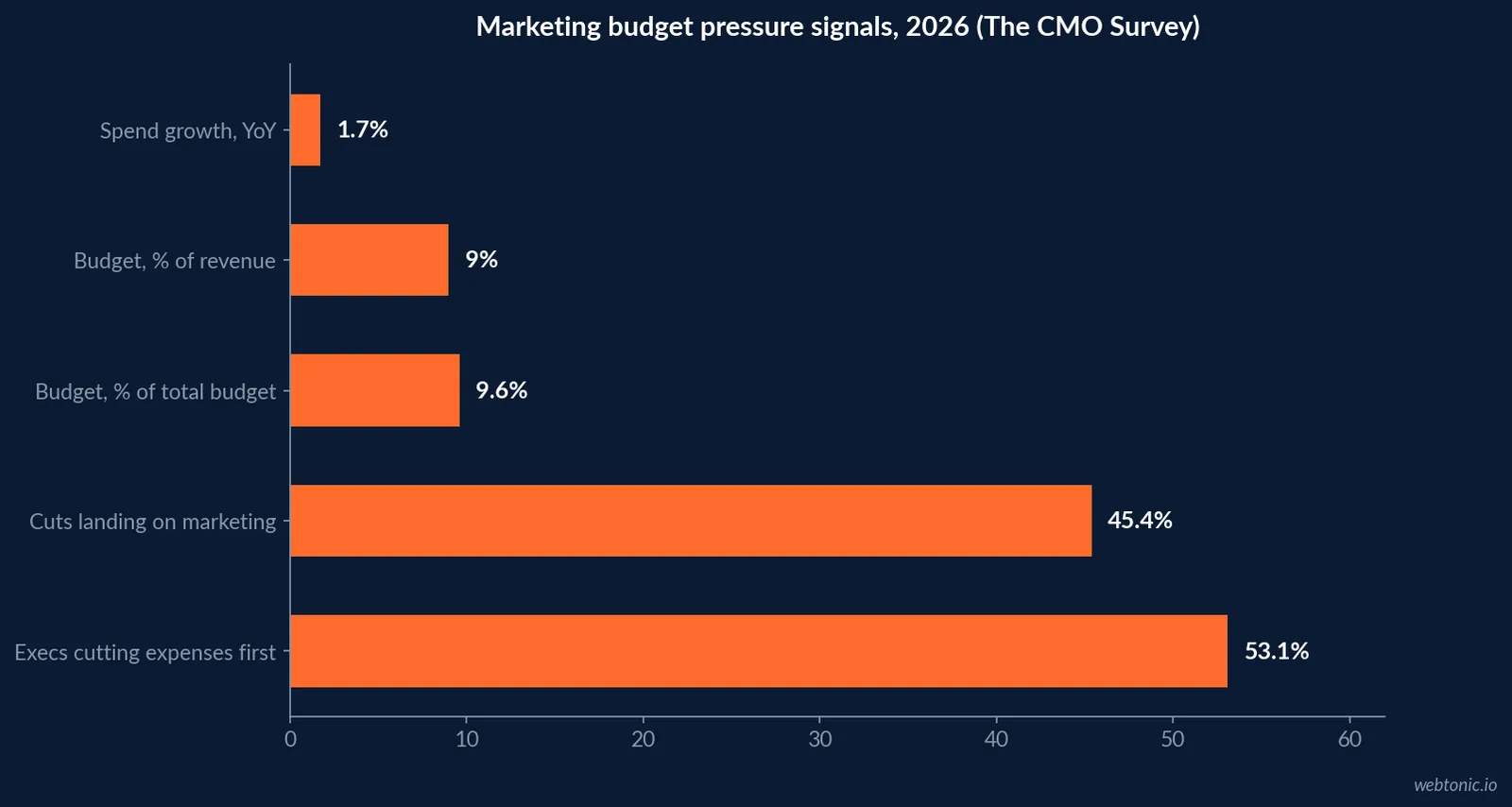
The market total is rising even as company-level budgets fall. The CMO Survey's 2026 data shows marketing budgets falling to 9.0% of company revenues and 9.6% of overall budgets - both the lowest levels in several years - with overall marketing spending growing just 1.7% over the prior twelve months, the smallest increase since 2021.
The same survey finds that when profits fall short of expectations, 53.1% of company executives respond by cutting expenses rather than investing in growth, up from 46% a year earlier - and when that happens, marketing expenses specifically get cut 45.4% of the time, more frequently than any other budget line. Acquisition spending is now 26% larger than retention spending and still growing, even though the CMO Survey's own performance data shows retention outperforming acquisition.
| CMO Survey metric, 2026 | Figure | Trend |
|---|---|---|
| Marketing spend, % of revenue | 9.0% | Lowest in several years |
| Marketing spend, % of total budget | 9.6% | Lowest in several years |
| YoY marketing spend growth | +1.7% | Smallest increase since 2021 |
| Executives who cut expenses first when profits miss | 53.1% | Up from 46% a year earlier |
| Share of cuts landing on marketing specifically | 45.4% | Highest of any expense category |
| Acquisition spend vs. retention spend | +26% larger | Growing, despite retention outperforming |
Martech is claiming a bigger slice of a shrinking pie
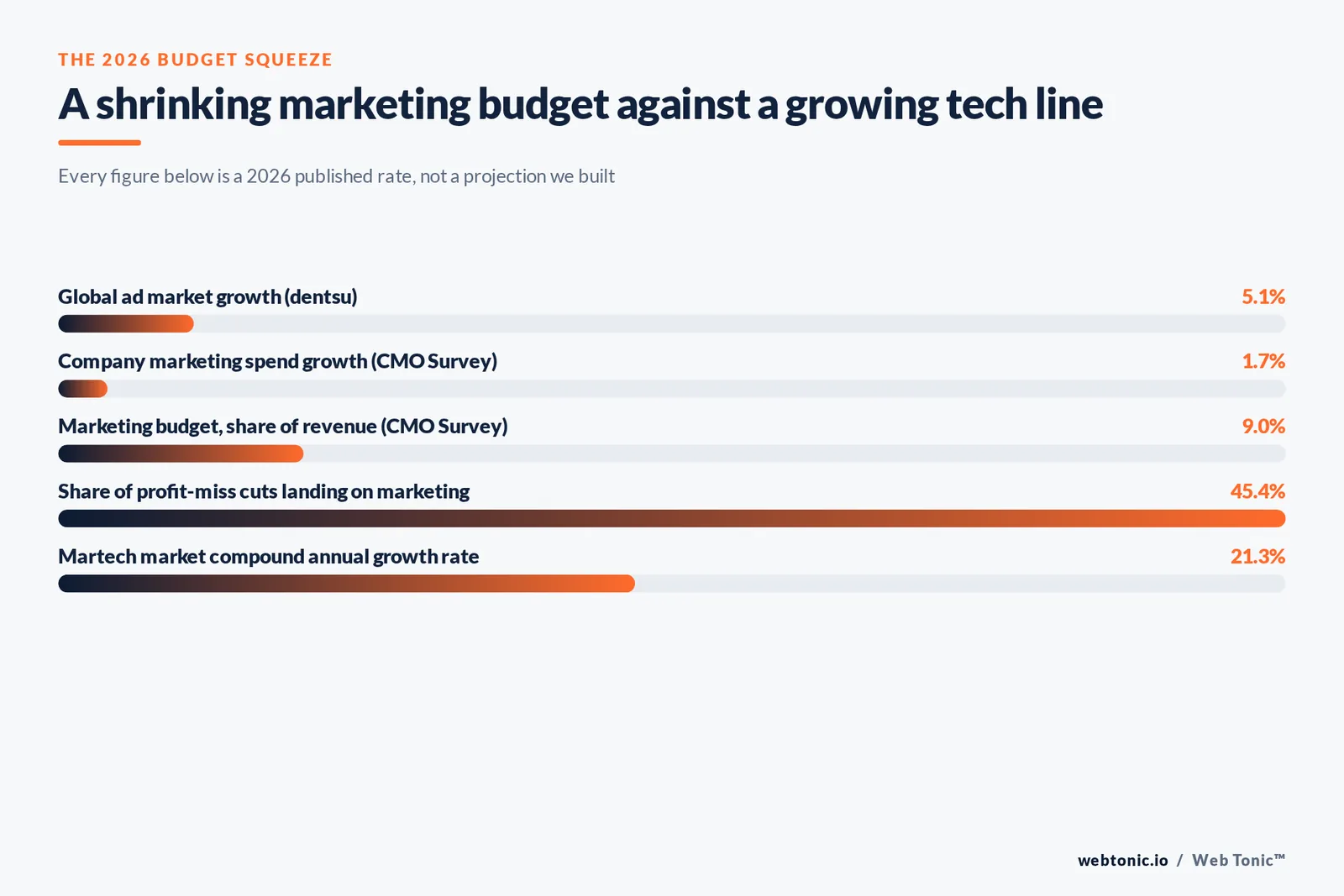
The global marketing technology market is forecast to grow from USD 589.14 billion in 2025 to USD 714.56 billion in 2026, a 21.3% compound annual growth rate, and on to USD 1,550.28 billion by 2030 at a similar pace, driven by AI-driven marketing tools, real-time customer insight demand and omnichannel personalization. Forrester's 2026 B2B marketing budget benchmarks add the practitioner view: technology investment is one of the few lines B2B marketing leaders are actively defending inside otherwise flat budgets.
Put the two data sets together and the arithmetic is uncomfortable: a marketing budget that is shrinking as a share of revenue is being asked to absorb a technology line growing at over 20% a year. Something else in the budget has to give. Our data and analytics practice spends most of its client conversations right now on exactly that trade-off.
The advertiser base is widening, not just spending more
Part of why the market total keeps climbing even as individual budgets shrink is that the pool of advertisers is widening. WPP Media's forecast explicitly credits AI-native companies entering the market as buyers - both AI companies advertising themselves and traditional advertisers deploying AI to make their own media spend more efficient - as a countervailing force against soft domestic demand in several major economies. Asia-based advertisers seeking growth in international markets add a second new source of demand that did not exist at this scale two forecast cycles ago.
That matters for anyone benchmarking their own budget against "the market": a rising total does not mean existing advertisers are spending more per head. It can mean, and increasingly does mean, that more distinct organizations are now buying media at all.
| New demand source (2026) | What it adds to the total | Why it does not lift existing budgets |
|---|---|---|
| AI-native companies | New advertiser category from scratch | Competing for the same auctions, not adding budget to yours |
| Asia-based advertisers going international | Cross-border spend growth | Regional, not a universal budget lift |
| Retail media networks | USD 200.4B channel in 2026 | Reallocates existing trade and shopper budgets |
| Generative Search ad inventory | USD 5.1B in 2026, forecast past USD 100B by 2030 | A new line item competing for the same pool |
What this means for a 2026-2027 budget conversation
Three planning implications follow directly. First, market growth and company-level budget growth are no longer the same trend - build a plan against your own budget trajectory, not the trillion-dollar headline. Second, retail media and video are absorbing a disproportionate share of new digital budget, so a channel mix built even eighteen months ago is already out of date. Third, martech's 20%+ growth rate means every renewal conversation should be treated as a budget reallocation decision, not a rubber stamp.
If you want a channel-by-channel view of where your own spend sits against these benchmarks, talk to our team, or read how our performance creative practice is adapting briefs for a retail-media-first mix.
Frequently Asked Questions
Has global advertising spend really passed USD 1 trillion?
By dentsu's forecast, yes - global advertising spend is set to grow 5.1% in 2026 and surpass USD 1 trillion for the first time on record, outpacing the 3.1% growth forecast for the global economy. WPP Media's separate midyear forecast is more bullish still, projecting 8.9% growth to USD 1.3 trillion excluding US political spend. The two houses disagree on the exact number because they scope the market differently, but both agree the trillion-dollar line has been crossed.
Are marketing budgets growing along with the market?
Not at the company level. The CMO Survey's 2026 data shows marketing budgets have fallen to their lowest share of company revenue in several years - 9.0% of revenue and 9.6% of overall budgets - with overall marketing spending growing just 1.7% year over year, the smallest increase since 2021. The market total is rising because more companies are spending, and because AI-native firms are entering the advertiser pool, not because existing marketing budgets are expanding.
Which region and channel are driving the growth?
Asia Pacific is the fastest-growing region in dentsu's forecast, led by India and China. By channel, retail media is the fastest-growing digital format at 14.1% growth, ahead of online video at 11.5% and social at 11.4%, while WARC Media separately puts the global retail media market at USD 200.4 billion in 2026, on track for 15.2% of all worldwide ad spend by 2027.
What happens to marketing budgets when profits disappoint?
They get cut first and hardest. The CMO Survey finds that when profits fall short of expectations, 53.1% of executives respond by cutting expenses rather than investing in growth - up from 46% a year earlier - and marketing expenses specifically get cut 45.4% of the time, more often than any other expense line. That is happening even as the same survey shows marketing's measurable impact on customers lasting longer than it used to.
Is martech spend rising or falling inside those shrinking budgets?
Rising, structurally. The global marketing technology market is forecast to grow from USD 589.14 billion in 2025 to USD 714.56 billion in 2026, a 21.3% compound growth rate, on its way to over USD 1.5 trillion by 2030. That means martech is claiming a larger slice of a marketing budget that, per the CMO Survey, is shrinking as a share of company revenue - a genuine squeeze on every other line item.
Sources
dentsu - Global Ad Spend Forecasts, 2026
WPP Media - This Year Next Year, 2026 Midyear Forecast
eMarketer - Worldwide Ad Spending Forecast 2026
MediaBrief, reporting WARC Media - Global retail media ad market forecast
The CMO Survey - Marketing contracts under economic pressure, 2026
The CMO Survey - Topline Report 2026
Forrester - 2026 B2B Marketing Budget Benchmarks: Technology
The Business Research Company - Marketing Technology Global Market Report 2026