Table of contents
Webflow holds about 1.2% of the total CMS market but 24.6% of agency websites, and its origins pass all three Core Web Vitals at 68.9% against WordPress at 49.3%. For a franchise system running dozens or hundreds of location pages, that gap is the entire migration argument - and the numbers below show where it holds up and where it does not, plus what a rebuild actually costs in 2026.
Key Takeaways
- Webflow is 1.2% of all detected CMS platforms versus 43.5% for WordPress, 6.2% Shopify and 3.4% Wix.
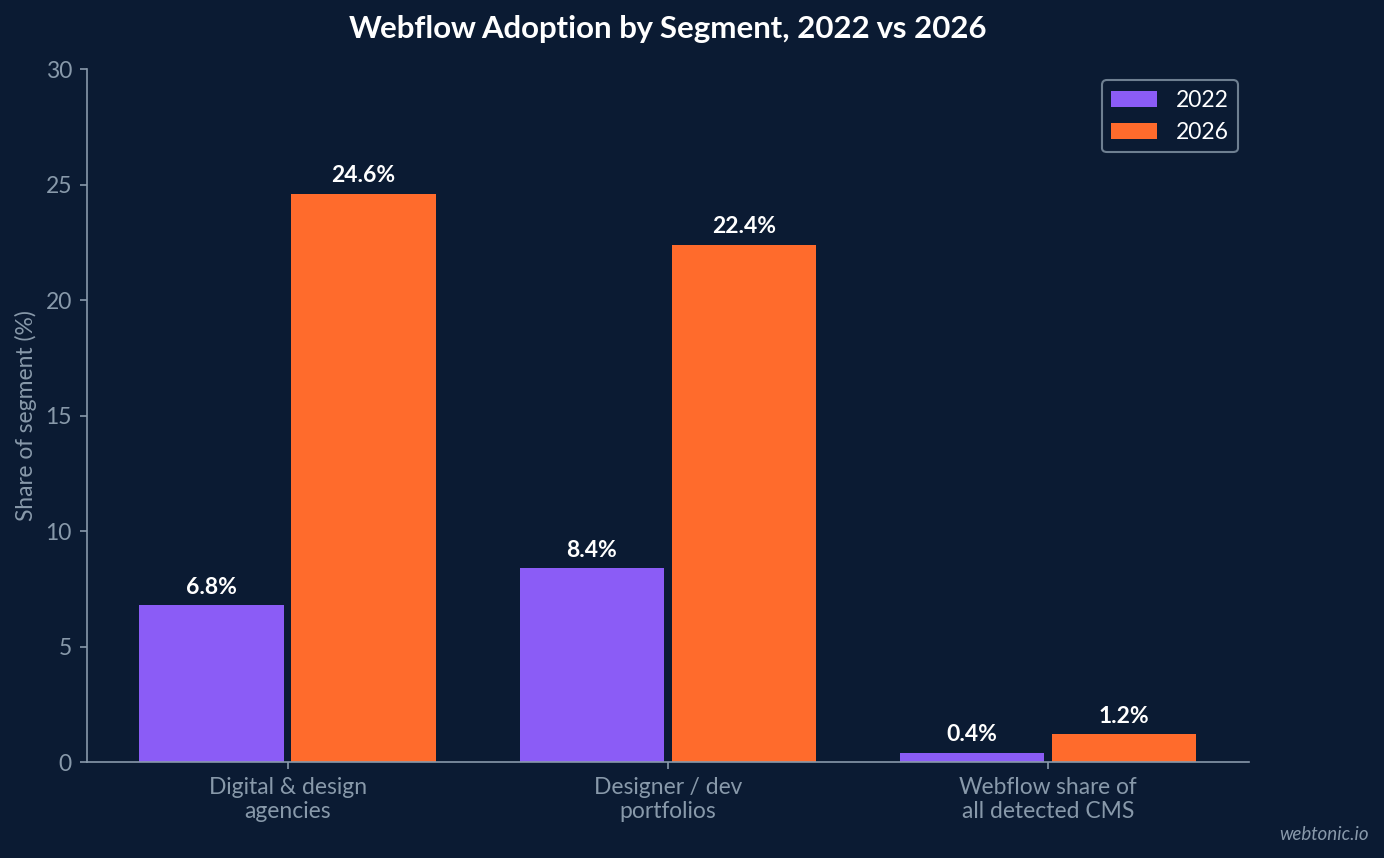
- Agency adoption jumped from 6.8% in 2022 to 24.6% in 2026, and designer portfolios from 8.4% to 22.4%.
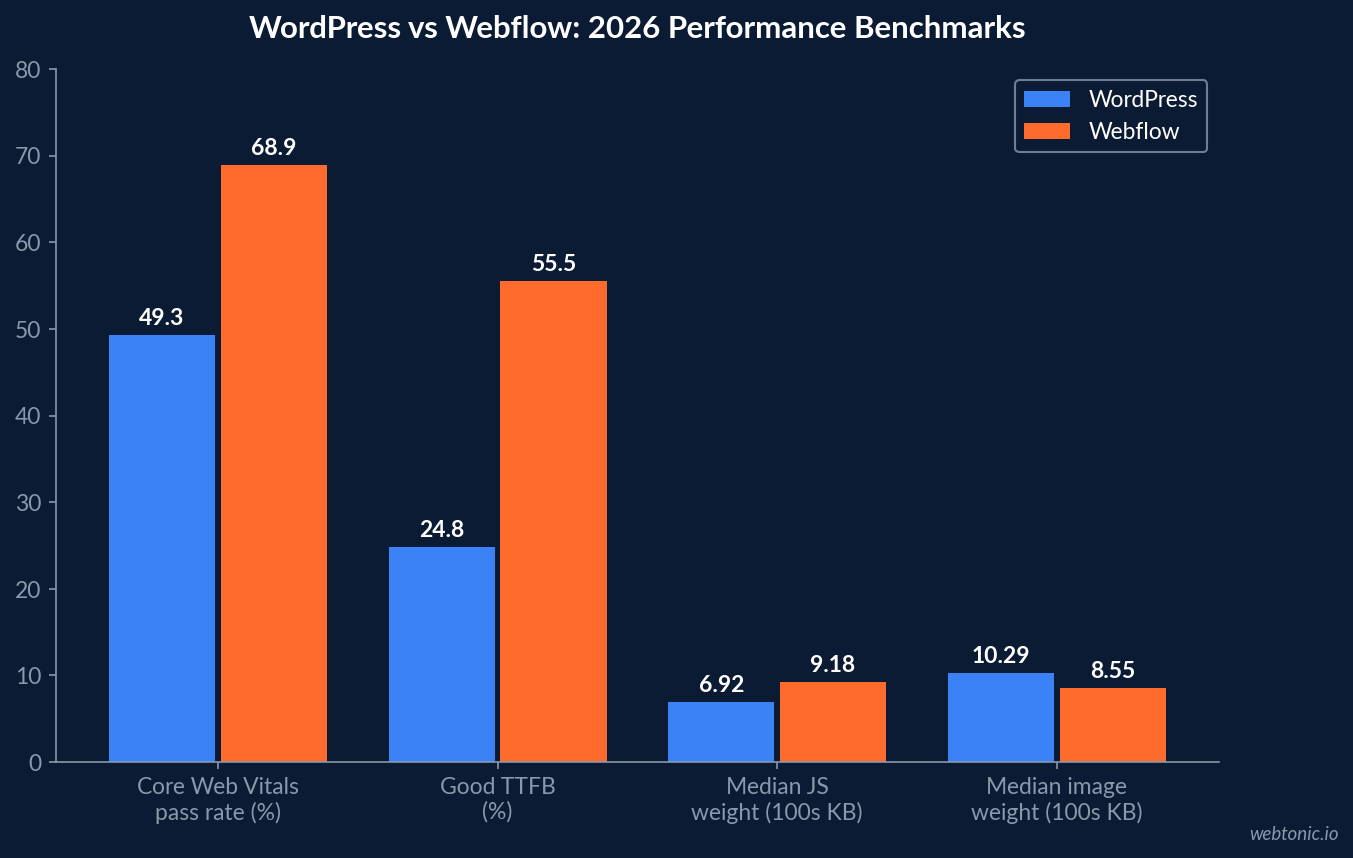
- 68.9% of Webflow origins pass all three Core Web Vitals vs 49.3% of WordPress; good TTFB is 55.5% vs 24.8%.
- Typical server response is 100-200ms on Webflow vs 400-800ms on WordPress, with new-page indexation in 2-7 days rather than 4-14.
- A full franchise rebuild on multi-site architecture runs mid-five to low-seven figures for large U.S. systems.
- One 28-location franchise saw organic traffic rise 67% in four months after replacing a single locations list with unique per-unit pages.
- Unified multi-location experiences are linked to 20-40% conversion improvement against fragmented franchisee-owned sites.
- Subfolders are the correct architecture for roughly 95% of franchises, not subdomains or standalone sites.
Webflow Adoption: Small Overall, Large Where Decisions Get Made
Platform share data reads two very different ways depending on which population you measure. Across the whole web, WordPress still holds 43.5% of detected CMS installs, Shopify 6.2%, Wix 3.4%, Squarespace 2.8%, Joomla 1.7%, Drupal 1.5% and Webflow 1.2%, with 32% of sites running no detectable CMS at all (Digital Applied). Measured among the people who specify and build franchise sites, the picture flips: Webflow now powers 24.6% of digital and design agency websites, up from 6.8% in 2022, and 22.4% of designer and developer portfolios, up from 8.4% (Visionary Marketing CMS Market Share Report 2026).
That is why franchise CMOs keep hearing about a platform with a single-digit market share. In practical terms, WordPress still runs most corporate franchise sites, while Webflow and HubSpot appear far more often in newer projects and rebuilds (DevHub 2026 CMO comparison). The installed base is legacy; the pipeline is not.
| Platform | Share of detected CMS installs (2026) | Franchise relevance |
|---|---|---|
| WordPress | 43.5% | Dominant legacy estate; plugin governance risk at scale |
| Shopify | 6.2% | Product-led franchise concepts and merchandise |
| Wix | 3.4% | Common in franchisee-built one-off local sites |
| Squarespace | 2.8% | Rare above 10 units |
| Joomla | 1.7% | Legacy only |
| Drupal | 1.5% | Enterprise systems with heavy compliance needs |
| Webflow | 1.2% overall; 24.6% of agency sites | Fast-growing choice for rebuilds |
| No detected CMS | 32.0% | Hand-coded or headless front ends |
Performance: Where the Webflow Case Is Strongest
Franchise sites fail on speed more often than on design, because every added location page multiplies template weight. Field data across origins is decisive on the platform comparison: Webflow origins pass all three Core Web Vitals 68.9% of the time versus 49.3% for WordPress, and record good time to first byte 55.5% versus 24.8% (PageSpeed Matters). A separate 2026 comparison lands at 58% for Webflow, 42% for WordPress and 34% for Squarespace (The Stacc) - different sampling, same direction and roughly the same 16-point gap.
| Metric | WordPress | Webflow | Why it matters for franchise estates |
|---|---|---|---|
| Core Web Vitals pass rate | 49.3% | 68.9% | Applies across every templated location page at once |
| Good TTFB share | 24.8% | 55.5% | Managed hosting and built-in CDN remove host variance |
| Median JavaScript weight | 692 KB | 918 KB | Webflow's weak spot - interactions add up fast |
| Median image weight | 1,029 KB | 855 KB | Automatic responsive images help unit-level photos |
| Typical server response time | 400-800ms | 100-200ms | Compounds across crawl of hundreds of pages |
| New page indexation | 4-14 days | 2-7 days | Faster time-to-visibility for new unit launches |
| IndexNow support | Via plugin | Not native | Plan for sitemap discipline either way |
Two caveats keep this honest. First, Webflow ships heavier JavaScript at a 918KB median against WordPress at 692KB - a franchise template stuffed with scroll interactions can erase the hosting advantage. Second, server response times of 100-200ms on Webflow versus 400-800ms on typical WordPress hosting and faster indexation windows of 2-7 days versus 4-14 days (Social Animal) reflect managed infrastructure, not magic. A well-hosted, well-governed WordPress estate closes most of the gap; the reason it usually does not is that franchise systems rarely have the central engineering discipline to keep 40 plugins in line.
CMS Structure: Location Pages Are the Whole Game
Whatever platform a franchise picks, the CMS decision that matters is whether each unit gets a real page. One agency reported a 28-location franchise client seeing a 67% increase in organic traffic within four months of replacing a single all-addresses "Locations" page with location-specific pages built on unique content (Livvvv). Benchmark data from 41 multi-location brands puts realistic expectations on the outcome: well-optimized location pages in mid-competition markets reach 200-600 monthly organic sessions within 6-12 months of active optimization (Authority Specialist).
Architecture governs the ceiling. Subfolders are the best choice for roughly 95% of franchises because they consolidate domain authority into one property and are simpler to administer than franchisee subdomains or separate sites. And consolidation pays at the conversion layer too: a unified multi-location experience is associated with a potential 20-40% conversion improvement versus a fragmented estate (Latitude Park), largely because forms, tracking and page speed stop varying by franchisee.
| CMS structure decision | 2026 best practice | Common franchise failure |
|---|---|---|
| URL architecture | Subfolders - correct for ~95% of systems | Franchisee-owned subdomains diluting authority |
| Location content source | One CMS collection, per-unit fields | Hand-built pages that drift out of sync |
| Per-page differentiation | Unique staff, reviews, service area, offers | Same 600 words with the city swapped |
| Template performance | Budget the template, not the page | One heavy hero regressing every unit page |
| Local schema | LocalBusiness subtype per unit, validated | Sitewide organization schema only |
| Governance | Central publishing rights, local content requests | Franchisee edit access with no review |
| Launch workflow | New unit live within days of opening | Location page added months after opening |
This is exactly the work our growth marketing and data intelligence teams sequence together on multi-location builds: the CMS schema comes first, then the content model, then the tracking, and only then the design. Reverse that order and the estate needs rebuilding within two years.
What a Franchise Webflow Build Costs
Budget ranges published for 2026 are wide because the word "rebuild" hides an order of magnitude. For large U.S. franchises, a full rebuild with multi-site architecture often ranges from mid-five figures to low-seven figures, depending on integrations, ecommerce, content volume and custom design (Arc4). The multiplier is integration count - point of sale, booking, franchisee onboarding, listings management and CRM - not template complexity.
On returns, one three-year platform comparison reported a Webflow build generating roughly $58,000 in incremental value with about a 32% conversion rate lift, against roughly $580,000 and a 72% lift for a fully custom build (KrishaWeb). Treat those as directional single-case figures rather than benchmarks - but the shape is instructive. Webflow buys most of the performance and speed-to-market benefit at a fraction of custom cost, and the remaining upside sits in bespoke functionality most franchise systems do not need on day one.
| Build tier | Typical 2026 scope | Indicative investment |
|---|---|---|
| Single-brand refresh | Design refresh, existing CMS, under 20 location pages | Low five figures |
| Mid-size franchise rebuild | New CMS model, 20-100 unit pages, 2-3 integrations | Five to low six figures |
| Large system rebuild | Multi-site architecture, ecommerce, deep integrations | Mid-five to low-seven figures |
| Ongoing optimization | CRO, content per unit, technical maintenance | Monthly retainer |
One more planning input: Webflow's 2026 State of the Website research surveyed about 1,000 business leaders and reports customer cases including a 1,170% year-over-year traffic increase (Webflow). Vendor-published outliers are not planning numbers, but they do reflect where the platform concentrates value: publishing velocity for teams that previously waited on developers.
How to Decide: A Franchise CMS Scorecard
The migration question is rarely "which CMS is better." It is "which failure mode can we afford." Use these seven checks before committing budget:
- Count your units and your growth rate. Under 20 locations, platform choice barely moves revenue; above 100, template performance affects every page at once.
- Measure your current Core Web Vitals pass rate against the 49.3% WordPress and 68.9% Webflow baselines before assuming a migration will fix speed.
- Audit TTFB. If you are at 400-800ms, managed hosting and a built-in CDN is the single fastest win available.
- Consolidate to subfolders - the right structure for about 95% of franchises - before spending on design.
- Model the conversion upside honestly: a unified experience is linked to 20-40% conversion improvement, which usually dwarfs the traffic gain.
- Price integrations, not pages. The mid-five-to-seven-figure range is driven by systems, not screens.
- Lock content governance so per-unit pages stay differentiated - templated sameness is the most common reason franchise location pages never rank.
Franchise teams comparing channel economics alongside a platform decision can pair this with our Google Ads benchmarks and the 2026 Google Ads cost guide, since a faster site changes paid performance as much as organic. If you want a second opinion on a live estate, talk to us.
Frequently Asked Questions
How much of the CMS market does Webflow actually hold in 2026?
Across all detected content management systems Webflow sits at roughly 1.2% of the web, against 43.5% for WordPress, 6.2% for Shopify and 3.4% for Wix. The headline share is small, but the segment share is not: Webflow now powers 24.6% of digital and design agency sites (up from 6.8% in 2022) and 22.4% of designer and developer portfolios (up from 8.4%). For franchise brands the practical read is that WordPress still runs most corporate franchise sites, while Webflow shows up disproportionately in newer builds and rebuilds.
Is Webflow genuinely faster than WordPress for a multi-location site?
On aggregate field data, yes. Webflow origins pass all three Core Web Vitals at 68.9% versus 49.3% for WordPress, and post good time to first byte 55.5% of the time versus 24.8%. A second 2026 dataset puts the pass rates at 58% for Webflow, 42% for WordPress and 34% for Squarespace. Server response time typically lands at 100-200ms on Webflow's managed hosting and CDN against 400-800ms on typical WordPress hosting. The caveat: Webflow ships heavier JavaScript (918KB median versus 692KB), so a bloated franchise template can still fail.
What does a franchise Webflow build cost in 2026?
For a large U.S. franchise system, a full rebuild on multi-site architecture typically ranges from mid-five figures to low-seven figures depending on integrations, ecommerce, content volume and custom design. Mid-sized systems with 20 to 100 units generally land in the five-figure to low-six-figure band. The variable that moves the number most is not design; it is how many systems (POS, booking, franchisee onboarding, listings management) the CMS has to talk to.
Can Webflow CMS handle hundreds of franchise location pages?
Yes, provided the location data lives in a CMS collection rather than in hand-built pages. One agency reported a 28-location franchise seeing a 67% increase in organic traffic within four months of replacing a single 'Locations' list with unique location-specific pages. Benchmarks from 41 multi-location brands suggest well-optimized location pages reach 200-600 monthly organic sessions within 6-12 months in mid-competition markets. Templated pages are the engine of franchise SEO and also the most common failure point when the template does not differentiate enough per unit.
Should franchise location pages sit on subfolders, subdomains or separate sites?
Subfolders (brand.com/locations/city) are the right answer for roughly 95% of franchises. They consolidate domain authority into one property and are far easier to govern than franchisee-owned subdomains or standalone sites. A unified multi-location experience is also associated with a potential 20-40% conversion improvement versus a fragmented estate of separate franchisee sites, mostly because tracking, forms and speed become consistent.
Does moving to Webflow help with AI search and generative engine optimization?
Indirectly, and only through fundamentals. Clean semantic markup, fast server response, reliable structured data and faster indexation (typically 2-7 days for new pages versus 4-14 on unmanaged WordPress) all make a franchise estate easier for crawlers and AI answer engines to parse. The platform is not a ranking factor. What moves AI visibility is unique per-unit content, consistent NAP data across the estate and schema that actually validates.
Sources
DevHub - Best Website Platforms for Franchise Brands (2026 CMO Comparison)
Visionary Marketing - CMS Market Share Report 2026
Digital Applied - Website Statistics 2026
PageSpeed Matters - WordPress vs Webflow vs Squarespace Speed Compared 2026
The Stacc - WordPress vs Webflow for SEO (2026)
Social Animal - WordPress vs Webflow SEO: 2026 Real Performance Data
KrishaWeb - WordPress vs Webflow vs Custom Build: Which Converts Better?
Livvvv - Webflow for Franchises: Multi-Location SEO Strategy
Arc4 - Franchise Website Development Playbook
Authority Specialist - Franchise SEO Benchmarks: 2026 Data from 41 Brands
Latitude Park - Multi-Location Website Design for Franchises
Webflow - 2026 State of the Website Report