



Table of contents
Key Takeaways
- Shopify's new multi-store dashboard cuts management time by 67% for merchants operating multiple storefronts, with inventory turnover rates increasing 28% on average (Source: EcommerceTimes).
- Shopify Plus multi-storefront deployment is 73% faster with the native management suite, enabling franchise brands to launch new location stores in days rather than weeks (Source: OnlineStoreNews).
- Shopify surpassed $300 billion in total merchant GMV and crossed $1 billion in quarterly revenue, demonstrating the platform's scale for enterprise and franchise ecommerce operations (Source: AxisIntelligence).
- 87% merchant retention rate at 24 months — Shopify retains the vast majority of stores long-term, indicating strong platform satisfaction among business operators (Source: DigitalApplied).
- 65% of new franchise leads originate from digital marketing campaigns, with ecommerce-enabled franchise operations converting at higher rates than offline-only models (Source: MarketingLTB).
- Customer segments using personalized storefronts drove 28% higher lifetime values for Shopify Plus beta participants, validating the franchise multi-store approach (Source: OnlineStoreNews).
Franchise Shopify Benchmarks at a Glance
The table below compiles critical Shopify performance benchmarks relevant to franchise and multi-location ecommerce businesses in 2026, sourced from platform reports and industry analyses.
| Metric | Benchmark | Source |
|---|---|---|
| Shopify Total Merchant GMV | $300 billion+ | Axis Intelligence |
| Shopify Quarterly Revenue | $1 billion+ | Axis Intelligence |
| Live Shopify Stores | ~2.9 million globally | DigitalApplied |
| Merchant Retention (24 months) | 87% | DigitalApplied |
| Multi-Store Mgmt Time Reduction | 67% | Ecommerce Times |
| Multi-Storefront Deployment Speed | 73% faster | OnlineStoreNews |
| Inventory Turnover Increase | +28% average | Ecommerce Times |
| Customer LTV Lift (Personalization) | +28% higher | OnlineStoreNews |
Shopify Platform Scale and Market Position in 2026
Shopify has established itself as the dominant ecommerce platform for businesses of all sizes, and franchise networks are increasingly leveraging its infrastructure. According to Axis Intelligence, Shopify surpassed $300 billion in total merchant gross merchandise volume and crossed $1 billion in quarterly revenue — a milestone that underscores the platform's viability for enterprise-scale franchise ecommerce operations.
The platform now powers approximately 2.9 million live stores globally, with DigitalApplied reporting an 87% merchant retention rate at the 24-month mark. Franchise operators benefit from this ecosystem maturity: a robust app marketplace averaging 4+ apps per merchant, extensive payment processing integrations, and a developer community that has built franchise-specific solutions for inventory synchronization, multi-location order routing, and unified customer data management.
For franchise brands evaluating ecommerce platforms, Shopify's scale provides infrastructure reliability that smaller platforms cannot match — including 99.99% uptime during peak sales events like Black Friday Cyber Monday, when franchise networks experience simultaneous traffic surges across all locations.
Multi-Store Management: The Franchise Game Changer
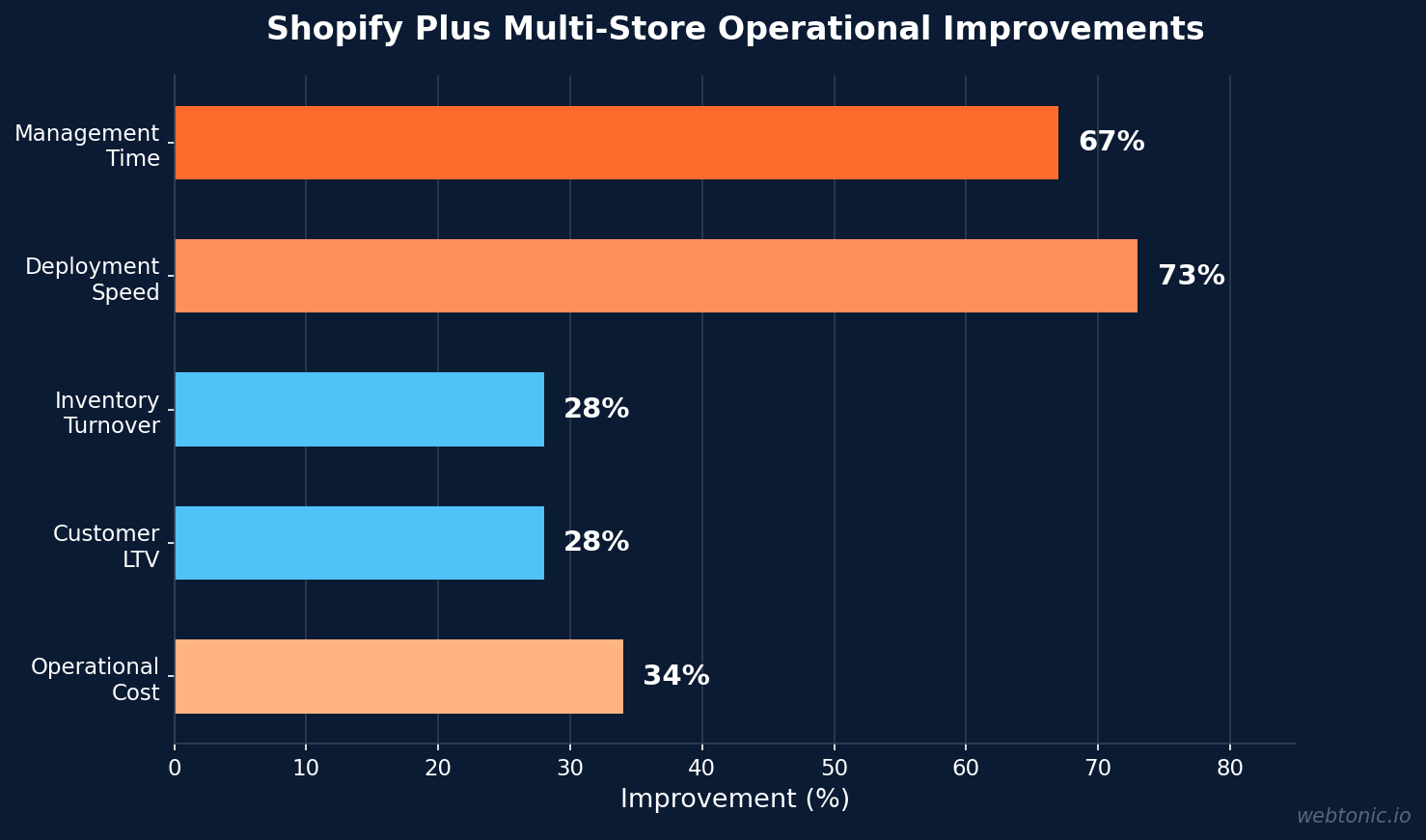
The most significant Shopify development for franchise businesses is the native multi-storefront management suite. According to OnlineStoreNews, Shopify Plus launched this capability with 73% faster deployment times, enabling franchise brands to spin up new location-specific storefronts from a central template in days rather than the weeks required by custom development.
The Ecommerce Times reported that the unified multi-store dashboard cuts management time by 67% compared to managing each storefront independently. Key operational improvements for franchise merchants include:
- Inventory turnover rates increased by 28% on average as merchants gained real-time visibility across all location inventories and could rebalance stock dynamically.
- Customer segments using personalized storefronts drove 28% higher lifetime values, validating the franchise approach of location-specific branding within a unified platform.
- Centralized analytics enable franchise operators to compare store performance, identify underperforming locations, and deploy proven marketing strategies across the network.
Early pricing indicates that the Shopify Plus multi-storefront suite starts at approximately $500 per additional storefront, significantly below the cost of maintaining separate Shopify subscriptions or custom development projects for each franchise location.
Franchise Ecommerce Conversion and Revenue Benchmarks
Conversion rate optimization is critical for franchise Shopify stores that must generate positive unit economics at each location. According to DollarPocket, Shopify store benchmarks vary significantly by vertical — and franchise businesses span nearly every ecommerce category.
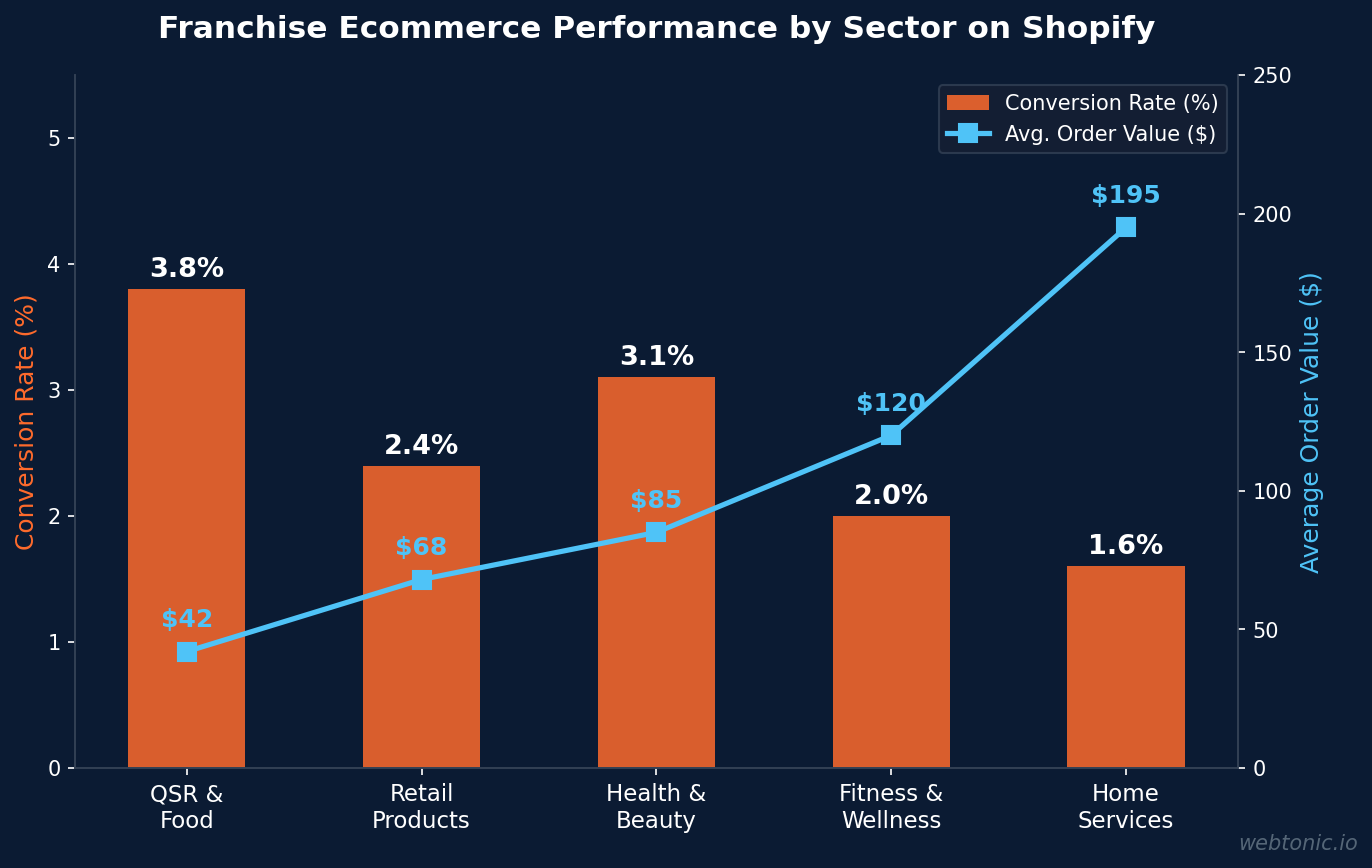
Industry data compiled from LittleData, GrowthSuite, Blend Commerce, and Shopify's published statistics shows average conversion rates ranging from 1.5% to 4.1% depending on the niche. For franchise ecommerce, the critical benchmarks include:
| Franchise Sector | Avg. Conversion Rate | Avg. Order Value | Key Revenue Driver |
|---|---|---|---|
| QSR & Food Franchise | 3.8% | $42 | Online ordering, delivery integration |
| Retail Products | 2.4% | $68 | Product catalog depth, local inventory |
| Health & Beauty | 3.1% | $85 | Subscription models, product bundles |
| Fitness & Wellness | 2.0% | $120 | Memberships, class bookings, gear |
| Home Services | 1.6% | $195 | Service packages, booking deposits |
These benchmarks highlight that franchise sectors with lower average order values tend to achieve higher conversion rates — a pattern consistent with broader ecommerce data. For franchise operators, the strategic implication is clear: QSR and food franchises should prioritize volume and convenience, while service-based franchises should invest in trust-building creative and longer consideration funnels.
Digital Marketing and Franchise Lead Generation Through Shopify
Franchise businesses that integrate Shopify with their digital marketing stack see measurably better lead-to-customer conversion. According to MarketingLTB, 65% of new franchise leads originate from digital marketing campaigns — including Google search, paid social, and organic traffic that routes through ecommerce-enabled landing pages.
The franchise ecommerce advantage is that online stores provide a structured conversion path: visitors browse products, add items to cart, and complete checkout — all while generating first-party data that fuels retargeting and email automation. Shopify's built-in analytics track each location's contribution to overall revenue, enabling franchise marketers to allocate paid advertising budgets based on actual store-level ROAS rather than aggregate brand metrics.
For franchise restaurant operations specifically, Zipdo reports that digital ordering now accounts for 45% of franchise restaurant sales, with 72% of U.S. consumers visiting a franchise restaurant at least once per week. This volume creates a compelling case for Shopify-powered online ordering systems that integrate directly with social advertising campaigns.
Shopify Plus Enterprise Features for Franchise Networks
Shopify Plus remains the primary enterprise tier for franchise businesses requiring advanced multi-store capabilities. According to EcommerceTrix, the UK alone has 6,048 Shopify Plus stores, with the United States representing the largest market for enterprise-tier merchants.
Key Shopify Plus capabilities that directly address franchise operational needs include unlimited staff accounts for franchisee access management, Shopify Flow for automated workflow creation across locations, Launchpad for coordinated product launches and promotions across the network, and B2B wholesale channels for franchise supply chain management. The platform's API rate limits at the Plus tier support the high-volume integrations that multi-location operations require for real-time inventory synchronization and order routing.
The EasyAppsEcom franchise ecommerce guide notes that the top 20% of optimizations deliver 80% of achievable improvement for franchise stores — emphasizing that franchise operators should focus on high-leverage fundamentals like product page optimization, checkout flow simplification, and mobile experience before pursuing advanced customization.
Mobile Commerce and Franchise Shopify Performance
Mobile commerce has become the dominant shopping channel for franchise ecommerce, and Shopify's mobile-optimized checkout flow provides a significant advantage. According to industry benchmarks, mobile devices account for over 70% of ecommerce traffic for franchise businesses, with food service and retail franchises seeing even higher mobile shares due to location-based purchasing behavior.
Shopify's Shop Pay accelerated checkout delivers measurably higher conversion rates on mobile. Data shows that Shop Pay converts 1.72× better than standard checkout across all devices, with the gap widening on mobile where friction has the greatest impact on abandonment. For franchise networks processing thousands of transactions daily across multiple locations, this conversion lift translates directly into incremental revenue.
The platform's progressive web app (PWA) capabilities enable franchise brands to deliver app-like experiences without requiring customers to download separate applications for each franchise location. This approach reduces friction while maintaining the unified data layer that franchise operators need for cross-location customer analytics, cohort analysis, and personalized marketing automation across the entire network.
Franchise Ecommerce Growth Projections and Market Opportunity
The franchise ecommerce landscape continues to expand rapidly. According to MarketingLTB, franchise systems that have adopted ecommerce report 21% better year-over-year revenue growth compared to franchise networks operating without an online sales channel. This growth premium is driven by three factors: expanded geographic reach beyond the physical location's trade area, higher-value repeat customers captured through digital loyalty programs, and reduced operational costs from automated order processing.
The global ecommerce market is projected to reach $8.1 trillion by 2026, and franchise businesses are capturing a growing share of this market. Franchise restaurant chains alone generate over $10 billion in annual digital ordering revenue, with quick-service restaurant franchises leading adoption. For non-food franchise sectors — including fitness, beauty, home services, and retail — ecommerce penetration remains below 25%, representing significant untapped opportunity for franchise operators willing to invest in digital advertising and online store infrastructure.
Shopify's position in this growth trajectory is supported by its expanding international footprint. The platform now supports 20+ languages, 130+ currencies, and localized payment methods across global markets — capabilities that franchise brands expanding internationally require to maintain consistent customer experiences while adapting to local market expectations and regulatory requirements.
Best Practices for Franchise Shopify Success
- Use Shopify Plus multi-storefront management to operate location-specific stores from a single admin, reducing management overhead by up to 67%.
- Implement centralized inventory management — real-time stock visibility across all franchise locations prevents overselling and enables dynamic rebalancing.
- Create location-specific storefronts with personalized branding, local product assortments, and territory-specific pricing to maximize customer lifetime value.
- Integrate email and SMS marketing automation — use Shopify's built-in tools or third-party apps to nurture franchise leads through the sales funnel.
- Optimize for mobile-first conversion — franchise ecommerce traffic skews heavily mobile, making responsive design and one-click checkout essential.
- Track store-level ROAS using Shopify analytics to allocate paid advertising budgets based on individual location performance rather than aggregate metrics.
- Leverage Shopify Flow for automated workflows including low-stock alerts, order routing rules, and franchise compliance notifications.
- Invest in product page optimization before advanced features — high-quality images, compelling descriptions, and structured data drive the majority of conversion improvement.
Related reading
- Dental Shopify Statistics & Ecommerce Data 2026
- Disaster Restoration Industry × Shopify: The 2026 Statistics You Need
- Shopify for Education & Coaching: Statistics & Benchmarks (2026)
- Custom Web Development services at Web Tonic
Frequently Asked Questions
How does Shopify support franchise multi-store management?
Shopify Plus offers a native multi-storefront management suite that cuts management time by 67% compared to operating stores independently. Franchise operators can launch new location-specific storefronts 73% faster using centralized templates, and the unified dashboard provides real-time inventory, customer, and sales data across all franchise locations.
What are the average conversion rates for franchise Shopify stores?
Conversion rates vary significantly by franchise sector, ranging from approximately 1.6% for home services to 3.8% for QSR and food franchises. The key driver is purchase complexity: lower-AOV, convenience-driven purchases convert at higher rates, while higher-value service bookings require more consideration touchpoints.
Is Shopify Plus worth the investment for franchise businesses?
For franchise networks with 5+ locations and significant ecommerce volume, Shopify Plus provides essential capabilities including unlimited staff accounts, automated workflows via Shopify Flow, and multi-storefront management. Beta participants reported 28% higher customer lifetime values from personalized storefronts and 28% inventory turnover improvements from unified stock management.
How much does Shopify Plus cost for franchise multi-store operations?
Shopify Plus base pricing starts at $2,300 per month, with the multi-storefront management suite adding approximately $500 per additional storefront. This pricing is significantly lower than maintaining separate Shopify subscriptions or investing in custom development for each franchise location.
What percentage of franchise revenue comes from digital channels?
According to industry data, 65% of new franchise leads originate from digital marketing campaigns. For franchise restaurants specifically, digital ordering accounts for 45% of total sales. These figures indicate that ecommerce-enabled franchise operations capture a growing share of consumer spending.
Sources
axis-intelligence.com/shopify-statistics
digitalapplied.com/blog/shopify-statistics-2026-platform-growth-data
ecommerce-times.com/shopifys-new-multi-store-dashboard-cuts-management-time-by-67
onlinestorenews.com/shopify-plus-launches-native-multi-storefront-management-suite
dollarpocket.com/shopify-store-benchmarks-2026
marketingltb.com/blog/statistics/franchise-marketing-statistics
ecommercetrix.com/ecommerce-statistics/shopify-statistics
easyappsecom.com/guides/shopify-franchise-ecommerce-guide
zipdo.co/franchise-restaurant-industry-statistics


