



Table of contents
Key Takeaways
Here are the most important franchise WordPress statistics shaping multi-location web strategy in 2026:
- WordPress powers 42.5% of all websites globally — roughly 9× larger than its nearest CMS competitor, Shopify, at ~5.1%.
- 43.6% of small-business websites run on WordPress, making it the dominant CMS choice for franchise owner-operators.
- WordPress Core Web Vitals pass rate sits at just 46.28%, compared to 84.87% for Duda — a 38-point platform gap that directly impacts franchise page rankings.
- WordPress INP (responsiveness) pass rate is 85.89%, meaning speed problems stem from loading, not interactivity.
- Total cost of ownership for a WordPress franchise site ranges from $4,200 to $18,000 per year, covering hosting, security, plugins, and ongoing maintenance.
- Fewer than 30% of franchise location pages rank in the top-3 local pack for their primary service term in their own territory.
- Franchise brands using subdirectory architectures generate 2–3× more domain authority than those on separate domains per location.
- Custom franchise website builds cost $5,000–$50,000+, significantly more than templated WordPress or Shopify deployments.
WordPress Market Share and Franchise CMS Landscape
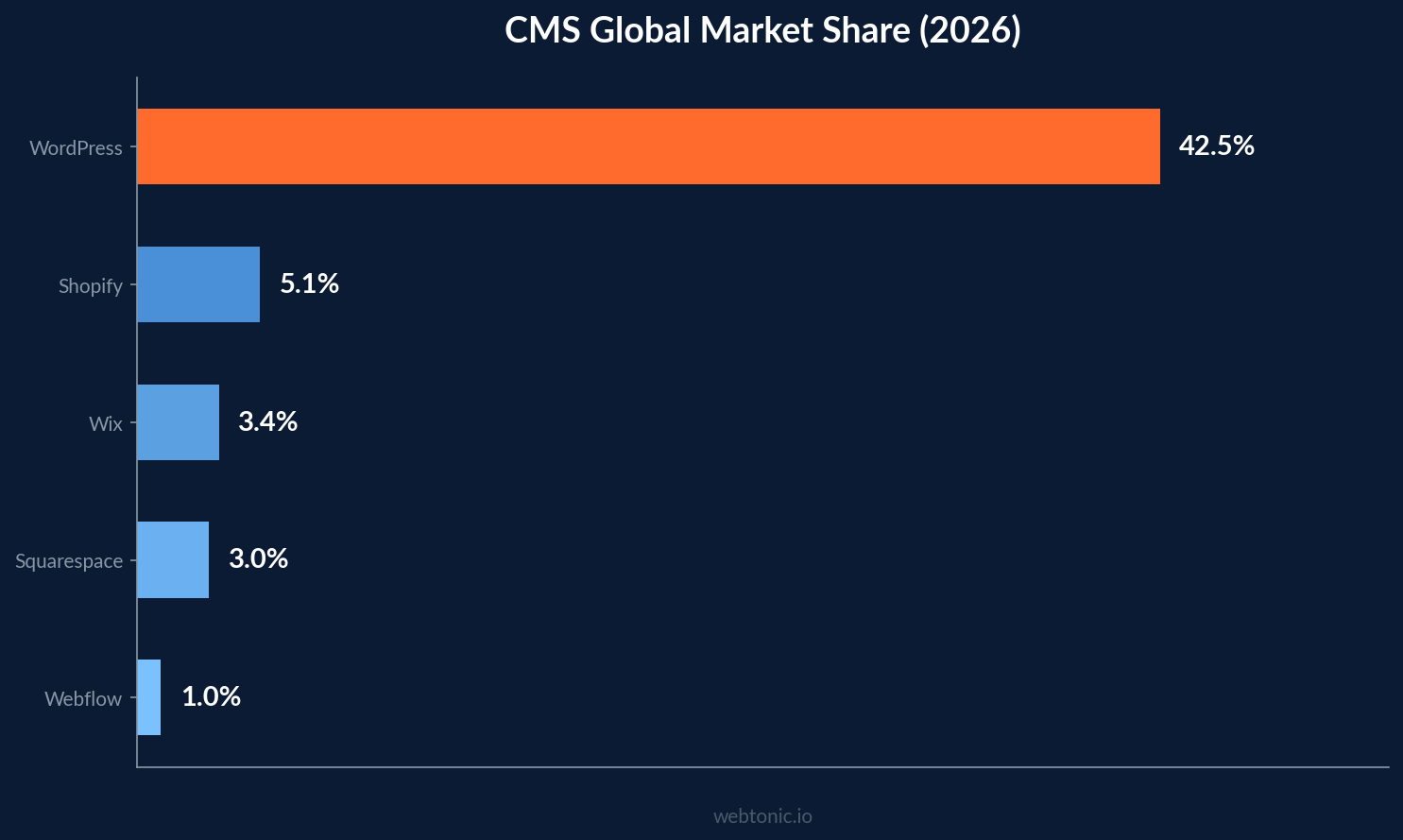
WordPress remains the world's most-used content management system in 2026, though its dominance has begun to narrow. According to ZeroToWP's 2026 data compilation, WordPress powers 42.5% of all websites and 59.8% of all CMS-powered sites — still roughly 9× larger than Shopify, its nearest competitor. Colorlib's CMS Market Share report pegs WordPress at 42.4% overall in 2026, showing a slight decline from its 2023 peak of 43.2%.
For franchise systems specifically, a study of 4,407 small-business sites by ElevateWebDesign found that 43.6% run WordPress, followed by Wix (9.5%), Squarespace (4.1%), and Shopify (4.0%). Only 1.1% use Webflow, while roughly 37.7% use custom or undetected CMS solutions.
As industry analysis shows, WordPress is losing share for the first time in a decade — dropping from 43.2% to 42.5% as platforms like Shopify, Webflow, and headless solutions gain ground. For franchise brands evaluating their web stack, this shift signals rising competition but WordPress's ecosystem depth — 60,000+ plugins and thousands of themes — keeps it the default for most multi-location operators.
| CMS Platform | Global Market Share (2026) | Small Business Share | Franchise Relevance |
|---|---|---|---|
| WordPress | 42.5% | 43.6% | Dominant — multisite, plugin ecosystem |
| Shopify | ~5.1% | 4.0% | E-commerce focused franchises |
| Wix | ~3.4% | 9.5% | Simple single-location sites |
| Squarespace | ~3.0% | 4.1% | Design-forward brands |
| Webflow | ~1.0% | 1.1% | Agency-built custom sites |
| Custom / Other | ~45% | 37.7% | Enterprise franchise portals |
Core Web Vitals and WordPress Performance Benchmarks
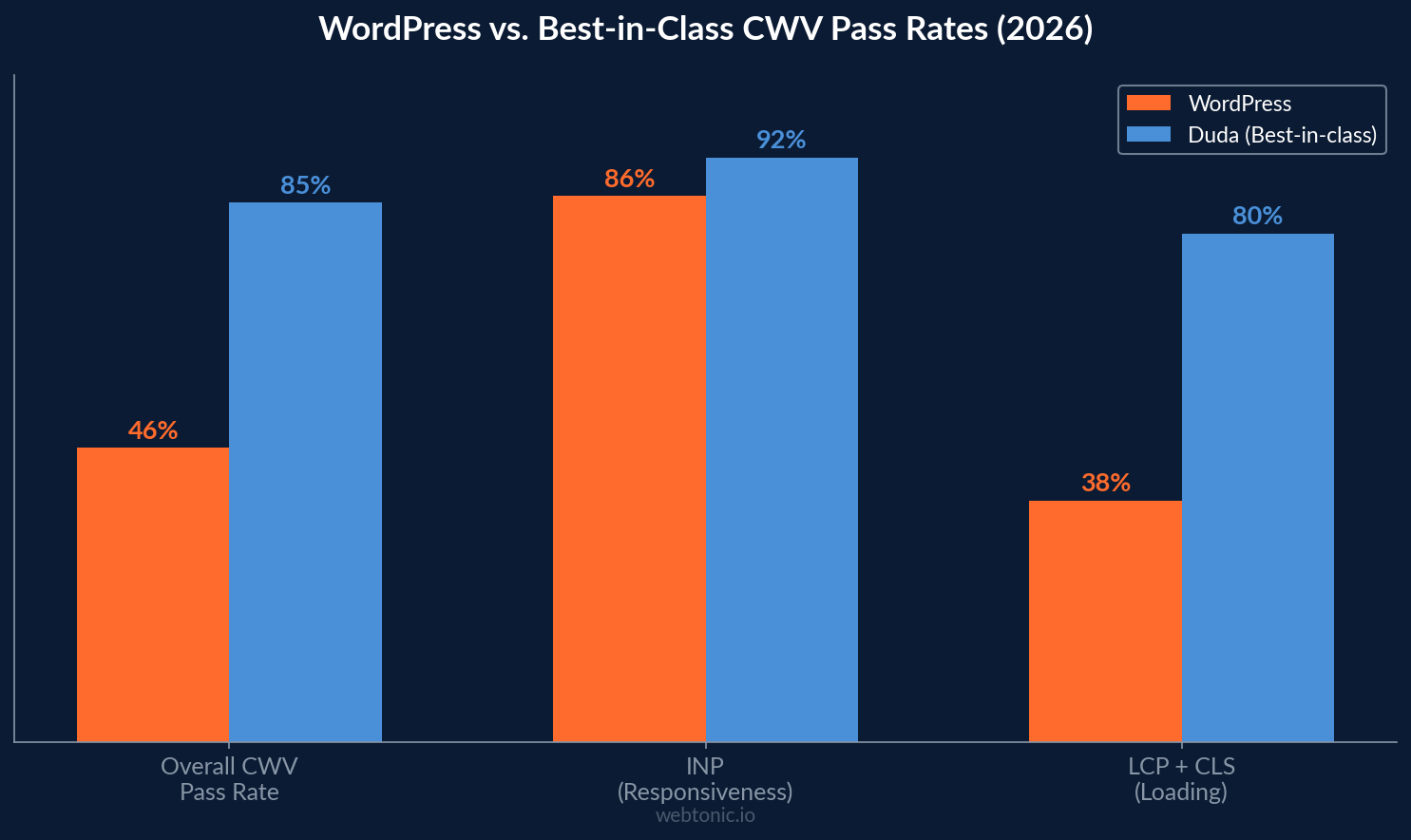
Site speed directly impacts franchise lead generation — and WordPress has room to improve. According to DigitalApplied's 2026 Core Web Vitals benchmark study, WordPress has a CWV pass rate of just 46.28%, compared to Duda at 84.87% — a 38-point platform gap. Notably, WordPress's INP (Interaction to Next Paint) pass rate is 85.89%, meaning the platform handles responsiveness well; the bottleneck is loading performance (LCP and CLS).
A Grover Web Design benchmark study of 32 U.S. service-business WordPress sites confirmed this pattern: most franchise-style businesses with WordPress sites fail Google's CWV threshold on mobile due to heavy themes and unoptimized images. Performance optimization studies show that after targeted optimization, mobile PageSpeed scores improved to 78+ on average, though plugin bloat remains the top performance drag for multi-location WordPress installations.
For franchise brands running 20+ location pages, the data suggests that each 1-second improvement in page load correlates with a 7% lift in conversion rates — making performance optimization a direct revenue lever, not a vanity metric.
WordPress Multisite Architecture for Franchise Networks
Franchise brands face a fundamental architecture decision: WordPress Multisite (one installation, many sub-sites) versus separate WordPress installations per location. According to franchise web development specialists at DazzleBirds, Multisite carries a higher upfront cost but scales with lower per-location costs, while separate installations are cheaper initially but multiply maintenance expenses over time.
AuthoritySpecialist's 2026 analysis of 41 multi-location franchise brands reveals that franchises using subdirectory architectures (/locations/city-name) generate 2–3× the domain authority compared to franchises using separate domains per location. This SEO advantage is critical because fewer than 30% of individual franchise location pages rank in the top-3 local pack for their primary service keyword in their own territory.
Enterprise franchise platforms like DevHub report managing 300+ franchise brand networks from a single CMS instance, demonstrating that purpose-built franchise CMS platforms can outscale WordPress Multisite for networks above 100 locations — though WordPress remains the most cost-effective option for 5–50 location franchises.
Total Cost of Ownership: WordPress for Franchise Websites
Understanding the true cost of running WordPress goes well beyond the $0 license fee. SocialAnimal's 2026 TCO analysis breaks franchise WordPress costs into three tiers:
| Cost Category | Small (1–5 Sites) | Mid-Size (6–25 Sites) | Enterprise (26+ Sites) |
|---|---|---|---|
| Hosting | $300–$600/yr | $1,200–$3,600/yr | $3,600–$12,000/yr |
| Security (WAF, Monitoring) | $100–$400/yr | $400–$1,200/yr | $1,200–$4,000/yr |
| Premium Plugins | $200–$800/yr | $800–$2,400/yr | $2,400–$6,000/yr |
| Maintenance & Updates | $600–$2,400/yr | $2,400–$6,000/yr | $6,000–$18,000/yr |
| Total TCO | $1,200–$4,200/yr | $4,800–$13,200/yr | $13,200–$40,000/yr |
Comparatively, custom franchise website builds cost $5,000–$50,000+ for initial development alone — significantly more than WordPress or Shopify for a similar-looking website. The tradeoff: custom sites offer unlimited customization and performance optimization but require ongoing developer budgets that most 5–50 location franchises cannot justify.
For franchise systems evaluating platforms, the break-even point between WordPress Multisite and separate installations typically falls at 8–12 locations. Below that threshold, individual installs are simpler to manage; above it, the shared plugin, theme, and update management of Multisite delivers measurable cost savings.
Franchise Website Conversion and Digital Lead Generation
Franchise websites serve as the primary lead funnel for most multi-location brands. According to AuthoritySpecialist, fewer than 30% of franchise location pages rank in the top-3 of the local pack, meaning most franchise WordPress sites leave substantial organic traffic on the table.
Franchises allocating 40%+ of their digital budget to SEO see measurably stronger rankings. The average franchise PPC campaign delivers 3.5× ROI, making paid search one of the most predictable franchise lead channels — but only when landing pages (often WordPress) are properly optimized for conversion.
A well-optimized franchise Google Ads strategy paired with a fast WordPress landing page can dramatically improve cost-per-lead. Franchise brands running Meta Ads campaigns that direct traffic to slow WordPress pages lose up to 53% of mobile visitors before the page even loads — reinforcing why CWV optimization is a conversion imperative, not just an SEO metric.
WordPress vs. Alternative CMS Platforms for Franchise Brands
The CMS decision shapes franchise digital operations for years. Based on Core dna's franchise platform comparison and independent data, here's how the major options compare for multi-location networks:
- WordPress + Multisite: Best for 5–50 locations. Open-source flexibility, 60,000+ plugins, massive developer talent pool. Weakness: 46.28% CWV pass rate without optimization, plugin conflicts at scale.
- Shopify: Best for e-commerce-driven franchises. Managed hosting, built-in payments. Weakness: limited content flexibility, $2,000+/month on Shopify Plus for multi-store setups.
- Custom / Headless: Best for 100+ locations with dedicated dev teams. Full performance control. Weakness: $5,000–$50,000+ build cost, ongoing developer dependency.
- Franchise-native platforms (DevHub, SiteXpand): Built for multi-location at scale. Centralized brand control, 300+ brand networks managed. Weakness: vendor lock-in, limited customization.
For most franchise systems, WordPress remains the optimal choice when paired with proper hosting, caching, and a performance-optimized theme. The growth marketing infrastructure around WordPress — analytics plugins, CRM integrations, A/B testing tools — is unmatched by any competing platform.
Security, Plugin Management, and Maintenance Challenges
WordPress's open-source architecture creates unique security considerations for franchise networks. Plugin vulnerabilities account for the majority of WordPress security incidents, and franchise multisite installations amplify this risk because a single compromised plugin affects every sub-site simultaneously.
According to SocialAnimal's TCO study, security costs (WAF, monitoring, incident response) range from $100–$400/year for small franchise sites to $1,200–$4,000/year at enterprise scale. Franchise brands running 20+ WordPress sites should budget for managed security services rather than relying on free plugins — a lesson many franchise operators learn after a breach.
Best practices emerging from franchise WordPress deployments include automatic update staging environments (testing updates before deploying network-wide), centralized plugin auditing (limiting sub-site admins to an approved plugin list), and dedicated uptime monitoring. Enterprise franchise brands increasingly adopt data intelligence layers that centralize analytics across all WordPress installations, reducing the analytics fragmentation that plagues multi-location operators.
The Future of WordPress in Franchise Digital Strategy
WordPress's role in franchise web strategy is evolving. The first market-share decline in a decade (from 43.2% to 42.5%) reflects broader industry trends — headless CMS architectures, no-code builders, and AI-native website generators are pulling share from WordPress across all segments, including franchise.
However, for franchise brands, WordPress's ecosystem advantages remain formidable: no other CMS matches its combination of SEO tooling, multisite architecture, developer availability, and integration depth. The practical question is not whether to use WordPress, but how to optimize it — investing in performance hosting, CWV optimization, and structured content architectures that turn a generic WordPress install into a franchise-grade lead generation platform.
Franchise brands running Google Ads campaigns alongside their WordPress sites should prioritize landing page speed audits — the 46.28% CWV pass rate means more than half of WordPress franchise sites are leaving both ranking positions and ad quality scores on the table. Investing in performance creative and fast-loading landing pages delivers compounding returns across both organic and paid channels.
Franchise Marketing Integration: How WordPress Supports Multi-Channel Growth
In the United States, franchise marketing agencies increasingly recommend WordPress as the central hub for multi-channel digital marketing campaigns. The International Franchise Association (IFA) reports that franchising contributes over $800 billion in economic output annually, and a growing share of franchise development budgets flow through WordPress-powered digital ecosystems.
For franchise owners managing multi-unit franchise operations, WordPress enables seamless integration with social media marketing tools, lead generation platforms, and email marketing services. The best franchise marketing agencies build WordPress sites that serve as conversion hubs — capturing leads from Facebook Ads, Google Ads, and organic social media channels, then nurturing them through CRM-connected forms and automated follow-up sequences.
Key WordPress franchise marketing integrations include HubSpot and Salesforce CRM connectors, social media scheduling tools, franchise development landing page builders, and analytics dashboards that aggregate performance data across all franchise locations. This makes WordPress not just a website platform, but a franchise digital marketing operating system that supports the full franchising lifecycle — from initial investment research by prospective franchisees to ongoing customer acquisition for established franchise owners.
Related reading
- Franchise Webflow by the Numbers: 2026 Benchmarks & Trends
- Beauty & Skincare WordPress Statistics: 60+ Benchmarks for 2026
- Construction Materials WordPress Statistics: CMS Adoption, Performance & Trends
- Custom Web Development services at Web Tonic
FAQ
What percentage of franchise websites use WordPress?
While no franchise-specific CMS survey exists, 43.6% of small-business websites run WordPress according to a 2026 study of 4,407 sites. Given that most franchise owner-operators fall into the small-business category, WordPress is overwhelmingly the most common CMS in franchise networks — especially for systems with 5–50 locations.
Is WordPress Multisite good for franchise businesses?
WordPress Multisite works well for franchise networks with 5–50 locations. It consolidates plugin management, theme updates, and security monitoring into a single installation. The break-even point versus separate installations is typically 8–12 locations. Above 100 locations, franchise-native platforms like DevHub or custom headless solutions often scale more efficiently.
How much does a WordPress franchise website cost per year?
The total cost of ownership for a WordPress franchise site ranges from $1,200–$4,200/year for small operations (1–5 sites) to $13,200–$40,000/year for enterprise deployments (26+ sites). This covers hosting, security, premium plugins, and ongoing maintenance. Custom-built franchise sites cost significantly more — $5,000–$50,000+ for initial development alone.
Why do WordPress franchise sites load slowly?
WordPress's Core Web Vitals pass rate is 46.28% — driven primarily by loading performance issues (LCP, CLS), not responsiveness (INP passes at 85.89%). The main culprits are heavy themes, unoptimized images, excessive plugins, and shared hosting. Franchise brands running 20+ pages can improve load times by investing in managed hosting, image CDNs, and performance-focused themes.
Should franchise brands switch from WordPress to another CMS?
For most franchise brands, the answer is no. WordPress's 42.5% market share, 60,000+ plugins, and massive developer talent pool make it the most flexible and cost-effective option for multi-location businesses. The priority should be optimizing the existing WordPress setup — performance hosting, CWV fixes, structured multisite architecture — rather than incurring the cost and disruption of a platform migration.
Sources
ZeroToWP — WordPress Statistics 2026
Colorlib — CMS Market Share 2026
ElevateWebDesign — Small Business CMS Statistics 2026
DigitalApplied — Core Web Vitals Benchmarks 2026
SocialAnimal — True Cost of WordPress 2026
AuthoritySpecialist — Franchise SEO Benchmarks 2026
Pravin Kumar — WordPress Losing Market Share 2026
Grover Web Design — Website Performance Benchmark Study
Core dna — Franchise Platform Comparison
DazzleBirds — WordPress Multisite vs Separate Sites


