Table of contents
Across 41 multi-location franchise brands analysed for 2026, fewer than 30% of individual location pages rank in the top three local pack results for their own primary service term. The gap is rarely a content-volume problem — it is a technical one: templated duplication, wasted crawl budget and template-level speed regressions that multiply across every territory. Here is the data franchise growth teams need for 2026.
Key Takeaways
- Fewer than 30% of franchise location pages reach the top-3 local pack for their primary service term in their own territory.
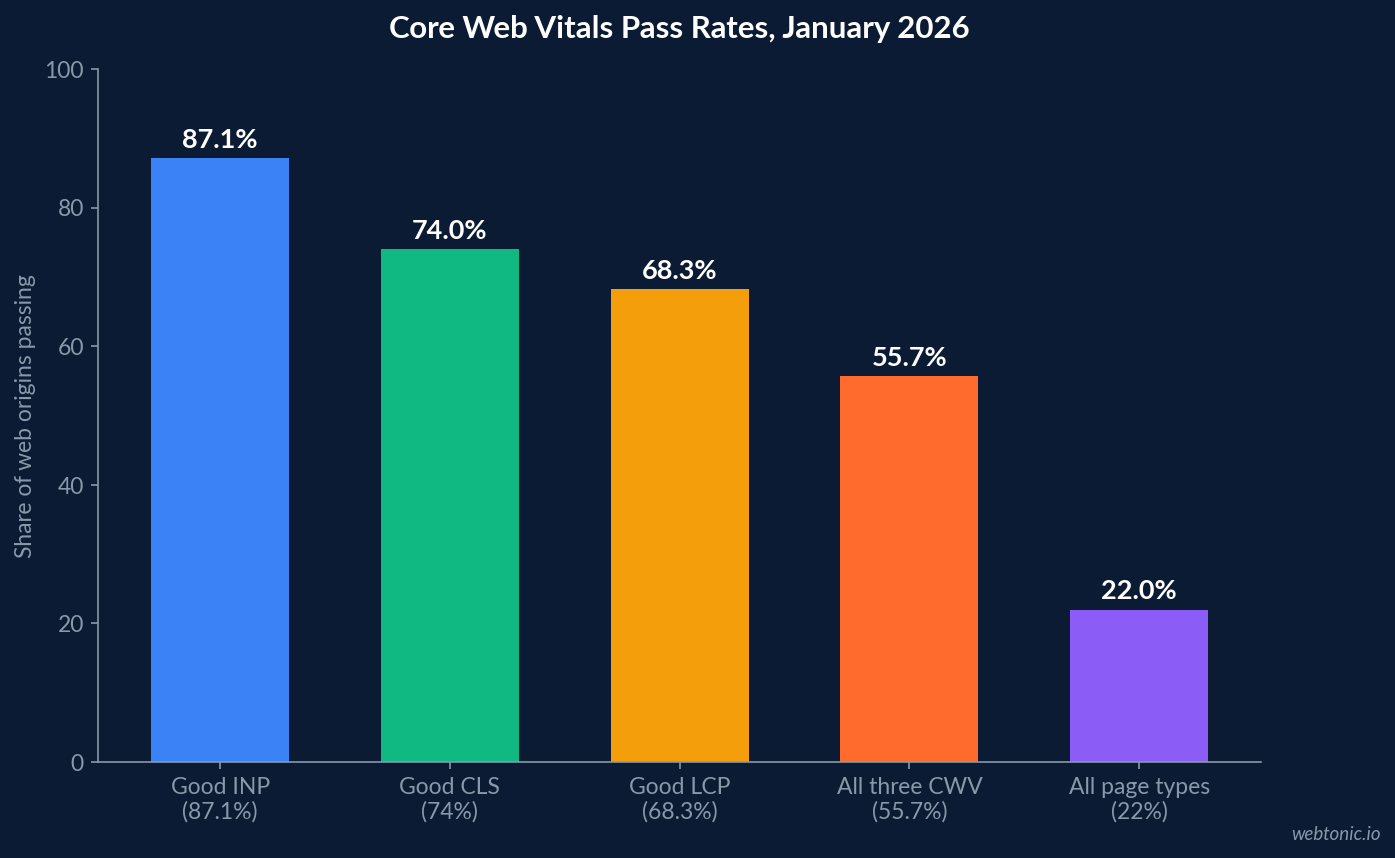
- 55.7% of web origins pass all three Core Web Vitals in January 2026, but only about 22% pass when every page type is measured — and location pages are exactly those deep pages.
- 43% of sites still fail the 200ms INP threshold, making INP the most commonly failed Core Web Vital on the open web.
- Poor site architecture wastes roughly 40% of crawl activity on URLs that will never rank — a compounding cost on networks with hundreds of location URLs.
- 73% of pages with good Core Web Vitals rank in the top 10 versus 53% of pages with poor scores, so speed acts as a tiebreaker at scale.
- Google Business Profile signals carry 32% of local pack ranking weight, the single largest factor, and consistent listing data drives 1.4–2.0x higher engagement.
- Only 68% of business contact details returned by ChatGPT and Perplexity match Google Business Profile data, creating a measurable AI-visibility gap.
Franchise Technical SEO Benchmarks at a Glance
These are the reference numbers we use when auditing a multi-unit network. Treat them as directional targets rather than guarantees: category, market density and domain authority all move the baseline.
| Metric | 2026 Benchmark | Source |
|---|---|---|
| Location pages in top-3 local pack | <30% of pages | Authority Specialist |
| Origins passing all three Core Web Vitals | 55.7% (Jan 2026) | theStacc / CrUX |
| Pages passing all three CWV (page-level) | 42–47% | Searchlab / HTTP Archive |
| Sites failing the 200ms INP threshold | 43% | theStacc / CrUX |
| Median load time of Google top-10 results | 1.65 seconds | Searchlab / Backlinko |
| Crawl activity wasted by weak architecture | ~40% | Siteoscope |
| GBP share of local pack ranking weight | 32% | BizIQ / Whitespark |
| Time to meaningful organic movement | 4–9 months | Authority Specialist |
Core Web Vitals: Why Templates Decide the Score
On a single-location site, Core Web Vitals is a page problem. On a franchise site it is a template problem. A template change that adds 800ms to Largest Contentful Paint affects every location page simultaneously, which is why performance monitoring belongs at the template level rather than the URL level (SEO Brothers).
The open-web baseline gives you the context for how hard this is. 55.7% of all web origins passed every Core Web Vital in January 2026, up from roughly 50% in early 2024 and 36% in 2022, yet only 21.98% of origins pass when every page type is measured rather than the home page alone. 43% of sites still fail the 200ms INP threshold, and 68.3% of origins have good LCP — the weakest of the three metrics (theStacc / CrUX 2026). Since March 2026 Google also evaluates Core Web Vitals at origin level, so domain-wide failures can drag down pages that individually pass.
The ranking and revenue case is well quantified. 73% of pages with good CWV scores rank in the top 10, versus 53% of pages with poor scores; the median load time of a Google top-10 result is 1.65 seconds (1.4s for the top three); 53% of mobile visitors abandon a page that takes longer than three seconds; and every extra second of load time costs roughly 7% of conversions (Searchlab 2026).
Mobile is where franchise templates break. Average LCP is 2.1 seconds on desktop versus 3.8 seconds on mobile — an 81% gap, and mobile Time to First Byte averages 1.4 seconds against 0.8 seconds on desktop. With 63.4% of web traffic now mobile and 100% of sites on mobile-first indexing, the mobile render of the location template is the version Google ranks.
Page Weight, Images and the Franchise Hero Problem
Franchise location templates are image-heavy by design: hero photography, franchisee headshots, trust badges, map embeds. That is expensive. The average web page is 2.3MB in 2026, up 18% since 2023, and images account for 48% of total page weight. Two fixes pay back fastest across a network: next-gen formats (WebP, AVIF) cut file size 30–50% with no visible quality loss, and a CDN reduces average TTFB by 52% while improving LCP by 33%. Lazy loading is still only used by 34% of websites, which makes it one of the cheapest remaining wins for a templated network.
Platform choice matters too. Only 54% of mobile pages pass LCP on WordPress against 67% on desktop — the widest platform gap in CrUX — while e-commerce sites are the worst performers overall at 31% passing all three CWV, versus 54% for informational sites. Franchise sites that bolt an online ordering or booking flow onto a marketing template inherit both problems at once. If a rebuild is on the table, our data intelligence team benchmarks template performance before and after so the gain is measurable.
| Technical lever | Measured impact | Effort across a network |
|---|---|---|
| Convert images to WebP/AVIF | 30–50% smaller files | Low — template + CDN rule |
| Add a CDN | TTFB −52%, LCP −33% | Low — one-time |
| Lazy-load below-fold media | Used by only 34% of sites today | Low — template attribute |
| Fix LCP from 4s to 2s | +15% conversion rate, +8% pageviews/session | Medium |
| Reduce main-thread JavaScript (INP) | Each 100ms INP gain = +3.8% session duration | Medium–high |
| Template-level CWV monitoring | Catches regressions before they hit every location | Low ongoing |
Crawl Budget and Indexation Across Hundreds of URLs
A 300-unit franchise with service and city permutations can generate tens of thousands of crawlable URLs. Weak architecture wastes roughly 40% of crawl activity on paginated views, internal search results and filtered URLs that will never rank, and strategic internal linking from already-indexed pages is what gets new location content discovered in hours or days instead of weeks (Siteoscope 2026).
The two Search Console statuses that matter most on franchise audits are "Crawled — currently not indexed" and "Duplicate without user-selected canonical". Both are symptoms of the same root cause: pages that do not differentiate enough to earn an index slot (Ranktracker). When location pages share body copy with only the city swapped, Google reads it as thin duplicate content and may deindex the page or rank the wrong one for a local query (Vendasta).
| Symptom in GSC | Most likely franchise cause | Fix |
|---|---|---|
| Crawled — currently not indexed | Templated copy with city-swap only | Rewrite 40–60% of body per location: staff, service mix, local proof |
| Duplicate without user-selected canonical | Service pages duplicated per city | Consolidate or self-canonicalise with unique intent per URL |
| Discovered — currently not crawled | Orphaned location URLs | Link from state hub, sitemap segment, and nearby locations |
| Alternate page with proper canonical | www/non-www or trailing-slash variants | Enforce one canonical host and one URL pattern |
| Soft 404 | Location page with no unique content or stock | Add unique services, hours, reviews and local content blocks |
| Excluded by noindex | Staging or franchisee-built pages pushed live | Governance: template lock + pre-launch checklist |
New units should never launch cold. A new location should go live with a defined URL, correct schema, internal links, a Business Profile, a citation plan, local content elements and a review-acquisition plan already in place — that launch checklist is what separates systems that rank in three months from systems that take twelve (ALM Corp).
Structured Data, NAP Consistency and AI Search
Schema is where technical SEO now feeds AI visibility. Location pages should use the most specific LocalBusiness subtype for the category — MedicalBusiness, LegalService, FinancialService, Restaurant — and BreadcrumbList to place each page in the hierarchy, with an explicit distinction between physical storefronts and service-area businesses (Foragentis).
The consistency data explains why this is urgent. Google Business Profile signals account for 32% of local pack ranking weight — the single largest factor — and multi-location brands with consistent listing data across directories see 1.4–2.0x higher engagement than those with inconsistent data. Meanwhile, consumers using ChatGPT to find local businesses grew from 6% in January 2025 to 45% in January 2026, and only 68% of the business contact information surfaced by ChatGPT and Perplexity matches Google Business Profile data (BizIQ 2026). Every mismatched suite number is now an answer-engine error, not just a directory error.
Google Business Profile actions rose 41% year over year, and 94% of high-performing multi-location brands run a dedicated local marketing strategy versus 60% of average performers — a 34-point strategy gap that shows up directly in ranking outcomes. In Search Engine Journal's multi-location visibility framework, page performance carries roughly 7% of the weighting on its own; the compounding value comes from combining speed with clean entity data (SEJ).

Franchise Sites vs the Web: Where the Gaps Are Widest
Comparing franchise networks to the open-web baseline shows the pattern clearly: franchise sites usually have better infrastructure than the average website and worse page-level differentiation.
| Signal | Open-web baseline | Typical franchise network | Implication |
|---|---|---|---|
| All three CWV passing | 55.7% of origins | Template-dependent — one template sets every score | Fix once, gain everywhere |
| HTTPS on top-10 results | 95.6% of pages | Near-universal on brand domains | Rarely the bottleneck |
| Responsive design | 92% of sites | Standard in franchise templates | Rarely the bottleneck |
| Unique page-level content | Varies by site | Lowest-scoring signal — city-swap copy is the norm | Highest-ROI fix |
| Indexation of deep pages | ~22% of origins pass CWV on all page types | Location pages are the deep pages | Audit location URLs, not the home page |
| Entity/NAP consistency | 68% AI-to-GBP match rate | Degrades with every ownership change | Governance problem, not a one-off fix |
A Technical SEO Priority Order for Multi-Unit Brands
Sequence matters more than completeness. Based on the benchmarks above, this is the order that produces measurable movement fastest across a network:
- Audit the location template, not the home page. Deep pages are where the 22% all-page-type pass rate bites.
- Kill crawl waste. Noindex paginated, filtered and internal-search URLs to reclaim the ~40% of crawl activity being burned.
- Ship the image and CDN fixes. 30–50% file-size cuts and 52% lower TTFB for one implementation.
- Differentiate 40–60% of each location page. Uniqueness is the single most consistent predictor of location-level ranking.
- Standardise schema and NAP so the 32% GBP weighting and AI answer engines read the same entity.
- Monitor at the template level so an 800ms regression never reaches every location unnoticed.
- Instrument the reporting. Track indexation, CWV and local pack position per location — not one site-wide average.
Expect four to nine months for significant organic traffic movement, with local pack visibility landing in three to six months in moderate markets and nine to twelve months in dense metros. Teams that want the paid and organic sides modelled together can pair this with our Google Ads benchmarks and the 2026 Google Ads cost guide.
Frequently Asked Questions
What is the biggest technical SEO problem for franchise websites?
Templated duplication. When location pages share the same body copy with only the city name swapped, Google treats them as thin or duplicate content and either suppresses them or picks the wrong page to rank. Across the 41 multi-location brands analysed by Authority Specialist for 2026, fewer than 30% of individual location pages rank in the top three local pack results for their own primary service term in their own territory. Uniqueness of on-page content is the most consistent predictor of location-level ranking performance.
How many websites actually pass Core Web Vitals in 2026?
It depends on how you measure. Origin-level CrUX data puts the share of origins passing all three Core Web Vitals at 55.7% in January 2026, while HTTP Archive's page-level Web Almanac analysis reports 42% to 47% depending on the threshold used, and only about 22% of origins pass when every page type is measured rather than the home page. For a franchise network the page-level number matters more, because location pages are the deep pages that usually fail.
Why do franchise location pages get 'crawled, currently not indexed'?
Because Google discovered the page, evaluated it, and decided it did not add enough unique value to justify an index slot. The usual causes on franchise sites are near-identical templated copy, orphaned pages with no internal links, faceted or filtered URLs consuming crawl budget, and canonical tags pointing away from the location page. Architecture problems alone can waste around 40% of a site's crawl activity on URLs that will never rank.
Which schema markup should franchise location pages use?
Use the most specific LocalBusiness subtype available for the category — MedicalBusiness, LegalService, FinancialService, Restaurant, HomeAndConstructionBusiness — rather than generic LocalBusiness, plus BreadcrumbList to link each location page into the site hierarchy. Include NAP data that matches the Google Business Profile exactly: only 68% of business contact details surfaced by ChatGPT and Perplexity currently match GBP data, which is a direct AI-visibility risk for brands with inconsistent listings.
How long does technical SEO take to show results across a franchise network?
Franchise SEO programmes typically take four to nine months before significant organic traffic movement, and local pack visibility for a primary category takes three to six months in moderate-competition markets and nine to twelve months in dense urban markets. Template-level technical fixes are the exception: because they deploy to every location page at once, speed and indexation improvements often show up in Search Console within two to four weeks.
Sources
Authority Specialist — Franchise SEO Benchmarks: 2026 Data from 41 Multi-Location Brands
Searchlab — Technical SEO Statistics 2026
theStacc — Core Web Vitals Statistics 2026
BizIQ — Multi-Location SEO Statistics 2026
Siteoscope — Crawl Budget & Site Architecture Waste
Vendasta — SEO for Franchise Websites 2026
SEO Brothers — Franchise SEO: Multi-Location Architecture
Ranktracker — The Franchise SEO Audit
Foragentis — Multi-Location SEO: Six-Pillar Framework
Search Engine Journal — Multi-Location Search Visibility
ALM Corp — Franchise SEO Challenges in 2026