



Table of contents

A franchise operator's international SEO budget is mostly a rollout cost: one URL decision, one hreflang system and a set of translated location pages per country. No survey publishes what franchisors spend on it. What is published is the share of franchise budgets going to websites (12%), Google's own rules for multi-country sites, and translation list prices, and that is what this page uses. For brands that only operate in the US, the multilingual question is Spanish-language local pages, not sites abroad.
Key Takeaways
- Websites take 12% of franchise marketing budgets; digital ads take 42% (AFMR 2025).
- Search PPC receives 36% of franchise budgets and social ads 29%.
- 85% of franchisors recommend or require franchisee local marketing spend; 48% leave tracking to franchisees.
- Papa John's ran 6,083 restaurants in 50 countries and territories at the end of fiscal 2025.
- 2,560 of them, about 42%, sat in its International segment.
- It opened 183 and closed 139 international restaurants in 2025.
- US franchise establishments are projected to grow from 832,521 to 845,000 in 2026 (IFA).
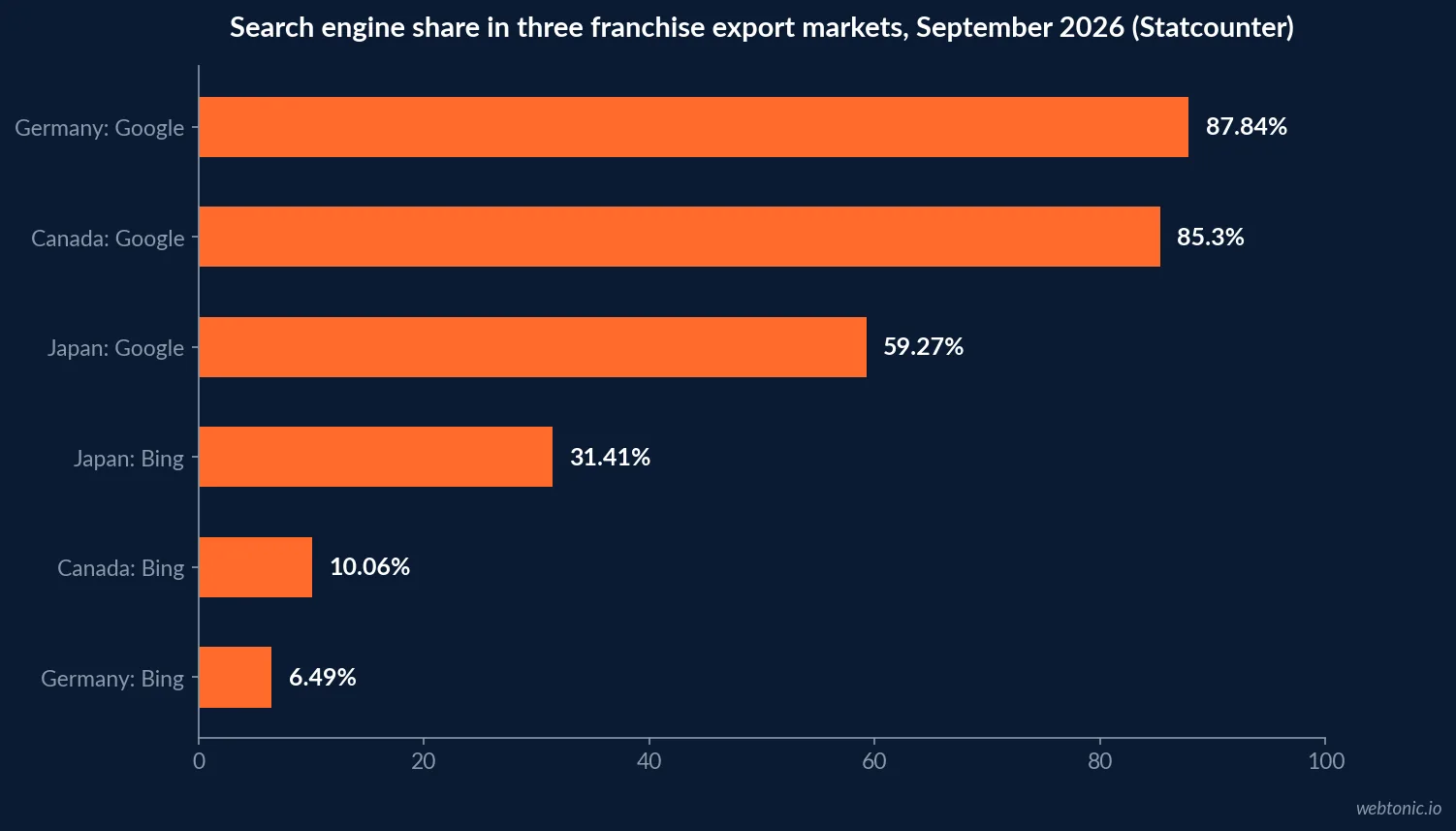
- Google holds 87.84% of search in Germany but 59.27% in Japan (Statcounter, September 2026).
Franchise international SEO at a glance
| Figure | Value | Source | Why it matters for a rollout |
|---|---|---|---|
| Website share of franchise marketing budget | 12% | AFMR 2025 via Franchising.com | The pool an international site draws from |
| Search PPC share | 36% | AFMR 2025 | Paid search can test a market first |
| Franchisors leaving local tracking to franchisees | 48% | AFMR 2025 | Country partners may not report SEO results |
| Papa John's international restaurants | 2,560 of 6,083 | Papa John's FY2025 10-K | A franchise brand with a large footprint abroad |
| US franchise establishments, 2026 projection | 845,000 | IFA Franchising Economic Outlook | Domestic growth is 1.5% |
What franchise budgets fund today
Franchise Update Media's 2025 Annual Franchise Marketing Report (AFMR), a questionnaire survey of franchise executives published in October 2025, put digital ads at 42% of total marketing budgets and social media at 22%, with websites at 12%, PR 8%, print 8%, broadcast 7%, community events 7% and direct mail 3%. Within digital, 36% goes to search engine PPC and 29% to social ads. International SEO has no line of its own; it is funded from the website share or from a market-entry budget held by a master franchisee.
| Channel (AFMR 2025) | Share of franchise marketing budget | Role in a new country |
|---|---|---|
| Digital ads | 42% | Fast demand test before organic content |
| Social media | 22% | Awareness while pages index |
| Websites | 12% | Locale URLs, hreflang, location pages |
| PR | 8% | Local links and citations |
| 8% | Rarely relevant to search | |
| Community events | 7% | Local mentions, reviews |
The local-spend gap carries abroad
The same research found 85% of respondents recommend or require franchisees to invest in local marketing, but 48% leave it to franchisees to track and manage that effort independently. In a multi-country system the gap widens: a master franchisee in Germany or Japan may run its own site and its own agency, and the brand loses sight of how its name ranks there. Budgeting for a shared international template, hreflang ownership and reporting is usually cheaper than reconciling a dozen independent sites later.
One franchisor's footprint abroad
Public filings show what an international franchise system looks like. In its fiscal 2025 Form 10-K, Papa John's reports 6,083 restaurants "operating in 50 countries and territories", of which 5,608 were franchised. Its International segment, "all restaurant operations outside of the United States and Canada", had 2,560 restaurants: 13 company-owned in the United Kingdom and 2,547 franchised. During the year it opened 183 international restaurants and closed 139, for net growth of 44, while North America added a net 9. That is one brand, not a sector benchmark, but it shows why the site architecture has to handle dozens of markets run mostly by franchise partners.
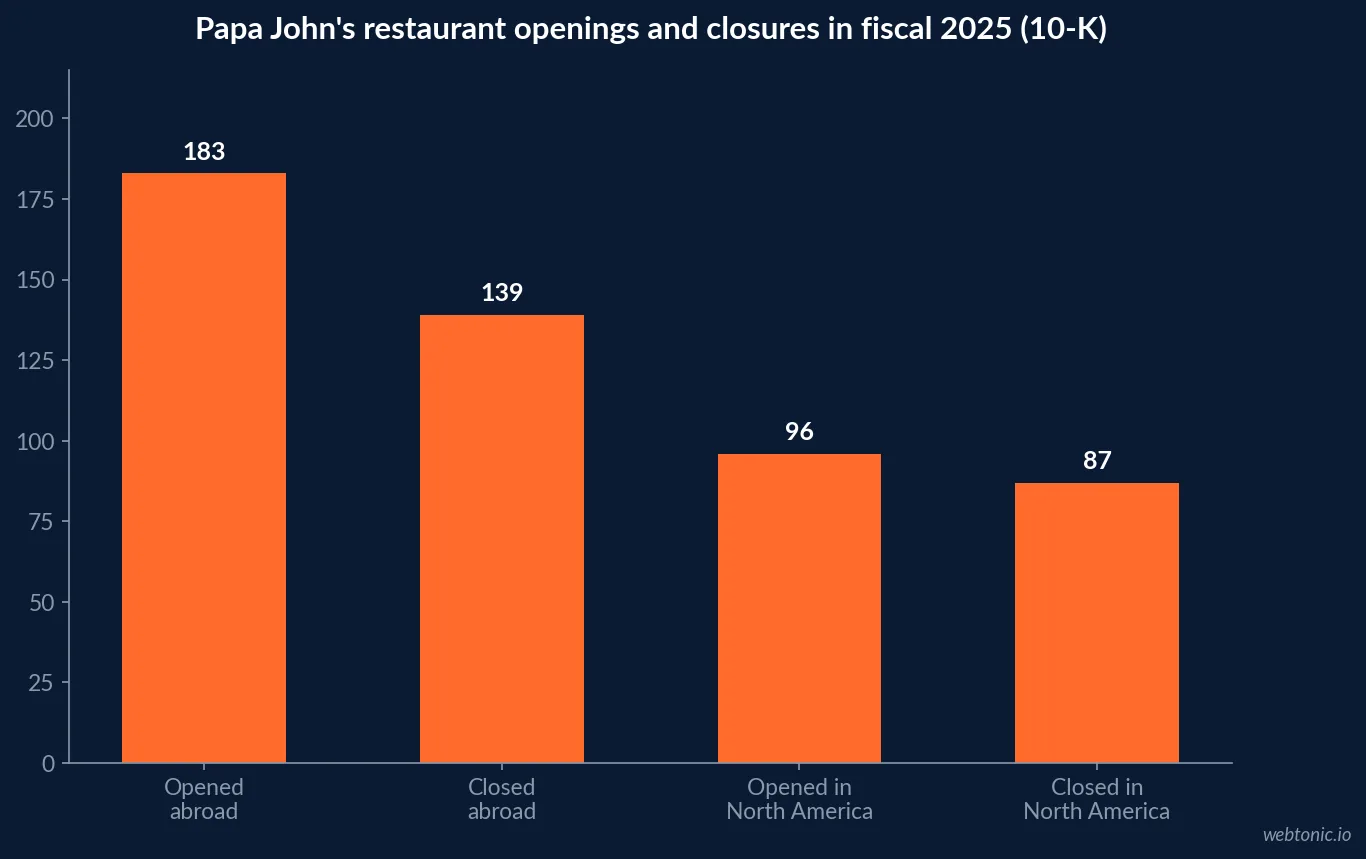
| Papa John's FY2025 (10-K) | North America | International | System-wide |
|---|---|---|---|
| Restaurants at Dec 29, 2024 | 3,514 | 2,516 | 6,030 |
| Opened | 96 | 183 | 279 |
| Closed | 87 | 139 | 226 |
| Restaurants at Dec 28, 2025 | 3,523 | 2,560 | 6,083 |
| Net change | +9 | +44 | +53 |
Choosing the URL model
Google Search Central sets out three structures and does not rank one above the others. The choice for a franchise usually follows the contract: who owns the domain, who hosts it, and who pays for it. A brand that keeps every market on one domain gets one technical team, one hreflang system and shared authority, but it has to give partners a workflow for local edits. A brand that lets each master franchisee run a country domain gets local ownership, but each site starts with its own link profile and its own maintenance bill. Neither model is cheaper in every case, which is why the contract terms, not an SEO preference, should settle it before any translation spend.
| Structure (Google example) | Google's listed pros | Google's listed cons | Franchise fit |
|---|---|---|---|
| Country domain (example.de) | Clear geotargeting; server location irrelevant; easy separation | Expensive; more infrastructure; strict ccTLD rules; one country only | Master franchisee runs its own market |
| Subdomain (de.example.com) | Easy to set up; different server locations; easy separation | Users may not tell language from country | Partner-hosted sites under the brand domain |
| Subdirectory (example.com/de/) | Easy to set up; low maintenance on the same host | Users may not recognize geotargeting from the URL alone | Brand-run sites with central control |
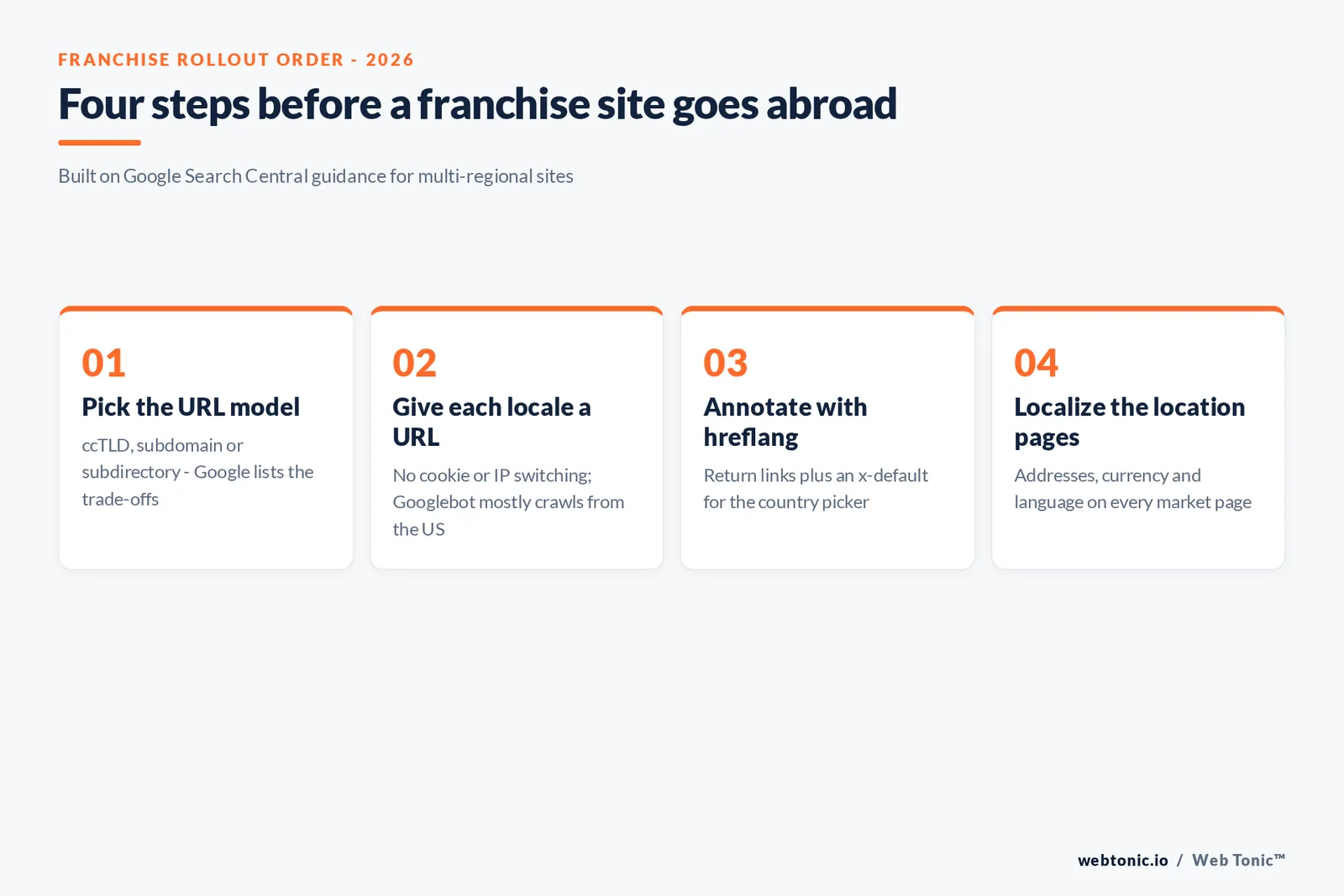
Rules that decide whether locations get crawled
Location finders that switch content by visitor country are a common franchise pattern, and Google warns about it directly. Its locale-adaptive pages guide says Google "might not crawl, index, or rank all your content for different locales" because Googlebot's default IP addresses appear to be US-based and it sends requests without an Accept-Language header. The multi-regional guide adds "Don't use IP analysis to adapt your content." Its hreflang documentation defines x-default for pages that match no listed language, such as a global country picker. Google also deprecated the Search Console International Targeting report, saying it "will continue to support and use hreflang tags".
- Give every country and language version its own crawlable URL.
- Link versions bidirectionally; Google processes the ones that point to each other.
- Show a country selector instead of auto-redirecting.
- Keep one language per location page.
Search engine share in common franchise markets
Statcounter data for September 2026 shows Google at 87.84% in Germany and 85.3% in Canada, but only 59.27% in Japan, where Bing holds 31.41%. In the US Google held 86.1% in August 2026. A franchise entering Japan should therefore budget for Bing Webmaster Tools and local listings alongside Google.
What AI answers change for location searches
Franchise discovery leans on "near me" and brand-plus-city searches, and those results are changing. In Pew Research Center's March 2025 browsing data, US users clicked a traditional result on 8% of visits with an AI summary and 15% without one. Ahrefs measured the top result's click-through rate falling 34.5% when an AI Overview appeared (April 2025) and 58% in its February 2026 update on December 2025 data. SparkToro and Datos estimated 58.5% of US Google searches ended without a click in 2024. All three are US, English-language studies; none measures French, German or Japanese franchise searches, and we found no published study that does. The safe reading is directional: in every market, more of the decision happens on the results page, so the location page has to carry accurate hours, address, menu or service list and prices in the local language, because that is the material search features and AI answers pull from.
That also changes how a franchisor should judge a country site. Rankings and clicks will understate its value if visitors get what they need from a map pack or a summary and then call or walk in. Budget for call and direction tracking per market from day one, rather than relying on organic sessions alone, and agree with each master franchisee who owns that data before the site launches.
Translation list prices for multi-country systems
Franchise sites carry many near-identical location pages, so word allowances matter more than language counts. List prices from Weglot's pricing page in October 2026 (USD shown as an estimate of the euro price):
| Weglot plan | Monthly list price | Languages | Words | Typical franchise use |
|---|---|---|---|---|
| Pro | USD 87 (EUR 79) | 5 | 200,000 | US Spanish pages plus a few markets |
| Advanced | USD 329 (EUR 299) | 10 | 1,000,000 | Regional rollout, one region |
| Extended | USD 769 (EUR 699) | 20 | 5,000,000 | Global system with many location pages |
Language still affects sales: CSA Research found in 2020 that 76% of online shoppers prefer product information in their native language and 40% will never buy from websites in other languages. That survey was about online purchases, not restaurant or service visits, so it supports translating menus, offers and booking flows rather than proving a footfall effect.
Domestic growth and the Spanish-language case
The IFA Franchising Economic Outlook projects establishments growing from 832,521 to 845,000 units, a 1.5% rise, with output up 1.6% to USD 921.4 billion. For a US-only system the multilingual audience is local: the Census Bureau's 2018-2022 ACS shows 78.3% of people age 5+ speak only English at home and Spanish accounts for 61.1% of those who speak another language. Spanish versions of location pages are usually the first multilingual budget line.
How to set the budget
- Map which countries are brand-run and which belong to master franchisees.
- Choose the URL model per country from Google's trade-offs and the contract.
- Count location pages per market to pick a translation tier.
- Fund hreflang ownership and reporting centrally; 48% of franchisors leave local tracking to franchisees.
- Test new markets with paid search before content, as 36% of franchise budgets already sit in PPC.
Our franchise enterprise SEO data covers multi-location SEO at home, and the franchise app store data covers ordering apps. For rollout planning across channels, see growth marketing.
Frequently Asked Questions
How much of a franchise marketing budget goes to the website?
In Franchise Update Media's 2025 Annual Franchise Marketing Report (AFMR), reported by Franchising.com in October 2025, websites take 12% of franchise marketing budgets, digital ads 42% and social media 22%. Within digital, 36% goes to search PPC and 29% to social ads. No survey breaks out international or multilingual SEO, so treat the 12% website line as the pool an international site rollout competes for.
Should a franchise use country domains or subfolders?
Google's multi-regional documentation lists trade-offs rather than a rule. Country-code domains give clear geotargeting but are expensive, need more infrastructure and can only target a single country. Subdomains are easy to set up and allow different server locations. Subdirectories are easy to set up and low maintenance on the same host. Master franchise agreements that hand a country to a local partner often favour a ccTLD the partner can run.
Can a franchise site redirect visitors by IP address?
Google advises against it. Its guidance says IP location analysis is 'difficult and generally not reliable', that most Google crawls originate from the US, and that automatic redirects can stop users and search engines seeing all versions. Use separate locale URLs, hreflang and a visible country selector.
What does it cost to translate a multi-country franchise site?
Translation proxy list prices are public. Weglot's pricing page (October 2026) lists USD 329 a month for ten languages and 1,000,000 words and USD 769 for twenty languages and 5,000,000 words, with USD shown as an estimate of the euro price. Location pages multiply word counts, so check allowances against the number of units per country.
Is the US franchise sector growing fast enough to need international SEO?
Domestically, the IFA's 2026 outlook projects franchise establishments rising from 832,521 to 845,000 units, a 1.5% increase. International SEO matters for brands that already sell master or area development rights abroad; for most domestic franchisors, Spanish-language local pages in the US are the first multilingual step.
Sources
Franchising.com - 2025 AFMR findings
Papa John's - Fiscal 2025 Form 10-K
International Franchise Association - Franchising Economic Outlook
Google Search Central - Multi-regional sites
Google Search Central - Locale-adaptive pages
Statcounter - Search engine share
Weglot - Pricing
CSA Research - Consumers prefer their own language
US Census Bureau - Language spoken at home
Pew Research Center - AI summaries and clicks
Ahrefs - AI Overviews and clicks


