



Table of contents
Franchise-specific organic CPL, CTR and conversion benchmarks are not published by any issuer, so this page uses the closest labelled data: local and AI visibility across multi-location brands, cross-industry click studies, and paid search comparators. Each table says which kind of number it is.
Key Takeaways
- US franchise units are forecast to grow from 832,521 to 845,000 in 2026.
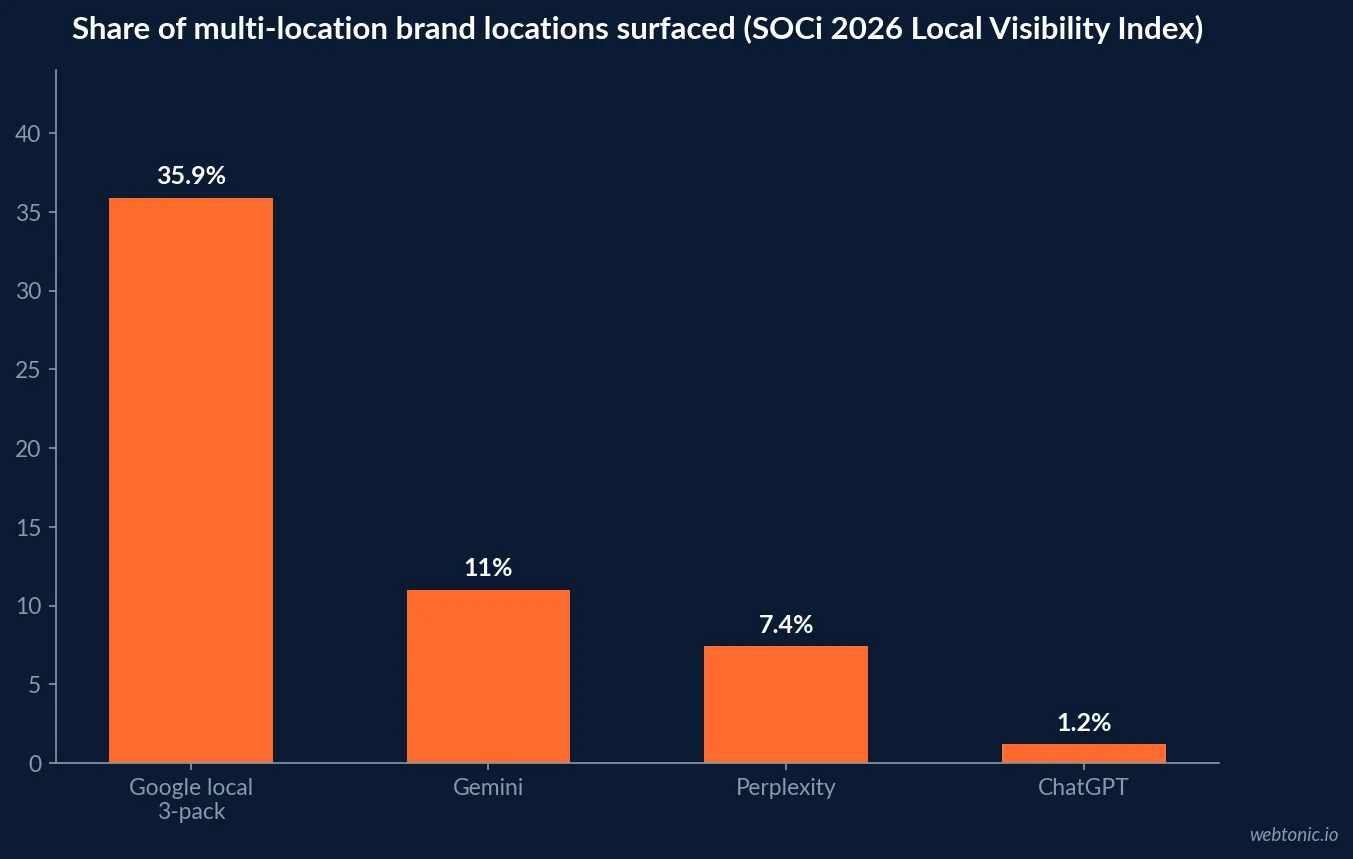
- Multi-location brands appear in the local 3-pack 35.9% of the time.
- ChatGPT recommends 1.2% of brand locations; Gemini 11.0%; Perplexity 7.4%.
- Google Maps supplies 32.5% of AI citations for local queries.
- Paid search averages USD 66.69 per lead across industries in 2026.
- Franchisors put 36% of budgets into search PPC and 12% into websites.
- 48% of franchisors leave local marketing tracking to franchisees.
- Top-result CTR runs 34.5% lower where an AI Overview shows.
How big the franchise footprint is
The IFA 2026 Franchising Economic Outlook forecasts franchise establishments rising from 832,521 to 845,000 units, up 1.5%, with output rising from USD 907.3 billion to USD 921.4 billion and employment reaching nearly 8.9 million jobs. Every one of those units is a potential map listing, location page and review profile, which is what makes franchise SEO an enterprise problem even when each unit is a small business.
| IFA 2026 outlook measure | 2025 | 2026 forecast | Change |
|---|---|---|---|
| Franchise establishments | 832,521 | 845,000 | +1.5% |
| Franchise output | USD 907.3B | USD 921.4B | +1.6% |
| Franchise GDP | USD 549.9B | USD 558.4B | +1.8% |
| Franchise employment | About 8.75M | Nearly 8.9M | +150,000 jobs (1.8%) |
| Implication | More units | More profiles and pages | More listings to keep accurate |
Local and AI visibility benchmarks
SOCi's 2026 Local Visibility Index analysed more than 350,000 locations across 2,751 multi-location brands. On average brands appeared in Google's local 3-pack 35.9% of the time, while ChatGPT recommended just 1.2% of locations, which SOCi describes as nearly 30 times more selective. In its franchise listings breakdown SOCi adds Gemini at 11.0% and Perplexity at 7.4%. SOCi sells listings software to these brands, so this is vendor research with a large, stated sample.
Where AI answers get their local data
SOCi's franchise analysis breaks down the sources AI platforms cite for local queries: Google Maps 32.5%, niche directory sites 26.3%, brand websites 23.1%, Yelp 10.5% and Facebook 7.6%. For a franchisor this is the traffic-mix question in a new form: the brand website is under a quarter of what AI engines read, and listings on platforms the franchisor does not own make up most of the rest.
| Source cited by AI for local queries | Share of AI citations | Who controls it |
|---|---|---|
| Google Maps | 32.5% | Franchisor or franchisee via Business Profile |
| Niche directory sites | 26.3% | Listings management |
| Brand websites | 23.1% | Franchisor |
| Yelp | 10.5% | Location-level claims |
| 7.6% | Location pages |
Click-through rate: what is measured and what is not
No study publishes organic CTR for franchise queries. The strongest recent issuer study is Ahrefs' 2025 AI Overviews analysis of 300,000 keywords: for informational queries the top-ranking page averaged about 2.6% CTR where an AI Overview appeared against a forecast of about 4.0% without one, a 34.5% reduction. Ahrefs notes 99.2% of keywords triggering AI Overviews are informational, so "near me" and booking queries are less exposed than a franchise's blog content.
SparkToro's 2024 study adds the ceiling: 58.5% of US Google searches ended without a click, and only 360 of every 1,000 searches sent a click to the open web.
Paid cost per lead as the comparator
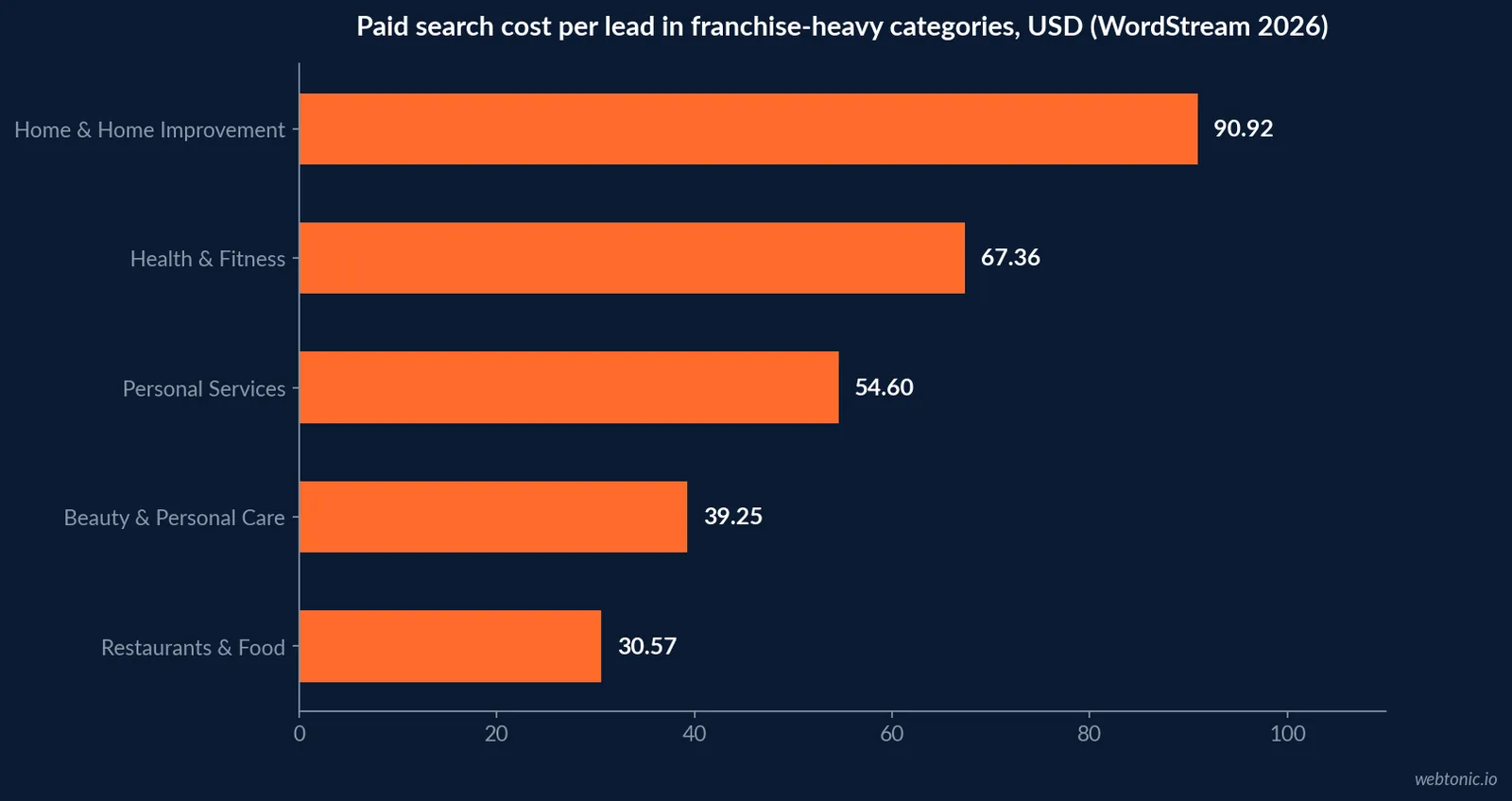
Because organic CPL is not published, the defensible comparison is paid search. WordStream's 2026 Google Ads benchmarks (LocaliQ vendor data, Google and Microsoft Ads) put the all-industry average at USD 66.69 per lead, USD 5.42 per click, 6.64% CTR and 8.18% conversion. The categories where franchise systems cluster vary widely: Restaurants and Food USD 30.57, Beauty and Personal Care USD 39.25, Personal Services USD 54.60, Health and Fitness USD 67.36 and Home and Home Improvement USD 90.92.
The spread matters more than the average. A quick-service restaurant brand and a home-services brand can both be "franchise", yet their paid leads differ by a factor of three, so any organic business case should be priced against the category the system actually sells in. It should also be priced per unit: a system-wide paid average hides territories where competition pushes costs far above it, which are usually the territories where strong unit pages and profiles earn the most.
| WordStream 2026 category (paid) | Avg cost per lead | Avg CTR | Avg CPC |
|---|---|---|---|
| Restaurants & Food | USD 30.57 | 6.83% | USD 2.05 |
| Beauty & Personal Care | USD 39.25 | 6.75% | USD 4.62 |
| Personal Services | USD 54.60 | 7.16% | USD 7.17 |
| Health & Fitness | USD 67.36 | 5.81% | USD 6.17 |
| Home & Home Improvement | USD 90.92 | 6.47% | USD 8.33 |
How franchisors split the budget
The 2025 Annual Franchise Marketing Report (AFMR), Franchise Update Media's survey of franchise marketing leaders presented at its June 2025 Franchise Customer Experience Conference and published on its Franchising.com site, found digital ads at 42% of total marketing budgets, social media at 22%, websites at 12%, and print and PR at 8% each. Within digital, 36% of budgets went to search engine pay-per-click and 29% to social advertising. 85% recommend or require franchisee local spend, yet 48% leave its tracking to franchisees, and 90% now monitor online reviews, up from 75% a year earlier.
| AFMR 2025 budget or practice | Figure | Enterprise SEO reading |
|---|---|---|
| Digital ads share of budget | 42% | Paid dominates the media plan |
| Search PPC share of budget | 36% | Paid search is the largest single line |
| Websites share of budget | 12% | Organic infrastructure is a minority line |
| Require or recommend local spend | 85% | Local SEO often funded at unit level |
| Leave local tracking to franchisees | 48% | Organic results rarely roll up centrally |
Managing hundreds of profiles
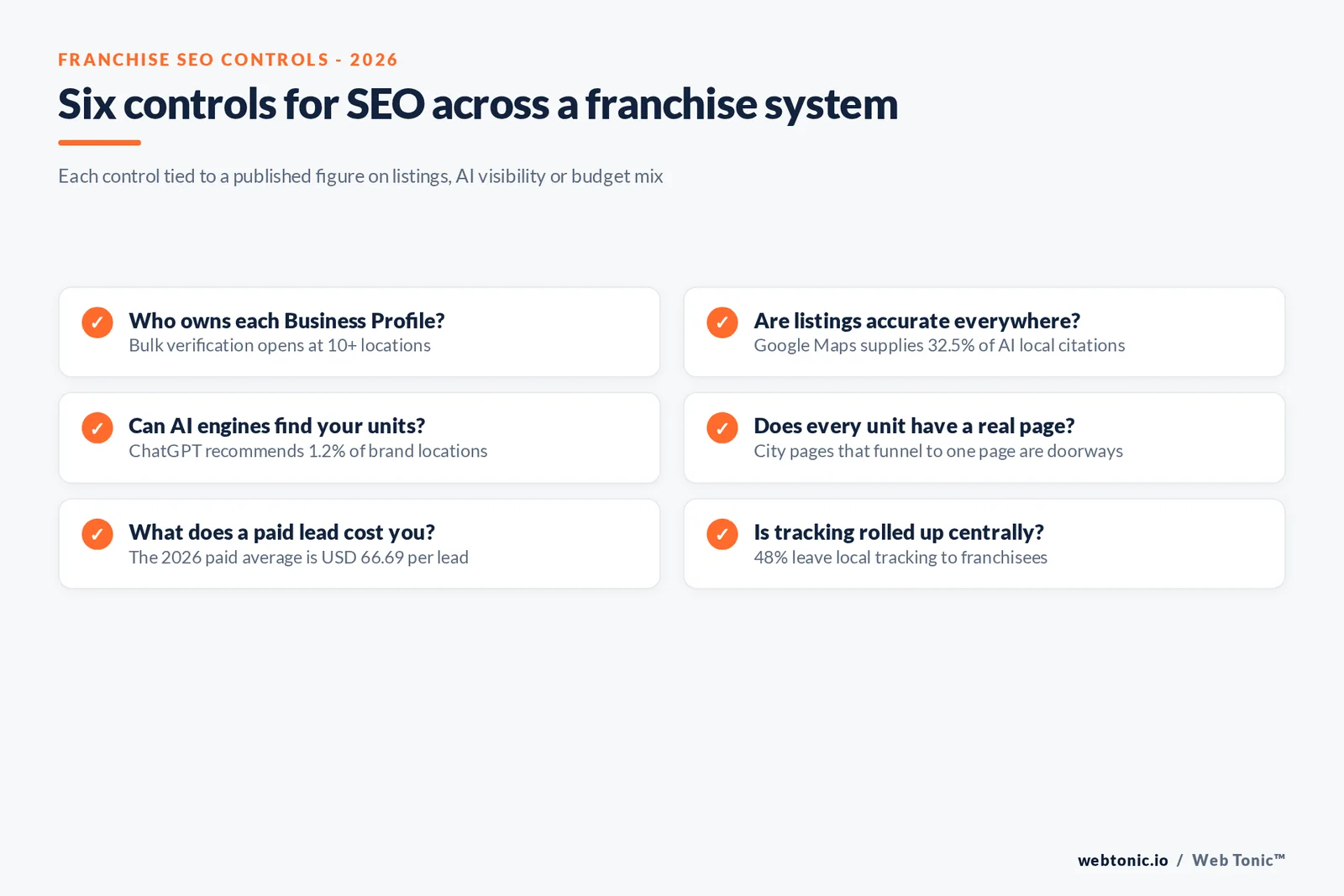
Google Business Profile offers bulk verification once a brand has 10 or more locations of the same business; duplicate, suspended and disabled profiles do not count, and agencies holding several businesses in one account cannot bulk verify. For a franchisor the harder question is ownership: whether the brand, the franchisee or an agency holds each profile, and who can edit hours, categories and photos.
That ownership question decides whether the listings data AI engines read is consistent. SOCi's index found the brand website is only 23.1% of cited sources for local queries, so a franchisor that controls its own site but not its profiles controls less than a quarter of what shapes AI answers. Written profile standards in the franchise agreement or operations manual, covering categories, naming, hours and photo rules, are the enterprise answer: they turn hundreds of independent owners into one consistent data set.
Unit pages, doorways and franchise development pages
Google's spam policies list pages "targeted at specific regions or cities that funnel users to one page" as doorway abuse. Unit pages with their own address, staff, hours, reviews and booking avoid that; territory pages with no unit behind them do not. Franchise development content has its own constraint: the FTC Franchise Rule, 16 CFR 436 requires the disclosure document at least 14 calendar-days before a prospect signs or pays, so "own a franchise" pages should route to that process rather than promise outcomes.
Traffic metrics to track at unit and system level
Because the published benchmarks stop at visibility and paid cost, a franchisor's own traffic metrics carry the weight. Pew Research Center found users who saw an AI summary clicked a traditional result in 8% of visits against 15% without one, and clicked a link inside the summary in only 1% of visits. For a system with hundreds of units, that means sessions alone understate how often a location was seen and chosen: calls, direction requests and bookings from the profile matter as much as site visits.
The most useful structure is two layers. At unit level, track the actions a customer takes to reach that location. At system level, track whether the brand appears at all, in the 3-pack and in AI answers, because a unit cannot fix a brand-wide listings or schema problem on its own.
| Metric | Level | Why it matters | Published reference point |
|---|---|---|---|
| Local 3-pack appearance rate | System | Share of searches where units are visible | 35.9% average (SOCi 2026) |
| AI recommendation rate | System | Presence in ChatGPT, Gemini, Perplexity answers | 1.2% / 11.0% / 7.4% (SOCi 2026) |
| Profile calls and directions | Unit | Actions that never reach the website | No industry benchmark published |
| Organic sessions per unit page | Unit | Demand captured by the site | 8% vs 15% click rate with/without AI summary |
| Paid cost per lead | Unit and system | Comparator for organic value | USD 66.69 all-industry (WordStream 2026) |
What these benchmarks cannot tell you
There is no issuer dataset for franchise organic CPL, organic CTR by position for "near me" queries, or organic conversion rate, and we have not filled that gap with estimates. SOCi measures visibility, Ahrefs and SparkToro measure clicks across all industries, and WordStream measures paid costs. A franchisor's own benchmark has to come from rolling up Search Console, Business Profile insights and call tracking across units, which the 48% who leave tracking to franchisees cannot yet do.
The practical consequence is that most franchise systems compare a centrally measured paid CPL with an organic channel nobody measures consistently, and organic loses budget arguments by default. Fixing measurement usually comes before any argument about spend.
Priorities for a franchise SEO program
- Centralise profile ownership once past 10 locations and bulk-verify.
- Treat listings accuracy as AI visibility: Maps and directories carry 58.8% of AI local citations combined.
- Give every unit a real page, not a city doorway.
- Benchmark against paid: USD 66.69 average, category-specific where possible.
- Roll tracking up centrally instead of leaving it to franchisees.
Read our cross-industry enterprise SEO statistics, see franchise CTV advertising data for the paid video side, explore growth marketing or contact us.
Frequently Asked Questions
What is a good organic cost per lead for a franchise?
No issuer publishes an organic cost per lead for franchises, and we have not estimated one. The published numbers are paid comparators: WordStream's 2026 Google Ads benchmarks (LocaliQ vendor data) put the all-industry average at USD 66.69 per lead, with Restaurants and Food at USD 30.57, Personal Services at USD 54.60 and Home and Home Improvement at USD 90.92.
What click-through rate should franchise locations expect from organic search?
There is no franchise-specific organic CTR study. Ahrefs' 2025 analysis of 300,000 informational keywords found the top-ranking page's average click-through rate at about 2.6% where an AI Overview appeared, against a forecast of about 4.0% without one, a 34.5% gap. For paid search, WordStream's 2026 all-industry average CTR was 6.64%.
How visible are franchise locations in local and AI search?
SOCi's 2026 Local Visibility Index, covering about 350,000 locations of 2,751 multi-location brands, found brands in Google's local 3-pack 35.9% of the time on average, while ChatGPT recommended 1.2% of locations, Perplexity 7.4% and Gemini 11.0%. SOCi is a vendor to multi-location brands, so read this as vendor research.
How do franchisors split their marketing budgets?
The 2025 Annual Franchise Marketing Report, as reported by Franchising.com, found digital ads at 42% of total marketing budgets, social media at 22% and websites at 12%. Within digital, 36% of budgets went to search engine pay-per-click and 29% to social media advertising. 85% recommend or require local franchisee spend, but 48% leave tracking to franchisees.
Do location pages for every franchise unit risk a spam penalty?
Only if they behave like doorways. Google's spam policies name 'multiple domain names or pages targeted at specific regions or cities that funnel users to one page' as doorway abuse. A unit page with its own address, hours, staff, reviews and booking is a real destination; a city page that only forwards to a central form is the risk.
Sources
IFA - 2026 Franchising Economic Outlook
Franchising.com - 2025 Annual Franchise Marketing Report findings
SOCi - 2026 Local Visibility Index announcement
SOCi - Local listings benchmarks for franchises 2026
WordStream by LocaliQ - 2026 Google Ads benchmarks
Ahrefs - AI Overviews reduce clicks by 34.5%
SparkToro - 2024 Zero-Click Search Study
Pew Research Center - AI summaries and clicks, 2025
Google Business Profile Help - Verify profiles in bulk
Google - Spam policies for Google web search
eCFR - 16 CFR Part 436, FTC Franchise Rule


