Table of contents
Franchise Shopping is a governance question before it is a bidding question: one central product feed, fed with store-level inventory by store code, is the model Google's own tools are built around. The International Franchise Association counts 832,521 franchise establishments in the US, but only the product-selling share of them can use Shopping at all.
Key Takeaways
- 832,521 US franchise establishments in 2025, forecast to reach 845,000 in 2026 (+1.5%).
- Franchise output is projected at $921.4 billion in 2026, up 1.6% (IFA/FRANdata).
- Commercial and residential services are forecast to grow 3.2%, the fastest segment, yet services cannot use Shopping.
- Local inventory ads are available in 47 countries, per Google's policy page.
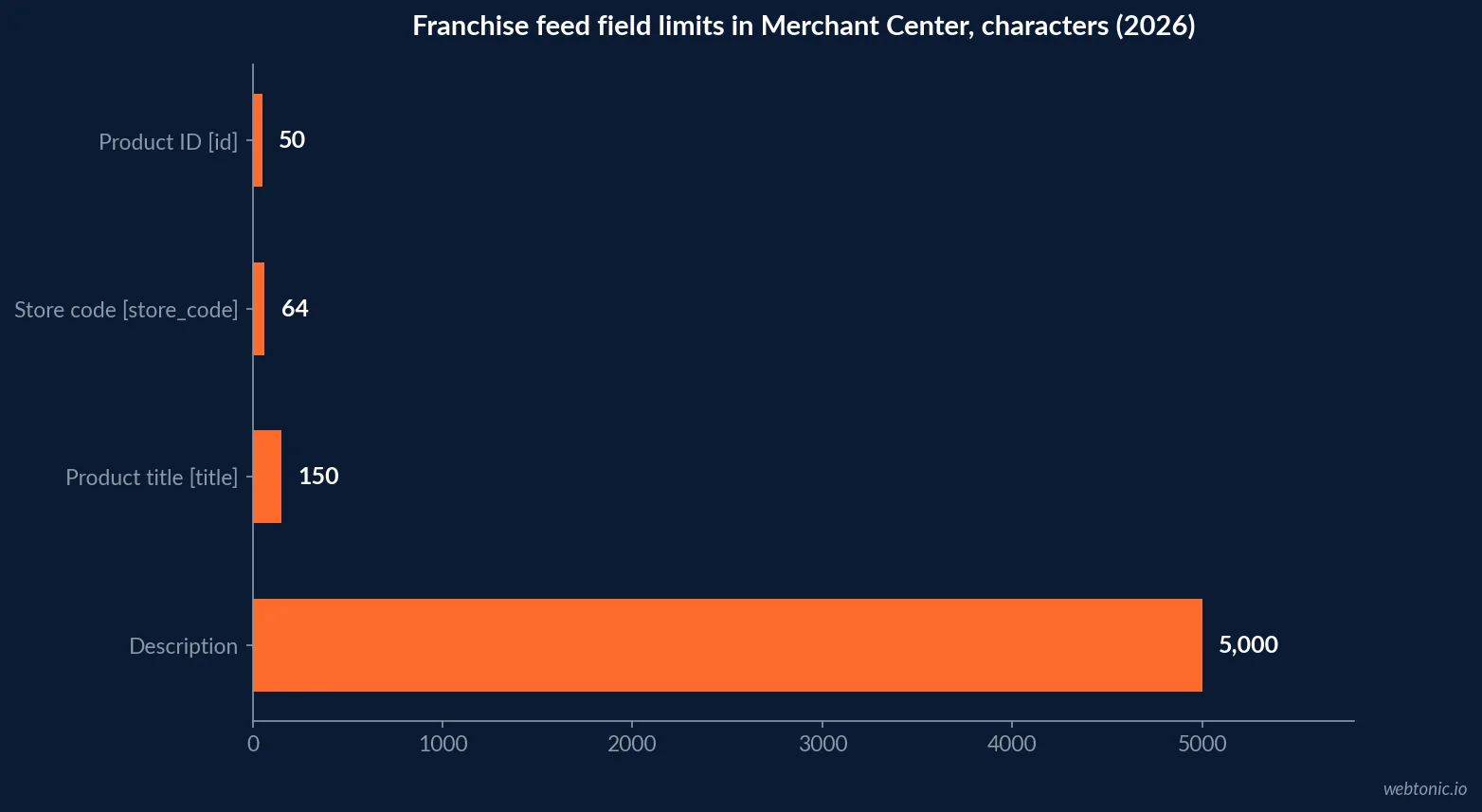
- Store codes allow up to 64 characters and must match the Business Profile exactly.
- Up to 24 hours for Business Profile locations to sync to Merchant Center.
- Performance Max held 62% of Google Shopping spend in Q4 2025 (Tinuiti, vendor data).
- Google Shopping ad spend rose 16% year over year in Q4 2025 while CPC fell 1%.
- 17.1% of US retail sales were e-commerce in Q2 2026 (Census Bureau).
- No named dataset publishes a franchise Shopping CTR, conversion rate or ROAS.
Franchise Shopping Feeds at a Glance
The table mixes system-level franchise data with Google's own setup limits and one vendor benchmark. Nothing in it is a franchise performance rate, because none is published.
| Metric | Figure | Scope and source |
|---|---|---|
| US franchise establishments, 2025 | 832,521 | IFA 2026 Franchising Economic Outlook |
| Forecast establishments, 2026 | 845,000 (+1.5%) | IFA / FRANdata forecast |
| Countries with local inventory ads | 47 | Google LIA policy page |
| Store code maximum length | 64 characters | Local inventory data specification |
| PMax share of Shopping spend, Q4 2025 | 62% | Tinuiti, advertisers running PMax and Shopping |
| US e-commerce share of retail, Q2 2026 | 17.1% | Census Bureau, seasonally adjusted |
| Franchise Shopping ROAS or CTR | Not published | No named dataset found |
What Google Shopping Will and Will Not Accept From a Franchise
Franchising spans restaurants, retail, fitness, home services and more, and Google treats those models very differently. Its Unsupported Shopping content policy is blunt: "Labor, time, effort, expertise, or actions, which do not result in ownership of a tangible product are not allowed. This includes any services sold bundled with physical goods." The listed examples include maintenance or repair services, accounting services and financial planning services. The same page lists immovable property such as real estate as unsupported.
That rules out Shopping for cleaning, lawn care, tutoring, tax preparation, restoration and most home-service franchises, which the IFA expects to be among the fastest growers at 3.2% in 2026. Retail, auto parts, pet supply, mattress, hardware and similar product franchises are the ones that can use Shopping and local inventory ads. Mixed models, such as a franchise that sells equipment and also installs it, can list the equipment only.
| Franchise model | Shopping / free listings | Local inventory ads | Google alternative |
|---|---|---|---|
| Product retail (hardware, pet, mattress) | Eligible | Eligible with stores | Shopping + PMax |
| Auto parts and accessories | Eligible (products) | Eligible with stores | Shopping + PMax for store goals |
| Home services (cleaning, repair) | Not allowed (services) | Not allowed | Local Services Ads, Search |
| Tax and financial services | Not allowed (services) | Not allowed | Search, Local Services Ads |
| Real estate brokerage | Not allowed (immovable property) | Not allowed | Search, PMax |
| Membership-only retail | Shopping possible | Ineligible if members-only | Shopping online offers |
Sources: Google Merchant Center, Unsupported Shopping content and Local inventory ads and free local product listings policies. The membership rule is Google's: stores that sell only to members are ineligible for local inventory ads unless non-members can also buy.
Centralized Feed vs Local Feeds: How Google's Data Model Splits the Work
Google separates the product catalog from store-level stock. The product data source describes each item once, while a local inventory data source lists, per store, only a handful of attributes. The local inventory data specification requires a store code of up to 64 characters and a product ID of up to 50 characters, with availability, quantity and price. That design suits a franchisor: it can own titles, images and identifiers centrally, and let each unit report only what is on its shelf.
Google also recommends uploading the inventory feed 24 hours after linking accounts or after a store code changes, because it can take up to 24 hours to sync Business Profile locations. The policy page adds that inventory updates take 24-48 hours to process. In practice that makes stale stock the commonest franchise failure: a unit that sells out on Friday may still show in-stock ads over the weekend if its point-of-sale feed only posts nightly.
| Decision | Centralized (franchisor-owned) | Local (unit-owned) |
|---|---|---|
| Product titles, images, GTINs | One source of truth across all units | Risk of duplicate, inconsistent listings |
| Price | One national price in primary feed | Per-store price in local inventory feed |
| Stock levels | Needs POS integration per unit | Unit uploads its own availability |
| Merchant Center structure | One account, many store codes | Advanced account only for multiple domains |
| Budget control | Advertising fund pays | Unit top-ups via separate campaigns |
Store Codes: Where Franchise Feeds Usually Break
The store code attribute is the join between a feed row and a physical unit. Google states that the attribute is case sensitive and must match the store codes submitted in your Business Profiles. When franchisees open, relocate or rename units, codes drift and products fall into a "Limited" state for missing inventory. Google's policy page lists exactly that symptom: products disapproved or limited due to missing inventory data, or a "No physical stores found in countries of sale" error when the Business Profile link is wrong.
Business Profile itself is built for chains. Google's bulk location management help page says that a business with 10 or more locations can add, verify and manage them in bulk through a business group, which is the natural owner of the codes a feed depends on. A franchisor that controls that business group controls the store codes, and therefore the feed.
Where the Shopper Lands: Hosted vs Merchant Storefronts
Local inventory ads can send a shopper to three places. Google's in-store availability hosted on Google option lets a merchant show local offers without needing a website that displays store stock, after passing inventory verification. The merchant-hosted local storefront sends the click to the brand's own page instead. Google's Storebuilder blueprint explains that the "full" version passes the store code into the URL and shows a distance annotation, while the "basic" version shows an "in-store" annotation; trusted status is reached after 10 consecutive guidelines checks.
For franchises the choice maps to who owns the store pages. A franchisor with per-location pages on one domain can use the full merchant-hosted route and keep analytics. A system whose units have no product pages can still run local ads through the Google-hosted view, at the cost of pickup features, which Google says are not compatible with the hosted option.
| Landing option | What it needs | Pickup today / later | Who owns the data |
|---|---|---|---|
| Google-hosted availability | Inventory verification | Not compatible | Google page |
| Merchant-hosted, basic | Product page with store check | Possible | Brand site |
| Merchant-hosted, full | Store code in URL template | Possible | Brand site, per store |
Campaign Structure: Performance Max, Shopping and Store Goals
Google now leans on automation for local products. Its local inventory ads FAQ says that if a local inventory feed exists, local inventory ads serve by default in Shopping, Performance Max and Demand Gen campaigns, and warns advertisers to review settings before August 2026 if they want separate online and local budgets. The same page says local inventory ads can appear on Google Maps.
For systems that care about foot traffic, Performance Max for store goals is the option Google points to. It asks for store locations through a linked Business Profile or affiliate locations, then optimises for store visits, store sales and local actions across Search, Maps, Waze, YouTube, Gmail and Display. That is also the one route open to franchises that sell a service at a location but no stockable product.
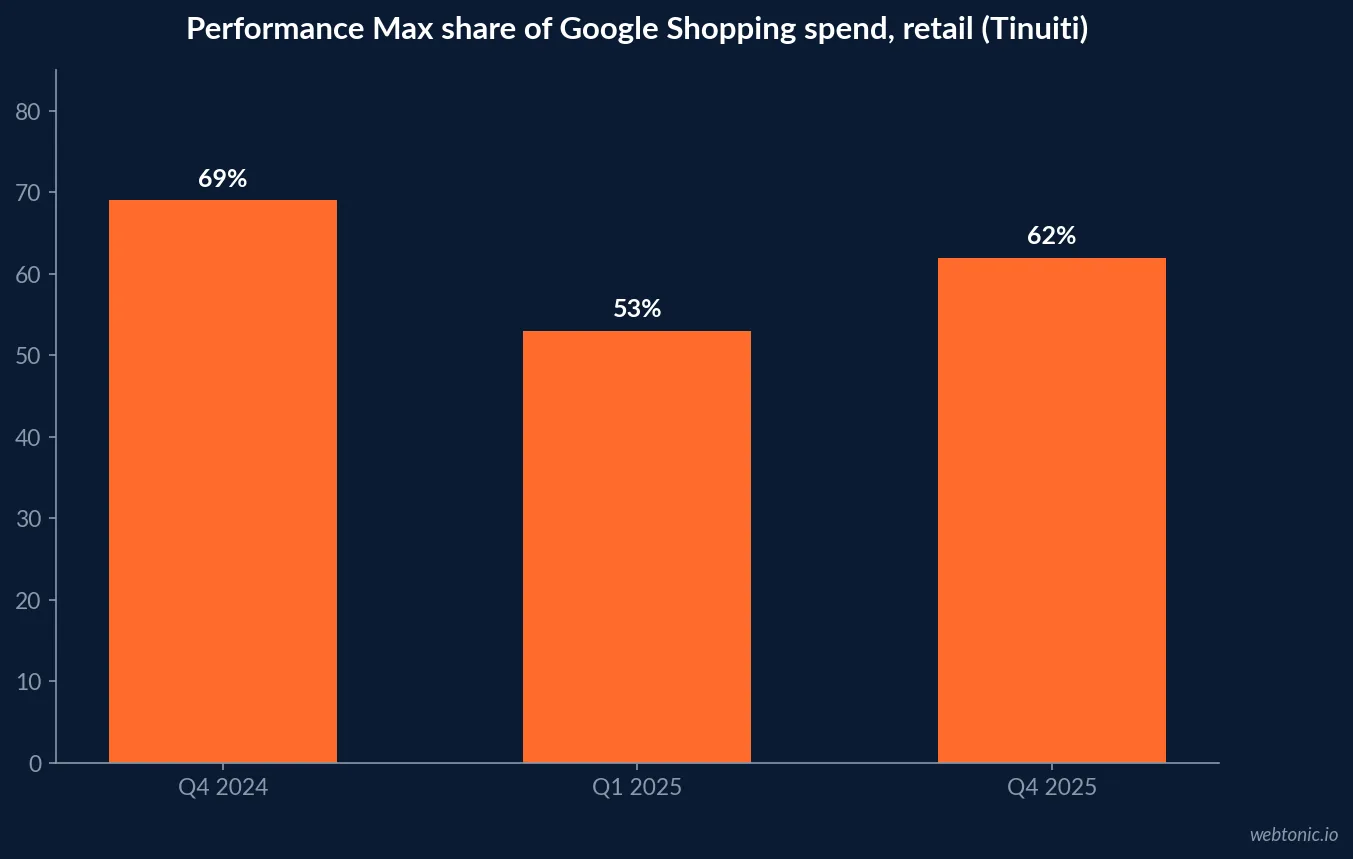
Cross-industry retail data shows how dominant the automated route has become. In Tinuiti's Q4 2025 Digital Ads Benchmark Report, Performance Max accounted for 62% of Google Shopping ad spend for brands running both PMax and standard Shopping, down from 69% a year earlier and up from a low of 53% in Q1 2025. PMax generated 61% of Shopping sales. These are Tinuiti client figures across retailers, not franchise data.
Retail Demand Context for Product Franchises
Online is still the minority channel for US retail, which is why local inventory matters for chains. The Census Bureau estimates Q2 2026 e-commerce at $340.2 billion, or 17.1% of total retail sales, up 12.2% from a year earlier against 6.7% for all retail. The other 83% or so of sales still happen offline, where a franchise's shelf is the product.
Mobile is where local searches happen. Adobe Analytics found that 56.4% of online transactions in the 2025 holiday season were made on a smartphone, up from 54.5% in 2024. Google's own Think with Google retail guide reported that searches for "open now near me" grew by over 400% year over year globally, a 2020-2021 comparison that is dated but still the figure Google publishes for this behaviour.
| Indicator | Value | Period | Source |
|---|---|---|---|
| US retail e-commerce sales | $340.2 billion | Q2 2026 (SA) | Census Bureau |
| E-commerce share of retail | 17.1% | Q2 2026 | Census Bureau |
| E-commerce growth YoY | 12.2% | Q2 2026 vs Q2 2025 | Census Bureau |
| Smartphone share of holiday transactions | 56.4% | Nov-Dec 2025 | Adobe Analytics |
| Google Shopping ad spend growth | +16% | Q4 2025 YoY | Tinuiti (vendor) |
| Google Shopping CPC change | -1% | Q4 2025 YoY | Tinuiti (vendor) |
Who Pays: Advertising Funds and Feed Budgets
A centrally run feed is almost always paid from a system advertising fund, and the rules on that fund are federal. Under the FTC Franchise Rule, 16 CFR 436.5, Item 11 of the disclosure document must explain whether franchisees must participate in other advertising funds, how unspent money is used, whether franchisees receive a periodic accounting of how advertising fees are spent, and the percentage of advertising funds used principally to solicit new franchise sales.
That matters for Shopping because feed tooling, Merchant Center management and national PMax budgets are shared costs, while local inventory benefits individual stores unevenly. Systems that show units store-level results from the shared campaign tend to face fewer disputes than those that report one national number. The rule sets the disclosure, not the split; the split is written in each franchise agreement.
Pickup Options That Favour Local Units
Local inventory ads are not only about what is on the shelf today. Google's FAQ notes that pickup options can promote products that are not in store now but can be collected within a few days, through its "pickup later" feature. For a franchise that holds limited stock per unit but ships from a central warehouse, that turns the national catalog into local offers. The catch is that the landing page must show in-store availability and pickup times, so the hosted-by-Google route cannot be used, and the franchisor's site has to carry store-level pages.
Google also states, on its policy page, that no shipping information is required for local offers and no online checkout is required, because the purchase happens in the store. That lowers the bar for franchisees without e-commerce, while any additional fees charged at checkout must still be included in the product price.
Industry Benchmarks: What Is Measured and What Is Not
Public research does not break Shopping results out by franchise status. The nearest useful comparisons are retail-wide, and they point to rising volume at flat prices: Tinuiti reports Google Shopping spend up 16% in Q4 2025 with click growth "in the upper teens for the third straight quarter" and CPC down 1%, partly because Amazon largely left US Shopping auctions from July 2025. For a franchise, that is a context figure, not a target.
For deeper channel context see our franchise Google Ads statistics, franchise Business Profile data and franchise local SEO benchmarks.
Setup Checklist for a Franchise Local Inventory Program
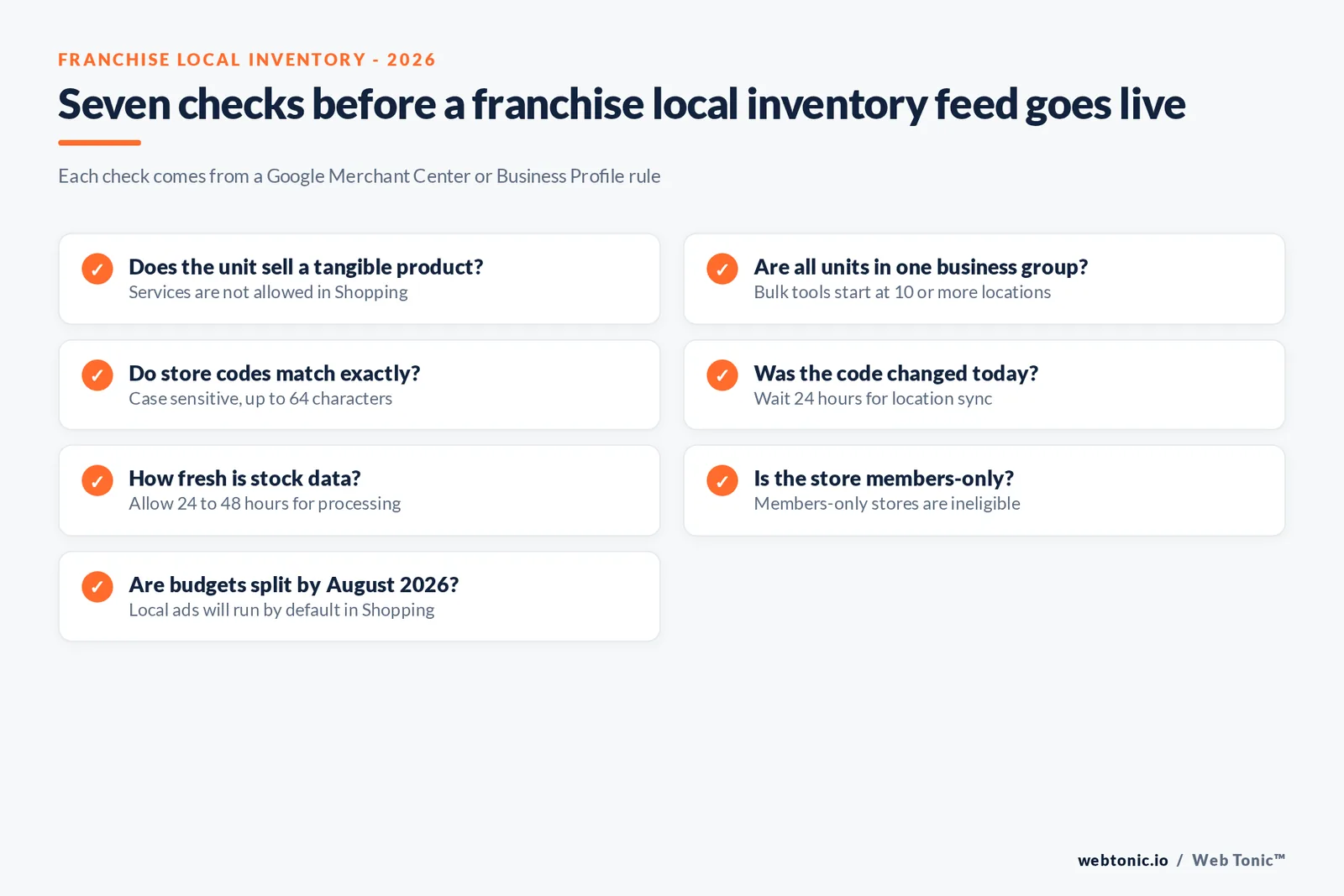
- Confirm every unit sells a tangible product; route service-only units to Local Services Ads or Search.
- Put all units in one Business Profile business group and lock store code naming.
- Keep one franchisor-owned product feed; add a local inventory data source per store code.
- Wait 24 hours after any store code change before uploading inventory.
- Push stock from point of sale at least daily; allow 24-48 hours for processing.
- Decide before August 2026 whether local and online budgets stay together in Shopping campaigns.
- Report results per store code so the advertising fund can show each unit its share.
Our data intelligence team builds store-level reporting of this kind; contact Web Tonic to discuss a feed audit.
Frequently Asked Questions
Should a franchise run one central Merchant Center feed or one per location?
Most systems keep one central product feed owned by the franchisor and add store-level detail through a local inventory data source keyed by store code. Google's local inventory specification needs only the store code, product ID, availability, quantity and price per store, so a franchisee does not need its own catalog. Separate accounts make sense when locations sell on distinct websites; Google's advanced account setup is built for multiple domains and brands, not for ordinary franchise units.
Can a service franchise such as cleaning, repair or tutoring use Google Shopping?
No. Google's Unsupported Shopping content policy states that labor, time, effort, expertise or actions that do not result in ownership of a tangible product are not allowed, including services sold bundled with physical goods. Service franchises should look at Local Services Ads, Search and Performance Max for store goals instead.
What does a franchise need before local inventory ads can run?
A physical location customers can visit and buy from, a verified Business Profile per location, store codes that match the Business Profile exactly (they are case sensitive), and a local inventory data source. Google says location sync can take up to 24 hours and inventory processing 24-48 hours, and membership-only stores are ineligible.
Is there a published Shopping ROAS or CTR benchmark for franchises?
No. None of the sources used here reports a franchise-specific Shopping click-through rate, conversion rate or return on ad spend. The closest benchmarks are cross-industry retail figures, such as Tinuiti's finding that Performance Max held 62% of Google Shopping spend in Q4 2025 for advertisers running both campaign types.
Who pays for Shopping campaigns in a franchise system?
It depends on the franchise agreement. The FTC Franchise Rule (16 CFR 436.5) requires the disclosure document to explain the advertising fund, how it is spent, whether franchisees get an accounting and what share is used to sell new franchises. A centrally run feed is usually funded from that pool, while local top-ups come from each unit.
Sources
International Franchise Association, 2026 Franchising Economic Outlook
Google Merchant Center, Unsupported Shopping content
Google, Local inventory ads and free local product listings policies
Google, Local inventory ads on Google Ads FAQs
Google, Local inventory data specification
Google, Store code attribute
Google, In-store availability hosted on Google
Google for Developers, Merchant-hosted local storefront
Google Business Profile, Bulk location management
Google Ads, About Performance Max for store goals
Tinuiti Digital Ads Benchmark Report Q4 2025 (vendor)
US Census Bureau, Quarterly Retail E-Commerce Sales Q2 2026
Adobe, 2025 Holiday Shopping Season release
Think with Google, 2022 Retail Marketing Guide
16 CFR 436.5, FTC Franchise Rule disclosure items