Table of contents
A US franchise brand does not manage one Google Business Profile - it manages one per location, times however many units are open. With 845,000 franchise establishments operating in the US in 2026 (International Franchise Association / FRANdata), the real GBP problem for a multi-unit brand is process at scale: bulk verification, location groups, and keeping each profile locally distinct while staying centrally compliant.
Key Takeaways
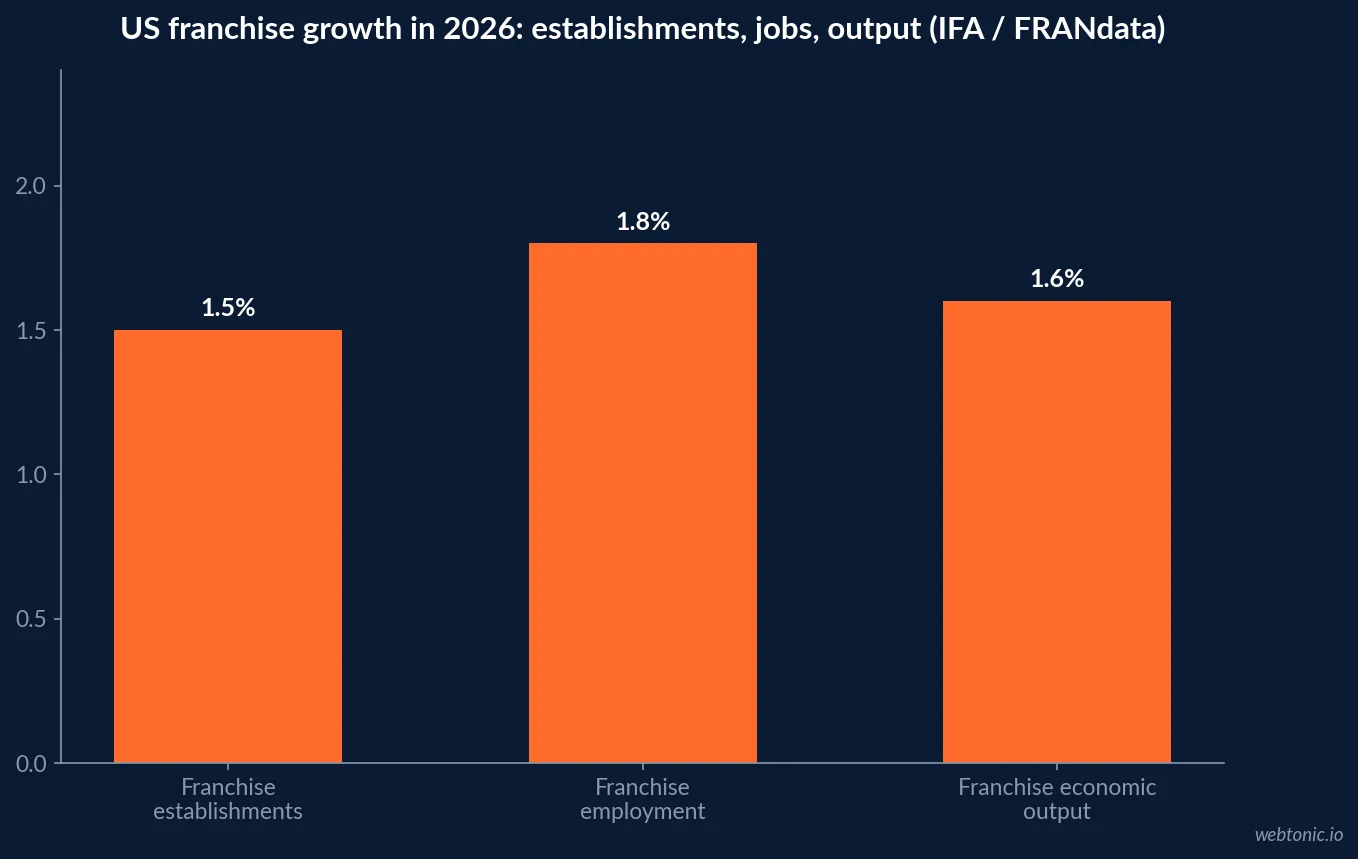
- 845,000 US franchise establishments were open in 2026, up 1.5% year over year (IFA/FRANdata).
- 8.9 million people worked at a franchised business in 2026, up 1.8%.
- USD 921.4 billion in franchise economic output in 2026, up 1.6%.
- 10 or more locations is the threshold for Google's bulk-verification feed.
- Below that threshold, each profile verifies individually, no franchise exception applies.
- Google recommends one business group per brand, not split across several groups.
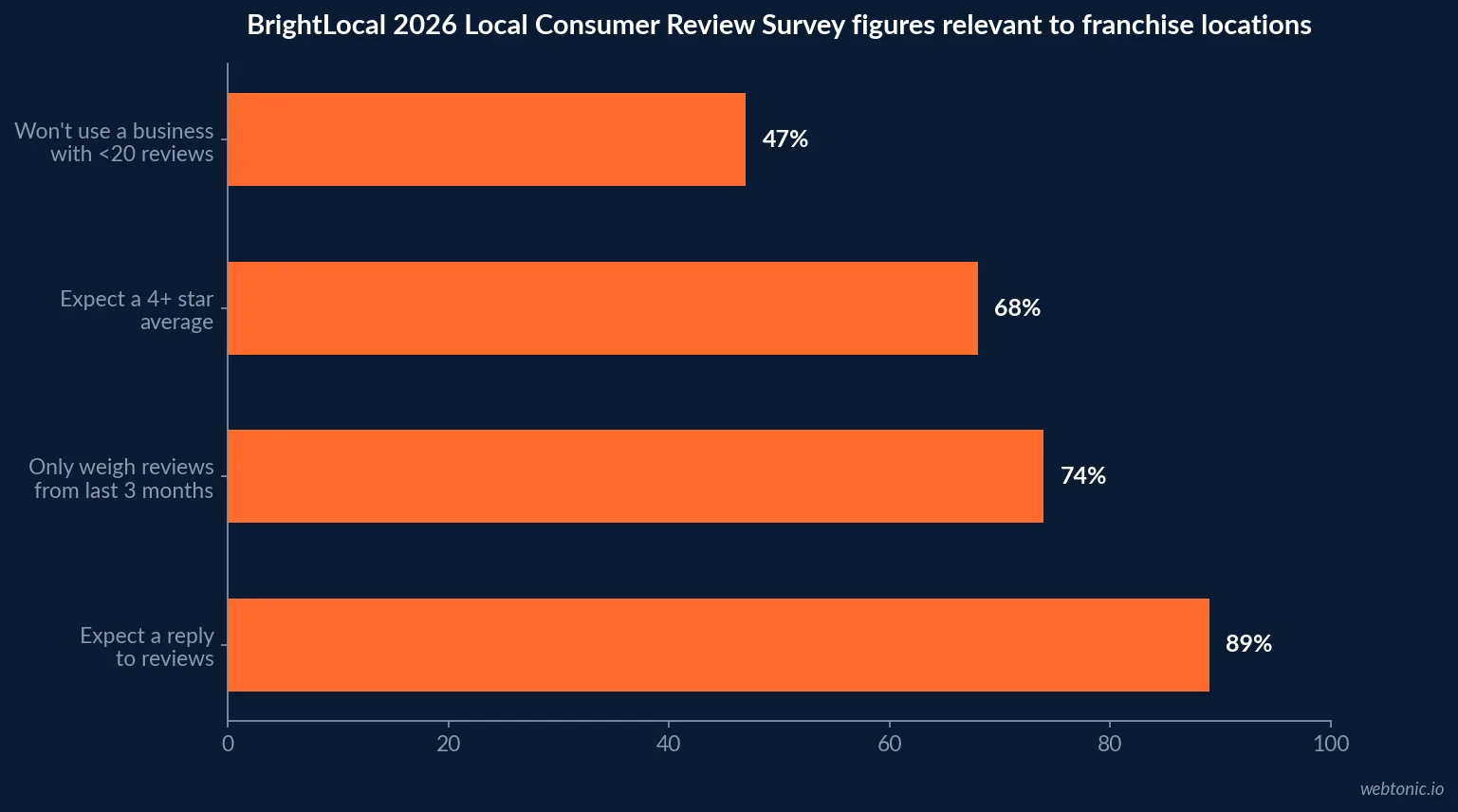
- 47% of consumers will not use a business with fewer than 20 reviews (BrightLocal 2026).
- 68% expect a 4-star average or higher before considering a business at all.
- 74% only weigh reviews written in the last 3 months - a location's review clock resets fast.
- 89% expect a business to reply to its reviews.
- Reply speed matters to 19% within a day, 32% within a week, 81% eventually.
- Google's share of where consumers read reviews fell from 83% to 71% year over year.
- Franchisee local marketing funds run 1% to 5% of location revenue in most systems (Franchising.com survey).
- 96% of consumers say they are open to writing a review when asked (BrightLocal 2025).
- Only 4% of consumers say they never read reviews at all.
- 40% of consumers now check 2 or more review sites before deciding, not Google alone.
| Franchise scale metric (2026) | Figure | Source | What it means for GBP |
|---|---|---|---|
| US franchise establishments | 845,000 | IFA / FRANdata Economic Outlook | That many distinct profiles to maintain |
| Franchise employment | 8.9 million, +1.8% | IFA / FRANdata | Growing headcount to train on profile hygiene |
| Franchise economic output | USD 921.4 billion, +1.6% | IFA / FRANdata | Rising volume for local-intent search |
| New franchised units opening in 2026 | 12,000-plus | IFA / FRANdata via PR Newswire | That many profiles need first-time verification |
| Bulk-verification threshold | 10+ locations of the same business | Google Business Profile Help | Below it, verify individually |
One brand, hundreds of profiles: why franchise GBP is a location-group problem
A franchise system does not have a single Google Business Profile to optimize - it has as many as it has open doors. The International Franchise Association's 2026 Franchising Economic Outlook, produced with FRANdata, counts 845,000 US franchise establishments in 2026, up 1.5%, generating USD 921.4 billion in economic output (up 1.6%) and employing 8.9 million people (up 1.8%). More than 12,000 new franchised businesses were projected to open in 2026 alone.
Every one of those locations is its own listing under Google's guidelines. A brand centralizes the standards; it cannot centralize the profile itself, because Google ties a Business Profile to a specific address or service area, not to a brand name.
Bulk verification: the 10-location threshold
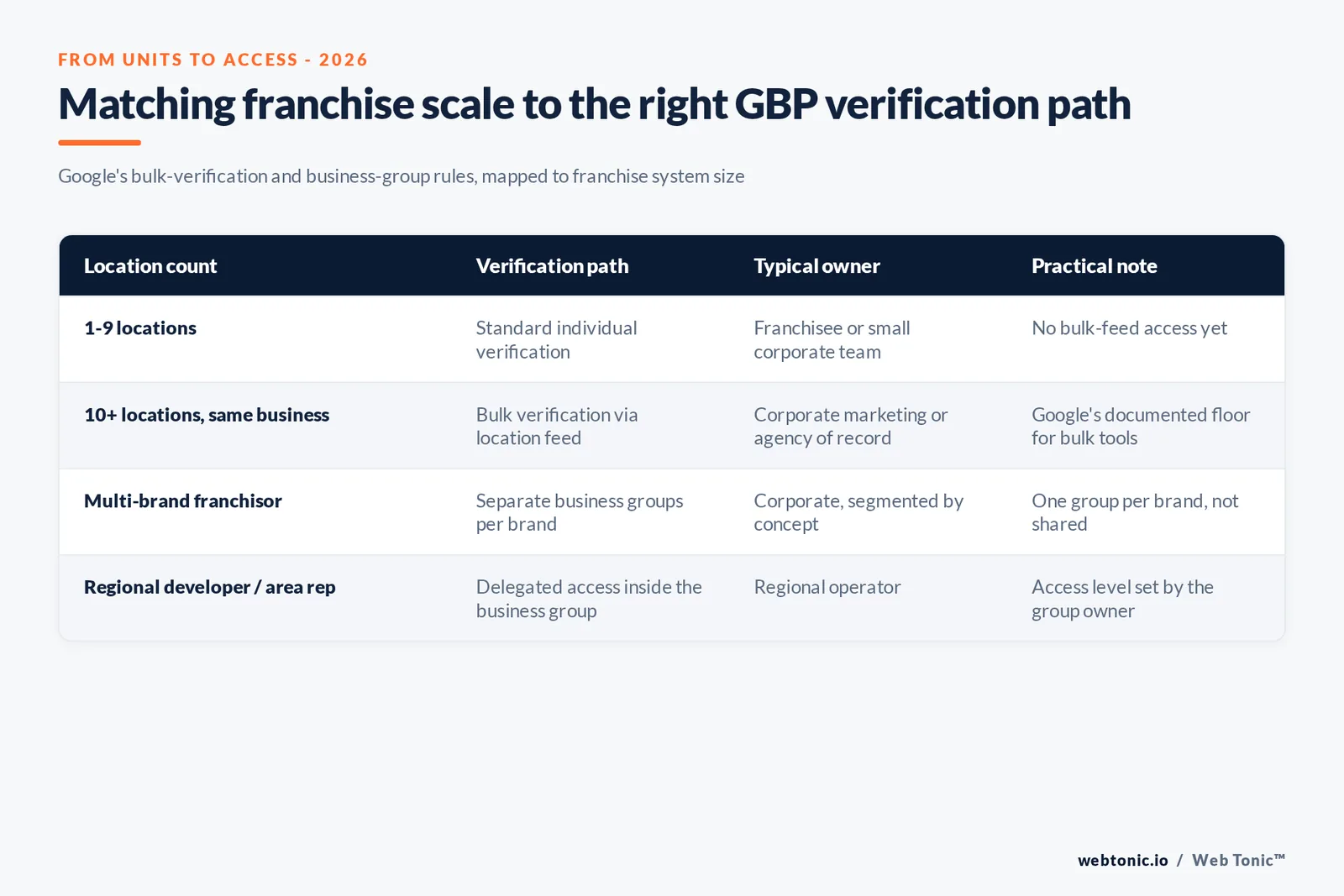
Google's own help documentation states that a business with 10 or more locations of the same business - or an individual who manages that many on behalf of others - can verify them in bulk through Business Profile Manager, using a location data feed rather than the standard one-by-one flow. Google's guidance on bulk-verification delays repeats the same floor: fewer than 10 locations, and the standard individual verification path applies with no franchise-specific shortcut.
That threshold has a real operational consequence for a young franchise system: a brand with 6 units open cannot yet use the bulk feed that a brand with 60 units relies on, and has to budget for manual verification and per-location edit review until it crosses 10.
| Location count | Verification path | Who typically owns it | Practical note |
|---|---|---|---|
| 1-9 locations | Standard individual verification per profile | Franchisee or a small corporate team | No bulk-feed access yet |
| 10+ locations, same business | Bulk verification via a location data feed | Corporate marketing or an agency of record | Google's documented floor for bulk tools |
| Multi-brand franchisor (several concepts) | Separate business groups per brand | Corporate, segmented by concept | Google recommends one group per brand, not shared |
| Regional developer / area rep | Delegated access inside the brand's business group | Regional operator | Access level set by the group owner, not a new login |
Business groups: who gets access to what
Once a brand is past initial verification, Google's bulk location management overview describes the business group (also called a location group) as the mechanism for sharing management of many profiles across several people without shared passwords. Google's guidance on creating and managing business groups explicitly recommends limiting a business to one group per business or brand, and reserves multiple groups for organizations that genuinely operate separate brands or divisions needing different user sets.
For a franchise system this maps cleanly: one business group per brand concept, with corporate holding owner-level access, an agency or in-house SEO team holding manager access, and individual franchisees holding location-level access to their own profile only. Managing agency business groups is the same mechanism a marketing agency uses to service a franchise system without individually collecting 845 sets of login credentials.
Why the location-level review count decides the sale
Centralized brand standards do not transfer review equity between locations. BrightLocal's 2026 Local Consumer Review Survey found that 47% of consumers will not use a business with fewer than 20 reviews, 68% expect at least a 4-star average, and 74% only weigh reviews from the last 3 months - meaning a newly opened franchise unit is judged on its own recent review flow, not the brand's decade of reputation thirty miles away. The same survey found 89% of consumers expect a reply, with reply speed mattering within a day to 19%, within a week to 32%, and eventually to 81%.
A separate signal worth tracking at the brand level: BrightLocal 2026 also found Google's share of where consumers actually read reviews slipped from 83% to 71% year over year, which is why the same survey's 2025 edition finding that 40% of consumers now check 2 or more review sites matters for a franchise system deciding where to concentrate review-generation effort beyond Google alone.
| BrightLocal consumer review figure | 2026 or 2025 edition | What it means per franchise location |
|---|---|---|
| Won't use a business with <20 reviews | 47% (LCRS 2026) | A new unit needs review volume fast, not just brand trust |
| Expect a 4-star average or better | 68% (LCRS 2026) | One bad batch of reviews can sink a single location's conversion |
| Only weigh reviews from the last 3 months | 74% (LCRS 2026) | Review velocity has to be sustained per unit, not banked once |
| Expect a reply to reviews | 89% (LCRS 2026) | Someone local should own replies, not a dormant corporate inbox |
| Open to writing a review when asked | 96% (LCRS 2025) | Location staff asking in person is the highest-leverage tactic |
| Check 2+ review sites before deciding | 40% (LCRS 2025) | Google-only reputation management leaves a gap |
Eligibility rules that hit franchise concepts unevenly
Not every franchise unit qualifies for the same profile type. Google's guidelines for representing a business require a service-area business - one with no walk-in storefront, common among home-service franchise concepts like cleaning, lawn care or handyman brands - to list one profile for its central office with a defined service area rather than a "virtual" address with no real presence. Google's guidance on managing service areas further splits hybrid businesses (serving customers on-site and traveling to them) from pure service-area businesses, and both differ from the storefront retail or restaurant profile most franchise buyers picture by default.
Google's business eligibility and ownership guidelines also state plainly that a profile requires in-person contact with customers during stated hours - a rule that trips up newly opened franchise units still operating without full signage or a completed build-out, and one corporate teams should check before a franchisee attempts self-verification on day one.
| Franchise concept type | Google profile type | Common trip-up at the unit level |
|---|---|---|
| Retail / restaurant storefront | Standard storefront profile | Photos and hours not updated at build-out |
| Home-service (cleaning, lawn, handyman) | Service-area business, one profile per hub with a defined area | Attempting a storefront profile with no real signage |
| Mobile + counter hybrid (some food, some auto) | Hybrid business profile | Miscategorizing as pure service-area and losing map-pin visibility |
| Professional / licensed practice under a franchise brand | Practitioner listing tied to the individual, plus the location profile | Confusing the practitioner's personal listing with the brand location |
Who pays for local marketing, and what that buys in GBP terms
Franchise systems already split marketing spend between national brand funds and local obligations, and that split shapes who has budget to invest in GBP work at all. A Franchise Update Media's 2025 Annual Franchise Marketing Leadership Report, via Franchising.com found most systems requiring contributions to a co-op, local or regional marketing fund cluster between 1% and 3% of franchisee revenue, and that 50% of surveyed service (non-brick-and-mortar) franchises require 5% of franchisee revenue toward that fund. Franchise systems that pool location-level spend into a single collective-buying program can secure better media rates than any single franchisee negotiating alone.
GBP management rarely appears as its own line item inside those funds - it typically rides inside a broader local SEO or reputation-management retainer, which is one reason franchise systems under-invest in the location-specific review-reply and photo-refresh work that BrightLocal's data shows actually moves conversion.
| Franchise marketing fund | Typical contribution | Source | GBP relevance |
|---|---|---|---|
| National brand fund | 1%-2% typical (3% for a third of brick-and-mortar service franchises) | Franchise Update Media AFMR 2025 | Funds brand-wide category and photo standards |
| Local / regional co-op fund | 1%-3% typical, 5% for many service franchises | Franchise Update Media AFMR 2025 | Closest fund to where GBP-specific spend could sit |
A practical rollout order for a growing franchise system
Verify individually below 10 open units, move to the bulk feed once past that threshold, and set up one business group per brand concept before assigning franchisee-level access - reversing that order is the most common cause of duplicate or orphaned listings inside a growing system. Layer in a review-reply SLA at the location level once profiles are stable, since BrightLocal's reply-speed data shows the majority of consumers expect a response within a week, not a quarter.
For brands weighing whether this sits with corporate SEO, a franchisee's own hire, or an outside partner, our growth marketing practice and the reputation angle covered in our reputation management data are useful starting references before setting the retainer scope. If e-commerce is layered on top of a franchise's physical locations, the e-commerce Google Business Profile data is worth comparing against the pure-location model here.
Frequently Asked Questions
Does a franchise brand get one Google Business Profile or one per location?
One per location. Google's own guidance treats each address that serves walk-in or in-person customers as its own Business Profile, and a franchise brand with 845,000 US units (International Franchise Association/FRANdata, 2026 Franchising Economic Outlook) is really managing that many separate listings, not one master page. What a brand centralizes is the process - naming, categories, photo standards - not the profile itself.
What is bulk verification and does every franchise qualify for it?
Google's Business Profile Manager lets an owner or manager verify 10 or more locations of the same business at once through a location feed, instead of verifying each one individually (Google Business Profile Help, 'Verify Business Profiles in bulk'). Brands under 10 open locations verify each profile the standard way; the threshold is a location count, not a franchise-specific rule, so a young franchise system with 4 locations open follows the same individual path as any small multi-location business.
How are corporate, regional and franchisee logins supposed to work?
Through a business group (Google also calls it a location group) - a shared workspace that lets a franchisor's marketing team, a regional developer and an individual franchisee all hold different access levels to the same set of profiles without swapping passwords (Google Business Profile Help, 'Bulk location management overview'). Google's own guidance recommends limiting a business to one group per brand rather than splitting locations across several groups, which is the setup mistake that shows up most often in multi-unit audits.
Does local review volume actually move which location a customer picks?
Yes, and it is measurable at the unit level. BrightLocal's 2026 Local Consumer Review Survey found that 47% of consumers will not use a business with fewer than 20 reviews, and 68% expect at least a 4-star average before they will consider it at all. Two locations of the same franchise brand, ten miles apart, compete on that number independently - a strong flagship store does not lend its review count to a newer location down the road.
Who should own review replies across a franchise system - corporate or the franchisee?
BrightLocal's 2026 survey found 89% of consumers expect a business to reply to reviews, and that reply speed reads as a trust signal on its own: replies matter within a day to 19% of consumers, within a week to 32%, and eventually to 81%. A location's owner or manager is best placed to reply with specifics (an order, a technician's name, a visit date); a corporate team is best placed to set the response templates and the escalation rule for anything alleging safety or legal issues.
Sources
International Franchise Association - 2026 Franchising Economic Outlook
FRANdata - 2026 Franchising Economic Outlook report
Google Business Profile Help - Verify profiles in bulk
Google Business Profile Help - Understand delays in bulk verification
Google Business Profile Help - Bulk location management overview
Google Business Profile Help - Create and manage business groups
Google Business Profile Help - Manage agency business groups
Google Business Profile Help - Guidelines for representing your business
Google Business Profile Help - Manage service areas
Google Business Profile Help - Business eligibility and ownership guidelines
BrightLocal - Local Consumer Review Survey 2026
Franchise Update Media - 2025 Annual Franchise Marketing Leadership Report (via Franchising.com)