Table of contents
The honest way to answer whether franchise SMS is worth it is to put a dated, sampled consumer survey next to a real per-message cost, not to repeat an unsourced open-rate claim. EZ Texting's own 2026 Consumer Texting Behavior Report (959 US consumers, published April 2026) is the closest thing to primary evidence on the demand side; Twilio, EZ Texting and The Campaign Registry's own pricing pages cover the cost side.
Key Takeaways
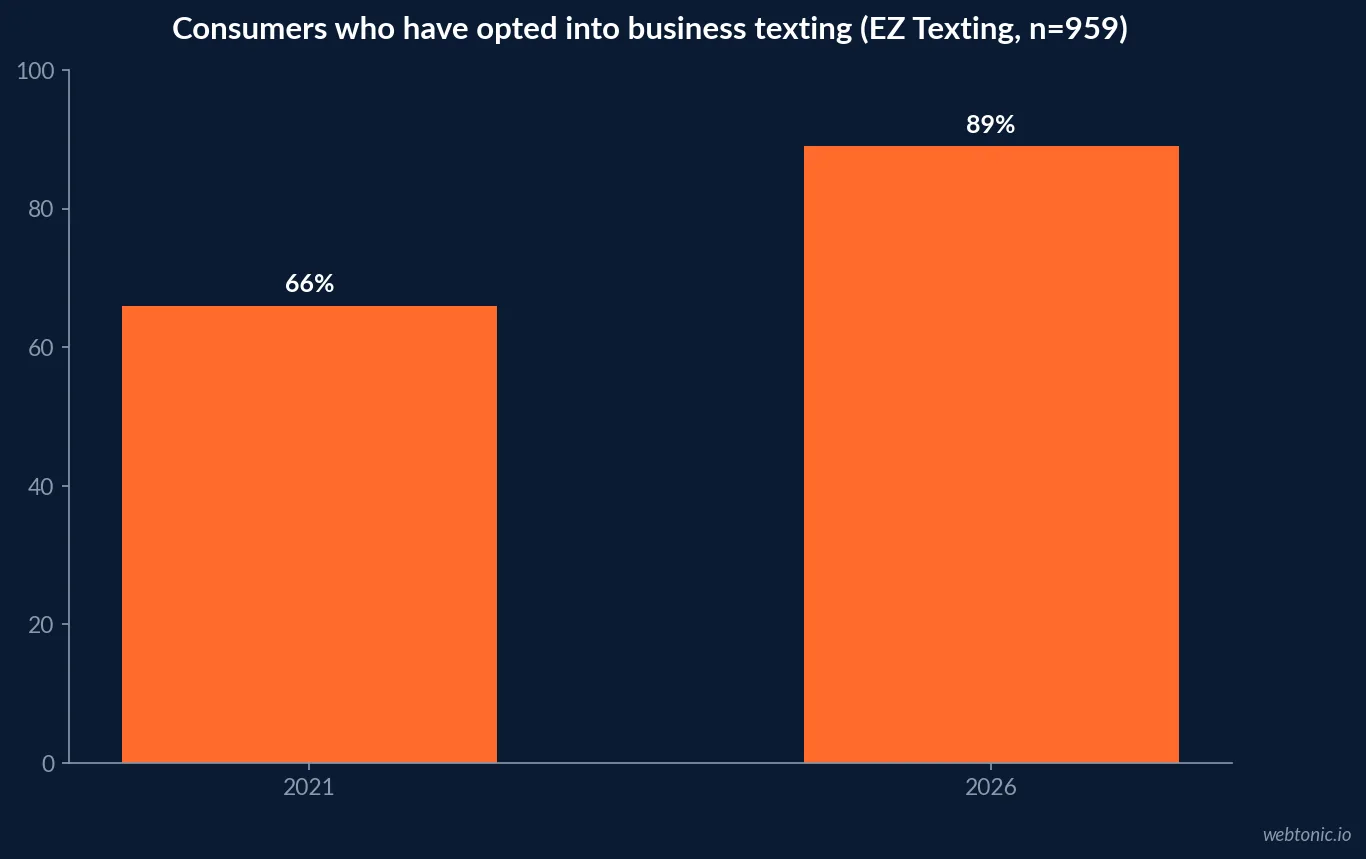
- 89% of consumers have opted into business texting, up from 66% in 2021 (EZ Texting, n=959, 2026).
- 67% say they are more likely to purchase from a business whose texts they receive.
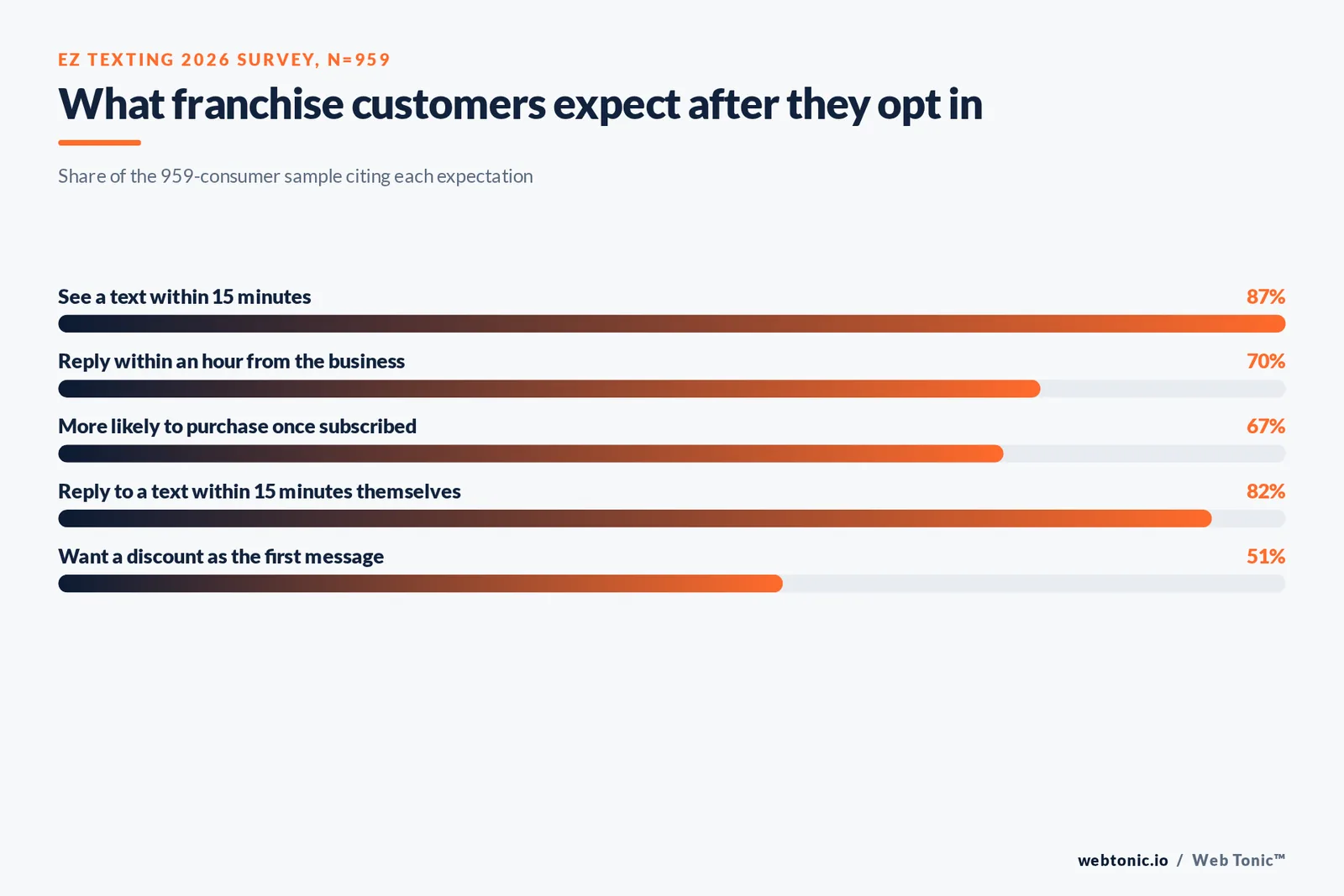
- 87% see a text within 15 minutes; 70% expect a reply within an hour.
- 56% say a discount offer increases opt-in odds, up 12 points year over year.
- 42% cite appointment reminders as a reason to opt in - the top franchise service use case.
- Texting is preferred over email in 9 of 10 message categories, per the same survey.
- Only 24% of consumers get 6+ business texts a day, versus 54% for business emails.
- Twilio charges USD 0.0083 per outbound SMS segment on a US long code.
- EZ Texting's Launch plan starts at USD 25 a month for 500 monthly credits.
- EZ Texting Enterprise starts at USD 3,000 a month for 200,000 monthly credits.
- The "Agents and Franchises" 10DLC campaign fee is USD 30 a month, three times the general Marketing rate.
- Brand registration with TCR is a one-time USD 4 to 4.50 per legal entity.
- 32% of consumers check a new text immediately; 82% respond within 15 minutes.
- 51% want a discount as their very first message from a business, up 9 points year over year.
- 18% now opt in via email or social media prompts, up from 14% in 2024.
The demand side: opt-in has become the norm
EZ Texting's own 2026 Consumer Texting Behavior Report - a survey of 959 US consumers, published April 13, 2026 - frames the shift plainly: opt-in is no longer the question. 89% of consumers have signed up for business texts, up from 66% in 2021, and 67% say they are more likely to purchase from a business whose texts they receive. The report's own conclusion is that the bar has moved from reach to retention - franchises now compete on program quality, not on whether texting works at all.
| Metric (EZ Texting, n=959, 2026) | Figure | 2021/prior comparison | Relevance to franchises |
|---|---|---|---|
| Consumers who have opted into business texts | 89% | 66% (2021) | Reach is no longer the constraint |
| More likely to purchase when subscribed | 67% | not stated | Direct revenue signal |
| Check a new text within 15 minutes | 87% | not stated | Sets the reply-speed bar |
| Expect a business reply within 1 hour | 70% | stabilized from a 2024 spike | A staffing requirement, not just a KPI |
| Opt in via email/social prompts | 18% | 14% (2024) | Multi-channel opt-in capture matters |
What actually gets a franchise customer to opt in
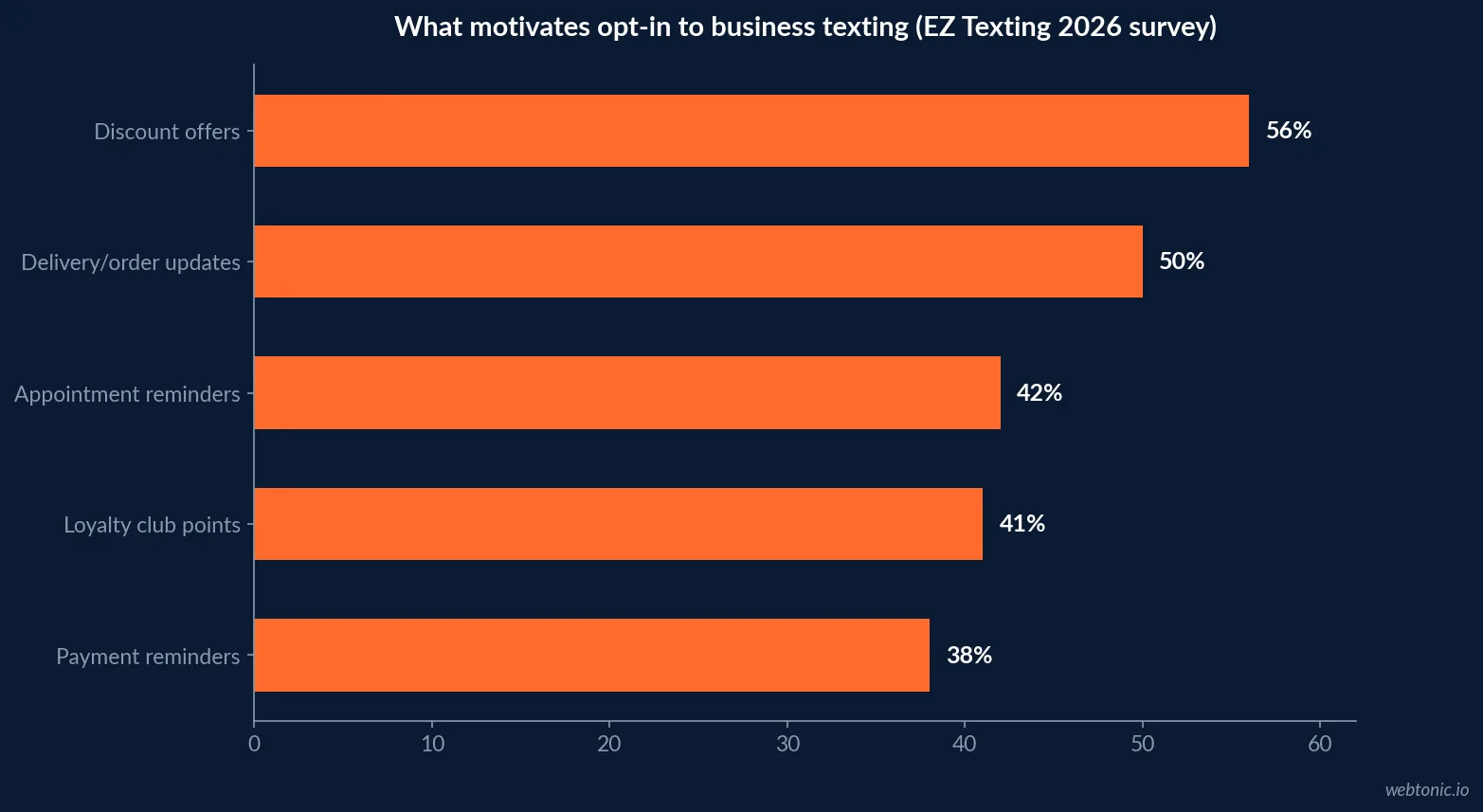
The same survey ranks opt-in motivators by specific incentive: 56% cite discount offers (up 12 points year over year), 50% cite delivery and order updates (up 9 points), 42% cite appointment reminders, 41% cite loyalty club points, and 38% cite payment reminders and receipts. Appointment reminders sit squarely inside the franchise service-brand use case - salons, auto service, fitness studios, home services - where a missed slot is a direct revenue loss.
The report also finds 51% of consumers want a discount or coupon as the very first message from a business, up 9 points year over year - a specific, testable design choice for a franchise's opt-in welcome flow, not a vague best practice.
| Opt-in motivator | Share citing it | YoY change | Best-fit franchise use case |
|---|---|---|---|
| Discount offers | 56% | +12 pts | Retail and food franchises |
| Delivery/order updates | 50% | +9 pts | Food and retail delivery |
| Appointment reminders | 42% | not stated | Service brands: salons, auto, fitness |
| Loyalty club points | 41% | not stated | Repeat-visit retail and food brands |
| Payment reminders/receipts | 38% | not stated | Subscription and membership franchises |
Where texting beats email, and where it does not
Across 9 of 10 message categories tested, consumers said they prefer texting to email - the sole exception is polls and surveys, where email still edges ahead. The gap widens furthest for urgent categories like appointment reminders and security alerts. For purely promotional offers and event invitations, the survey found text and email running nearly even, meaning a franchise gains little by defaulting every promotion to SMS instead of matching the channel to the message type.
Inbox pressure also favors texting for now: only 24% of consumers receive six or more business texts a day, compared with 54% who receive six or more business emails. That relative scarcity is, in the report's own words, an advantage to protect rather than exploit by over-sending.
What it costs to run, franchise-specific
On raw API pricing, Twilio's own pricing page lists USD 0.0083 per outbound SMS segment on a US long code. On a managed platform, EZ Texting's own pricing page starts Launch at USD 25 a month for 500 monthly credits and scales through Boost at USD 75 and Scale at USD 125 up to Enterprise at USD 3,000 a month for 200,000 monthly credits and a dedicated short code - the tier a large multi-unit system would actually need.
The franchise-specific line item sits on top: The Campaign Registry's own Fees and Pricing guide lists an "Agents and Franchises" 10DLC campaign use case at USD 30 a month per campaign, three times the USD 10 general Marketing rate, plus a one-time brand registration fee of roughly USD 4 to 4.50 per legal entity.
| Cost line (2026) | Amount | Frequency | Source |
|---|---|---|---|
| Twilio outbound SMS segment | USD 0.0083 | Per segment | Twilio |
| EZ Texting Launch | USD 25/mo (USD 20 annual) | Monthly, 500 credits | eztexting.com |
| EZ Texting Scale | USD 125/mo (USD 100 annual) | Monthly, up to 50k contacts | eztexting.com |
| EZ Texting Enterprise | USD 3,000/mo | Monthly, 200k credits | eztexting.com |
| TCR brand registration | USD 4.00-4.50 | One-time per entity | campaignregistry.com |
| TCR Agents and Franchises campaign | USD 30/mo | Recurring per campaign | campaignregistry.com |
The compliance layer a multi-unit rollout cannot skip
None of the demand-side numbers above override consent law. The TCPA (47 U.S.C. 227, via Cornell LII) and 47 CFR 64.1200 require prior consent and a working STOP opt-out at every location a franchise texts from. The FCC's 2023 one-to-one consent rule, which would have forced separate consent per sender, was vacated by the Eleventh Circuit in January 2025 and should not be described as active; carrier-level filtering is instead governed day to day by the CTIA Messaging Principles. A franchisor rolling out texting across dozens of locations under one shared brand registration is the exact structure the "Agents and Franchises" 10DLC use case exists to police.
So, is it worth it?
Against the evidence gathered here, the case is use-case specific rather than universal. Appointment reminders, delivery updates and time-sensitive offers sit inside the categories where the 2026 survey shows texting winning outright, and the incremental cost per message is small enough that a franchise location sending a few thousand reminders a month stays well inside a Launch or Boost plan. Where the case weakens is broad promotional blasting, where email performs nearly as well per the same survey at a lower per-send cost - the 89% opt-in rate is a license to use SMS well, not a mandate to use it for everything. Our performance creative team scopes which message types earn the text channel before recommending the 10DLC registration spend.
Rolling it out across a multi-unit system without duplicating fees
The biggest execution risk in a franchise SMS rollout is not the per-message rate - it is registering the same brand more than once. TCR's own fee schedule charges brand registration once per legal entity, so a franchisor should register the parent brand centrally and attach each location's number to that single registration rather than letting individual franchisees each pay the one-time fee and the recurring Agents and Franchises campaign fee separately. Done correctly, a 50-location system pays one brand registration fee and one recurring campaign fee that covers every location's number, not fifty of each. Our data and analytics team builds that kind of shared-registration model before a franchisor signs a platform contract, specifically to avoid the duplicated-fee trap.
| Rollout structure | Registration cost | Recurring campaign fee | Risk if skipped |
|---|---|---|---|
| Centralized (one brand, all locations) | USD 4.00-4.50 once | USD 30/mo total | None - carriers see one registered sender |
| Per-franchisee (each location registers) | USD 4.00-4.50 x N locations | USD 30/mo x N locations | Duplicated fees, inconsistent sender ID across locations |
Frequently Asked Questions
Is SMS marketing actually worth it for a franchise system in 2026?
The opt-in trend argues yes: EZ Texting's own 2026 Consumer Texting Behavior Report, a survey of 959 US consumers published April 2026, found 89% have signed up for business texts, up from 66% in 2021, and 67% say they are more likely to purchase from a business whose texts they receive. Against a per-segment cost near a cent and a franchise-specific 10DLC fee of USD 30 a month per campaign, the arithmetic favors texting for time-sensitive use cases; it does not replace email for long-form content.
What does it cost a multi-location franchise to text customers?
Twilio's own pricing lists USD 0.0083 per outbound SMS segment on a US long code. On a managed platform, EZ Texting's own pricing starts at USD 25 a month (Launch, 500 credits) and scales to USD 125 a month (Scale, up to 50,000 contacts) or USD 3,000 a month at Enterprise scale. On top of either, The Campaign Registry's own fee schedule lists a USD 30-a-month 'Agents and Franchises' 10DLC campaign fee - three times the USD 10 general Marketing rate.
What actually gets consumers to opt in to franchise texting?
Per EZ Texting's 2026 survey, the strongest driver is a clear explanation of benefit, which has overtaken brand trust as the top motivator. Specific incentives rank below that: 56% say a discount offer increases their odds of opting in (up 12 points year over year), 50% cite delivery/order updates, and 42% cite appointment reminders - the use case most relevant to service-based franchises.
How fast do consumers actually respond to franchise texts?
Fast, per the same 959-consumer sample: 87% see a text within 15 minutes, and 70% expect a business to reply within an hour of their own message. That expectation is a staffing requirement as much as a marketing one - a franchise turning on two-way texting without a monitored inbox is setting up to miss its own audience's stated expectation.
Does SMS beat email for franchise use cases?
It depends on the message type. EZ Texting's survey found texting is the preferred channel across 9 of 10 message categories, losing only to email for polls and surveys, and the gap is widest for urgent categories like appointment reminders and security alerts. For pure promotional offers, text and email run nearly even, so channel choice should follow message type, not a blanket preference.
Sources
EZ Texting, 2026 Consumer Texting Behavior Report (n=959)
EZ Texting pricing (vendor page)
Twilio SMS pricing, United States (vendor page)
The Campaign Registry, Fees and Pricing (2026)
47 U.S.C. 227 (TCPA), Cornell LII
47 CFR 64.1200, eCFR
CTIA Messaging Principles and Best Practices
Web Tonic performance creative services
Web Tonic: SMS marketing statistics hub