Table of contents
Key Takeaways
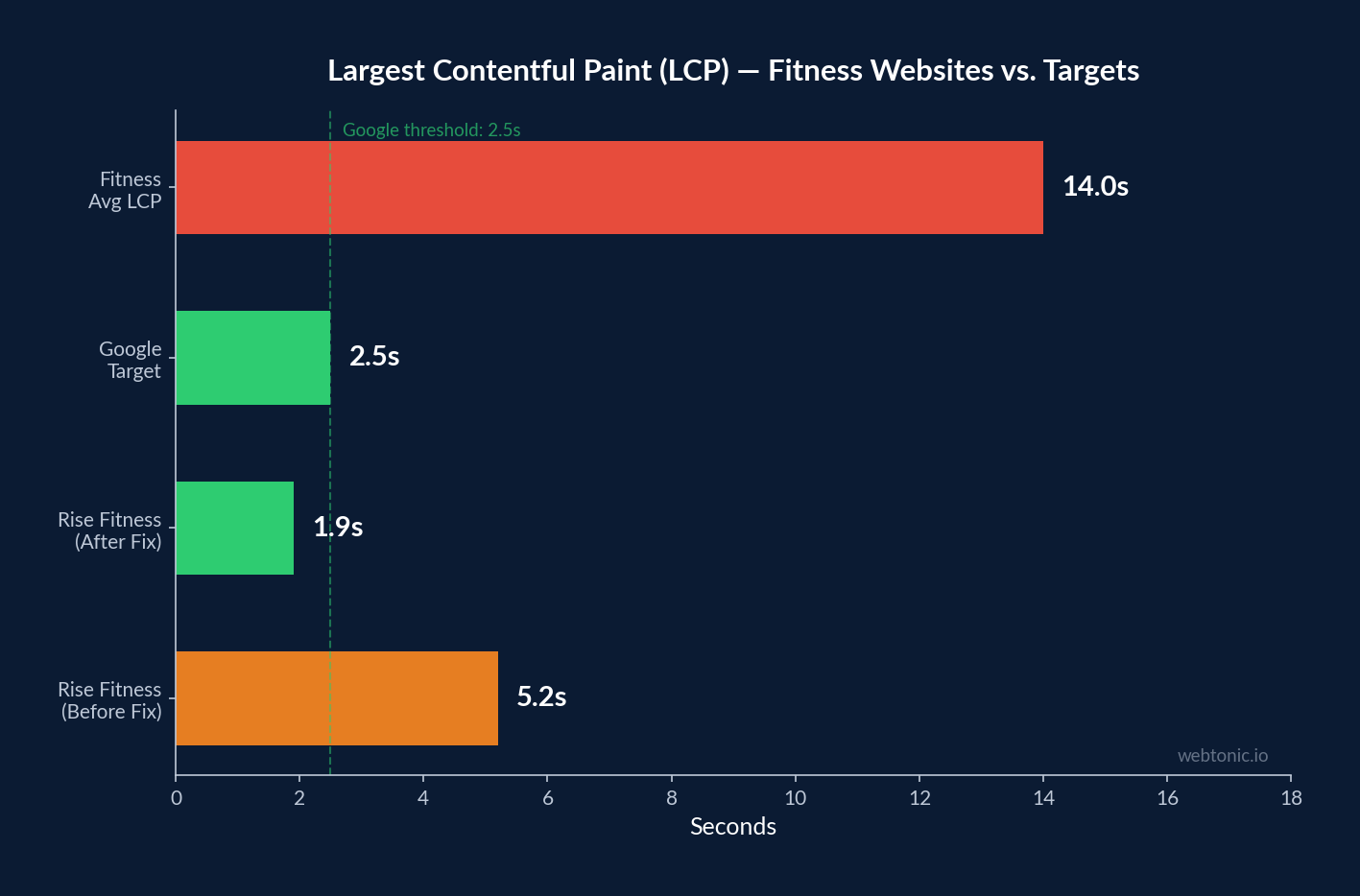
- The average gym website takes 14.0 seconds to render its main content (LCP), exceeding Google's 2.5-second passing threshold by 11.5 seconds — putting the vast majority of fitness sites at a severe ranking disadvantage.
- 83.3% of graded gym homepages scored a C or lower on overall website quality audits, with only 2.8% earning an A (90+) and 16.7% failing outright below 50/100.
- Organic search delivers 48.2% of all fitness website traffic, making technical SEO the single highest-leverage infrastructure investment for gyms and studios.
- 72.4% of fitness website traffic comes from mobile devices, yet many gym sites still fail mobile Core Web Vitals — creating a gap between traffic source and experience quality.
- A Rise Fitness technical SEO overhaul cut bounce rate from 62% to 37% (−40%), increased session duration by 35%, and reduced page load time by 63% from 5.2s to 1.9s.
- Only 49.1% of all websites pass Core Web Vitals as of 2026, and the fitness industry falls well below this already-modest global average due to heavy image content and unoptimized CMS themes.
- Top-performing fitness retailers capture 42–68% of category traffic through organic search, while gym brands ranking in the top 3 local pack positions see 2.5–3× higher CTRs than those in positions 4–7.
Fitness Website Technical SEO Benchmarks at a Glance
These benchmarks are drawn from real audit data across gym and fitness websites, providing actionable targets for technical optimization in 2026.
| Metric | Fitness Industry Avg. | Google Target / Best Practice | Source |
|---|---|---|---|
| LCP (Largest Contentful Paint) | 14.0s | ≤2.5s | Borah Labs |
| PageSpeed Score (Mobile) | 47/100 | ≥80/100 | Borah Labs |
| Homepage Quality Score | 65/100 median | ≥90/100 | Codivox |
| Mobile Traffic Share | 72.4% | N/A (mobile-first index) | CuFinder |
| Bounce Rate (Overall) | 44.5% | <40% | CuFinder |
| Mobile Bounce Rate | 48.2% | <42% | CuFinder |
| Organic Traffic Share | 48.2% | N/A | CuFinder |
Core Web Vitals Performance: Where Fitness Sites Fail
The gap between fitness website performance and Google's thresholds is stark. Borah Labs' 2026 gym benchmarks show the average fitness site takes 14.0 seconds to render its main content — that is 11.5 seconds over Google's 2.5-second LCP threshold. This single metric alone pushes most gym sites out of the "good" Core Web Vitals category.
The average gym website scores just 47/100 on Google PageSpeed for mobile. Anything above 80/100 puts a fitness site ahead of most competitors, yet the industry average sits nearly half that. According to Codivox's gym website study, 83.3% of graded gym homepages scored a C or lower, with scores ranging from 38 to 93.
Globally, only 49.1% of all websites pass Core Web Vitals, climbing from 28.6% in 2022 to the current rate (PageSpeed Matters). The fitness industry falls significantly below this benchmark due to heavy hero images, unoptimized video backgrounds, and bloated third-party scripts from booking and CRM plugins.
Mobile Optimization: The 72% Reality
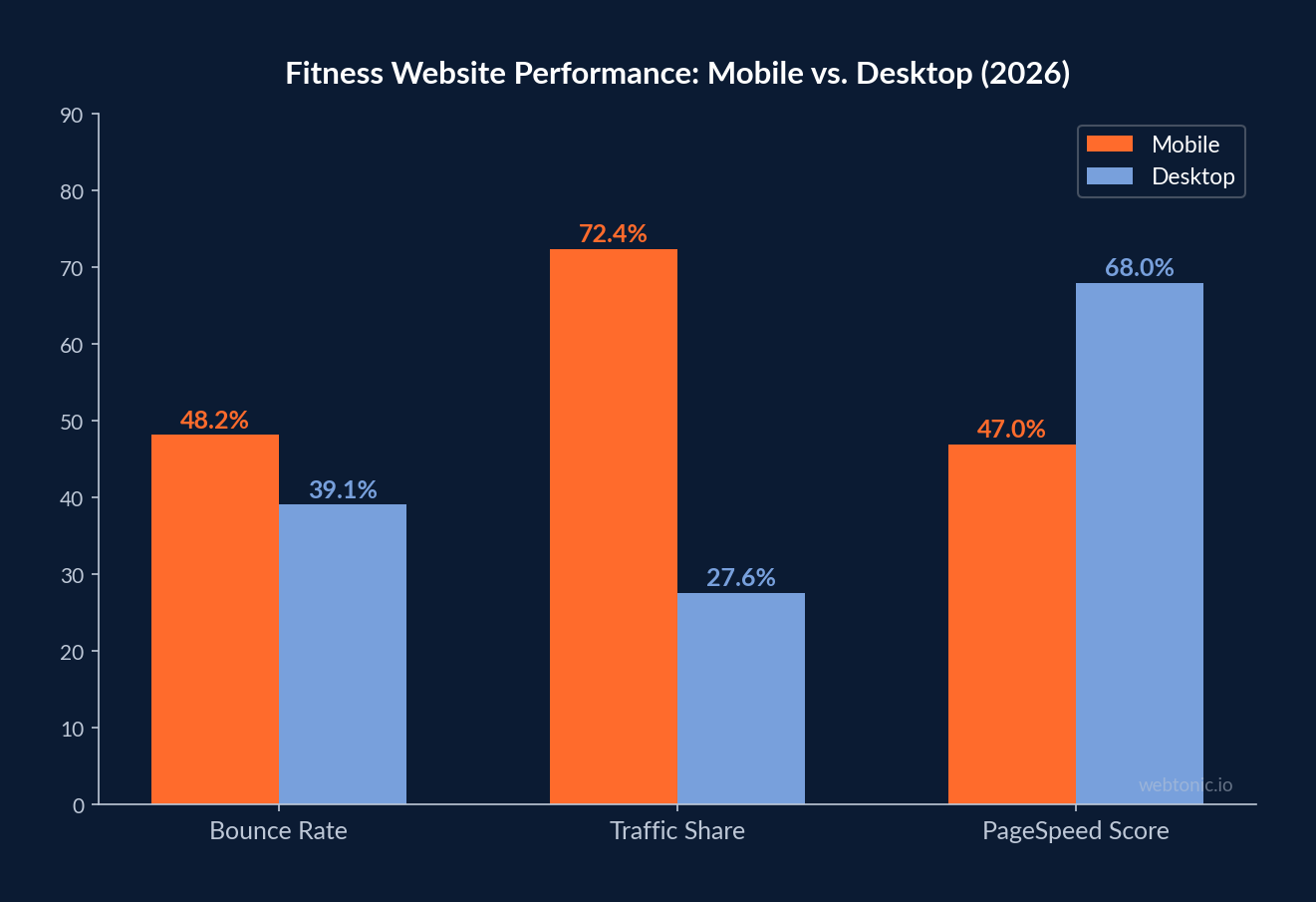
With 72.4% of fitness website traffic coming from mobile devices (CuFinder), mobile performance directly determines whether most visitors experience a fast or broken site. Some urban fitness markets see mobile traffic shares exceeding 80%.
Firebreather Marketing consistently observes around 70% mobile visitors across their gym client sites — yet most of these sites were originally designed desktop-first. The disconnect is measurable: mobile bounce rates sit at 48.2% versus 39.1% on desktop, a 9.1 percentage point gap that signals poor mobile experiences.
For growth marketing teams spending on paid ads that drive mobile clicks, slow mobile sites destroy return on ad spend. Google's Think with Google research established that each additional second of load time can cost 7–27% in conversions — and most gym sites add 10+ unnecessary seconds.
| Mobile Metric | Fitness Avg. | Optimal Target | Gap |
|---|---|---|---|
| Mobile Traffic Share | 72.4% | N/A | Majority mobile, sites built desktop-first |
| Mobile Bounce Rate | 48.2% | <42% | +6.2pp above target |
| Desktop Bounce Rate | 39.1% | <35% | +4.1pp above target |
| Mobile PageSpeed | 47/100 | ≥80/100 | −33 points below target |
| Mobile LCP | 14.0s | ≤2.5s | 5.6× slower than target |
Organic Search Traffic and SEO ROI for Fitness
Organic search remains the most cost-efficient traffic source for fitness businesses. According to CuFinder benchmarks, organic search delivers 48.2% of all fitness website traffic, ahead of paid channels, social referrals, and direct visits. Top-performing fitness retailers capture 42–68% of category traffic through organic search (Authority Specialist).
Ahrefs' organic traffic benchmark study across millions of websites shows the Beauty & Fitness vertical averages 9,672 monthly organic visits per site, with top-quartile sites reaching 53,261 (Ahrefs). The difference between average and top-performing sites is almost entirely attributable to technical SEO foundations — sites with fast LCP, proper indexing, and mobile-first architecture capture a disproportionate share of search traffic.
A Rise Fitness case study quantified the ROI of technical SEO investment: after a comprehensive technical overhaul, the brand achieved a 60% increase in organic traffic, 40% bounce rate reduction (from 62% to 37%), 35% longer session duration, and 63% page load improvement (5.2s → 1.9s).
Page Speed Impact on Fitness Conversions
A 37,036-site study by PageSpeed Matters confirmed the direct link between speed and rankings: among the most competitive sites, the page-one pass rate is 46.7% versus 39.1% on page two, a 7.6 percentage point gap. Sites that fail Core Web Vitals entirely see even steeper ranking penalties.
SearchLab's 2026 technical SEO statistics compile data showing a 27% conversion drop per extra second of load time. For a gym spending $10,000/month on Google Ads driving traffic to a 14-second LCP site, this speed penalty could be costing the equivalent of $2,700+/month in lost membership conversions.
The crawl efficiency problem compounds these issues. SEOmator's 2026 Crawl Waste Report found that only 45.9% of crawler requests return a 200 status code across analyzed sites. For fitness businesses with class schedules, trainer profiles, and location pages, poor URL management creates wasted crawl budget that delays indexing of important content.
Structured Data and Schema Markup Adoption in Fitness
Schema markup is an underutilized competitive advantage for fitness websites. Frostbite Marketing emphasizes that structured data is how gyms "hand AI engines the facts instead of hoping they infer them" — critical as AI-powered search grows.
The five most relevant schema types for fitness websites are:
- LocalBusiness / GymOrFitnessCenter — name, address, hours, price range
- Service — personal training, group classes, nutrition coaching
- Event — class schedules, workshops, challenges
- FAQPage — membership questions, cancellation policies
- Review / AggregateRating — Google star ratings and testimonials
Google's public schema usage dataset shows that most schema types (76.9%) appear on fewer than 1,000 domains — meaning early adopters in any niche, including fitness, gain a significant visibility edge in rich results and AI-powered search experiences.
Crawl Efficiency and Indexing Challenges for Fitness Sites
Beyond page speed, fitness websites face structural crawling problems that prevent Google from discovering and indexing their most important content. SEOmator's Crawl Waste Report reveals that only 45.9% of all crawler requests return a 200 status code, meaning more than half of Google's crawl budget is spent on redirects, 404 errors, and non-canonical pages.
For fitness businesses, the crawl waste problem is amplified by several common technical patterns. Gym chains with multiple locations often generate duplicate pages through CMS parameter variations — a single class schedule page might be accessible at 5–10 different URLs when filtered by date, instructor, or class type. Each duplicate consumes crawl budget without adding indexable value. Personal trainer directories with profile pages that change frequently (new certifications, schedule updates) create churn that forces Google to re-crawl pages constantly.
Google's Gary Illyes has noted that about 90% of sites never need to worry about crawl budget. But fitness businesses with dynamic class schedules, multiple location pages, and blog content fall into the 10% that do — their sites are large enough and dynamic enough that crawl prioritization directly impacts which pages get indexed and when.
Implementing proper canonical tags, consolidating parameter-driven variations, and setting up an XML sitemap that prioritizes revenue-generating pages (location landing pages, membership signup pages) over low-value content (past class schedules, expired promotions) can recover 30–50% of wasted crawl budget.
Local SEO Technical Requirements for Gyms
Multi-location fitness brands face unique technical SEO challenges that single-location businesses do not. Authority Specialist found that gym brands ranking in the top three local pack positions generate organic click-through rates roughly 2.5 to 3× higher than those ranking in positions four through seven.
This CTR differential makes local technical SEO one of the highest-ROI activities for fitness businesses. The technical foundations that drive local pack rankings include proper NAP (Name, Address, Phone) consistency across the website and Google Business Profile, hreflang implementation for multi-language gym markets, GymOrFitnessCenter schema on each location page, and mobile-optimized location landing pages with embedded Google Maps and structured hours-of-operation data.
For franchise fitness brands operating 50+ locations, programmatic technical SEO becomes essential. Each location page needs unique title tags, meta descriptions, and H1s that include the city name alongside the brand. Template-based approaches that generate identical content across all locations trigger Google's duplicate content filters and suppress rankings. The technical solution is dynamic content modules that pull location-specific data (membership pricing, class schedules, trainer bios, local reviews) into a shared page template while maintaining unique, indexable content on each page.
Given that 48.2% of all fitness website traffic comes from organic search, and local searches ("gym near me," "yoga studio [city]") represent the highest-intent queries in the industry, the technical SEO investment required to support proper local page architecture pays back through direct membership acquisition at zero marginal cost per click.
Technical SEO Best Practices for Fitness Websites
- Compress and lazy-load hero images — fitness sites rely on large visuals, but unoptimized hero images are the primary driver of the 14.0s average LCP. Use next-gen formats (WebP/AVIF) and lazy loading for below-fold content.
- Audit and defer third-party scripts — booking widgets, live chat, CRM integrations, and analytics tags contribute to JavaScript bloat. Load non-critical scripts asynchronously or defer until after LCP.
- Implement server-side rendering or static generation — single-page apps (React/Angular) used by some gym chains create crawling challenges. Static generation ensures Google can index class schedules and location pages immediately.
- Consolidate URL structure — with only 45.9% of crawler requests returning 200, fitness sites should audit for redirect chains, duplicate parameter URLs, and orphaned pages that waste crawl budget.
- Deploy LocalBusiness schema on every location page — gym brands ranking in top-3 local pack positions see 2.5–3× higher CTRs than those in positions 4–7. Structured data reinforces local relevance signals.
- Target mobile PageSpeed ≥ 80 — the industry average is 47/100. Reaching 80+ puts a fitness site ahead of virtually all competitors and into Google's preferred performance tier.
- Set up proper XML sitemaps and robots.txt — ensure class schedule pages, trainer profiles, and blog content are all discoverable while blocking CMS admin panels and duplicate filter URLs.
Frequently Asked Questions
Why do gym websites load so slowly compared to other industries?
Gym websites average a 14.0-second LCP due to three main factors: oversized hero images and video backgrounds designed to showcase facilities, heavy booking and CRM widget scripts (MindBody, Glofox, etc.), and unoptimized CMS themes that were chosen for aesthetics rather than performance. The cumulative result is a PageSpeed score of 47/100, well below competitive thresholds.
How much traffic can a gym gain by fixing technical SEO?
Rise Fitness saw a 60% organic traffic increase after a comprehensive technical overhaul that cut load times from 5.2s to 1.9s. Authority Specialist data shows that top-performing gym brands capture 42–68% of category traffic organically, while underperforming sites with poor technical foundations struggle to break 20%. The delta represents thousands of potential monthly visitors and membership inquiries.
Do Core Web Vitals actually affect gym website rankings?
Yes. A 37,036-site study confirmed a 7.6 percentage point gap in page-one pass rates between sites that pass Core Web Vitals and those that do not. For competitive local fitness searches ("gym near me," "personal trainer [city]"), even small ranking improvements translate into significant membership pipeline growth because the top 3 local pack positions receive 2.5–3× more clicks.
What is the most important technical SEO fix for a fitness website?
Reducing LCP below 2.5 seconds delivers the highest single-fix impact. With the industry average at 14.0 seconds, simply compressing images, implementing lazy loading, and deferring non-essential scripts can cut load times by 60–80%. This single improvement typically lifts PageSpeed scores from the 40s to the 70s and directly reduces the 48.2% mobile bounce rate that costs fitness sites visitors and conversions.
Should fitness websites invest in schema markup?
Absolutely. Schema markup enables rich snippets, star ratings, and FAQ dropdowns in search results. Since 76.9% of schema types are used on fewer than 1,000 domains, fitness businesses implementing GymOrFitnessCenter, Event, and FAQPage schemas gain immediate visibility advantages. The implementation cost is minimal — usually a one-time setup per page template — but the CTR improvements compound over every search impression.
Sources
Borah Labs — Gyms & Fitness Website Benchmarks 2026
Codivox — Gym Website Statistics 2026
CuFinder — Fitness and Wellness Marketing Benchmarks 2026
PageSpeed Matters — Core Web Vitals Pass Rate 2026
Firebreather Marketing — Gym Mobile Traffic Data
Ahrefs — Average Organic Traffic Benchmarks 2026
Higglo — Rise Fitness SEO Case Study
Authority Specialist — Gym SEO Benchmarks 2026
SearchLab — Technical SEO Statistics 2026
SEOmator — Crawl Waste Report 2026
Frostbite Marketing — AI Search Optimization for Fitness Studios