Table of contents

No public study shows dominant fitness brands claiming half of search visibility. We looked for one and found none, so this page answers the headline honestly: it measures what the scale of the big chains actually is, how search traffic behaves in 2026, and what enterprise SEO requires once a brand runs dozens or thousands of clubs.
Key Takeaways
- 81 million Americans belonged to a gym, studio or fitness facility in 2025 (HFA).
- That membership base grew 5.2% year on year, an all-time high.
- Americans made nearly 7 billion facility visits in 2025.
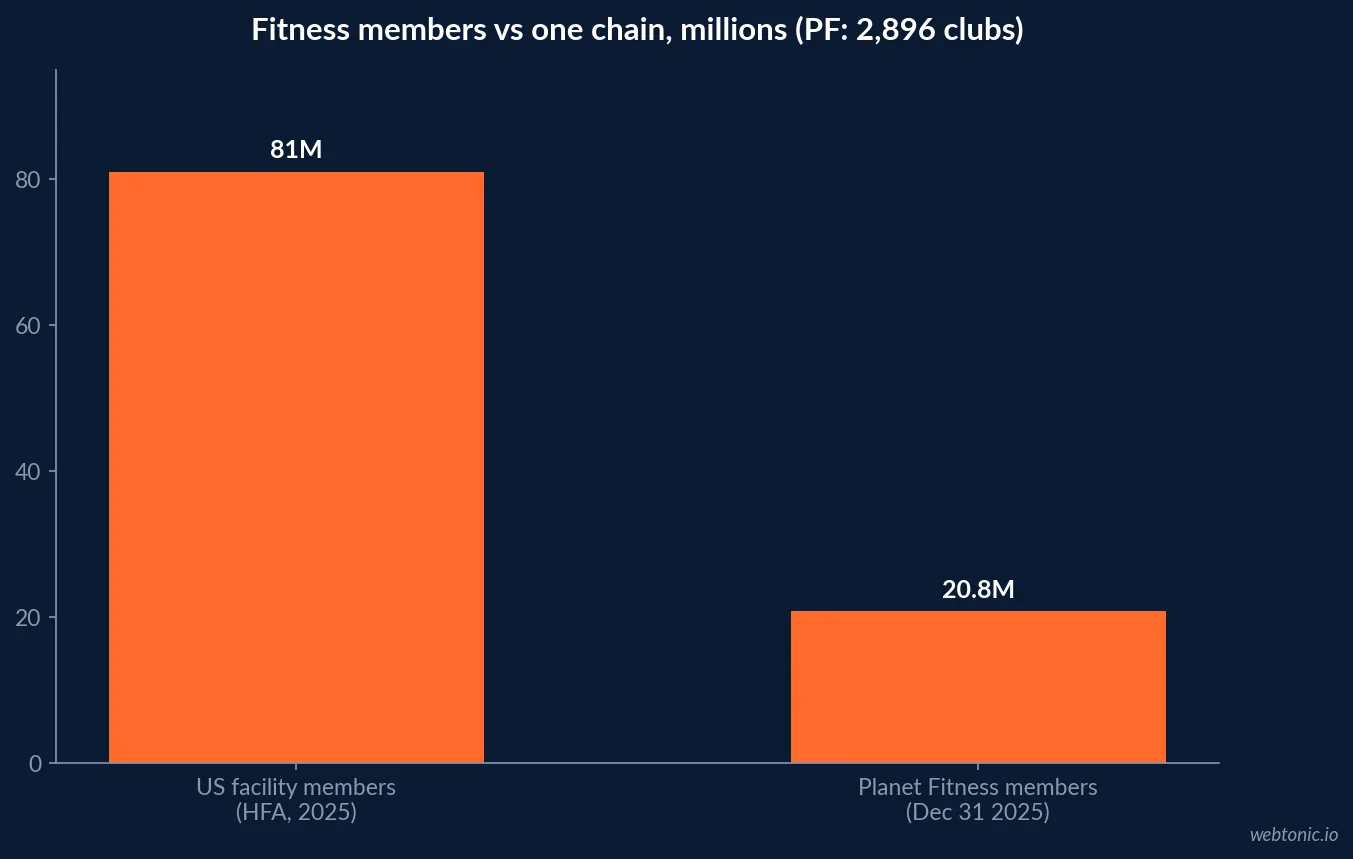
- Planet Fitness ended 2025 with 2,896 clubs and about 20.8 million members.
- It opened 181 clubs in 2025, 158 of them franchisee-owned.
- Google handled 86.1% of US search engine traffic in August 2026 (Statcounter).
- 58.5% of US Google searches ended with zero clicks in 2024 (SparkToro and Datos).
- Google Business Profile bulk verification starts at 10 or more locations.
- No dataset publishes a visibility share for fitness chains versus independent clubs.
Is there any data behind "half of search visibility"?
Not that we could verify. Visibility share is a rank-tracker metric computed on a chosen keyword set, and no association, regulator or vendor publishes one for the fitness category. Any figure you see quoted without a keyword list, a date and a tool behind it should be treated as a claim rather than a statistic.
What can be sourced is the structure of the market. The Health and Fitness Association 2026 consumer report counts 81 million members in 2025, and Planet Fitness's own fourth-quarter 2025 results report 2,896 clubs. The two numbers are not like-for-like (Planet Fitness includes members outside the US), so we do not divide one by the other. They do show that one franchisor operates at a scale where search becomes a data governance job rather than a copywriting job.
Fitness enterprise SEO benchmarks at a glance
| Metric | Figure | Source and year | What it tells an enterprise team |
|---|---|---|---|
| US facility members | 81 million | HFA, 2025 data | The addressable base for club searches |
| Membership growth | +5.2% | HFA, 2025 | Demand is rising, not shrinking |
| Planet Fitness clubs | 2,896 | Planet Fitness, Dec 31 2025 | One brand, thousands of local pages |
| Google share of US search | 86.1% | Statcounter, Aug 2026 | Google rules decide the playbook |
| US zero-click searches | 58.5% | SparkToro and Datos, 2024 | Rankings do not equal visits |
| Bulk profile threshold | 10+ locations | Google Business Profile Help | Where chain tooling starts |
| Health and Fitness paid CPL | USD 62.80 | WordStream, Apr 2024 to Mar 2025 | Paid comparator only |
How big are the big fitness brands?
Planet Fitness is the clearest public case because it reports its footprint every quarter. It ended 2025 with 2,896 clubs across all 50 states and several other countries, opened 181 clubs during the year (158 franchisee-owned, 23 corporate-owned) and grew system-wide same club sales by 6.7%. Every one of those clubs needs a profile, a page and consistent hours.
The wider industry is healthy too. HFA's 2025 benchmarking report, drawn from 175 companies representing more than 17,000 facilities, found median revenue growth of 9.9% in 2024, a median EBITDA margin of 23.6% and net membership growth of 5.5%. Operators with margins like that can fund centralised SEO, which is part of why chains invest in it.
| Market structure signal | Figure | Source |
|---|---|---|
| Facility members, 2025 | 81 million | HFA 2026 consumer report |
| Facility visits, 2025 | Nearly 7 billion | HFA 2026 consumer report |
| Members who never used membership | 4.6% (from about 10%) | HFA 2026 consumer report |
| Gen Z (18-24) penetration | 35.5% | HFA 2026 consumer report |
| Benchmark sample | 175 companies, 17,000+ facilities | HFA 2025 benchmarking report |
| Median revenue growth, 2024 | 9.9% | HFA 2025 benchmarking report |
| Planet Fitness members | About 20.8 million | Planet Fitness Q4 2025 results |
Where fitness searches actually happen
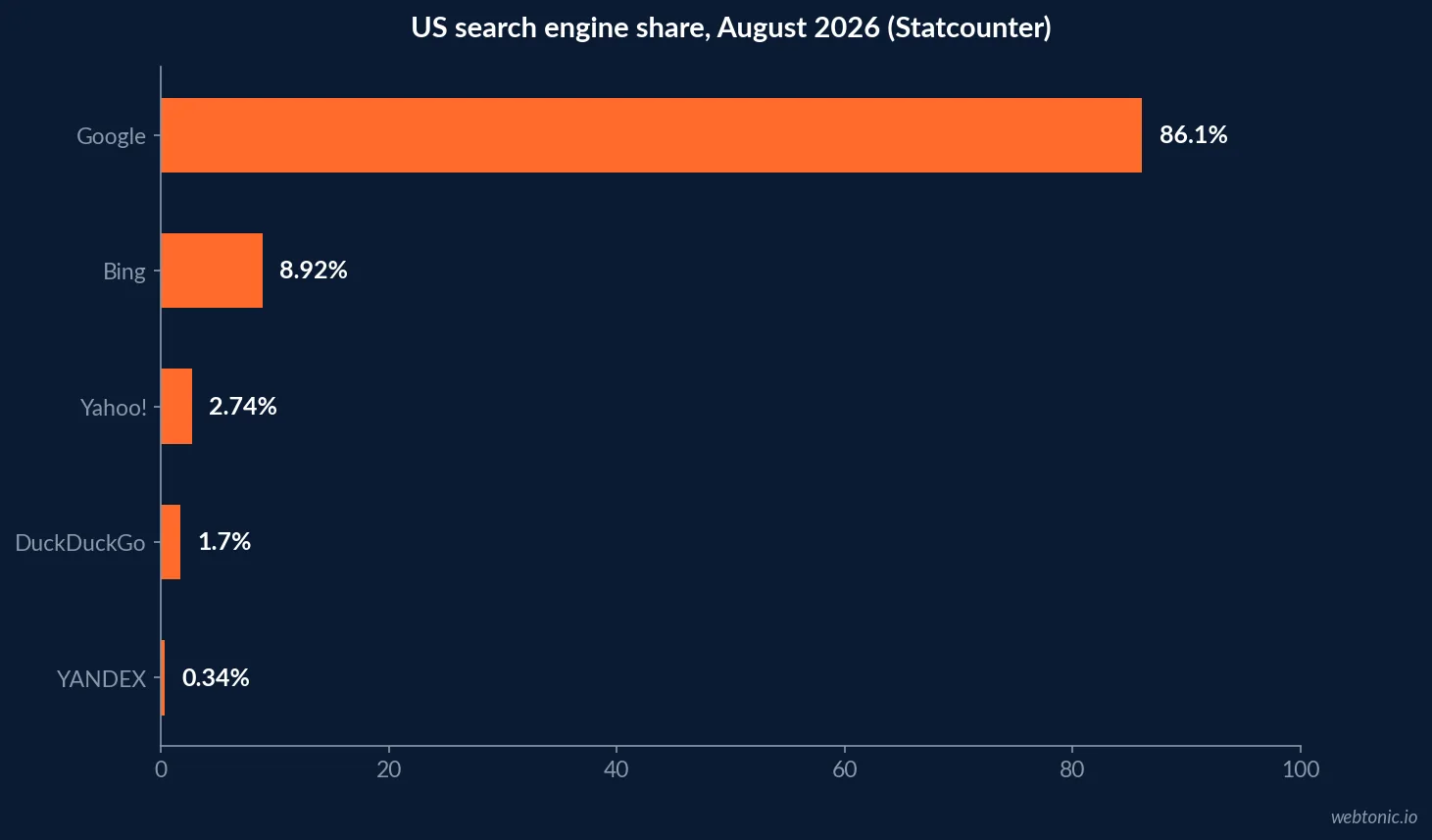
For a US gym chain, enterprise SEO is mostly Google SEO. Statcounter put Google at 86.1% of US search engine traffic in August 2026, with Bing at 8.92%, Yahoo at 2.74% and DuckDuckGo at 1.7%. Bing still matters for a brand with thousands of locations, because Bing Places and Apple Maps feed voice assistants and in-car search, but the priority order is not in doubt.
| Search engine | US share, Aug 2026 | Enterprise implication |
|---|---|---|
| 86.1% | Business Profile, Search Console, structured data | |
| Bing | 8.92% | Bing Places sync for every club |
| Yahoo! | 2.74% | Served largely from Bing's index |
| DuckDuckGo | 1.7% | Relies on third-party map and index data |
| YANDEX | 0.34% | Negligible for US clubs |
Rankings are not visits: zero-click and AI summaries
Even a brand that owned half of all fitness rankings would not own half of the clicks. The SparkToro and Datos 2024 zero-click study found that 58.5% of US Google searches ended without a click, and only 360 of every 1,000 US searches sent a click to the open web. Pew Research tracked 900 US adults in March 2025 and found users clicked a traditional result on 8% of visits with an AI summary against 15% without one.
Ahrefs reran its click study on 300,000 keywords with December 2025 data and found that an AI Overview correlates with a 58% lower click-through rate for the top-ranking page. None of these studies isolates gym queries. "Planet Fitness near me" is a navigational, map-driven search, so the honest reading is that informational fitness content (workout guides, class explainers) carries more click risk than club-finder pages.
| Click-loss study | Finding | Scope |
|---|---|---|
| SparkToro and Datos, 2024 | 58.5% of US Google searches zero-click | Clickstream panel, all queries |
| SparkToro and Datos, 2024 | 360 of 1,000 US searches reach the open web | Clickstream panel |
| Pew Research, March 2025 | 8% click rate with AI summary vs 15% without | 900 US adults |
| Pew Research, March 2025 | 18% of searches produced an AI summary | Same panel |
| Ahrefs, Dec 2025 data | -58% CTR for position 1 with an AI Overview | 300,000 keywords |
AI answers in health-adjacent queries
Conductor's 2026 AEO and GEO benchmarks report analysed 21.9 million Google searches and found 25.11% triggered an AI Overview. Its Health Care sector saw the highest rate at 48.75%. Fitness sits beside health care rather than inside it, so that figure is a ceiling to watch, not a fitness benchmark. Conductor also found AI referrals made up just 1.08% of website traffic across 10 industries, with ChatGPT supplying 87.4% of that referral traffic.
For a gym chain, the practical takeaway is to keep class schedules, prices and amenities on crawlable club pages, because those are the facts answer engines lift.
Club pages versus doorway pages
This is where multi-location fitness SEO most often goes wrong. Google's spam policies describe doorway abuse as "multiple domain names or pages targeted at specific regions or cities that funnel users to one page" and "substantially similar pages that are closer to search results than a clearly defined, browseable hierarchy." A club page that swaps only the city name in a template fits that description.
A club page that carries its own address, opening hours, class timetable, equipment list, parking notes, staff and reviews is a real destination. The test is simple: would a member of that club find something on the page they could not find on the next one?
Google Business Profile at 10 or more clubs
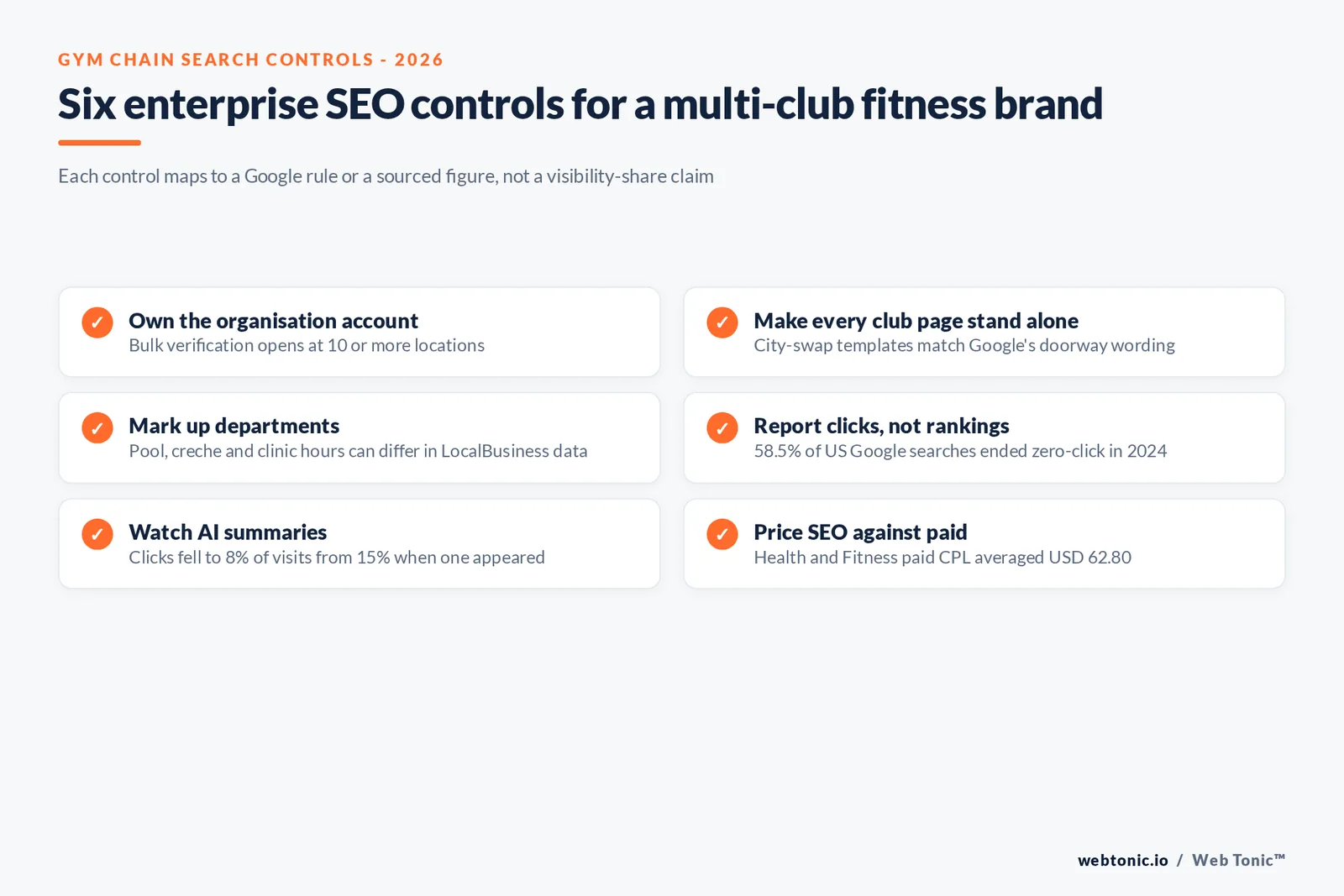
Google Business Profile Help lets a business verify profiles in bulk once it has 10 or more locations of the same business, through a spreadsheet in Business Profile Manager. Duplicate, suspended or disabled profiles do not count towards the 10-profile minimum, and agencies managing several different businesses in one account cannot bulk verify. For a franchisor, that means the brand, not each franchisee's agency, should own the organisation account.
Our fitness local SEO statistics cover the single-club side of this; the enterprise version is about governance, change control and hours that stay right across every holiday.
Structured data for clubs with departments
Google's LocalBusiness structured data documentation lets a site describe business hours, reviews and "different departments within a business," each with its own opening hours or phone number. That maps neatly onto large clubs with a pool, a creche or a physio clinic on different hours. Mark up the department rather than inventing a second business location.
| Enterprise task | Google's own threshold or rule | Fitness application |
|---|---|---|
| Bulk profile verification | 10 or more locations of the same business | Franchisor owns the account |
| Doorway abuse | City pages that funnel users to one page | Every club page must stand alone |
| LocalBusiness markup | Departments can carry their own hours | Pool, creche, clinic hours |
| Search Console API | 50K rows per day per type per property | Enough for most club networks |
| Crawl budget guide | 1 million+ pages, or 10,000+ changing daily | Rarely applies to gym sites |
Paid search as the cost comparator
Because no study publishes an organic cost per lead for gyms, paid search is the nearest priced benchmark. WordStream's 2025 Google Ads benchmarks, based on more than 16,000 US campaigns from April 2024 to March 2025, report these Health and Fitness averages. Treat them as a paid comparator, not an SEO result.
| Paid search metric | Health and Fitness | All industries |
|---|---|---|
| Average click-through rate | 7.18% | 6.66% |
| Average cost per click | USD 5.00 | USD 5.26 |
| Average conversion rate | 6.80% | 7.52% |
| Average cost per lead | USD 62.80 | USD 70.11 |
A chain that knows its own paid cost per lead can price the organic traffic its club pages earn. That is the only defensible way to put a number on SEO value for a fitness brand, and it uses your data, not an industry average.
How to measure your own visibility share
- Build a keyword set per market: brand, "gym near me" variants, class types and price queries.
- Track it weekly in one rank tracker and compute share of clicks, not share of rankings.
- Pull Search Console data per club through the API, which returns up to 50K rows per day per type.
- Report map-pack presence separately from organic links, because the two behave differently.
- Compare against your own paid cost per lead before claiming a return.
If you want this built as a live dashboard, our data intelligence team does exactly that. For the wider channel picture, see the enterprise SEO statistics hub and our fitness CTV advertising data.
Frequently Asked Questions
Do dominant fitness brands really hold half of search visibility?
No public dataset we could find measures that. There is no association, government or vendor study that publishes a share of Google visibility for gym chains against independent clubs, so the headline is a question this page tests rather than a finding. What the data does show is scale: Planet Fitness reported 2,896 clubs and about 20.8 million members at the end of 2025, while the Health and Fitness Association counted 81 million Americans with a facility membership. Visibility share has to be measured keyword by keyword with a rank tracker on your own query set.
What makes fitness SEO an enterprise problem?
Location count. Once a brand passes 10 clubs, Google Business Profile allows bulk verification, and every club needs its own accurate profile, hours and landing page. The work shifts from writing pages to governing data across hundreds of listings, keeping location pages genuinely distinct so they do not read as doorway pages, and marking up each club with LocalBusiness structured data.
Are city landing pages for gyms considered doorway pages?
Not automatically. Google's spam policies describe doorway abuse as multiple pages targeted at regions or cities that funnel users to one page, or substantially similar pages closer to search results than a browseable hierarchy. A club page with its own address, timetable, amenities, staff and reviews is a real destination; a template that swaps only the city name is the risk.
How much do AI Overviews affect gym searches?
No fitness-specific click study exists. Cross-industry data is the best guide: Ahrefs found a 58% lower click-through rate for the top-ranking page when an AI Overview appears (December 2025 data), and Pew found users clicked a traditional result on 8% of visits with an AI summary against 15% without one in March 2025. Club-finder and membership-price queries are local and navigational, so the effect on them is untested rather than proven.
What does a gym lead cost from paid search for comparison?
WordStream's 2025 benchmarks, built from more than 16,000 US campaigns between April 2024 and March 2025, put the Health and Fitness average cost per lead at USD 62.80 against USD 70.11 across all industries. That is a paid comparator only; no published study reports an organic cost per lead for fitness brands.
Sources
Health and Fitness Association - 2026 US consumer report release
Health and Fitness Association - 2025 benchmarking report
Planet Fitness - Q4 and full-year 2025 results
Statcounter - US search engine market share
SparkToro - 2024 zero-click search study
Pew Research Center - AI summaries and clicks, 2025
Ahrefs - AI Overviews reduce clicks update
Conductor - 2026 AEO and GEO benchmarks report
Google Search Central - spam policies
Google Search Central - LocalBusiness structured data
Google Business Profile Help - verify profiles in bulk
WordStream - 2025 Google Ads benchmarks