Table of contents

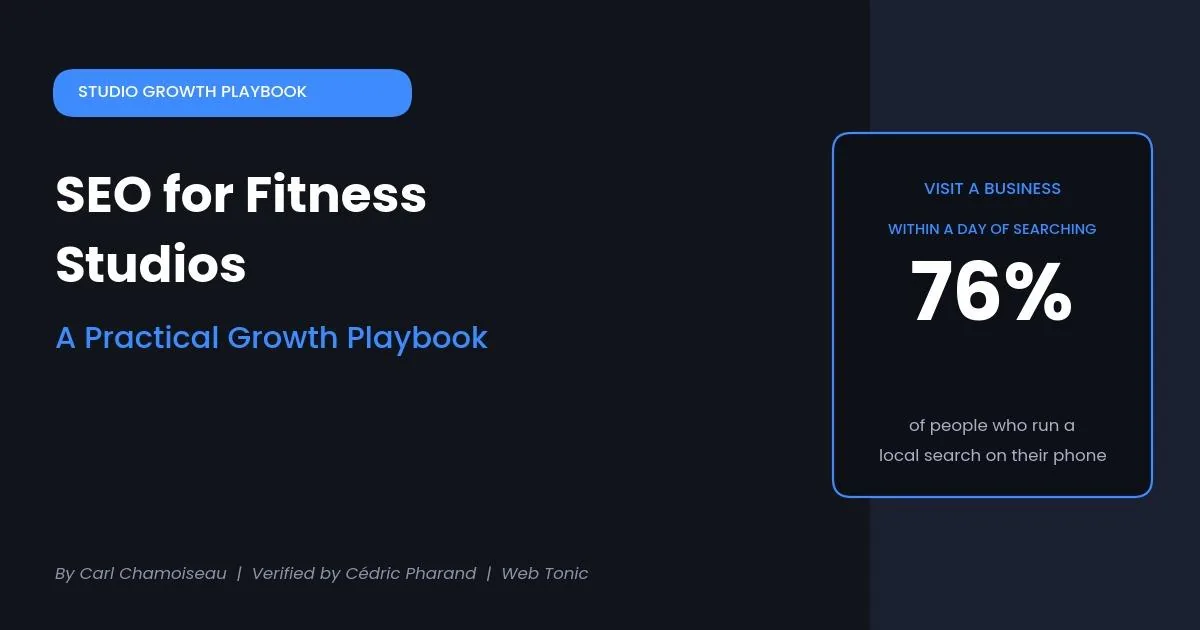
A prospective member doesn't shop for a gym anymore. She shortlists one in about fifteen minutes on her phone, comparing three tabs while deciding whether tonight is the night she finally starts training. SEO for fitness studios is what decides which three studios make that shortlist, and increasingly, which one gets the trial booking before she even sets the phone down.
This playbook covers what actually drives local rankings for a gym or studio in 2026, the one Google Business Profile decision that trips up more fitness businesses than any other, and a practical framework for prioritizing your optimization effort.
Key takeaways
- 76% of people who run a local search on their phone visit a business within a day, and for a studio, that visit is usually a trial class.
- Google Business Profile signals make up roughly 32% of local Map Pack rankings, more than any other single category, making it the highest-leverage asset a studio owner controls.
- Top-3 Map Pack fitness businesses average 280-450 Google reviews, while positions #6-10 sit at just 80-200.
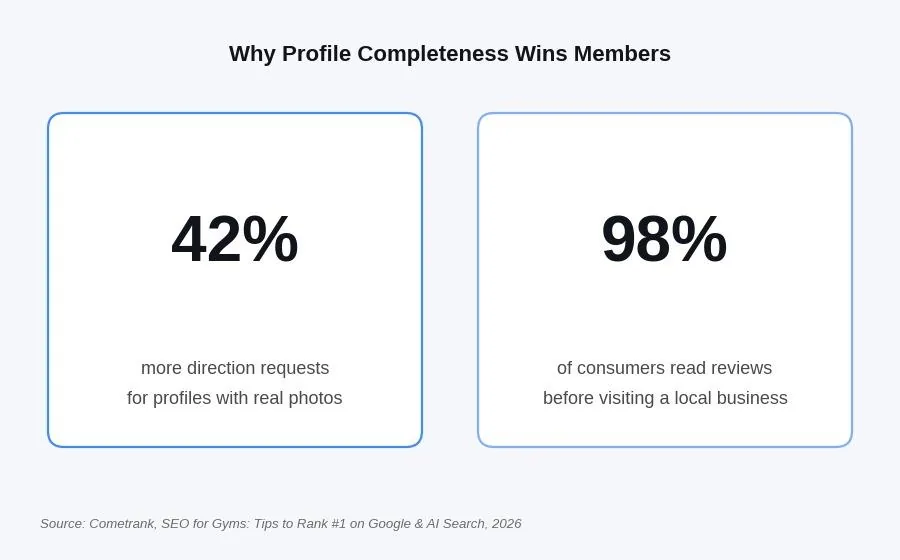
- Listings with real photos get 42% more direction requests, and 98% of consumers read reviews before visiting a local business.
- Category selection matters more for fitness than almost any other local business type. A studio listed only as "Yoga studio" is invisible for "gym near me" searches, even if it also offers strength training.
Why category selection makes or breaks fitness studio SEO
Fitness businesses face a structural challenge most local businesses don't: "Gym," "Fitness center," "Yoga studio," "Pilates studio," "CrossFit gym," and "Personal trainer" are all distinct Google Business Profile categories with different search volumes and different competitor sets. A studio that only lists itself as "Yoga studio" captures zero visibility for "fitness center near me" searches, even if the class schedule includes strength and conditioning work.
Fitness studio SEO tool
Which GBP category should you pick?
Category selection determines which searches you're even eligible to appear in. Select your primary offering and any secondary services below.
Recommended setup
Primary: Gym
Add secondary categories as you check them above to widen your search visibility without diluting your primary category match.
The fix isn't complicated, it just requires treating category selection as a strategic decision rather than an afterthought. A yoga studio that also runs strength classes should keep "Yoga studio" as primary, since that's the specific, high-intent search it actually wants to win, and add "Fitness center" as a secondary category to capture broader searches too.
Google Business Profile is the foundation
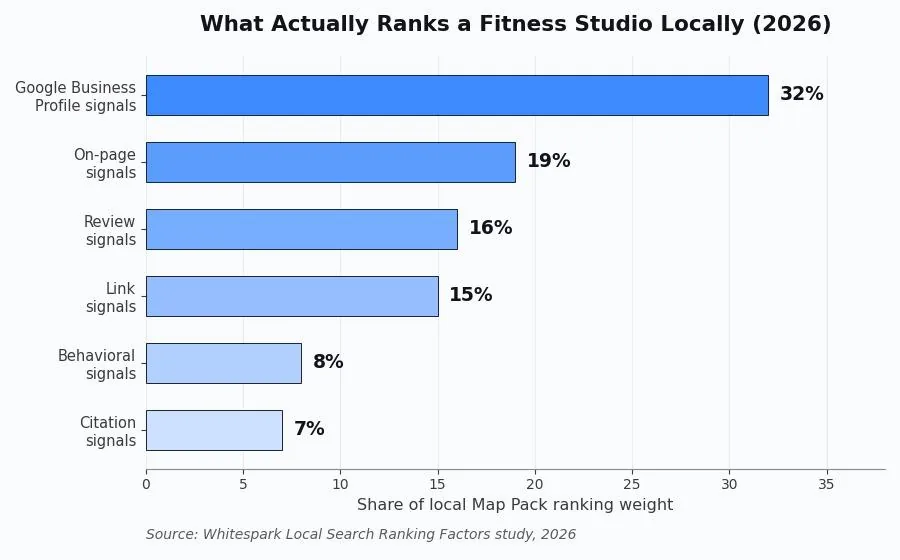
Google Business Profile signals account for roughly 32% of local Map Pack ranking weight, more than any other single category. The Whitespark Local Search Ranking Factors study has the full breakdown. For a fitness studio, that means the primary and secondary category choice, complete service listings, and consistently active photos and posts carry more ranking influence than almost anything else on this list.
A few things matter most:
- Choose primary and secondary categories deliberately, based on which searches actually drive membership, not just what technically describes the business.
- Upload real photos regularly: class spaces, instructors, and group sessions, not stock imagery. Listings with real photos get 42% more direction requests than those without.
- Post weekly updates, whether that's a schedule change, a new class launch, or a seasonal promotion. Google tracks profile activity, and inactive profiles rank behind active ones.
Reviews decide both rank and bookings
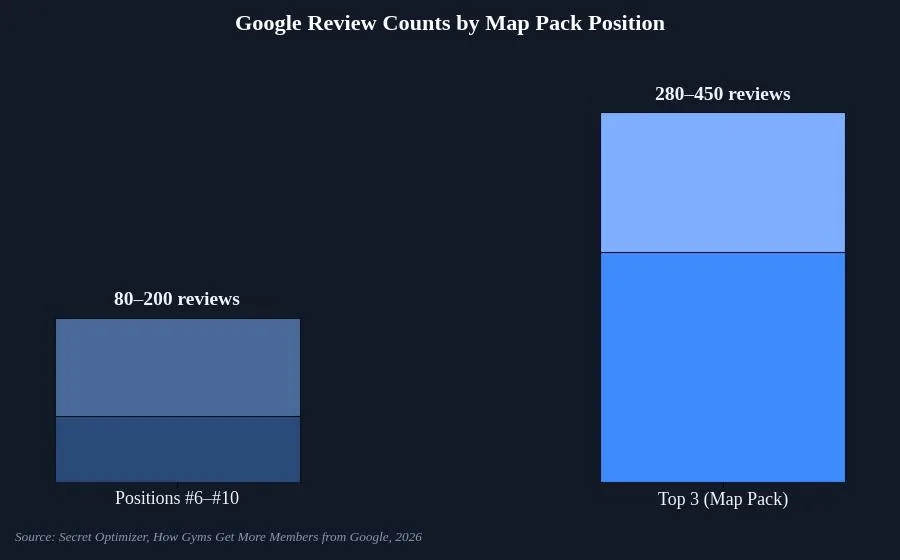
Reviews do two jobs simultaneously for a fitness studio: they influence whether it shows up in local search, and they influence whether a prospective member actually books once they find it. Top-3 Map Pack fitness businesses average 280-450 Google reviews, while positions #6-10 sit at just 80-200. Secret Optimizer's 2026 analysis of how gyms get more members from Google lays out the pattern. And 98% of consumers read reviews before visiting a local business in the first place, Cometrank's guide to ranking a gym on Google and AI search confirms.
Specific reviews outperform generic ones. "Great gym, friendly staff" does less for both conversion and search than a review that names a specific class and instructor, since that level of detail builds a searchable entity around the instructor and signals exactly what a prospective member can expect. Asking at the class level, right after a positive session, produces meaningfully more detailed reviews than a generic post-membership request.
Track what's actually working
Use the free tools you already have access to. Google Search Console shows which local queries are actually driving clicks to your site, so you can see whether "hot yoga [neighborhood]" is pulling its weight or just sitting unranked. Google Analytics shows whether that traffic converts into trial bookings once it lands. Google Keyword Planner helps validate real demand for a new class-specific page before you invest time building it, and Google Maps performance data rounds out the picture by showing how your listing behaves specifically inside the Map Pack.
Comparing your local SEO investment options
| Tier | Typical monthly cost | Best for | What's included |
|---|---|---|---|
| Entry / DIY-adjacent | $1,000-$2,000 | Solo trainers, single-location studios just starting out | GBP optimization, basic on-page work, citation cleanup |
| Full local SEO | $2,000-$4,000 | Studios competing in a crowded local market | Everything above plus content, service pages, ongoing review strategy |
| Full-service with integrated coaching | $2,000+ | Studios wanting SEO tied directly to membership conversion, not just rankings | Local SEO plus funnel and conversion strategy |
Figures reflect 2026 U.S. market benchmarks aggregated from Secret Optimizer and Marketing LTB's review of top gym SEO agencies; individual markets and competition levels will vary.
Build pages around classes, not one generic schedule
A single "Schedule" page competes for nothing specific. Each class type deserves its own page: "Hot Yoga in [City]" ranks for hot yoga searches the same way a dedicated "CrossFit [City]" page ranks for CrossFit searches. Flento's guide to local SEO for fitness studios and gyms covers the instructor-page angle too: Google increasingly surfaces individual instructor information, and a page for each lead instructor builds a searchable entity that captures both branded searches and the trust that turns a researcher into a first-time visitor.
This is also where fitness SEO connects directly to conversion. A prospective member deciding between three studios in fifteen minutes is answering one question: does this studio actually work for my schedule? A class page that ranks for "early morning HIIT [neighborhood]" is a page that pulls in a qualified visitor at the exact moment they're ready to book. That's the case Skyfield Digital's 2026 search playbook for fitness businesses makes.
AI search is starting to matter too
Roughly 60% of gym-related searches now happen on mobile with clear local intent, RankWebSolution's 2026 guide to fitness SEO practices finds, and a growing share of that research phase is shifting to AI tools. Questions like "how much does a CrossFit membership cost" or "what should I bring to my first BJJ class" increasingly get answered by ChatGPT, Perplexity, or Google AI Overviews before a prospective member ever runs a traditional search.
The good news: the same fundamentals that win classic local rankings feed AI citation too. Structured, specific, locally grounded content, answering the exact questions a prospective member would ask, performs well on both surfaces at once, since it's an extension of the existing strategy rather than a second one layered on top.
Common fitness studio SEO mistakes
- Choosing the wrong primary GBP category, or leaving high-value secondary categories unclaimed.
- Letting reviews go generic and infrequent. Specific, recent reviews outperform a large batch of old, vague ones.
- Building one generic schedule page instead of dedicated pages per class type and per instructor.
- Inconsistent NAP data, especially across Mindbody, ClassPass, and other fitness-specific directories that carry real local signal weight.
- Ignoring AI search entirely. The content investment required overlaps almost completely with what already wins classic local rankings.
Frequently asked questions
How is local SEO different for a yoga studio versus a gym?
The core tactics (GBP optimization, reviews, NAP consistency, location-specific content) are the same. What differs is the keyword profile and category strategy: gyms target higher-volume, broader terms like "gym near me," while yoga studios target more specific terms like "yoga class [city]," typically facing less direct competition but lower search volume.
How many Google reviews does a fitness studio need to rank well?
There's no fixed number, but top-3 Map Pack fitness businesses average 280-450 reviews, compared to 80-200 for positions #6-10. Recency matters as much as volume: a steady stream of recent, specific reviews outperforms a large batch of old, generic ones.
Should I use "Gym" or a more specific category like "Yoga studio" as my primary?
Choose based on which search you most want to win. A studio primarily built around yoga should keep "Yoga studio" as primary and add "Fitness center" as secondary if it also offers general classes, rather than defaulting to the broader category and losing the specific, high-intent search.
How long does fitness studio SEO take to show results?
Most studios see initial ranking movement within 60-90 days of consistent, focused work, with stronger organic authority building over the following 3-6 months.
Does AI search change fitness studio SEO strategy?
Not fundamentally. The same structured, specific, locally grounded content that wins classic Map Pack rankings is what gets cited by ChatGPT, Perplexity, and Google AI Overviews. It's an extension of the existing strategy, not a separate one.
Turning searches into filled classes
SEO for fitness studios in 2026 comes down to being the studio that shows up, loads fast, and answers the one question a prospective member actually has: does this work for my life? The studios winning memberships are treating Google Business Profile, review generation, and class-specific content as ongoing infrastructure, not a one-time setup, and they're the ones filling classes while their competitors wonder why walk-ins are down.
If you're ready to turn local search into a predictable pipeline of trial bookings, Web Tonic's growth marketing team builds SEO strategies for fitness and wellness businesses as part of a full-funnel approach. See Web Tonic's Growth Marketing services
More from Web Tonic: growth marketing services, data & analytics, performance creative.
Sources: whitespark.ca · secretoptimizer.com · cometrank.ai · marketingltb.com · flento.io · skyfielddigital.com · rankwebsolution.com