



Table of contents
Fitness brands spend heavily on digital advertising, yet most struggle to connect ad spend to actual memberships. Only 29% of marketers report high confidence in their attribution data, and the average fitness business loses visibility on 38% of its pipeline to dark-funnel channels. These attribution statistics for 2026 reveal where the industry stands — and where the gaps remain.
Key Takeaways
- $5.37 billion — global marketing attribution software market value in 2025, projected to reach $25.65B by 2036 (14.2% CAGR).
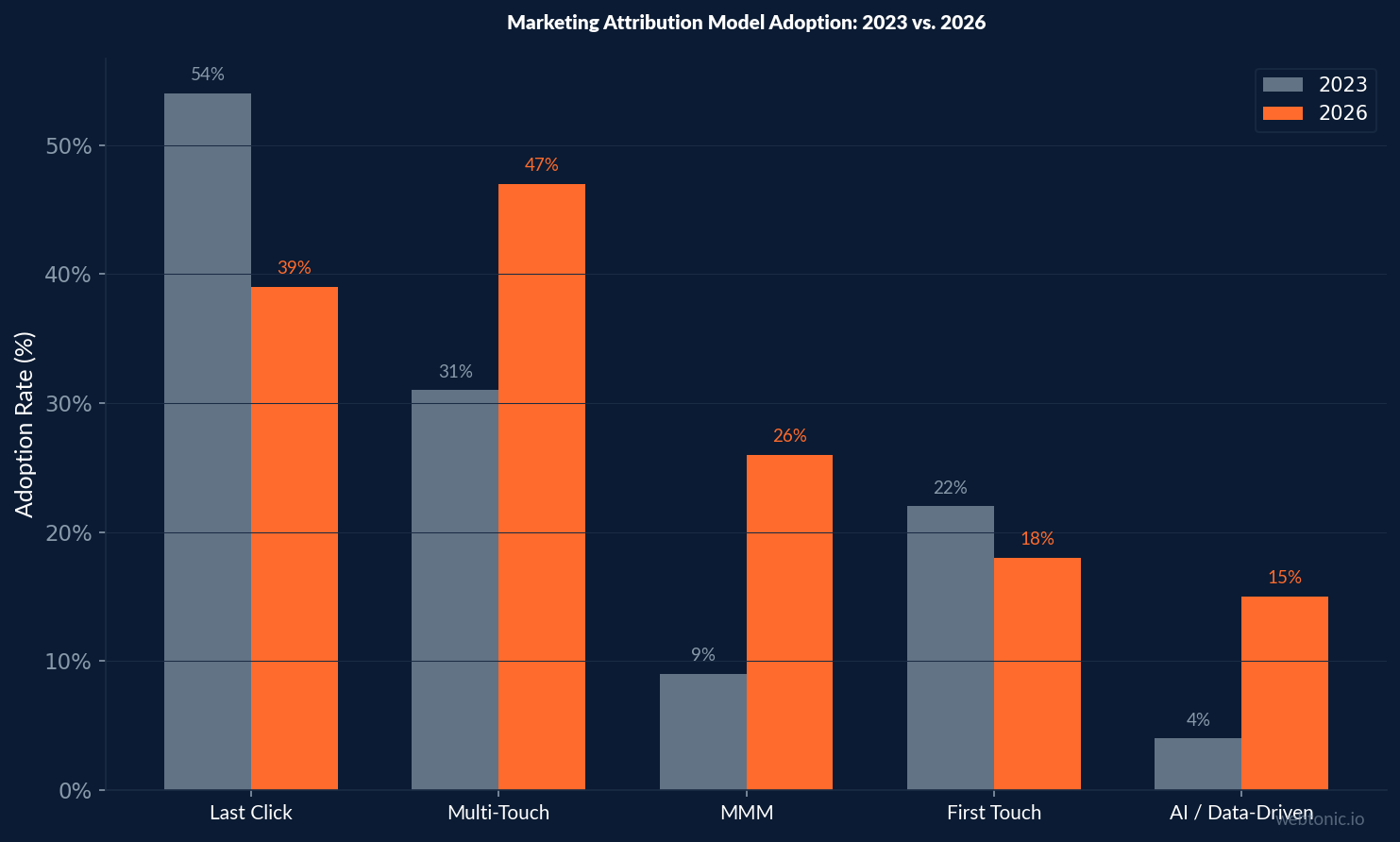
- 47% of marketers now use multi-touch attribution models, up from 31% in 2023.
- 38% average dark-funnel gap in B2B/services pipeline — touchpoints attribution can't see.
- 33% average ROI improvement reported by teams that improved attribution accuracy.
- 2.3× higher ROAS for brands using data-driven attribution vs. last-click models.
- 74% annual gym membership retention rate — making lifetime value attribution critical.
- $640 average fitness customer lifetime value, requiring 4–7 touchpoints before conversion.
Fitness Marketing Attribution at a Glance
This table summarizes the key attribution metrics fitness marketers need to benchmark against in 2026.
| Metric | Value | Source |
|---|---|---|
| Multi-touch adoption rate | 47% | digitalapplied.com |
| Last-click still dominant | 39% of marketers | amworldgroup.com |
| Attribution software market | $5.37B (2025) | giiresearch.com |
| Projected market (2036) | $25.65B | giiresearch.com |
| Market CAGR | 14.2% | giiresearch.com |
| Dark-funnel gap (avg) | 38% of pipeline | growthba.com |
| AI-attribution accuracy lift | +22 points | digitalapplied.com |
| Avg fitness CLV | $640 | cufinder.io |
| Gym retention rate | 74% annual | cufinder.io |
Attribution Model Adoption Trends
The attribution landscape has shifted dramatically. Multi-touch attribution adoption reached 47% in 2026, up from just 31% three years ago, according to digitalapplied.com. Marketing mix modeling (MMM) has also surged from 9% to 26% adoption over the same period, driven by privacy restrictions limiting pixel-based tracking.
Despite this progress, 39% of marketers still rely on last-click attribution as their primary model. For fitness businesses where the member journey spans 4–7 touchpoints across social media, Google Search, referrals, and walk-ins, last-click attribution dramatically undervalues top-of-funnel channels like brand awareness campaigns and community engagement.
Companies using data-driven attribution models outperform last-click users by 18% in ROAS, according to empire325marketing.com. The gap widens for subscription businesses like gyms, where the initial conversion is just the beginning of a revenue stream averaging $640 in lifetime value.
The Dark-Funnel Challenge in Fitness
Attribution's biggest blind spot is the dark funnel — the 38% of B2B and services pipeline that happens in channels traditional tracking can't see, per growwithba.com. For fitness brands, this includes word-of-mouth referrals, Reddit threads, community events, and in-person recommendations that drive trial visits.
44% to 48% of agencies reported four or more attribution challenges simultaneously in the 2026 AgencyAnalytics Benchmarks Report, making attribution the most complex operational problem facing marketing teams today. The fitness industry faces compounded difficulty because the median gym takes 47 hours to make first contact with a lead — by which time the original touchpoint data has often decayed.
Top-performing gyms with strong follow-up processes convert 20% or more of leads into paying members, compared to the 10–15% industry average. This performance gap is closely tied to attribution quality — teams that know which channels deliver high-intent leads can prioritize follow-up accordingly.
Attribution Model Performance Comparison
This table compares the major attribution models fitness marketers can deploy and their effectiveness for subscription-based businesses.
| Model | Adoption Rate | Best For | Fitness Limitation |
|---|---|---|---|
| Last Click | 39% | Simple e-commerce | Ignores brand awareness channels |
| Multi-Touch | 47% | Multi-channel journeys | Requires clean CRM integration |
| MMM | 26% | Budget allocation | Needs 2+ years of data |
| First Touch | 18% | Lead gen awareness | Overvalues top-of-funnel |
| AI / Data-Driven | 15% | Large-scale optimization | Cost prohibitive for small gyms |
AI-Powered Attribution in Fitness Marketing
Artificial intelligence is reshaping attribution accuracy. AI-powered attribution models improve holdout test fidelity by 22 percentage points over deterministic models, according to digitalapplied.com. This means AI can more reliably predict which channels actually drive conversions, even when cookie-based tracking fails.
56% of marketing teams now use AI-powered analytics tools, and the number using AI agents for marketing optimization has grown from just 4% in 2023 to 45% in 2026, per digitalapplied.com. For fitness operators, AI attribution can connect offline events — like a gym tour that started with an Instagram ad three weeks earlier — to the original campaign, closing a gap that manual attribution misses entirely.
One fitness-focused case study from aimpointdigital.com showed that data-driven attribution targeting generated an additional $6 million per year in customer lifetime value from new joiners alone by redirecting spend to the channels that genuinely influenced sign-ups.
Fitness Marketing Funnel and Conversion Benchmarks
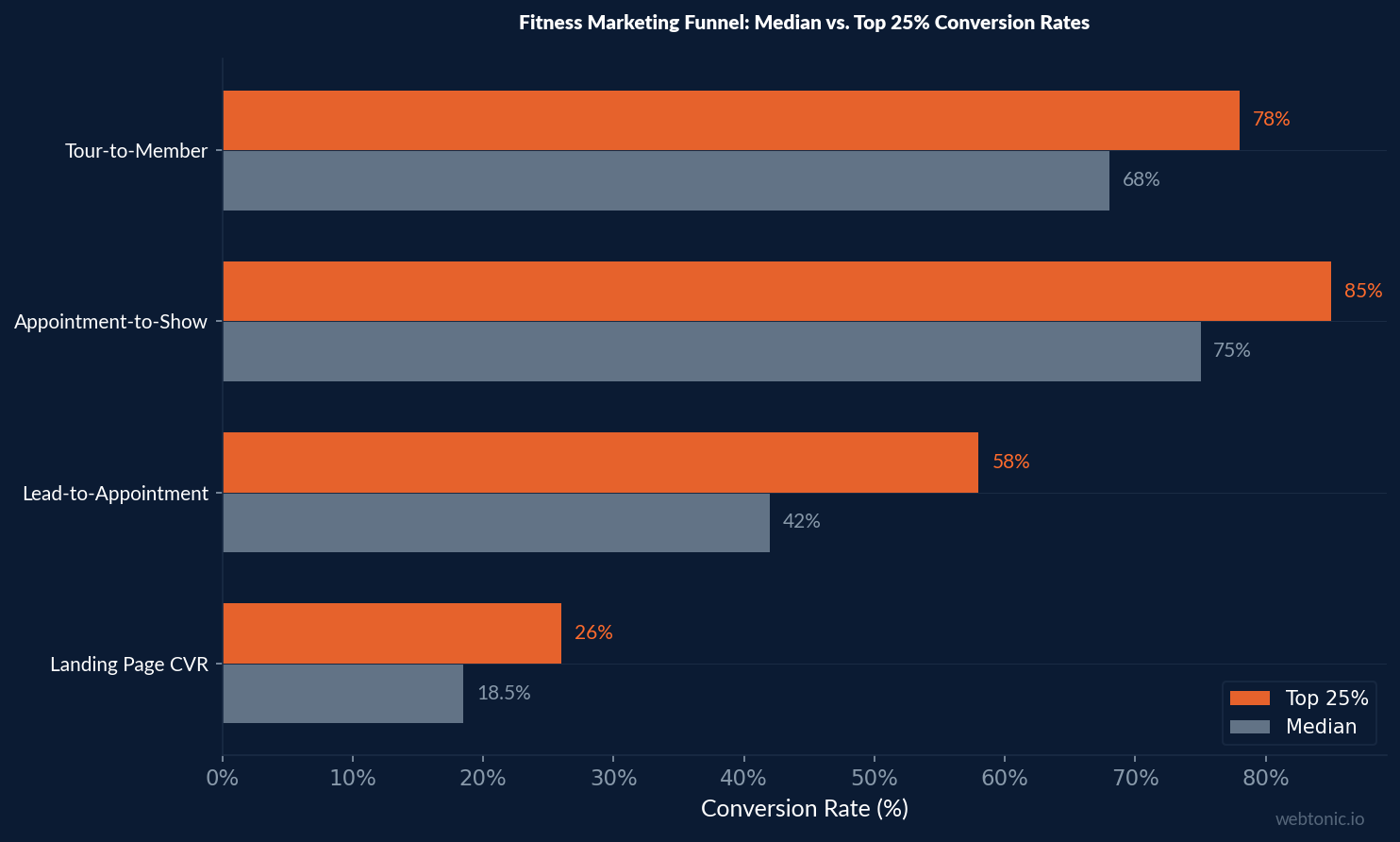
Attribution only matters if you understand the funnel it measures. The fitness industry's conversion pipeline has clear benchmarks that attribution should track at every stage.
| Funnel Stage | Bottom 25% | Median | Top 25% |
|---|---|---|---|
| Landing page CVR | 2% | 18.5% | 26.0% |
| Lead-to-appointment | 28% | 42% | 58% |
| Appointment-to-show | 62% | 75% | 85% |
| Tour-to-member CVR | 55% | 68% | 78% |
| Speed to first contact | 47 hours | 2 hours | 5 minutes |
| Monthly churn rate | 8.5% | 6.5% | 4.2% |
Source: pilotium.cc and cufinder.io. These benchmarks highlight why attribution must extend beyond the click — the gap between a 5-minute first contact and a 47-hour delay represents a massive conversion opportunity that attribution data can identify and close.
The funnel data also reveals a critical insight for attribution model selection. Because tour-to-member conversion rates range from 55% to 78%, the most valuable marketing channels are those that drive qualified visitors through the door — not just those that generate the most clicks. Attribution models that weight in-person touchpoints (tour bookings, trial class sign-ups) deliver more accurate ROAS calculations than purely digital tracking. Gyms using integrated CRM systems that connect online lead sources to in-gym visit data consistently achieve 20%+ lead-to-member conversion rates, nearly double the industry average of 10–15%.
Best Practices for Fitness Attribution
- Use 30-day attribution windows for paid channels and 90-day windows for organic channels where consideration cycles are longer (zatrovo.com).
- Implement first-touch attribution as a baseline before layering multi-touch — even basic attribution is dramatically more useful than none (glofox.com).
- Track offline-to-online touchpoints by using unique promo codes, QR codes at events, and staff-reported lead sources at the front desk.
- Connect your CRM to ad platforms to close the loop between ad click and membership activation — data intelligence platforms can automate this.
- Budget 11.7% of marketing spend on analytics and measurement, the current industry average per digitalapplied.com.
- Run incrementality tests quarterly — pause one channel in one market and measure the lift difference to validate attribution model accuracy.
- Don't ignore the dark funnel — survey new members at sign-up about how they first heard about you to capture unmeasurable touchpoints.
- Separate brand and non-brand conversions in reporting — brand search conversions inflate attribution credit for paid search, masking the true cost of non-brand member acquisition that drives incremental growth.
- Set up server-side tracking early — as browser-based cookies decline, server-side conversion APIs from Meta and Google provide more durable attribution data that survives ad blockers and privacy restrictions.
Attribution Software Market Overview
The marketing attribution software market was valued at $5.37 billion in 2025 and is projected to reach $25.65 billion by 2036, growing at a 14.2% CAGR, according to giiresearch.com. This growth reflects the increasing demand for accurate cross-channel measurement as privacy regulations tighten and cookie-based tracking declines.
For fitness businesses, the practical implication is that attribution tools are becoming more accessible. Small and mid-size fitness operators can start with platform-native attribution (Google Analytics 4, Meta's Conversions API) before investing in dedicated multi-touch solutions. The market growth trajectory suggests that today's enterprise-only features — cross-device tracking, offline conversion matching, predictive modeling — will become available at SMB price points within 2–3 years.
The attribution technology stack continues to evolve. First-party data strategy adoption reached 71% in 2026 and is projected to hit 88% by 2027, reflecting the industry-wide shift away from cookie-based measurement. For gyms, first-party data — email addresses collected at sign-up, phone numbers from trial bookings, member IDs from loyalty programs — is the foundation of accurate attribution. Platforms like Google and Meta both support offline conversion uploads that match these identifiers to ad interactions, closing the attribution loop for businesses where the conversion happens in-person.
Privacy regulations are accelerating this shift. Consent Mode V2 requirements in the EU and evolving CCPA standards in California mean fitness brands operating across jurisdictions must implement consent-aware tracking that adjusts attribution models based on user opt-in status. Brands that proactively adopt privacy-first attribution frameworks avoid the measurement disruption that reactive compliance creates — and maintain more consistent data quality for decision-making. The average analytics budget allocation of 11.7% of marketing spend increasingly flows toward privacy-compliant measurement infrastructure rather than additional tracking pixels.
Attribution Challenges by Channel
Each marketing channel presents unique attribution difficulties for fitness brands. Understanding these gaps helps marketers design measurement systems that capture the full picture.
| Channel | Attribution Difficulty | Common Blind Spot | Recommended Fix |
|---|---|---|---|
| Paid Search | Low | Brand vs. non-brand conflation | Segment brand/non-brand in reporting |
| Paid Social | Medium | View-through conversions uncounted | Use 1-day view + 7-day click window |
| Organic Social | High | Engagement ≠ conversion credit | UTM every post, track assisted conversions |
| Referral / Word-of-Mouth | Very High | Entire channel invisible to pixels | Ask "how did you hear about us?" at sign-up |
| Email Marketing | Low | Over-credited due to last-click bias | Use multi-touch to redistribute credit |
| Events / Community | Very High | Offline-to-online journey untracked | Unique promo codes per event |
44% of organizations have formalized analytics processes that address these gaps systematically. The remaining majority rely on ad-hoc solutions — spreadsheets, manual survey questions, or platform-native attribution that favors the platform's own channels. For fitness brands investing across 3–5 channels simultaneously, formalizing your measurement framework is a prerequisite for accurate ad spend optimization.
Industry Comparison: Fitness vs. Other Verticals
How does fitness marketing attribution compare to other industries? The subscription-based model creates unique challenges that transactional businesses don't face.
Fitness businesses operate on a recurring revenue model with $640 average CLV, meaning the true value of acquisition unfolds over months, not at the point of sale. This long payback window makes attribution harder because the conversion event (sign-up) captures only 10–15% of the eventual revenue. By contrast, e-commerce brands see immediate ROAS from a single purchase.
Marketing ROI across digital channels averages 4.2:1 for fitness, competitive with education (4.5:1) and outperforming legal services (3.1:1), per gitnux.org. However, this ROI calculation depends entirely on the attribution model used — last-click models systematically undervalue brand awareness channels by 18% compared to data-driven models. Fitness brands that switch from last-click to multi-touch attribution typically discover that social media and content marketing contribute 25–40% more assisted conversions than previously measured, reshaping budget allocation priorities.
The fitness app market compounds the challenge. The global fitness app market reached $15.6 billion in 2023, with marketing investments up 22%. App-based fitness brands face dual attribution complexity: tracking both app installs and in-app subscription conversions, often across different measurement SDKs. Day-30 app retention sits at just 12%, making cohort-based attribution essential for understanding true acquisition costs.
Referral attribution is another area where fitness businesses diverge from other industries. Referral programs drive 30% or more of new memberships at top-performing gyms, yet most attribution models treat referrals as a single touchpoint with full conversion credit. In reality, the referred member likely interacted with multiple brand touchpoints — social media posts, Google searches, website visits — before the friend's recommendation pushed them to convert. Multi-touch models that credit the referral appropriately (rather than giving it 100% credit) provide a much clearer picture of which awareness channels are actually seeding the referral pipeline.
Related reading
- Fitness Email Marketing Statistics 2026: Open Rates, ROI & Industry Benchmarks
- Fitness Analytics Statistics: Retention, Funnel & Attribution Benchmarks (2026)
- Beauty & Skincare Attribution Statistics: Benchmarks & Industry Data
- Marketing Attribution services at Web Tonic
Frequently Asked Questions
What is marketing attribution in fitness?
Marketing attribution in fitness is the process of identifying which advertising channels, campaigns, and touchpoints drive gym memberships and class bookings. It connects ad spend to actual revenue by tracking the customer journey from first awareness to membership activation — typically spanning 4–7 touchpoints across paid search, social media, referrals, and in-person visits.
Which attribution model works best for gyms?
Multi-touch attribution is the most effective model for gyms because the member journey involves multiple channels. 47% of marketers now use multi-touch models, and data-driven attribution delivers 2.3× higher ROAS than last-click. For smaller gyms with limited data, a position-based model (40% credit to first and last touch, 20% distributed across middle interactions) offers a practical starting point.
How much should a gym spend on attribution tools?
The industry average for analytics and measurement spending is 11.7% of the total marketing budget. A gym spending $5,000/month on advertising should allocate roughly $585/month toward measurement tools. Many platform-native tools (GA4, Meta CAPI) are free, making entry-level attribution accessible even for small operators.
Why is the dark funnel a problem for fitness marketing?
The dark funnel represents the 38% of pipeline activity that happens in channels attribution can't track — word-of-mouth, Reddit discussions, offline recommendations, and community events. For fitness businesses, where personal referrals drive a significant share of new members, this blind spot means attribution models consistently undervalue organic and community-driven growth.
How does AI improve fitness marketing attribution?
AI-powered attribution models improve prediction accuracy by 22 percentage points over traditional deterministic models. They can connect offline events (like a gym tour) to earlier digital touchpoints (like an Instagram ad viewed weeks prior) and adjust credit allocation dynamically based on conversion patterns, rather than relying on fixed rules.
Sources
digitalapplied.com — Marketing Attribution Statistics 2026
empire325marketing.com — 41 Marketing Attribution Statistics
amworldgroup.com — Marketing Attribution Statistics 2026
growwithba.com — Attribution Crisis: 150-Brand Study
agencyanalytics.com — Marketing Attribution in 2026
giiresearch.com — Marketing Attribution Software Market
cufinder.io — Fitness and Wellness Industry Benchmarks 2026
pilotium.cc — State of Gym Marketing 2026
aimpointdigital.com — $6MM Fitness Marketing Case Study
zatrovo.com — Studio Marketing Attribution


