



Table of contents
AI now covers 24.2% of marketing activities, up from 13.1% a year earlier, and marketers project 55.9% within three years. These are the published 2026 numbers an AI readiness engagement should be measured against.
Key Takeaways
- AI covers 24.2% of marketing activities, up from 13.1%.
- Generative AI alone covers 22.4%, up from 7.0% - a 220% rise.
- Marketers project 55.9% of activities within three years.
- 41.5% now work on generative engine optimisation.
- Content generation leads use cases at 73.9%.
- Personalisation follows at 65.4% and automation at 48.9%.
- Data analysis sits at 46.3% and audience targeting at 45.2%.
- AI knowledge and skill gaps block 35.7% of teams.
- Resourcing blocks 22.3% and data architecture 19.1%.
- 61% of marketers call this the biggest disruption in 20 years.
- 80% use AI for content and 75% for media production.
- Only 9% of stacks are described as fully AI-optimised.
- Martech has fallen to 19.4% of marketing budget.
- Training spend fell to 3.8% from 5.8% of marketing spend.
- About 61% of external agencies used generative AI against 17% in-house.
The adoption baseline, measured properly
The CMO Survey 2026 measures share of marketing activities rather than tool purchases. AI covers 24.2%, up from 13.1%; generative AI covers 22.4%, up from 7.0%, a 220% increase; and marketers project 55.9% within three years. Some 41.5% report working on generative engine optimisation.
Share of activity is the honest denominator. A team can own every popular tool and still sit below the benchmark, which is why an AI readiness assessment should open with this number rather than a stack inventory.
| Adoption measure | 2026 figure | Prior figure |
|---|---|---|
| All AI share of activities | 24.2% | 13.1% |
| Generative AI share | 22.4% | 7.0% (+220%) |
| Projected share in three years | 55.9% | Not applicable |
| Working on generative engine optimisation | 41.5% | Not previously measured |
| Stacks described as fully AI-optimised | 9% | Not previously measured |
What the work is actually being used for
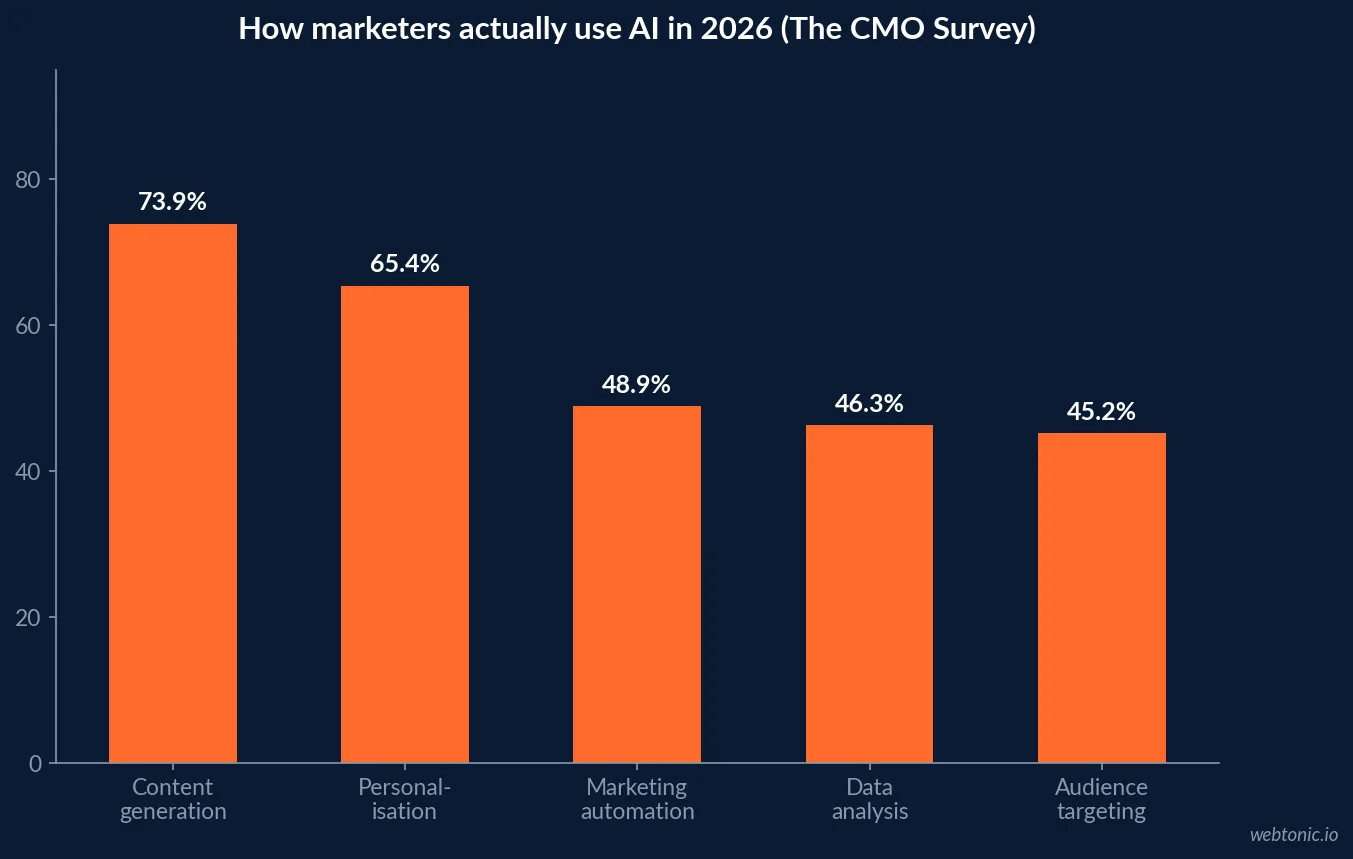
The CMO Survey ranks use cases at content generation 73.9%, personalisation 65.4%, marketing automation 48.9%, data analysis 46.3% and audience targeting 45.2%. HubSpot's State of Marketing reports 80% using AI for content, 75% for media production and 61% calling this the biggest disruption in marketing in 20 years.
Content is the standardised case; everything else is still mostly pilots. A readiness plan that treats all five as equally mature will overpromise on the four that are not.
The barrier is knowledge, and the budget went the other way
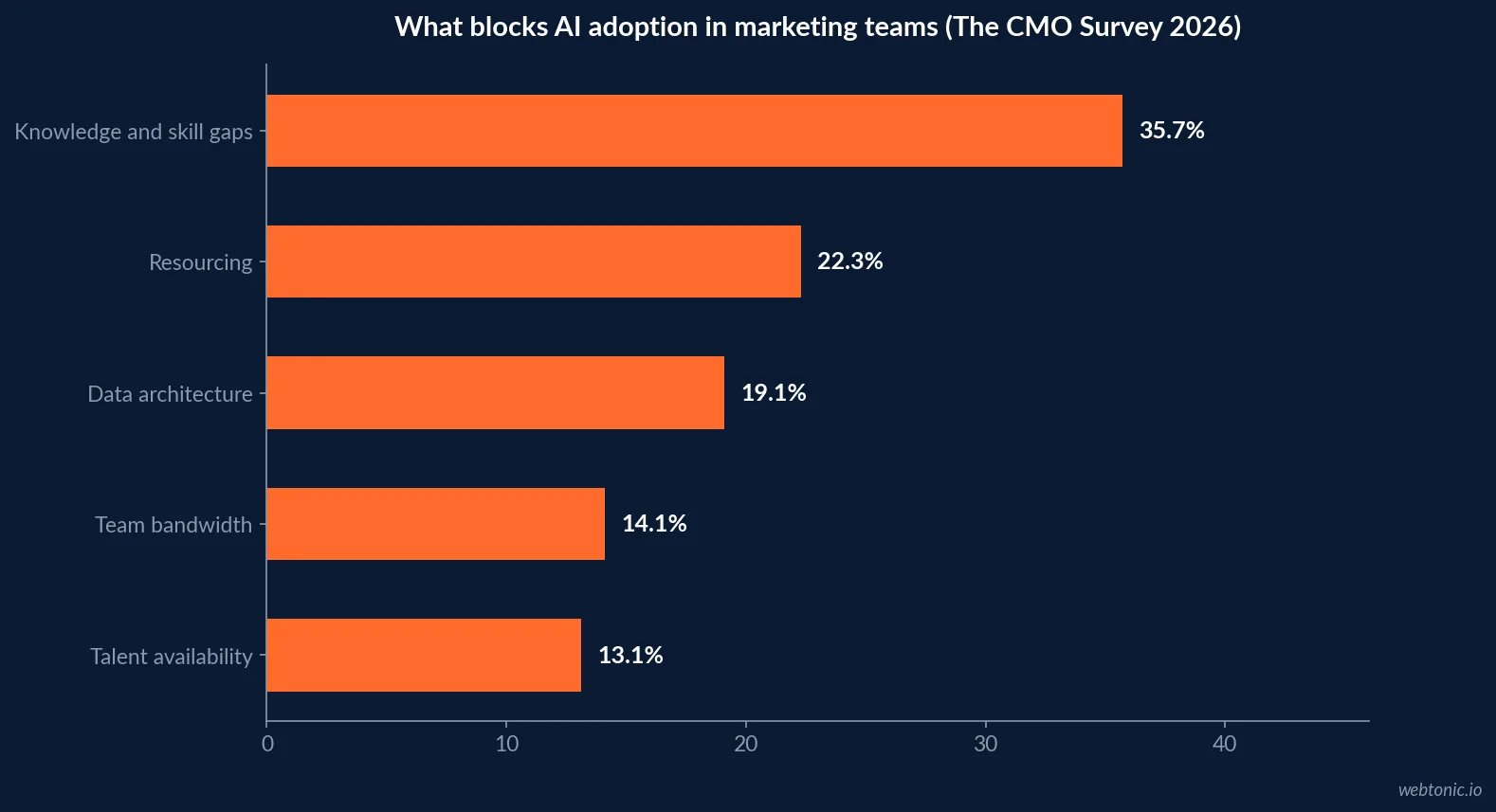
The CMO Survey ranks barriers as AI knowledge and skill gaps 35.7%, resourcing 22.3%, data architecture 19.1%, team bandwidth 14.1% and talent availability 13.1%. Over the same period training fell to 3.8% of marketing spend from 5.8%, headcount growth was down 50% year on year and overall spend growth was 1.7%.
Skill gaps are named as the top barrier while the training line is being cut. Any readiness engagement that does not restore that line is optimising the wrong constraint.
| Barrier | Share of marketers | What it actually needs |
|---|---|---|
| AI knowledge and skill gaps | 35.7% | A restored training line, not more tools |
| Resourcing | 22.3% | Fewer, narrower use cases |
| Data architecture | 19.1% | Source consolidation before automation |
| Team bandwidth | 14.1% | Standardise one case, then the next |
| Talent availability | 13.1% | Rent senior capability short term |
The stack cannot absorb it yet
Gartner's 2026 CMO Spend Survey puts martech at 19.4% of marketing budget, a five-year low against 26.6% in 2021, with 62% planning to invest more, 56% of spend on consumption-based pricing against 9% cutting, 41% adding usage controls, 24% overhauling systems and only 9% fully AI-optimised.
Consumption pricing changes the arithmetic of AI adoption specifically. Generative workloads scale with usage, so a successful pilot can produce an unbudgeted invoice, and the 41% adding usage controls are responding to exactly that.
Capability self-ratings put a ceiling on it
The CMO Survey's 1-to-7 self-ratings are vendor selection 4.9, tactical use of data 4.8, systems integration 4.8, generating technology ROI 4.5, demonstrating that ROI 4.2, training 3.9 and hiring 3.7. Nothing scores above 5 and the ratings are flat against 2024.
AI is being layered onto a base that self-rates below 5 on every dimension that matters for implementation. That is the most useful sanity check in this dataset - and the reason the projected 55.9% should be read as an intention, not a forecast.
| KPI | 2026 comparator | Cadence | Decision it forces |
|---|---|---|---|
| AI share of activities | 24.2% (from 13.1%) | Quarterly | Widen or narrow the pilot set |
| Generative AI share | 22.4% (from 7.0%) | Quarterly | Standardise or stop a use case |
| Standardised use cases | Content generation 73.9% | Monthly | Document it or retire it |
| Named skill gap | 35.7% of marketers | Quarterly | Train, hire or rent |
| Martech share of budget | 19.4% of budget | Quarterly | Cap, renegotiate or cut |
| AI search visibility | 41.5% now work on GEO | Monthly | Fund or ignore AI answers |
The delivery side moved first
RSW/US's 2026 New Year Outlook reports roughly 61% of external agencies using generative AI in 2025 against 17% of in-house agencies, while 66% of client firms keep at least 26% of work in-house and 60% have some in-house agency capability.
That asymmetry has a practical reading. Where the internal skill gap is the binding constraint - as 35.7% of marketers report - renting the capability for two or three quarters buys working practice faster than a hiring round does.
Attach an efficiency number to the AI claim
Benchmarkit's CY-2025 benchmarks report median CAC payback of 16 months, improved from 18, the strong quartile at 10 months, the weak quartile at 24 and top performers at six months or less.
If an AI programme is working, one of these slow numbers should move within a year. Until then, adoption percentages describe activity, not value - the distinction our data intelligence team insists on before any automation is scaled.
Where AI search fits
With 41.5% of marketers working on generative engine optimisation and 61% calling AI the biggest disruption in twenty years, visibility inside AI answers has moved from curiosity to a reporting line. It is also measurable, which most AI claims are not.
Treat it like any other channel: a named owner, a monthly number, and a decision attached. Our channel strategy guidance applies unchanged.
A readiness plan that survives scrutiny
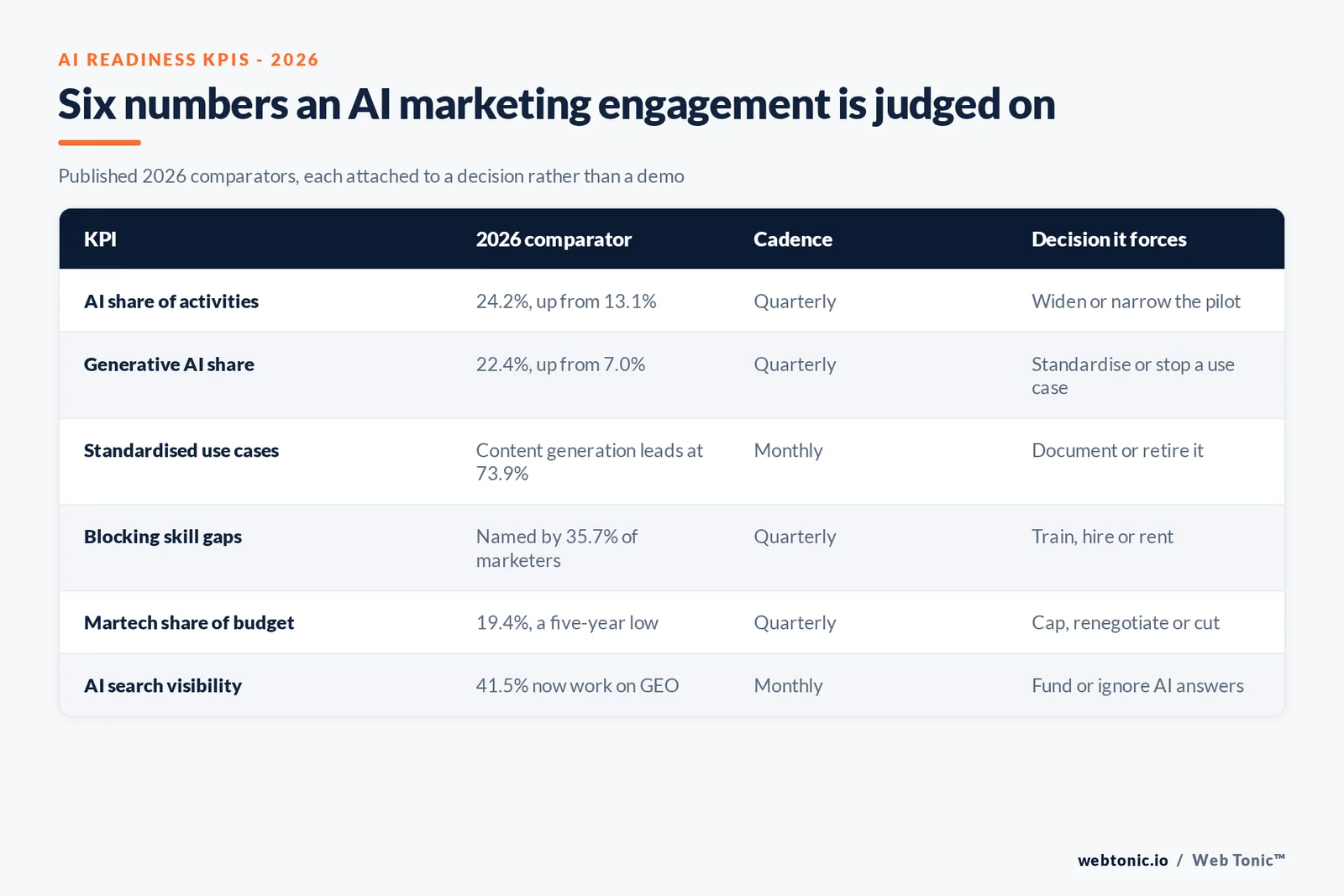
Benchmark share of activities against 24.2%, standardise the one mature use case at 73.9%, fund the skill gap named by 35.7%, cap consumption while 56% of martech spend is usage-priced, and hold the projected 55.9% as an intention to be tested. That is a plan built from published numbers rather than demos.
If you want it applied to your own stack, our growth team can run the assessment, or send us your current reporting pack and we will benchmark it against these figures.
Growth context for the AI claim
Hinge's 2026 High Growth Study reports median growth of 9.9%, the lowest since 2018, with high growth at 36.6%, average at 8.5% and no growth at -11.4%, and high-growth firms spending 12.0% of revenue on marketing against 5.0%. Notably, keyword and SEO research fell from 33.5% to 27.0% of firms.
Read against AI adoption, that last number is a warning rather than a trend to copy. Search behaviour is changing while research effort is falling, and the 41.5% working on generative engine optimisation are the firms responding to the gap.
| Context measure | 2026 figure | Why it matters for an AI plan |
|---|---|---|
| Median firm growth | 9.9%, lowest since 2018 | Little slack for unproven spend |
| High-growth firms | 36.6% | The tier worth benchmarking against |
| No-growth firms | -11.4% | AI cannot substitute for demand |
| Marketing spend of revenue | 12.0% vs 5.0% | Funding capacity differs sharply |
| Keyword and SEO research | 33.5% to 27.0% | Research effort falling as search shifts |
What AI advice costs, honestly
No published study prices AI marketing advisory as a product, so the rate base is consulting-wide. Fractional Pulse's 2026 comparison puts loaded hourly rates at USD 300 to 700 for project work, USD 200 to 600 for hourly advisory and USD 200 to 500 inside a retainer, with retainers at USD 5,000 to 25,000 a month on six to twelve month terms, and notes that buying project work through a retainer costs four to five times more.
Fractional Jobs adds 149% year-on-year demand growth and 87% of practitioners with eleven or more years of experience. Buy the readiness assessment as a fixed-scope project, and only move to a retainer once a use case is standardised.
Standardise the one mature use case first
HubSpot reports 80% using AI for content and 75% for media production, and the CMO Survey puts content generation at 73.9%. Meanwhile the Content Marketing Institute's 2026 B2B research finds 97% of organisations with a content strategy but only 52% of top performers calling their governance mature, with challenges ranked prompting action 40%, resources 39% and measurement 33%.
High usage plus weak governance is how AI output arrives faster than anyone can check it. Documenting one use case - inputs, review step, owner - is worth more than adding a second tool.
| Use case | 2026 adoption | Maturity read |
|---|---|---|
| Content generation | 73.9% (80% per HubSpot) | Standardise and document now |
| Personalisation | 65.4% | Pilot with a measured outcome |
| Marketing automation | 48.9% | Blocked by data architecture at 19.1% |
| Data analysis | 46.3% | Needs a frozen definition set first |
| Audience targeting | 45.2% | Test against a holdout before scaling |
Related reading
- Marketing Operations Consulting Statistics: Benchmarks and KPIs
- Marketing KPI Scorecard Statistics: Benchmarks and KPIs
- AI Marketing Advisory Statistics: Cost and Pricing
- Marketing Strategy Consulting services at Web Tonic
Frequently Asked Questions
How much of marketing actually uses AI in 2026?
The CMO Survey 2026 reports AI covering 24.2% of marketing activities, up from 13.1% a year earlier, with generative AI specifically at 22.4% against 7.0% - a 220% increase. Marketers project 55.9% within three years. Those three numbers are the fairest adoption comparator for an AI readiness assessment, because they measure share of activity rather than whether a tool has been bought.
What do marketing teams use AI for?
The CMO Survey 2026 ranks the use cases: content generation 73.9%, personalisation 65.4%, marketing automation 48.9%, data analysis 46.3% and audience targeting 45.2%. HubSpot's State of Marketing reports 80% using AI for content and 75% for media production. Content is the standardised case; the rest are still largely pilots.
What blocks AI adoption in marketing?
Knowledge and skill gaps, by a wide margin. The CMO Survey 2026 ranks barriers as AI knowledge and skill gaps 35.7%, resourcing 22.3%, data architecture 19.1%, team bandwidth 14.1% and talent availability 13.1%. Meanwhile training spend fell to 3.8% of marketing spend from 5.8%, which is the opposite of what the barrier ranking implies.
What KPIs should an AI readiness engagement be judged on?
Share of activities using AI against the 24.2% benchmark, number of standardised use cases against content generation at 73.9%, the skill gap named by 35.7% of marketers, martech share of budget against Gartner's 19.4%, and AI search visibility given that 41.5% of marketers now work on generative engine optimisation. Each needs a decision attached rather than a demo.
Is AI changing how marketing organisations buy help?
The delivery side has moved faster than the client side. RSW/US's 2026 New Year Outlook reports roughly 61% of external agencies using generative AI in 2025 against 17% of in-house agencies, while 66% of client firms keep at least 26% of work in-house. That asymmetry is a practical reason to rent AI capability before building it.
Sources
The CMO Survey - Highlights and Insights Report 2026
HubSpot - State of Marketing
Gartner 2026 CMO Spend Survey via Chief Marketer
RSW/US - 2026 New Year Outlook Report
Benchmarkit - CY-2025 B2B SaaS Performance Metrics Benchmarks
Content Marketing Institute - B2B Content Marketing Trends 2026
Hinge Research Institute - 2026 High Growth Study
Fractional Pulse - Fractional executive engagement comparison 2026
Fractional Jobs - The Fractional Work Report


