Table of contents

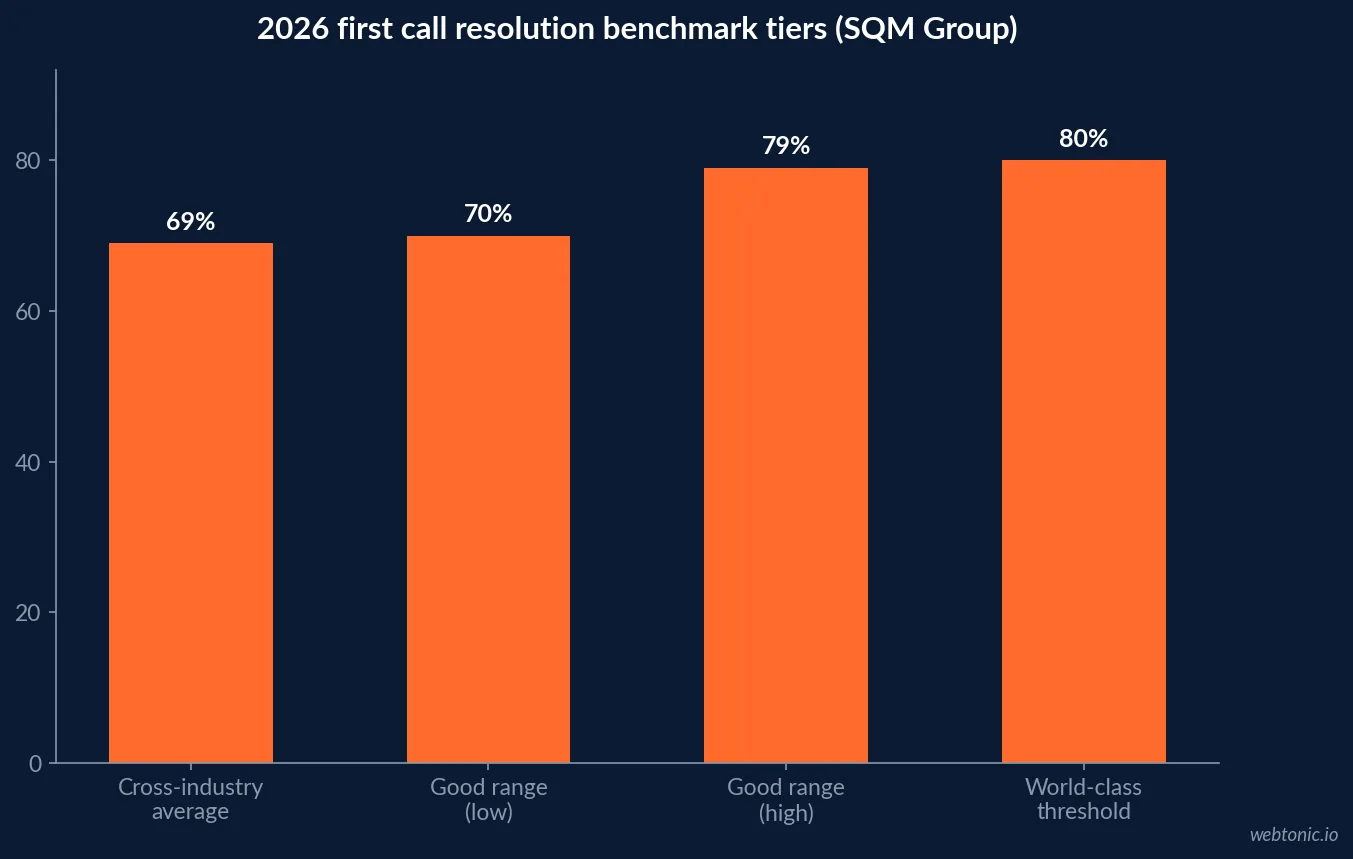
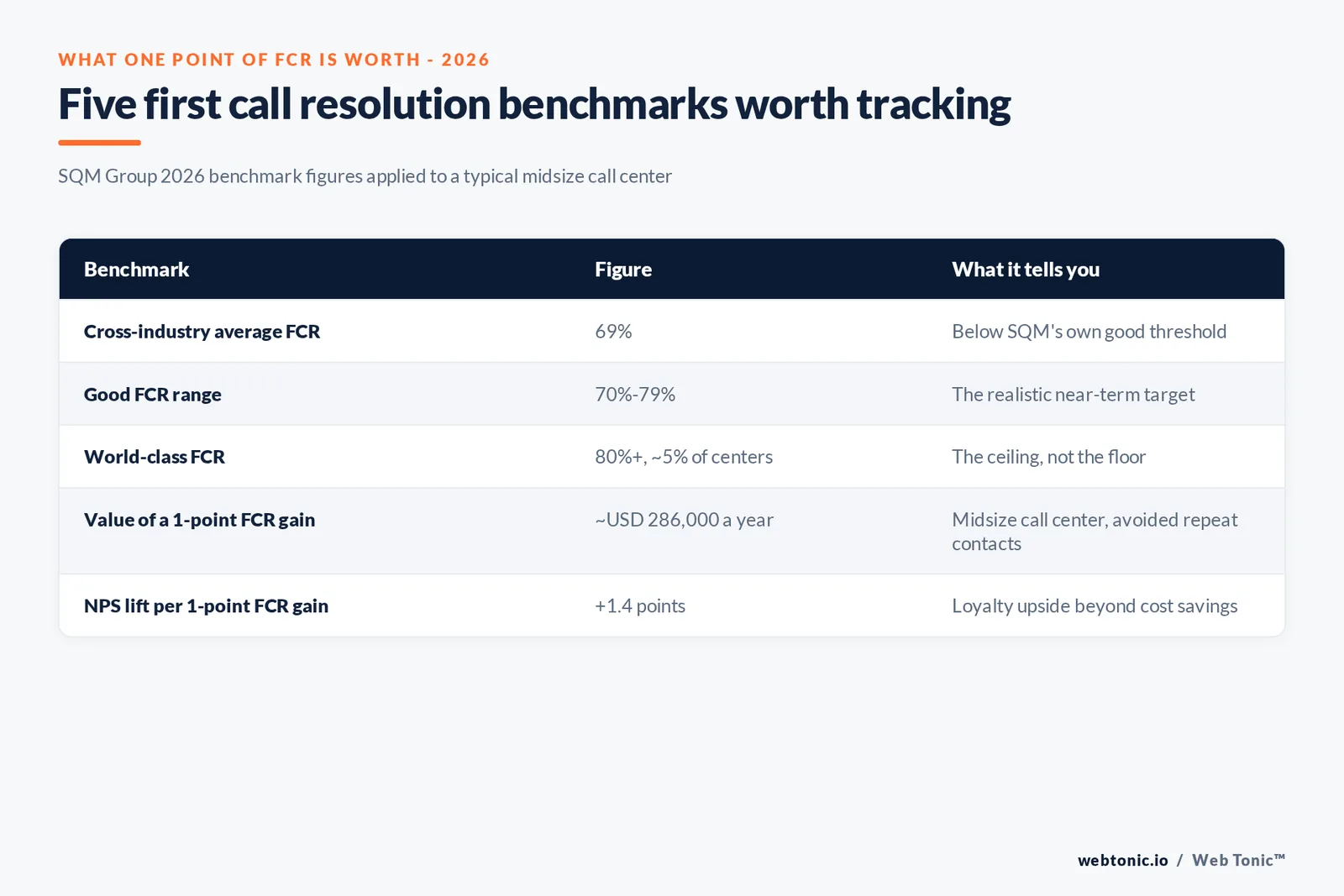
The cross-industry average first call resolution rate is 69%, a good rate is 70-79%, and world-class is 80% or higher - a tier only about 5% of call centers reach. This page pulls the 2026 benchmark numbers apart by industry and call type, and puts a dollar figure on what moving the rate actually buys a call center.
Key Takeaways
- The aggregated cross-industry average FCR rate is 69% (SQM Group).
- A good FCR rate runs 70% to 79%; world-class is 80% or higher (SQM Group).
- Only about 5% of call centers reach world-class FCR (SQM Group).
- FCR rates range from 43% to 88% across benchmarked call centers (SQM Group).
- Retail, not-for-profit and insurance lead at 73-75% average FCR (SQM Group).
- No telecommunications company has ever hit world-class FCR in 25-plus years of SQM benchmarking.
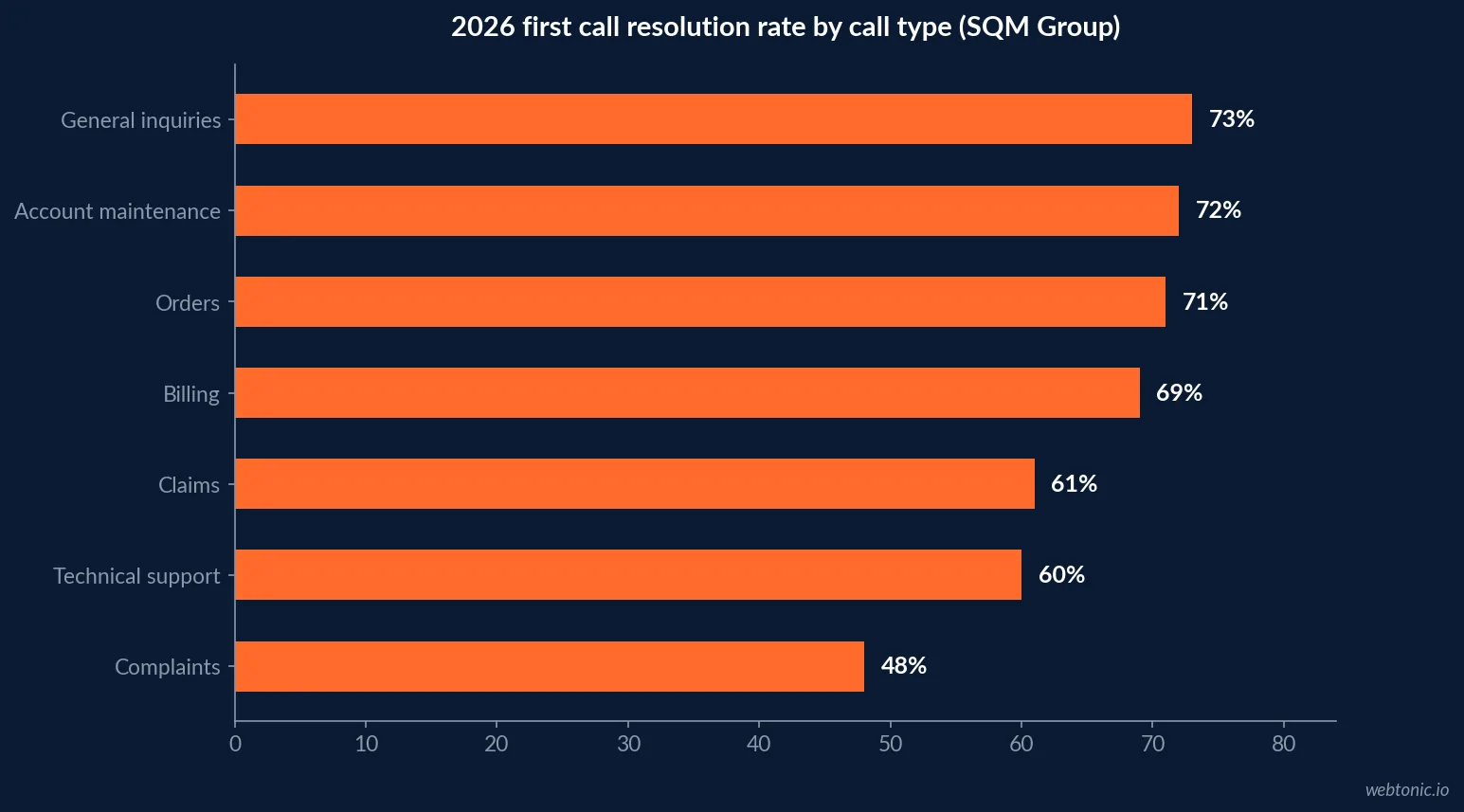
- General inquiries resolve first-contact at 73%, the highest of any call type (SQM Group).
- Complaints resolve first-contact at just 48%, the lowest of any call type (SQM Group).
- A 1-point FCR improvement is worth about USD 286,000 a year for a typical midsize call center.
- The same 1-point gain lifts interactional NPS by 1.4 points (SQM Group).
- Average handle time rose 18% year over year to 697 seconds in SQM's latest study.
- 85% of agents now work from home, roughly double the pre-pandemic share (SQM Group).
- Annual agent turnover sits at 34%, also roughly double pre-pandemic levels (SQM Group).
- Calls lasting around 15 minutes have an FCR rate 5% lower than 5-10 minute calls (SQM Group).
- AI-augmented operations are pushing FCR above 85% on eligible, well-defined ticket types.
What a good FCR rate actually is
SQM Group, which has benchmarked first call resolution across more than 500 leading North American call centers for over 25 years, defines a good FCR rate as 70% to 79%. Rates of 80% or higher are classed as world-class, a standard SQM's own 2024 benchmark data says only about 5% of call centers reach. The aggregated cross-industry average sits at 69% - below SQM's own "good" threshold, which means the typical center still has room to move before it qualifies as merely good, let alone world-class.
The full observed range in SQM's benchmark runs from 43% to 88%, a 45-point spread that says FCR is far more a function of call complexity and center discipline than of industry alone.
| FCR benchmark tier (SQM Group) | Rate | Share of call centers reaching it |
|---|---|---|
| Cross-industry average | 69% | - |
| Good | 70%-79% | Roughly the middle band of the market |
| World-class | 80%+ | ~5% of call centers |
| Observed range across all benchmarked centers | 43%-88% | - |
| Bottom-quartile centers | Below 55% | Roughly a quarter of the market |
FCR by industry
SQM Group's 2024 benchmark data breaks the average down by sector. Retail, not-for-profit, and insurance call centers lead the pack, averaging a good FCR rate of 73-75%. Retail's result tracks with generally lower call complexity, but insurance is a notable outlier - those calls carry moderate to high complexity yet still land in the good range. Energy, health insurance, and financial services generally sit at a moderate or lower good-FCR level and have stayed roughly flat for five straight years. Technical support, government, and telecommunications remain in SQM's "needs improvement" category - and despite more than 25 years of benchmarking, no telecommunications company has ever achieved world-class FCR in SQM's data.
| Industry | SQM Group FCR tier | Trend |
|---|---|---|
| Retail | Good, 73-75% average | Consistently strong, low call complexity |
| Not-for-profit | Good, 73-75% average | Consistently strong |
| Insurance | Good, 73-75% average | Strong despite moderate-high complexity |
| Energy / health insurance / financial services | Moderate or lower good-FCR level | Flat for 5+ years |
| Technical support / government / telecommunications | Needs improvement | Telecom has never hit world-class |
FCR by call type
Complexity, not industry, is the real driver underneath those sector averages. SQM Group's call-type breakdown shows general inquiries resolving first-contact at 73%, account maintenance at 72%, orders at 71%, and billing at 69% - all low-to-moderate complexity interactions. Claims resolve at 61%, technical support at 60%, and complaints resolve first-contact at just 48%, the lowest of any category, because complaints typically require investigation, escalation, or a policy exception that one call cannot settle.
Call length matters too: SQM's data shows calls running around 15 minutes have an FCR rate 5% lower than calls in the 5-10 minute range, reinforcing that longer calls are usually longer because the issue itself resists first-contact resolution, not the other way around.
| Call type | FCR rate | Relative complexity |
|---|---|---|
| General inquiries | 73% | Low |
| Account maintenance | 72% | Low |
| Orders | 71% | Low-moderate |
| Billing | 69% | Moderate |
| Claims | 61% | Moderate-high |
| Technical support | 60% | High |
| Complaints | 48% | Highest |
What one point of FCR is worth
The financial case is specific, not directional. SQM Group's research puts a 1% improvement in FCR at roughly USD 286,000 in annual savings for a typical midsize call center, driven mostly by avoided repeat contacts. The same 1-point gain is linked to a 1.4-point increase in interactional Net Promoter Score for the average call center, which is the evidence base for treating FCR as a leading indicator for both cost and loyalty rather than a service-desk vanity metric.
Set against a market where the average sits at 69% and the range runs to 88%, even a middle-of-the-pack center closing half the gap to world-class is looking at a seven-figure annual savings opportunity purely from reduced repeat contact volume.
Why the average has barely moved despite more pressure on agents
SQM Group's latest study shows the aggregated average FCR fell only 2 percentage points from the previous year - a surprisingly small drop given that 85% of agents now work from home and annual agent turnover sits at 34%, both roughly double their pre-pandemic levels. Average handle time, meanwhile, rose 18% year over year to 697 seconds, suggesting centers are increasingly trading call length for resolution rate rather than letting FCR erode further under staffing pressure.
| Operating condition (SQM Group, latest study) | Figure | Change |
|---|---|---|
| Agents working from home | 85% | ~2x pre-pandemic |
| Annual agent turnover | 34% | ~2x pre-pandemic |
| Average handle time | 697 seconds | +18% YoY |
| Aggregated FCR average, year-over-year change | 69% | -2 points |
Where AI is starting to move the number
The next shift in this benchmark is coming from automation, on a narrow slice of volume. Lorikeet's 2026 contact center benchmark data reports AI-augmented operations pushing FCR above 85% on eligible, well-defined ticket types - ahead of the human-team benchmarks SQM Group and others report. CallForce's 2026 benchmark review separately puts the broader customer-support median at 75%, with a healthy band running 65% to 85% - a wider spread than SQM's own "good" band, reflecting how much ticket mix and channel (voice versus chat) shift the number.
The AI effect is concentrated on the low-complexity end of the call-type table above; the complaint and technical-support categories that already sit at the bottom are exactly the ones AI-driven resolution has struggled to move so far, because they depend on judgment and exception-handling rather than a lookup or a scripted fix.
| FCR benchmark source (2026) | Reported figure | Scope |
|---|---|---|
| SQM Group | 69% average, 70-79% good, 80%+ world-class | Cross-industry, voice-first |
| CallForce | 75% median, 65-85% healthy band | Cross-industry, all channels |
| Lorikeet | AI-augmented ops above 85% | Eligible ticket types only |
| Zendesk (citing SQM Group) | 70-79% industry standard for a good rate | Cross-industry |
Why FCR sits inside the broader service metric set
FCR rarely moves alone. Salesforce's State of Service research tracks FCR alongside customer satisfaction, average handle time, and channel mix as part of one connected service operating system, arguing that teams which improve FCR in isolation - without also managing handle time and channel routing - often see the gain erode within a quarter as agents unconsciously trade speed for resolution or vice versa. That is consistent with SQM's own data above, where average handle time rose 18% in the same period FCR held roughly flat.
MetricNet's benchmark framework makes the same point structurally, reporting "Net First Contact Resolution Rate" alongside voice customer satisfaction and call quality rather than as a standalone KPI - because a center can inflate FCR by narrowing what counts as "resolved" unless it is checked against satisfaction and repeat-contact data in the same report.
How to use these benchmarks
- Benchmark against your specific call-type mix, not a blended average. A center weighted toward billing and inquiries should expect a materially higher FCR than one weighted toward complaints and technical support.
- Treat 70% as the floor to clear, not the target. SQM's own "good" band starts at 70%, and the aggregated average of 69% sits just below it.
- Model the dollar value before pitching an FCR initiative. USD 286,000 per point for a typical midsize center turns a QA process improvement into a number finance can evaluate against the cost of getting there.
- Route complaints differently rather than trying to raise their FCR to match inquiries. The 25-point gap between complaints (48%) and inquiries (73%) reflects task complexity that process alone will not close.
- Watch handle time and FCR together. A rising average handle time alongside a stable FCR, as in the current data, usually means agents are trading speed for resolution - worth confirming before treating either metric in isolation.
Where this connects to acquisition and retention marketing
FCR is a downstream lever on the same customer relationship that acquisition marketing spends to create - a low resolution rate quietly erodes the lifetime value paid channels are working to build. Our data and analytics practice connects service-desk metrics like FCR to marketing and retention reporting, and our guide to what paid social acquisition actually costs in 2026 is a useful companion if a support-experience problem is quietly raising your effective customer acquisition cost. Talk to us about connecting the two.
Frequently Asked Questions
What counts as a good first call resolution rate?
SQM Group, the research group that has benchmarked FCR across 500-plus North American call centers for over 25 years, defines a good FCR rate as 70% to 79%. Rates of 80% or higher are classed as world-class, a tier only about 5% of call centers reach. The aggregated cross-industry average sits lower, at 69% in the most recent benchmark, which means the typical call center is still short of SQM's own 'good' threshold.
Which industries have the best first call resolution?
Retail, not-for-profit, and insurance lead SQM Group's benchmark with a good FCR rate averaging 73-75%. Retail's result tracks with lower call complexity, but insurance's is notable because those calls carry moderate to high complexity. Energy, health insurance, and financial services sit at a moderate or lower level and have stayed roughly flat for five years, while technical support, government, and telecommunications remain in SQM's 'needs improvement' band - no telecom company has ever hit world-class FCR in SQM's 25-plus years of tracking it.
Which call types are hardest to resolve on the first contact?
Complaints, by a wide margin. SQM Group's call-type data puts complaints at a 48% FCR rate, the lowest of any category, followed by technical support at 60% and claims at 61%. General inquiries resolve first-contact most often at 73%, followed by account maintenance at 72%, orders at 71%, and billing at 69%. The pattern tracks complexity: inquiries and account maintenance are typically low-complexity interactions, while complaints usually require investigation, escalation, or a policy exception that cannot be resolved on one call.
How much is a 1-point FCR improvement actually worth?
SQM Group's research puts a single percentage-point FCR improvement at roughly USD 286,000 in annual savings for a typical midsize call center, largely from avoided repeat contacts. The same 1-point gain is linked to a 1.4-point increase in interactional Net Promoter Score, which is why FCR is treated as a leading indicator for both cost and loyalty rather than a service-desk vanity metric.
Is AI changing first call resolution benchmarks?
It is starting to, on the ticket types it can fully own. Industry benchmark aggregators tracking 2026 data report AI-augmented operations pushing FCR above 85% on eligible, well-defined ticket types, above the human-team benchmarks reported by SQM Group and others. The effect is concentrated in narrow, rules-based interactions - the complaint and technical-support categories that already drag the average down are exactly the ones AI resolution has struggled to move so far.
Sources
SQM Group - Call Center FCR Benchmark 2024 Results by Industry
SQM Group - What Is a Good First Call Resolution Rate?
Zendesk - First Contact Resolution: Benefits and Best Practices
MetricNet - Contact Center Benchmarks
AmplifAI - Call Center KPI Benchmarks by Industry (2026)
Salesforce - State of Service Report