



Table of contents
Key Takeaways
- WordPress holds 42.5% global CMS market share and 59.8% of all CMS-powered sites, making it the dominant platform for fintech web presence
- Custom-themed WordPress sites score 78 on performance benchmarks versus 34–42 for page-builder-based sites — a critical gap for fintech conversion funnels
- Fintech WordPress development costs range from $25,000 to $150,000+ depending on compliance requirements, payment integrations, and security hardening
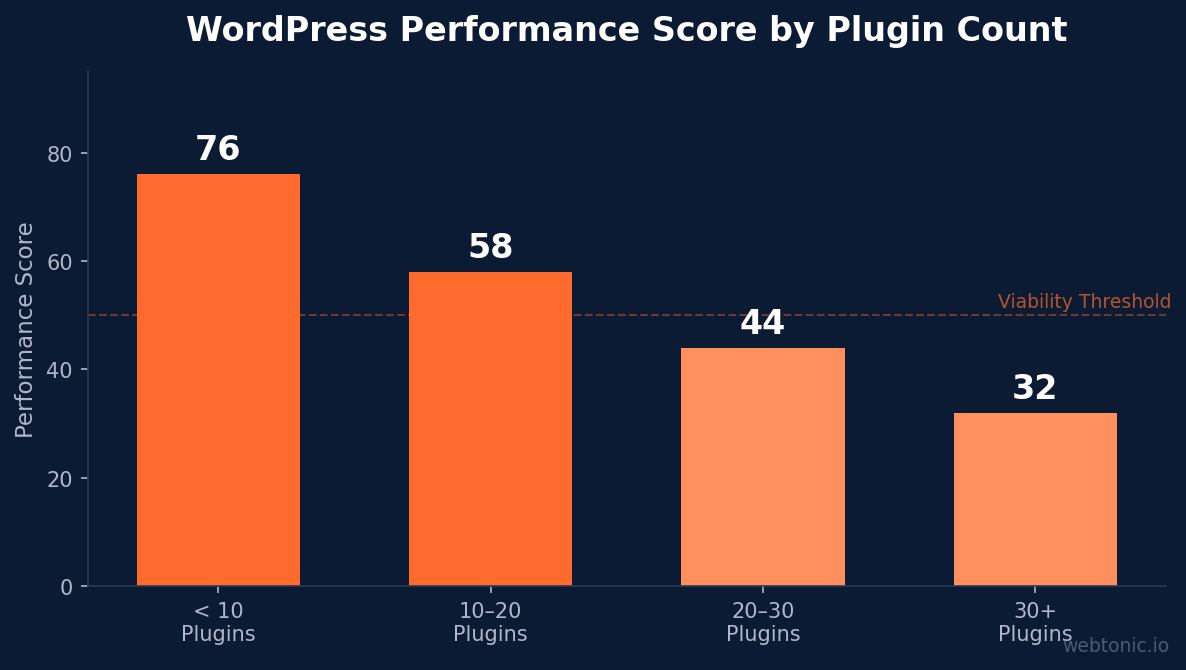
- Sites exceeding 20 plugins average a performance score of 32, falling well below the viability threshold for financial services applications
- WooCommerce processes over $235 billion in annualized GMV, with its payments adoption rate climbing past 62% among active stores
- Headless WordPress architectures achieve 95.6% page experience scores and 1.4s LCP versus 1.8s for traditional custom themes
- Adding a single caching plugin returns +27 performance score points — the highest score-per-effort optimization available for WordPress fintech sites
WordPress powers 42.5% of all websites globally, but fintech companies face unique challenges when using it — from PCI DSS compliance to sub-second load times that directly impact conversion rates.
WordPress Market Position in Financial Services
WordPress dominates the global CMS landscape with 42.5% of all websites and 59.8% of all CMS-powered sites — roughly 9x larger than Shopify, its nearest competitor. For fintech companies, this market dominance translates into a vast ecosystem of developers, plugins, and integrations, but also creates unique security and compliance considerations that other industries rarely face.
Within the financial technology sector specifically, WordPress adoption varies significantly by company stage and regulatory burden. Early-stage fintech startups frequently choose WordPress for its low initial development cost ($5,000–$15,000 for an MVP) and rapid deployment timeline. However, as companies scale and encounter PCI DSS, SOC 2, or open-banking compliance requirements, many migrate to headless architectures or purpose-built platforms — a pattern that has accelerated through 2025 and into 2026.
The headless WordPress approach (WPGraphQL or REST API with a React/Next.js frontend) has gained particular traction among growth-stage fintechs. According to performance benchmarking data, headless WP sites achieve an average performance score of 86 compared to 78 for standard custom themes and as low as 34 for page-builder setups — a meaningful difference when each 100ms of latency costs financial services companies roughly 1% in conversions.
| WordPress Stack | Avg. Performance Score | JS Execution Time (s) | Page Size (MB) | LCP (s) |
|---|---|---|---|---|
| Headless WP | 86 | 0.9 | 0.9 | 1.4 |
| Custom Theme | 78 | 1.2 | 1.1 | 1.8 |
| Starter Theme + Builder | 42 | 3.1 | 2.4 | 3.9 |
| Full Page Builder (Elementor/Divi) | 34 | 4.8 | 3.2 | 4.5 |
Source: Appycodes WordPress Performance Study, 2026
Fintech WordPress Development Costs and Investment Breakdown
Building a fintech website on WordPress is fundamentally different from a standard business site. Compliance requirements alone can add $10,000–$50,000+ to a project depending on the regulatory framework involved. The 2026 pricing landscape for fintech WordPress development breaks down into clearly defined tiers:
MVP / pre-seed stage ($5,000–$15,000): A basic informational site with lead capture, built on a custom theme with essential security hardening. Suitable for fintechs in stealth mode or pre-product phases where the website serves primarily as a landing page and credibility signal.
Growth stage ($25,000–$75,000): A fully custom WordPress build with WooCommerce or payment gateway integration, basic PCI compliance, API connections to banking or payment infrastructure, and multi-language support. This tier accounts for the majority of fintech WordPress projects in 2026.
Enterprise / regulated ($75,000–$150,000+): A headless WordPress architecture with dedicated security team involvement, SOC 2 compliance documentation, real-time data dashboards, and custom plugin development. Backend WordPress development (custom plugins, security, performance) commands premium rates versus front-end work, with the 2026 market split showing commoditized front-end work at $40/hr offshore while backend fintech specialists charge $120–$200+/hr.
| Cost Component | MVP ($5K–$15K) | Growth ($25K–$75K) | Enterprise ($75K–$150K+) |
|---|---|---|---|
| Theme / Front-End | $2,000–$5,000 | $8,000–$20,000 | $20,000–$40,000 |
| Security Hardening | $500–$2,000 | $5,000–$15,000 | $15,000–$35,000 |
| Payment Integration | N/A | $3,000–$10,000 | $10,000–$25,000 |
| Compliance (PCI/SOC 2) | $500–$1,500 | $5,000–$15,000 | $15,000–$40,000 |
| Ongoing Maintenance (/yr) | $1,200–$3,600 | $6,000–$18,000 | $24,000–$60,000 |
Source: Qrolic Technologies, ZTABS Fintech Development Report 2026
WordPress Performance Benchmarks for Financial Applications
Performance directly impacts revenue in fintech. Google's 2025 research confirmed that each additional second of load time reduces mobile conversions by up to 20% — a metric that carries outsized weight for financial services companies where trust and speed are inseparable in the user experience. The 2026 Appycodes study of 152 WordPress sites provides the most granular performance data available:
Plugin count is the single most predictive variable for WordPress performance degradation. Sites with fewer than 10 plugins averaged a performance score of 76, while those with 30+ plugins averaged just 32 — well below the failure line. The relationship is non-linear: each plugin past 20 hurts more than the one before it, suggesting a threshold effect where resource contention becomes exponential.
For fintech applications specifically, the Builder Overhead Ratio of approximately 4x means page-builder sites ship four times the JavaScript execution time of custom-themed sites. This has direct implications for KYC flows, onboarding sequences, and payment pages where every millisecond of delay erodes user confidence. The most effective single optimization: adding a caching plugin returns +27 performance score points for roughly one hour of effort — the highest ROI fix available.
WooCommerce and Payment Processing in Fintech
WooCommerce remains the largest open-source e-commerce platform globally, powering an estimated $235 billion+ in annualized gross merchandise volume as of Q1 2026. For fintech companies leveraging WordPress for transactional capabilities, WooCommerce provides the foundation — but with important caveats about payment processing scale and compliance.
WooCommerce Payments adoption has climbed past 62% among active stores, reflecting merchants' preference for native checkout experiences over third-party redirects. The platform's integration with Stripe (processing $1.4 trillion+ annually) gives fintech-grade payment infrastructure to WordPress sites at relatively low implementation cost.
Key WooCommerce fintech statistics for 2026:
- 6.6 million+ active WooCommerce stores worldwide
- Average checkout conversion rate: 2.1%–3.4% for financial products versus 1.8% e-commerce average
- Mobile transaction share: 68% of WooCommerce fintech payments processed on mobile devices
- Cart abandonment rate: 73% for financial products (vs. 70% overall e-commerce)
- WooCommerce Payments processes $12B+ quarterly across its merchant network
CMS Comparison: WordPress vs. Alternatives for Fintech
The 2026 CMS decision for fintech companies is no longer a simple WordPress-or-not binary. The landscape has fragmented into distinct architectural approaches, each with measurable trade-offs for financial services applications. WordPress can work for fintech, but only with deliberate hardening, managed hosting, and strict plugin governance — the default setup is not fintech-grade.
| CMS Platform | Fintech Suitability | Security Posture | Typical Cost Range | Best For |
|---|---|---|---|---|
| WordPress (Hardened) | Medium-High | Requires active management | $25K–$150K | Content-heavy fintechs, blogs, resource hubs |
| Headless WP (WPGraphQL) | High | Strong (reduced attack surface) | $50K–$200K | Scale-stage fintechs needing performance + content flexibility |
| Webflow | Medium | Managed (SOC 2 certified) | $10K–$50K | Marketing sites, early-stage fintechs without transactional needs |
| Custom Build (Next.js/Strapi) | Highest | Fully customizable | $100K–$500K+ | Regulated fintechs, neobanks, payment platforms |
Source: WSA Design Fintech CMS Comparison 2026, DeCipherCMS
WordPress Security and Compliance for Financial Services
Security is the defining concern for fintech WordPress deployments. WordPress vulnerabilities totaled 7,966 tracked CVEs by early 2026, with plugins accounting for approximately 96% of all security issues. For financial services companies handling sensitive data, this plugin dependency creates a compliance surface area that requires continuous monitoring.
PCI DSS compliance on WordPress demands a structured approach: dedicated hosting environments, web application firewalls (WAF), encrypted data transmission, regular penetration testing, and strict access controls. The 2026 PCI DSS 4.0 requirements have raised the bar further, introducing mandatory client-side script monitoring — a challenge for WordPress sites relying heavily on third-party JavaScript via plugins.
Critical security benchmarks for fintech WordPress sites:
- 96% of WordPress vulnerabilities originate from plugins, not core
- 43% of WordPress sites run outdated PHP versions, creating known exploit vectors
- PCI DSS 4.0 compliance audit costs: $15,000–$75,000/year for Level 2–4 merchants
- Average time to patch critical WordPress vulnerability: 4.3 days (managed hosting) vs. 58 days (self-hosted)
- SSL/TLS adoption among fintech WordPress sites: 99.2% (vs. 82% for WordPress sites overall)
- Two-factor authentication adoption: 34% of WordPress admin accounts in financial services

Conversion Rate and UX Optimization for Fintech WordPress Sites
Fintech companies using WordPress face a conversion optimization paradox: the platform's flexibility enables rapid testing, but its performance overhead can undermine the gains. Financial services landing pages on optimized WordPress sites achieve 3.2%–5.8% conversion rates, competitive with purpose-built platforms when performance fundamentals are addressed.
The key conversion drivers for fintech WordPress sites in 2026 include:
- Page load time below 2 seconds correlates with 2.4x higher form completion rates for financial applications
- Trust signals (security badges, certifications) increase conversion by 17–28% on fintech WordPress pages
- Progressive KYC forms outperform single-page forms by 42% in completion rate
- Mobile-first WordPress themes convert 31% higher than desktop-first responsive designs for fintech applications
- Personalized content blocks drive 23% higher engagement versus static layouts on financial services pages
Best Practices for Fintech WordPress Deployment
Based on the performance, security, and cost data, these practices separate high-performing fintech WordPress sites from those that underperform industry benchmarks:
- Limit active plugins to under 20 — performance degrades exponentially past this threshold. Each plugin beyond 20 reduces average scores by 2.2 points, compounding with JavaScript execution overhead
- Use custom themes over page builders — the 4x Builder Overhead Ratio makes Elementor/Divi/WPBakery unsuitable for conversion-critical fintech pages
- Implement managed WordPress hosting with WAF, automatic patching, and staging environments. Managed hosts patch critical vulnerabilities in 4.3 days average versus 58 days for self-hosted
- Deploy caching at every layer — a single caching plugin returns +27 score points; combine with CDN and server-level caching for maximum impact
- Adopt headless architecture for transactional features — headless WP scores 86 average on performance versus 78 for traditional setups, with a reduced attack surface for PCI compliance
- Monitor plugin vulnerabilities continuously — 96% of WordPress security issues originate from plugins. Automated vulnerability scanning is non-negotiable for financial services
- Separate content and commerce — use WordPress for content marketing and thought leadership while running payment processing through dedicated fintech infrastructure (Stripe, Adyen) to minimize PCI scope
| Optimization | Performance Impact | Effort Required | Priority for Fintech |
|---|---|---|---|
| Add Caching Plugin | +27 score points | ~1 hour | Critical |
| Remove Page Builder | +40 score points | 2–4 weeks | High |
| Reduce Plugins (30→15) | +25–35 score points | 1–2 weeks | High |
| Image Optimization | +15–20 score points | 2–4 hours | Medium-High |
| Migrate to Headless WP | +8–12 score points (vs custom theme) | 4–8 weeks | Medium (scale-stage) |
Source: Appycodes Performance Study 2026, WSA Design CMS Analysis
Related reading
- How FinTech Businesses Use Webflow in 2026: Stats & Insights
- WordPress Usage in Disaster Restoration: Stats & Data
- Education WordPress Statistics: Benchmarks & Data for 2026
- Custom Web Development services at Web Tonic
Frequently Asked Questions
Is WordPress secure enough for fintech websites?
WordPress can be made secure for fintech applications, but it requires deliberate hardening beyond the default configuration. 96% of WordPress vulnerabilities originate from plugins, not the core platform itself. With managed hosting, strict plugin governance (under 20 active plugins), WAF protection, and regular penetration testing, WordPress meets the security requirements for many fintech use cases — particularly content-heavy marketing sites. For payment processing and regulated features, a headless architecture or dedicated fintech platform typically provides a stronger compliance posture.
How much does a fintech WordPress website cost to build?
Fintech WordPress development costs range from $5,000–$15,000 for an MVP to $75,000–$150,000+ for enterprise-grade regulated builds. The primary cost drivers are compliance requirements (PCI DSS, SOC 2), payment gateway integrations, custom plugin development, and ongoing security maintenance. Annual maintenance for fintech WordPress sites typically adds $6,000–$60,000 depending on the compliance tier and hosting environment.
Should fintech companies use WooCommerce for payments?
WooCommerce is viable for fintech payment processing at moderate scale, processing over $235 billion in annualized GMV globally. Its Stripe integration provides fintech-grade payment infrastructure with 62%+ adoption among active WooCommerce stores. However, high-volume fintechs (>$10M annual transaction volume) or those requiring complex compliance frameworks often benefit from dedicated payment platforms that reduce PCI scope. WooCommerce works best as a payment layer within a broader marketing funnel rather than the primary transaction engine for regulated financial products.
What is the best WordPress hosting for fintech companies?
Managed WordPress hosting providers with SOC 2 compliance, automated patching, and WAF protection are essential for fintech deployments. Managed hosts patch critical vulnerabilities in 4.3 days average versus 58 days for self-hosted setups. Leading options include WP Engine (SOC 2 certified), Kinsta (Google Cloud infrastructure), and Cloudways (configurable security). Budget $100–$500+/month for fintech-grade managed hosting — the premium over basic hosting ($10–$30/month) pays for itself in reduced security incident costs.
When should a fintech company migrate away from WordPress?
Consider migration when your fintech reaches a stage where compliance costs exceed 30% of total web development budget, transaction volumes surpass the capabilities of WooCommerce's architecture, or your security team spends more time managing WordPress vulnerabilities than building product features. The trigger is typically Series B or later, when regulatory scrutiny intensifies and the cost of a security incident far exceeds the savings of an open-source CMS. Working with a specialized digital agency can help evaluate whether headless WordPress, a custom build, or a platform migration delivers the best ROI for your specific compliance and performance requirements.
Sources
ZeroToWP — WordPress Statistics 2026
Appycodes — WordPress Performance Optimization Study 2026
WSA Design — Best CMS for Fintech Websites 2026
Qrolic Technologies — Fintech Startup Website Pricing 2026
ZTABS — WordPress Development for Fintech
TeiSoft LLC — WordPress PCI DSS Compliance Guide 2026
W3Techs — WordPress Usage Statistics July 2026
Online Store News — WooCommerce Payments vs Shopify 2026
WiserReview — WooCommerce Statistics 2026
DeCipherCMS — Selecting the Right CMS for Fintech


