



Table of contents

WordPress powers nearly half of all websites and holds an outsized share of the education sector, where its open-source flexibility and LMS plugin ecosystem make it the default platform for course creators, coaching businesses, and academic institutions. Here are the numbers that define WordPress adoption and performance in education.
Key Takeaways
- WordPress powers 42.5% of all websites and 59.8% of CMS-powered sites globally — 9x larger than Shopify (ZeroToWP)
- 44.2% of education websites run on WordPress, the second-highest CMS adoption rate by vertical (Visionary Marketing)
- 75% of educational institutions report increased student engagement after transitioning to a WordPress platform (Notta)
- LearnDash holds 21.6% WordPress LMS market share, more than double Tutor LMS at 9.7% (WMTips)
- LearnPress has 5 million+ downloads and 100,000+ active installations (ThimPress)
- 87% of parents research schools online before enrollment decisions (Zipdo)
WordPress Market Share in Education
WordPress dominates the CMS landscape, and the education sector leans on it more than most. 42.5% of all websites run WordPress, accounting for 59.8% of all CMS-powered sites — a lead so large that Shopify, the nearest competitor, is roughly 9x smaller (ZeroToWP). Within education specifically, 44.2% of sites use WordPress, behind only charity/non-profit (64.6%) and content publishers (58.2%) (Visionary Marketing).
The W3Techs tracker puts WordPress at 50.9% absolute usage as of July 2026, measuring a slightly different sample that includes all detectable sites (W3Techs). Either way, no competing platform comes close for education websites. Academic institutions, online course providers, and coaching businesses choose WordPress for its plugin ecosystem, theme flexibility, and the ability to own their data without SaaS lock-in.
CMS Market Share by Vertical (2026)
| Vertical | WordPress Share | Rank |
|---|---|---|
| Charity / Non-Profit | 64.6% | #1 |
| Content Publishers / News | 58.2% | #2 |
| Personal Brand / Portfolio | 52.4% | #3 |
| B2B Services | 48.6% | #4 |
| Education | 44.2% | #5 |
| Hospitality | 38.9% | #6 |
WordPress LMS Plugin Landscape
The learning management system (LMS) plugin market is what makes WordPress uniquely powerful for education. LearnDash leads with 21.6% market share, followed by LearnPress at 12.5% and Tutor LMS at 9.7% (WMTips). An earlier analysis of 240,000 WordPress LMS sites found LearnDash powering 83,415 course websites — a 34.8% share at the time (SellCoursesOnline).
LearnPress has crossed 5 million total downloads and 100,000+ active installations, boosted by its free tier and integration with the Eduma theme (ThimPress). Geographic preferences shape the market: LearnDash is strongest in the US, UK, and Spain, while Tutor LMS leads in India, Brazil, and Poland (WMTips).
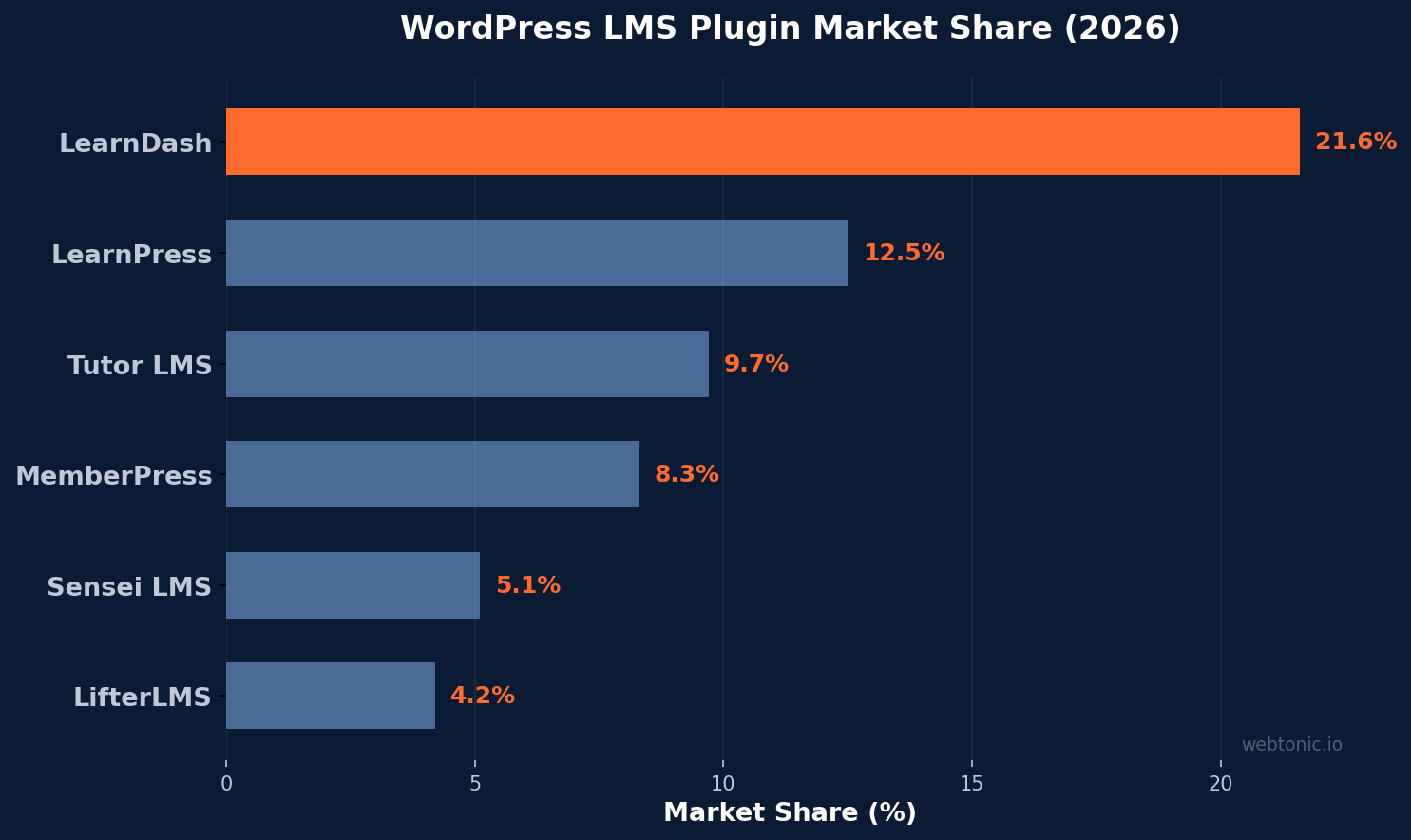
Top WordPress LMS Plugins by Market Share (2026)
| Plugin | Market Share | Strongest Region |
|---|---|---|
| LearnDash | 21.6% | US, UK, Spain |
| LearnPress | 12.5% | India, Global |
| Tutor LMS | 9.7% | India, Brazil, Poland |
| MemberPress | 8.3% | UK |
| Sensei LMS | 5.1% | Spain |
| LifterLMS | 4.2% | US |
Education Website Performance Benchmarks
Education institutions that move to WordPress see measurable performance gains. 75% report increased student engagement after the transition (Notta). Parent-facing metrics are equally strong: 87% of parents research schools online before making enrollment decisions, and institutions with WordPress-based sites see 3x more admission enquiries than those on static or legacy platforms (Zipdo).
Online education marketing benchmarks show WordPress sites converting at competitive rates. Landing page conversion sits at 3.2% for education, with email open rates averaging 36.5% and free-trial-to-paid conversion at 18.2% (CuFinder). Mobile search intent is significant: 68% of education-related searches happen on mobile devices, with 46% carrying local intent — making mobile-responsive WordPress themes a non-negotiable requirement (Zipdo).
WordPress Theme and Plugin Ecosystem for Education
The education WordPress theme market has matured significantly. Eduma (ThimPress) leads with 47,000+ active users, offering deep LearnPress integration for course creation, quiz management, and certificate delivery (ThimPress). Premium education themes typically bundle $639+ worth of LMS add-ons in packages starting at $69, dramatically lowering the barrier to launching a course business.
Beyond LMS plugins, education WordPress sites commonly integrate scheduling tools, payment gateways, and community forums. The average education WordPress site runs 18–24 active plugins, higher than the cross-industry average of 12–15, reflecting the complexity of managing enrollments, content drip, assessments, and student communications on a single platform. For coaching businesses evaluating their digital growth stack, WordPress offers the most extensible foundation available. The block editor (Gutenberg) has also matured, allowing education content teams to build rich lesson layouts, embed video, and create interactive elements without touching code — a significant workflow improvement over previous WordPress versions.
Accessibility is another strength driving education adoption. WordPress's core meets WCAG 2.1 AA standards, and most education themes include built-in accessibility features like keyboard navigation, screen reader compatibility, and contrast controls. For institutions required to meet Section 508 compliance in the United States, WordPress provides the most well-documented accessibility framework of any major CMS.
WordPress vs. Alternative Platforms for Education
CMS Comparison for Education Websites
| Platform | Education Market Share | LMS Built-In | Monthly Cost Range |
|---|---|---|---|
| WordPress | 44.2% | Via plugins (20+ options) | $5–$50/mo (hosting) |
| Kajabi | 3.8% | Native | $149–$399/mo |
| Teachable | 3.1% | Native | $59–$249/mo |
| Thinkific | 2.7% | Native | $49–$499/mo |
| Squarespace | 2.2% | Via MemberSpace | $16–$49/mo |
| Wix | 1.9% | Wix Courses | $17–$36/mo |
WordPress's cost advantage is significant. Hosting a WordPress education site costs $5–$50 per month (depending on hosting provider), while SaaS alternatives like Kajabi start at $149/month. The trade-off is setup complexity: WordPress requires more technical configuration, but offers complete control over data, design, and functionality. For institutions and coaching businesses building long-term assets, WordPress delivers 3–10x lower total cost of ownership over a 5-year period compared to SaaS course platforms.

WordPress Security and Compliance for Education
Education websites handle sensitive data — student records, payment information, and personal details — making security a primary concern for WordPress deployments. Over 60% of WordPress security breaches stem from outdated plugins, which means education sites running 18–24 active plugins face elevated risk without a maintenance protocol. Best-in-class education WordPress sites implement automatic plugin updates, web application firewalls, and two-factor authentication as baseline security layers.
Compliance requirements add another dimension. Education institutions in the US must address FERPA (Family Educational Rights and Privacy Act) regulations, while European organizations need GDPR-compliant data handling. WordPress's self-hosted model gives institutions complete control over data storage location and processing, an advantage over SaaS platforms that may store data across jurisdictions. Managed WordPress hosting providers now offer FERPA-aligned hosting plans with audit logging, encrypted databases, and access controls designed specifically for the education sector.
Course Revenue and Monetization Data
WordPress-powered course sites generate significant revenue across the education spectrum. Course creators using LearnDash or LearnPress typically price individual courses between $49 and $497, with membership bundles averaging $29–$99 per month. The most successful WordPress education sites combine one-time course sales with recurring memberships, creating predictable revenue streams that grow with enrollment.
According to industry surveys, top-performing WordPress course creators earn $50,000–$200,000 annually from digital education products. The economics favor WordPress because SaaS platforms charge 5–10% transaction fees on top of monthly subscriptions, while WordPress sites using WooCommerce or direct payment gateway integration keep 97–98% of revenue after payment processing. For coaching businesses scaling their paid advertising efforts, the higher margin structure of WordPress makes customer acquisition costs easier to justify.
SEO Advantages of WordPress for Education
WordPress's SEO capabilities are a primary reason education organizations choose the platform. Plugins like Yoast SEO and Rank Math give education sites granular control over meta tags, schema markup, and sitemap generation — capabilities that SaaS platforms typically restrict. Education WordPress sites using structured data for courses (CourseInfo schema) see 28% higher click-through rates in search results versus non-structured listings.
The platform's content management strength matters for SEO scale. Education sites publishing 4+ blog posts per month see 3.5x more organic traffic than those publishing less frequently. WordPress makes this feasible with its native editor, scheduling, and category/tag taxonomy — features that analytics-driven teams use to build topical authority across hundreds of keyword clusters.
Best Practices for Education WordPress Sites
- Choose an LMS plugin early — LearnDash for premium features and US/UK markets; LearnPress for cost-sensitive global deployments
- Prioritize mobile-responsive themes — 68% of education searches happen on mobile, and Google's mobile-first indexing penalizes non-responsive sites
- Implement course schema markup — CourseInfo structured data improves CTR by 28% in search results
- Bundle security and performance plugins — education sites handle sensitive student data and require SSL, firewall, and caching as baseline
- Invest in page speed optimization — compress images, use CDN, and leverage caching to keep load times under 3 seconds
- Publish consistently — 4+ posts per month drives 3.5x organic traffic growth for education blogs
- Integrate email marketing — welcome emails with course previews achieve a 52% open rate in education (CuFinder)
Related reading
- Education & Coaching Webflow Statistics: Market Share & Performance Data (2026)
- The State of Landing Pages & CRO in Education & Coaching: 2026 Stats & Trends
- Shopify for Education & Coaching: Statistics & Benchmarks (2026)
- Custom Web Development services at Web Tonic
FAQ
What percentage of education websites use WordPress?
44.2% of education websites run on WordPress, making it the dominant CMS in the sector. Only charity/non-profit (64.6%) and content publisher (58.2%) verticals have higher WordPress adoption rates.
Which WordPress LMS plugin is most popular?
LearnDash leads with 21.6% market share, followed by LearnPress at 12.5% and Tutor LMS at 9.7%. LearnDash is 2.2x more popular than Tutor LMS and is strongest in the US, UK, and Spain.
Is WordPress good for online course websites?
Yes. WordPress paired with an LMS plugin offers the most flexible and cost-effective solution for course websites. 75% of educational institutions report increased student engagement after moving to WordPress, and the platform's plugin ecosystem supports everything from quiz creation to payment processing at a fraction of SaaS platform costs.
How much does a WordPress education website cost?
Hosting costs range from $5–$50 per month, plus a one-time premium theme purchase ($49–$69 typical). LMS plugin costs add $0–$199/year depending on tier. Total first-year cost is typically $200–$800, compared to $1,800–$4,800 for SaaS alternatives like Kajabi or Teachable.
Does WordPress help with education SEO?
WordPress is widely considered the strongest CMS for SEO. Education sites using WordPress SEO plugins achieve 28% higher click-through rates with course schema markup, and the platform's content management tools support the consistent publishing cadence (4+ posts/month) that drives 3.5x organic traffic growth. The platform's native taxonomy system (categories and tags) helps education sites build topical clusters that search engines reward with higher domain authority.
What are the biggest challenges of WordPress for education?
The primary challenges are maintenance overhead and plugin management. Education WordPress sites run an average of 18–24 active plugins, each requiring regular updates for security and compatibility. Institutions also need to address FERPA and GDPR compliance through proper hosting configuration, data handling procedures, and access controls. Choosing a managed WordPress host with education-specific compliance features addresses most of these concerns. Despite these challenges, WordPress's 44.2% education market share demonstrates that the benefits outweigh the operational complexity for most organizations.
Sources
zerotowp.com/wordpress-statistics-2026
w3techs.com/technologies/details/cm-wordpress
visionary-marketing.co.uk/blog/cms-market-share-report-2026
notta.ai/en/blog/wordpress-statistics
wmtips.com/technologies/lms
wmtips.com/technologies/compare/learndash-vs-tutor-lms
sellcoursesonline.com/wordpress-lms-websites-tech-study
eduma.thimpress.com
zipdo.co/marketing-in-the-education-industry-statistics
cufinder.io/blog/benchmarks/online-education


