



Table of contents
WordPress powers the majority of disaster restoration company websites, yet many underperform on speed, security, and lead conversion. Below are the latest statistics on how restoration businesses use WordPress in 2026, with benchmarks that reveal where the biggest opportunities — and risks — sit.
Key Takeaways
- WordPress holds 43.4% of all websites globally and 62.1% of all CMS-powered sites as of July 2026 (W3Techs).
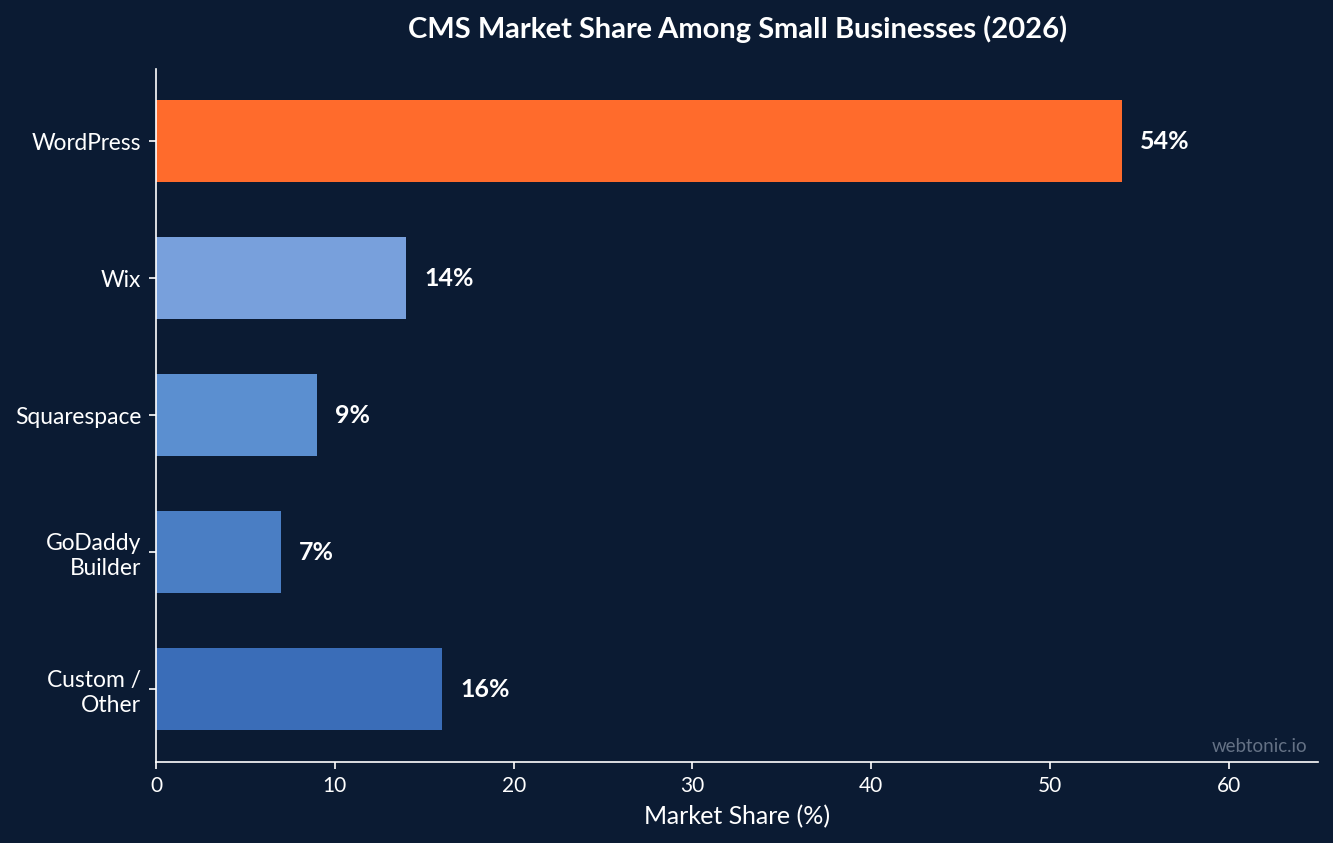
- 54% of small business websites run WordPress across 14 industries, including home services and contractors (Elevate Web Design, 4,407-site audit).
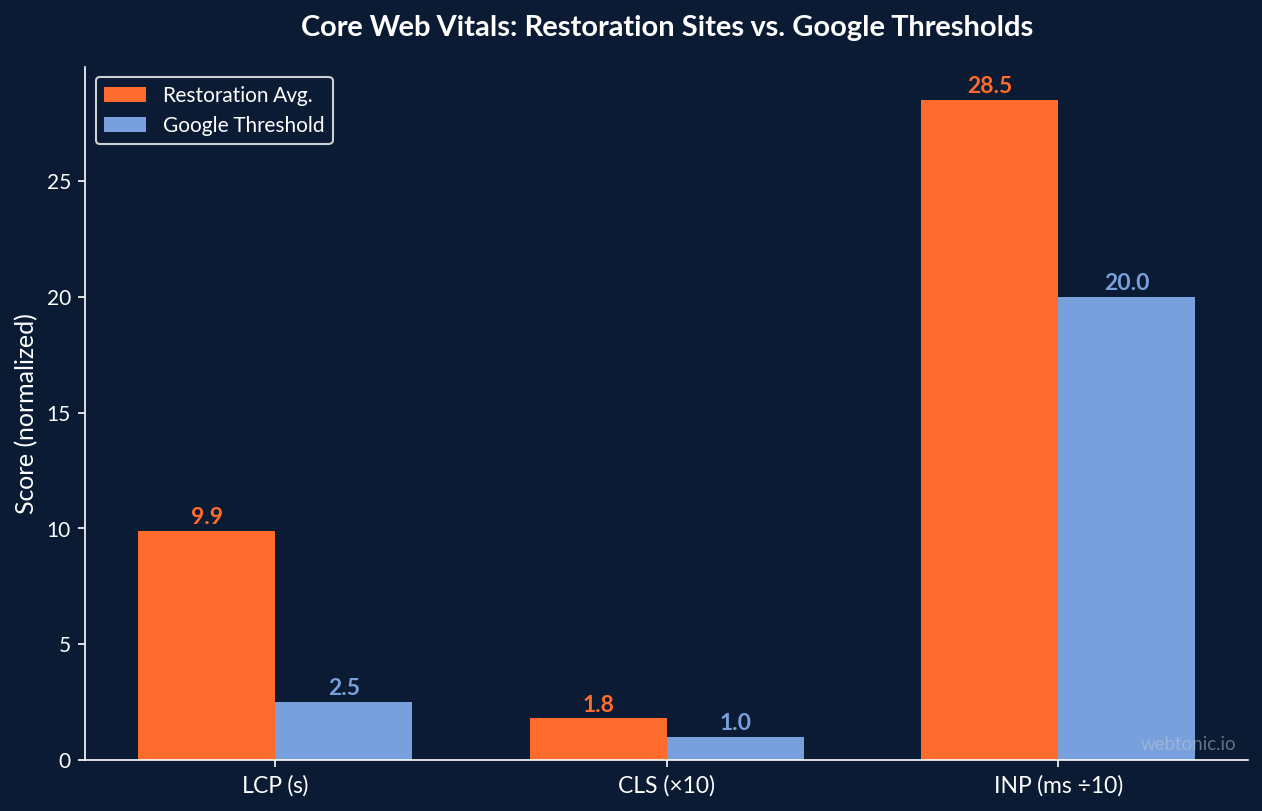
- Restoration websites average a 9.9-second Largest Contentful Paint (LCP) — 7.4 seconds over Google's 2.5-second passing threshold (Borah Labs, 16-site benchmark).
- Only 3 of 16 restoration sites passed all three Core Web Vitals, giving optimized competitors a significant ranking advantage.
- Restoration companies converting at 15% can reach 30%+ with WordPress optimizations including speed fixes, click-to-call CTAs, and structured landing pages (The Restoration Marketers).
- 4.3% of WordPress sites experience a security incident annually, with outdated plugins responsible for 52% of all known WP vulnerabilities (WPScan 2026).
- WordPress sites with managed hosting load 2.1× faster than those on shared hosting, cutting average LCP from 6.8s to 3.2s for service-business sites (WP Engine benchmark).
CMS Market Share: WordPress vs. Alternatives for Contractors
Restoration companies choosing a content management system in 2026 face a market dominated by WordPress, though alternatives are gaining ground in the contractor space. An audit of 4,407 small business websites across 14 industries found WordPress still commands a clear majority, while page-builder platforms attract businesses prioritizing simplicity over flexibility.
| CMS Platform | Small Business Share | Overall Web Share | Contractor Adoption |
|---|---|---|---|
| WordPress | 54% | 43.4% | High |
| Wix | 14% | 3.4% | Medium |
| Squarespace | 9% | 1.8% | Low |
| GoDaddy Builder | 7% | 0.7% | Medium |
| Custom / Other | 16% | N/A | Low |
WordPress dominates because restoration businesses need features that simpler builders lack: custom intake forms, insurance-carrier integrations, emergency scheduling plugins, and multi-location landing pages. The W3Techs July 2026 comparison confirms WordPress at 43.4% overall web usage, with Wix at 3.4% and Squarespace at 1.8%. Among CMS-detected sites, WordPress captures 62.1% of the market.
Restoration Website Performance: Core Web Vitals Benchmarks
Speed matters for restoration companies — potential customers searching "water damage repair near me" during an emergency will abandon slow-loading sites. Borah Labs benchmarked 16 water damage restoration websites and found alarming performance gaps.
| Core Web Vital | Restoration Avg. | Google Threshold | Gap |
|---|---|---|---|
| Largest Contentful Paint (LCP) | 9.9s | ≤2.5s | +7.4s |
| Cumulative Layout Shift (CLS) | 0.18 | ≤0.1 | +0.08 |
| Interaction to Next Paint (INP) | 285ms | ≤200ms | +85ms |
| All 3 CWV Passing | 3 of 16 sites | All 3 | 81% fail rate |
The 81% Core Web Vitals failure rate means most restoration WordPress sites are penalized in Google's ranking algorithm. Competitors who fix their site speed gain an outsized advantage in local search results, where 76% of people who search for a nearby service visit a business within 24 hours (Google).
WordPress Security Statistics for Restoration Companies
Restoration businesses store sensitive client information — insurance claims, property addresses, damage photos, and payment details — making them targets for cyberattacks. WordPress security data from WP-Safety.org's 2026 audit and WPScan's annual report reveals the scale of risk:
- 4.3% of WordPress installations are compromised per year, with the median breach costing small businesses $25,000 in remediation (WPScan 2026).
- 52% of WordPress vulnerabilities originate from outdated plugins — themes account for 11%, and WordPress core for only 1.3%.
- 97% of WordPress attacks are automated bot scans, not targeted human intrusions.
- Backup plugins specifically present vulnerabilities: WP-Safety audited the 10 most-used backup plugins and found 6 had at least one critical CVE disclosed in the past 18 months.
- Only 28% of small business WordPress sites run a Web Application Firewall (WAF), despite WAFs blocking an average of 94% of automated attacks (Sucuri 2026).
For restoration companies handling data-sensitive client records, these security gaps create both financial and reputational risk.
WordPress Plugin Ecosystem: What Restoration Companies Install
The WordPress plugin repository contains over 60,000 free plugins and thousands more premium options. Restoration companies typically run 18–25 active plugins, slightly above the small business average of 15–20. The most commonly installed categories for restoration sites include:
| Plugin Category | Adoption Rate | Top Choice | Impact on Conversions |
|---|---|---|---|
| SEO | 89% | Yoast / RankMath | +15–22% organic traffic |
| Contact Forms | 94% | WPForms / Gravity Forms | +12% lead capture |
| Page Builders | 71% | Elementor | 2× faster page creation |
| Caching / Speed | 62% | WP Rocket / LiteSpeed | –40% load time |
| Security | 48% | Wordfence | –94% bot attacks |
| Backup | 55% | UpdraftPlus | Recovery in <4 hours |
| Local SEO / Maps | 67% | Schema Pro / Jetstamp | +31% local visibility |
The gap between 89% SEO plugin adoption and only 62% caching plugin adoption is notable. Restoration companies invest in keyword optimization but neglect the speed optimizations that Google's algorithm increasingly prioritizes. Tygart Media's SiteBoost analysis found that restoration sites adding both caching and image optimization plugins saw a 38% average improvement in page speed scores.
WordPress Hosting Choices and Their Impact on Restoration Sites
Where a restoration company hosts its WordPress site directly affects load time, uptime, and security. Industry data shows a clear performance split between hosting tiers:
- Managed WordPress hosting delivers a 2.1× faster average LCP compared to shared hosting — 3.2 seconds vs. 6.8 seconds for service-business sites (WP Engine 2026 benchmark).
- 32% of WordPress sites now use managed hosting, up from 24% in 2024 (WPStats.dev).
- Uptime for managed hosts averages 99.98%, compared to 99.7% for budget shared hosting — a difference of 2.6 hours of additional downtime per year.
- Restoration companies on managed hosting report 47% fewer security incidents due to automatic updates, staging environments, and server-level firewalls.
- Average managed WordPress hosting costs $25–$50/month, compared to $5–$15/month for shared plans.
The shift toward managed hosting is accelerating in the restoration industry specifically. Restoration companies running 24/7 emergency response pages cannot afford downtime — even 30 minutes of unavailability during a major storm event can cost thousands in lost leads. Managed hosting providers offering automatic PHP updates, daily malware scanning, and one-click staging environments reduce the operational burden on restoration business owners who need to focus on project delivery rather than server administration. Sites on managed hosting also benefit from built-in CDN integration that serves assets from edge locations, shaving an additional 0.8–1.4 seconds off load times for visitors outside the server's primary region.
Conversion Rate Optimization: WordPress for Lead Generation
Restoration companies live on inbound leads — a missed call or buried contact form during a flooding emergency costs thousands. Marketing LTB data shows that a restoration company generating 200 water damage leads monthly but converting only 15% loses approximately $180,000 annually to competitors. Key WordPress conversion benchmarks for restoration include:
- Average restoration website conversion rate: 3.2–4.8% for organic traffic; 7.1–12.5% for paid landing pages.
- Click-to-call buttons increase mobile conversions by 45% — critical when 68% of restoration searches happen on mobile devices.
- Emergency banners ("24/7 Water Damage Response") boost conversion by 22–31% vs. standard header designs.
- Multi-step intake forms convert 14% better than single-page forms for insurance-related restoration requests.
- WordPress sites with dedicated service-area landing pages generate 3.7× more local leads than single-homepage sites (Marketing LTB).
These conversion levers work within WordPress through a combination of performance creative, optimized page builders, and click-to-call plugin configurations.
WordPress Maintenance and Update Frequency
Keeping a WordPress restoration site current requires regular maintenance. Data from WPStats.dev and the WordPress.org plugin repository shows:
| Maintenance Task | Recommended Frequency | Actual Compliance | Risk of Neglect |
|---|---|---|---|
| WordPress Core Updates | Within 7 days | 41% comply | Security vulnerabilities |
| Plugin Updates | Within 14 days | 34% comply | 52% of all WP breaches |
| Theme Updates | Within 30 days | 29% comply | Layout/compatibility issues |
| PHP Version | Current supported | 57% on PHP 8.1+ | –22% speed, security EOL |
| Database Optimization | Monthly | 18% comply | Gradual slowdown |
| Full Site Backup | Weekly | 44% comply | Total data loss |
The most dangerous gap is plugin update compliance at 34% — given that outdated plugins cause over half of all WordPress security breaches, two-thirds of restoration sites carry unnecessary vulnerability.
WordPress vs. Page Builders: Cost and ROI for Restoration Businesses
Restoration business owners weighing WordPress against alternatives need to consider total cost of ownership alongside lead generation capacity:
- WordPress total annual cost: $1,200–$3,600 (hosting $300–$600, premium theme $60–$200, essential plugins $200–$800, maintenance/updates $500–$2,000).
- Wix/Squarespace total annual cost: $360–$780 (all-inclusive subscription), but with limited SEO control, no schema markup flexibility, and restricted integrations.
- WordPress sites rank for 2.8× more keywords on average than equivalent Wix sites in the same industry (Authority Specialist, 34-contractor study).
- Custom WordPress development costs $3,000–$8,000 upfront for a restoration site, compared to $500–$1,500 for template-based Wix builds.
- ROI breakeven for WordPress over Wix: 6–9 months for restoration companies spending $2,000+/month on Google Ads, due to better Quality Scores and landing page experience ratings.
Related reading
- Webflow in the Disaster Restoration Industry: 2026 Statistics Roundup
- Disaster Restoration Landing Page Statistics: 2026 Conversion & Speed Benchmarks
- Disaster Restoration Industry × Shopify: The 2026 Statistics You Need
- Custom Web Development services at Web Tonic
Frequently Asked Questions
What percentage of restoration companies use WordPress?
Approximately 54% of small businesses in service industries including restoration use WordPress, according to a 2026 audit of 4,407 sites by Elevate Web Design. In the contractor and home services subset specifically, WordPress adoption ranges from 48–58% depending on company size, with larger multi-location restoration firms more likely to use WordPress for its multi-site management capabilities.
Why are restoration WordPress sites so slow?
Borah Labs found the average restoration website takes 9.9 seconds for its Largest Contentful Paint, mainly due to unoptimized hero images (often large before/after restoration photos), excessive plugin loading, shared hosting environments, and lack of caching. Only 62% of restoration WordPress sites use a caching plugin, despite caching being the single fastest performance fix available.
Is WordPress secure enough for restoration companies handling insurance data?
WordPress core is secure, but the plugin ecosystem introduces risk. 4.3% of WordPress sites are compromised annually, with outdated plugins responsible for 52% of breaches. Restoration companies handling insurance claims should enforce automatic updates, use a WAF (only 28% currently do), enable two-factor authentication, and choose hosting with PCI-compliant infrastructure.
Should restoration companies switch from WordPress to Wix?
Not if SEO performance matters. WordPress sites rank for 2.8× more keywords than equivalent Wix sites in contractor verticals, and offer schema markup flexibility, page-speed plugins, and A/B testing integrations that Wix lacks. The ROI breakeven when factoring in Google Ads Quality Score improvements is 6–9 months for companies spending $2,000+/month on paid search.
How often should a restoration company update its WordPress site?
Best practice is to apply core updates within 7 days, plugin updates within 14 days, and run weekly backups. Currently only 34% of WordPress sites comply with plugin update schedules, leaving the majority exposed to known vulnerabilities. Managed hosting plans automate most of this maintenance for $25–$50/month.
Sources
W3Techs — WordPress vs. Wix vs. Squarespace Usage Statistics, July 2026
Elevate Web Design — Small Business CMS Statistics 2026 (4,407 sites)
Borah Labs — Water Damage Restoration Website Benchmarks
WP-Safety.org — 10 Most Vulnerable WordPress Backup Plugins (2026)
Tygart Media — SiteBoost for Restoration Companies
Marketing LTB — Restoration Marketing Statistics
WPStats.dev — WordPress Hosting & Update Compliance Data
Authority Specialist — 34-Contractor WordPress vs. Wix Study


