Table of contents
Key Takeaways
- Webflow powers over 330,000 live websites globally and holds a 0.8% total market share, with finance ranking among the top 10 industries by adoption (Popupsmart).
- Financial services no-code adoption reached 61% in 2024 and is projected to hit 74% by 2026, making it one of the fastest-growing verticals for no-code platforms (Kissflow).
- The average fintech website development cost ranges from $25,000 to $500,000, with mid-range projects landing between $75,000 and $250,000 — Webflow sites typically fall in the lower third of this range (Monocubed).
- The average fintech landing page scores 45 out of 100 on conversion optimization audits, with trust-signal misalignment as the primary drag on performance (Roast.page).
- Every additional second in page load time costs fintech sites a 2.5% drop in conversion rate during high-traffic periods — Webflow sites average 2–2.5 seconds on mobile vs. 3–6 seconds for custom builds (Gemeos Agency).
Webflow Platform Overview for Financial Services
Webflow has evolved from a designer-focused website builder into a full-stack visual development platform used by companies like Anthropic, Backbase, and Trustly. For fintech companies, the platform addresses a specific pain point: the need for fast iteration on marketing sites without compromising on compliance requirements or performance standards.
| Metric | Value | Source |
|---|---|---|
| Total live Webflow websites | 330,000+ | Popupsmart |
| Overall market share | 0.8% of all websites | W3Techs via Popupsmart |
| Annual revenue (2024) | $213 million (up 66% YoY) | Tap Twice Digital |
| Financial services companies using Webflow | 1,250 | Web Radar |
| Page builder category share | 6.08% | Website Categorization API |
| Top industry vertical | Business and Finance | Website Categorization API |
| Top country by adoption | US (32,330 companies) | Web Radar |
No-Code Adoption in Financial Services
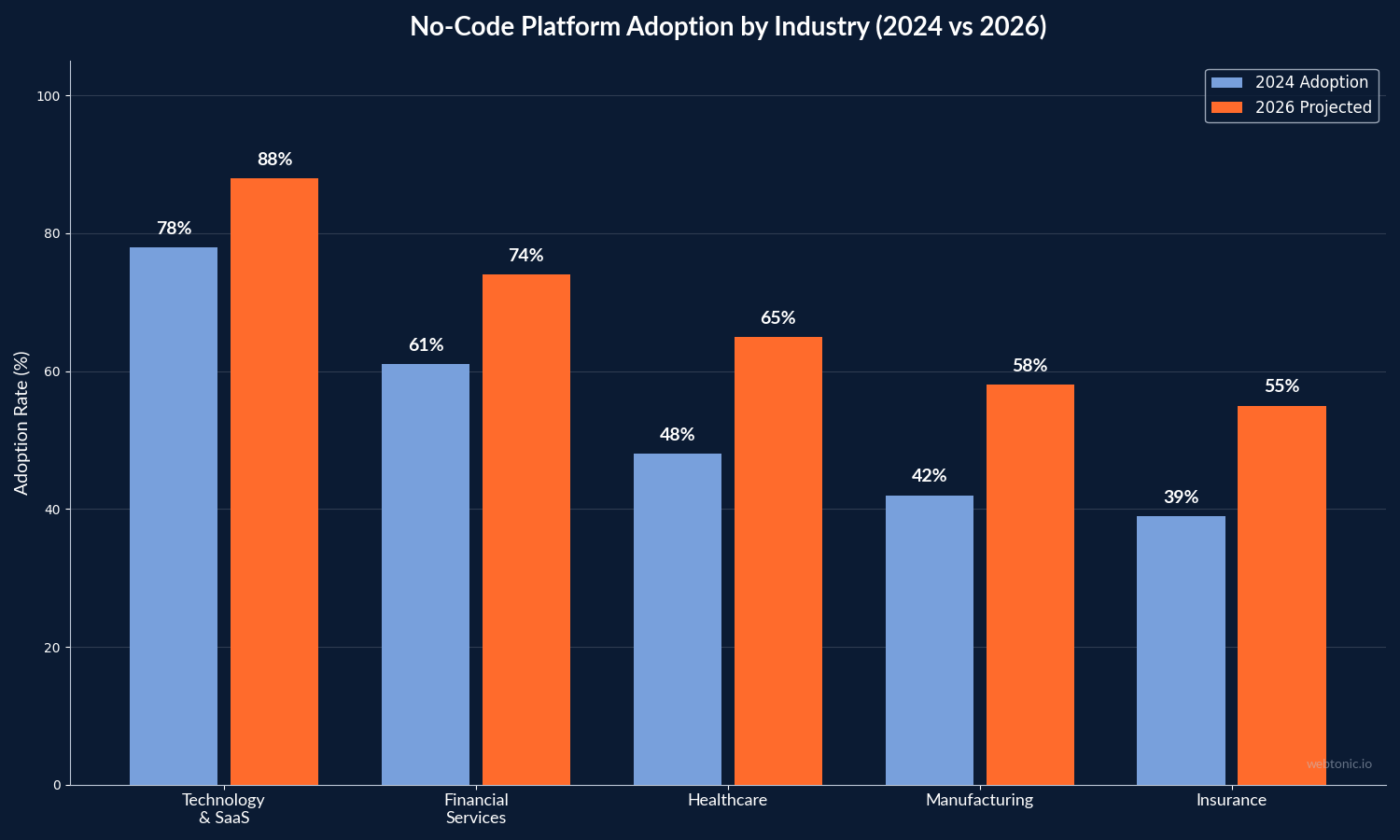
The shift toward no-code platforms in fintech is driven by regulatory compliance automation and the need for customer-facing app development without traditional development cycles. Financial services is now the second-fastest-growing sector for no-code adoption behind Technology & SaaS.
| Industry | 2024 Adoption Rate | 2026 Projected Rate | Growth Speed | Primary Bottleneck |
|---|---|---|---|---|
| Technology & SaaS | 78% | 88% | Fast | None (leading adopter) |
| Financial Services | 61% | 74% | Fast | Compliance validation |
| Healthcare | 48% | 65% | Moderate | HIPAA/regulatory |
| Manufacturing | 42% | 58% | Moderate | Legacy ERP integration |
| Insurance | 39% | 55% | Moderate | IT governance |
A Forrester study found that 82% of financial services organizations now have at least one formally sanctioned no-code platform deployed, driven by regulatory compliance automation and customer-facing app needs (Kissflow). This represents a fundamental shift from the early 2020s when fintech teams relied almost exclusively on custom development stacks.
FinTech Website Development Cost Benchmarks
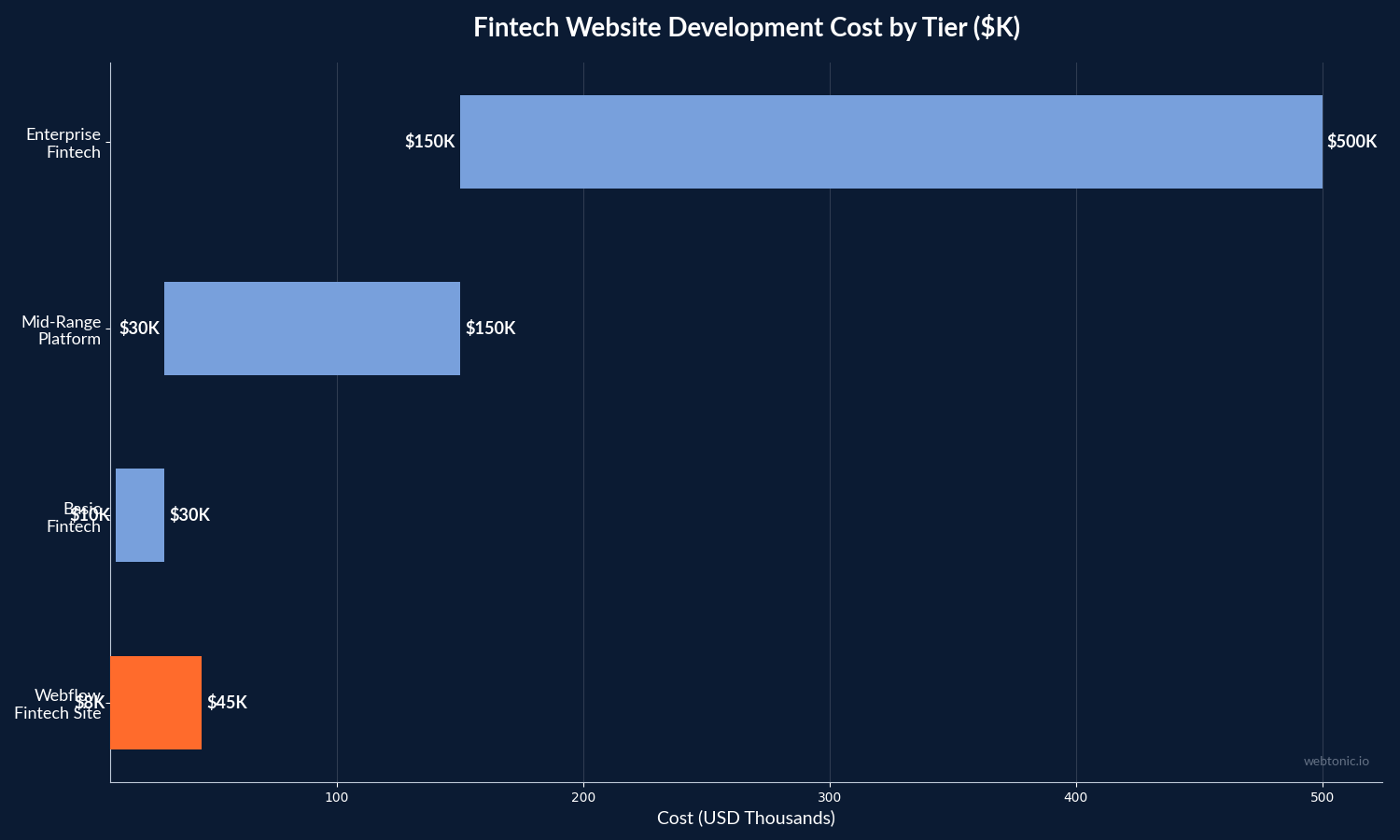
Website development costs in fintech vary dramatically based on complexity, compliance requirements, and platform choice. No-code platforms like Webflow reduce the lower end of costs significantly while maintaining the design quality enterprise fintech brands demand.
| Project Tier | Cost Range | Typical Scope | Timeline |
|---|---|---|---|
| Basic Fintech Website | $10,000 – $30,000 | Informational site, compliance pages, basic forms | 4–8 weeks |
| Mid-Range Platform | $30,000 – $150,000 | Product showcases, API documentation, lead generation | 8–16 weeks |
| Enterprise Fintech | $150,000 – $500,000+ | Full platform, regulatory integrations, multi-region | 16–40 weeks |
| Regulatory Compliance Module | $10,000 – $35,000 | Reporting automation, audit trails | 4–10 weeks |
| Webflow Fintech Site | $8,000 – $45,000 | Marketing site, landing pages, CMS content | 3–8 weeks |
Webflow sites fall in the $8,000 to $45,000 range for most fintech marketing sites — roughly 60–80% less than equivalent custom-built solutions. The platform's visual editor allows marketing teams to launch and iterate on pages without developer involvement, which compounds savings across quarterly campaigns and product launches (Monocubed; Qrolic).
Fintech Website Performance and Conversion Benchmarks
Performance is not optional in financial services. Users expect near-instant page loads, and even minor delays erode trust — a critical factor when asking visitors to share financial information or sign up for regulated products.
- Average fintech landing page optimization score: 45 out of 100 — the primary drag is a mismatch between trust signals and conversion elements (Roast.page).
- 2.5% conversion rate drop per additional second of load time during high-traffic periods like tax deadlines and product launches (Forrester via Gemeos).
- Webflow fintech sites average 2–2.5 seconds on mobile, compared with 3–6 seconds for custom builds that rely on heavy JavaScript frameworks (Gemeos).
- Most fintech sites plateau at roughly 2% conversion rate — the gap between 2% and 5%+ is driven by trust architecture, not traffic volume (OneMetric).
Webflow's built-in CDN, lazy loading, and responsive image optimization give fintech marketing teams a performance baseline that often requires dedicated DevOps work on custom stacks. The platform also handles SSL certificates automatically — meeting the ~100% HTTPS adoption standard expected across financial services websites.
Webflow Industry Adoption by Vertical
While advertising and AI companies dominate Webflow's user base, financial services ranks eighth among all industries — a notable position given the sector's traditionally conservative approach to platform adoption.
| Industry | Companies Using Webflow | Share of Total |
|---|---|---|
| Advertising | 3,850 | 6.3% |
| Artificial Intelligence | 3,437 | 5.6% |
| Consulting | 3,271 | 5.4% |
| Health Care | 2,644 | 4.3% |
| Information Technology | 1,811 | 3.0% |
| Analytics | 1,477 | 2.4% |
| Apps | 1,347 | 2.2% |
| Financial Services | 1,250 | 2.1% |
Fintech firms including Trustly, Backbase, and several Series B+ startups have migrated to Webflow for their marketing sites while keeping core product UI on React or Angular. Backbase specifically cited Webflow's data protection compliance as a deciding factor: "We serve regulated financial institutions, so data protection and compliance are non-negotiable" (Web Radar).
Webflow vs. Custom Development for Fintech
The decision between Webflow and custom development is not binary for most fintech companies. The dominant pattern is a hybrid approach: Webflow for marketing and content sites, custom stacks for product interfaces and transactional flows.
- GTM time reduction: from 1 month to 1 week for marketing page launches when switching from custom CMS to Webflow (Webflow customer case studies).
- Finance is the top subcategory in Webflow's "Business and Finance" vertical, indicating fintech marketing sites make up the largest share of financial services adoption (Website Categorization API).
- 60,875 total companies use Webflow globally, with the US accounting for 32,330 (53%) of all deployments (Web Radar).
- No-code/low-code market projected to reach $187 billion by 2030, with financial services among the top three growth drivers (Kissflow).
For fintech startups in the seed-to-Series A stage, Webflow offers a compelling growth marketing platform: ship a professional, conversion-optimized site in weeks rather than months, iterate without engineering tickets, and redirect developer resources toward product features that directly generate revenue.
Compliance and Security Considerations
Compliance remains the primary bottleneck for no-code adoption in financial services. While Webflow itself does not process financial transactions, the platform's security posture matters for fintech marketing sites that collect leads and handle sensitive pre-qualification data.
- Webflow provides SOC 2 Type II compliance, automatic SSL, and GDPR-compliant hosting options — meeting the baseline security requirements for most fintech marketing operations.
- ~100% of financial services websites now use HTTPS, and Webflow's automatic SSL provisioning ensures compliance without manual configuration.
- Compliance validation is the single biggest friction point slowing fintech no-code adoption from 61% to 74% — primarily around audit trail requirements and data residency regulations (Kissflow).
- Backbase's migration to Webflow required the platform to pass institutional-grade data protection checks before proceeding, demonstrating that enterprise fintech compliance standards can be met.
For companies building in regulated markets, a data intelligence strategy that separates marketing analytics from product telemetry is essential — and Webflow's integration ecosystem supports this separation cleanly.
Best Practices for Fintech Webflow Sites
- Separate marketing and product domains — Run Webflow on your marketing subdomain while keeping product UI on your core stack.
- Optimize for Core Web Vitals — Target LCP under 2.5 seconds. Webflow's built-in CDN helps, but heavy hero animations can push scores above threshold.
- Build trust architecture into page design — Security badges, regulatory disclosures, and social proof above the fold. The average fintech page scores just 45/100 because of trust-signal placement gaps.
- Use CMS collections for compliance content — Terms, disclosures, and regulatory pages benefit from CMS-driven content that compliance teams can update without developer involvement.
- Implement structured data for fintech pages — Organization schema, FAQ schema, and breadcrumb markup improve visibility in AI-driven search results.
- Plan for multi-region content — Use Webflow's localization features to manage region-specific regulatory language without duplicating entire sites.
- Benchmark against the 2% conversion plateau — If your fintech site converts below 2%, the issue is likely trust architecture rather than traffic quality.
Fintech Website Design Patterns That Convert
Beyond platform choice, the design patterns that drive conversion in fintech follow specific, data-backed principles. Trust architecture — the strategic placement of security badges, regulatory disclosures, testimonials, and social proof — is the primary differentiator between pages that convert at 2% and those reaching 5%+.
- Above-the-fold trust signals improve conversion by 15–25% on fintech pages. Security badges, regulated entity disclosures, and encryption indicators should appear before users scroll.
- Minimalist UI with clear CTAs outperforms feature-heavy pages — fintech users are looking for clarity, not complexity. The best-performing fintech sites limit each page to a single primary action.
- Social proof from recognizable enterprise logos increases trust by up to 40% for B2B fintech companies. Customer logos should appear in the hero or immediately below.
- Mobile-first design is non-negotiable: 54% of fintech traffic comes from mobile devices, and mobile conversion rates drop sharply below the 2-second LCP threshold.
- FAQ and educational content sections reduce bounce rates by 20–30% on fintech product pages by addressing compliance and security concerns proactively.
Webflow's component-based design system makes it straightforward to A/B test these patterns without engineering involvement — a significant advantage when iteration speed directly impacts conversion rate optimization. For fintech startups looking to build a high-converting web presence, combining Webflow's design flexibility with a solid paid search strategy creates a full-funnel acquisition engine.
Future Outlook: No-Code in Fintech Through 2028
The trajectory of no-code adoption in financial services points toward near-universal adoption for marketing and operational tools by 2028. Several converging trends will accelerate this shift.
- AI-powered design tools built into platforms like Webflow are reducing the skill floor for professional-quality website creation. Fintech teams that previously needed agencies can now ship competitive sites in-house.
- Regulatory technology (RegTech) integrations are being built natively into no-code platforms, addressing the primary adoption bottleneck for financial services (compliance validation).
- The no-code/low-code market is projected to reach $187 billion by 2030, with financial services as one of the top three growth drivers alongside healthcare and retail.
- Webflow's enterprise tier now includes audit trails, role-based access controls, and advanced security features that meet the requirements of mid-market and enterprise fintech companies.
- Headless CMS architectures are becoming standard for fintech — using Webflow as the marketing frontend while custom backends handle transactions and sensitive data processing.
For fintech companies evaluating their digital marketing infrastructure, the question is no longer whether to adopt no-code tools, but how to integrate them into a compliance-approved technology stack that maximizes team velocity without compromising security standards.
Webflow Fintech Case Studies and Results
Several high-profile fintech companies have publicly documented their migration to Webflow, providing concrete performance data that validates the platform's suitability for regulated financial services.
- Trustly — The Swedish open banking platform rebuilt its global website on Webflow to support multi-region growth. The migration enabled them to scale their online presence across multiple regions while maintaining compliance with local regulations. The team reduced page deployment time from weeks to days.
- Backbase — A global digital banking platform serving regulated financial institutions. Their team specifically cited Webflow's data protection capabilities: the platform "went through the required checks and gave us the confidence we needed to move forward." Backbase now manages its marketing presence through Webflow while its product runs on a proprietary stack.
- Multiple Series B+ fintech startups have adopted the hybrid architecture pattern: Webflow for marketing, docs, and blog content; React or Next.js for the product application. This separation keeps marketing velocity high without compromising product security.
The common thread across these case studies is speed-to-market. Fintech companies consistently report reducing their go-to-market time for new landing pages from one month to one week after migrating to Webflow. For teams running quarterly product launches or compliance-driven content updates, this time savings compounds dramatically. Combining a fast-iteration Webflow site with strategic paid search campaigns creates a feedback loop where marketing teams can test messaging, measure conversion impact, and iterate within a single sprint cycle.
Frequently Asked Questions
Is Webflow suitable for fintech websites?
Yes. Over 1,250 financial services companies currently use Webflow, including regulated entities like Trustly and Backbase. The platform provides SOC 2 Type II compliance, automatic SSL, and GDPR-compliant hosting. However, Webflow is best suited for marketing and content sites — core product interfaces with transaction processing should remain on custom stacks.
How much does a fintech Webflow website cost?
A typical fintech marketing site built on Webflow costs $8,000 to $45,000, compared with $25,000 to $500,000 for custom-built alternatives. The cost depends on complexity, number of pages, and integration requirements. Most mid-market fintech companies spend $15,000–$30,000 on a Webflow marketing site.
How does Webflow performance compare to custom development for fintech?
Webflow fintech sites average 2–2.5 seconds of load time on mobile, compared with 3–6 seconds for JavaScript-heavy custom builds. The platform's built-in CDN, lazy loading, and image optimization provide a strong performance baseline that often matches or exceeds custom solutions built without dedicated performance engineering.
What percentage of fintech companies use no-code platforms?
61% of financial services organizations adopted no-code platforms as of 2024, with projections reaching 74% by 2026. Compliance validation remains the primary adoption bottleneck, but financial services is the second-fastest-growing vertical for no-code adoption behind Technology & SaaS.
Can Webflow handle fintech compliance requirements?
Webflow meets baseline compliance requirements for marketing sites, including SOC 2 Type II, automatic HTTPS, and GDPR-compliant hosting. For transaction-processing pages or apps handling sensitive financial data, companies typically pair Webflow marketing sites with compliant backend systems and maintain clear data separation between marketing and product environments.
Sources
popupsmart.com/blog/webflow-statistics
kissflow.com/no-code/no-code-adoption-statistics-industry
monocubed.com/blog/fintech-website-development-cost
the-web-radar.com/technologies/webflow
gemeosagency.com/en/blog/webflow-finance-players-standard
qrolic.com/blog/fintech-startup-website-cost-in-2026
roast.page/for/fintech
onemetric.io/blog/fintech-website-conversion
websitecategorizationapi.com/technologies/websites-using-Webflow