



Table of contents
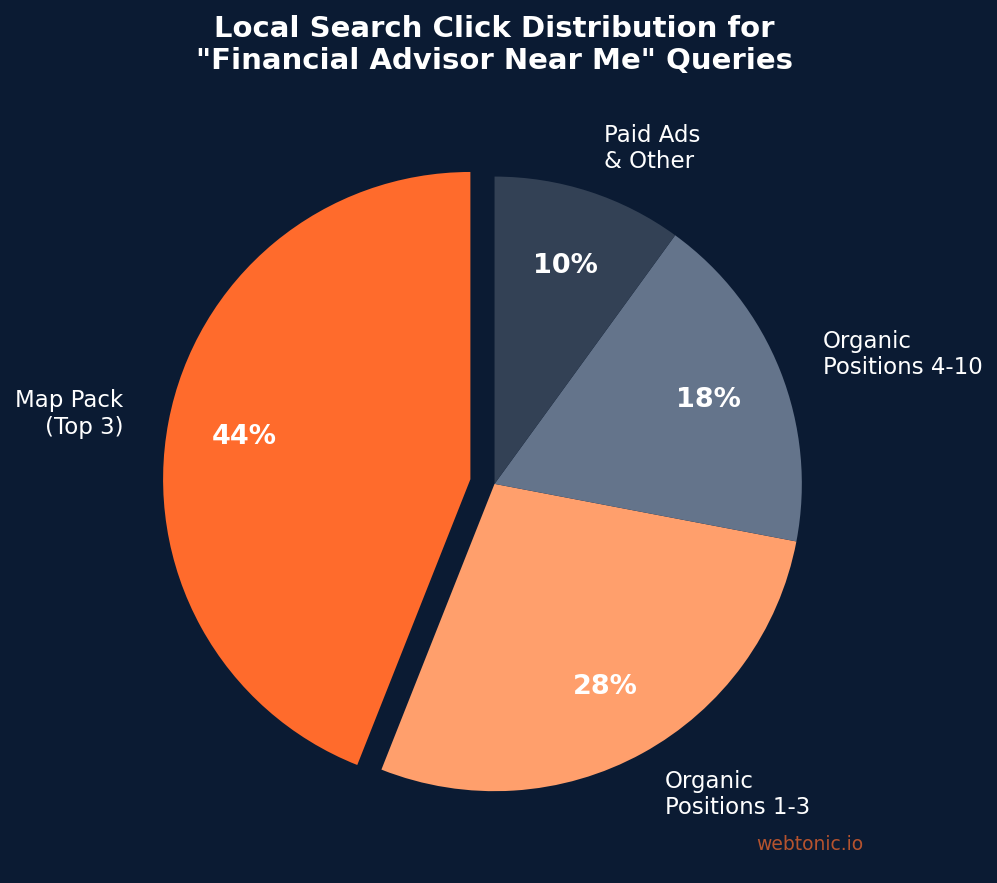
Top-ranked financial advisors in local search average 45.6 Google reviews, while those in positions 4–5 average just 18.67 — less than half. Local SEO has become the primary discovery channel for prospective advisory clients, with the Google Map Pack capturing 44% of all local search clicks and generating 7× more engagement than standard organic results.
Key Takeaways
- Top-3 ranked financial advisors average 45.6 Google reviews, while those ranked 4th–5th average only 18.67 reviews, according to a study of 100 U.S. cities (Advisor Rankings, 2025).
- The Google Map Pack captures 44% of all local search clicks and firms in the Map Pack receive 7× more clicks than positions 4–10 (BrightLocal 2025, via OJay Media).
- 98% of consumers used the internet to find a local business in the past year, making online visibility essential for advisory firm growth (BrightLocal, 2025).
- GBP profile completeness is the number-one local ranking factor in Whitespark's 2024 Local Search Ranking Factors report — ahead of review count and link signals.
- Organic search drives 38–54% of qualified prospect inquiries for established RIAs and CFP firms in 2026 (Authority Specialist, 2026).
- AI referral traffic represents 0.85% of total sessions for financial advisors, with AI Overviews triggering on 25.79% of Google searches in the vertical (OpenLens, 2026).
Financial Advisory Local SEO Benchmarks at a Glance
| Metric | Financial Advisory | All-Industry Average |
|---|---|---|
| Avg. reviews (top-3 ranked) | 45.6 | 73 (all local businesses) |
| Median reviews (top-3 ranked) | 20.5 | 35 |
| Map Pack click share | 44% | 42% |
| Map Pack vs organic CTR | 7× positions 4–10 | 5× positions 4–10 |
| Organic lead share (established firms) | 38–54% | 30–45% |
| GBP optimization to Map Pack | 6–10 weeks | 4–8 weeks |
| AI referral traffic share | 0.85% | 1.2% |
Google Reviews and Local Ranking Correlation
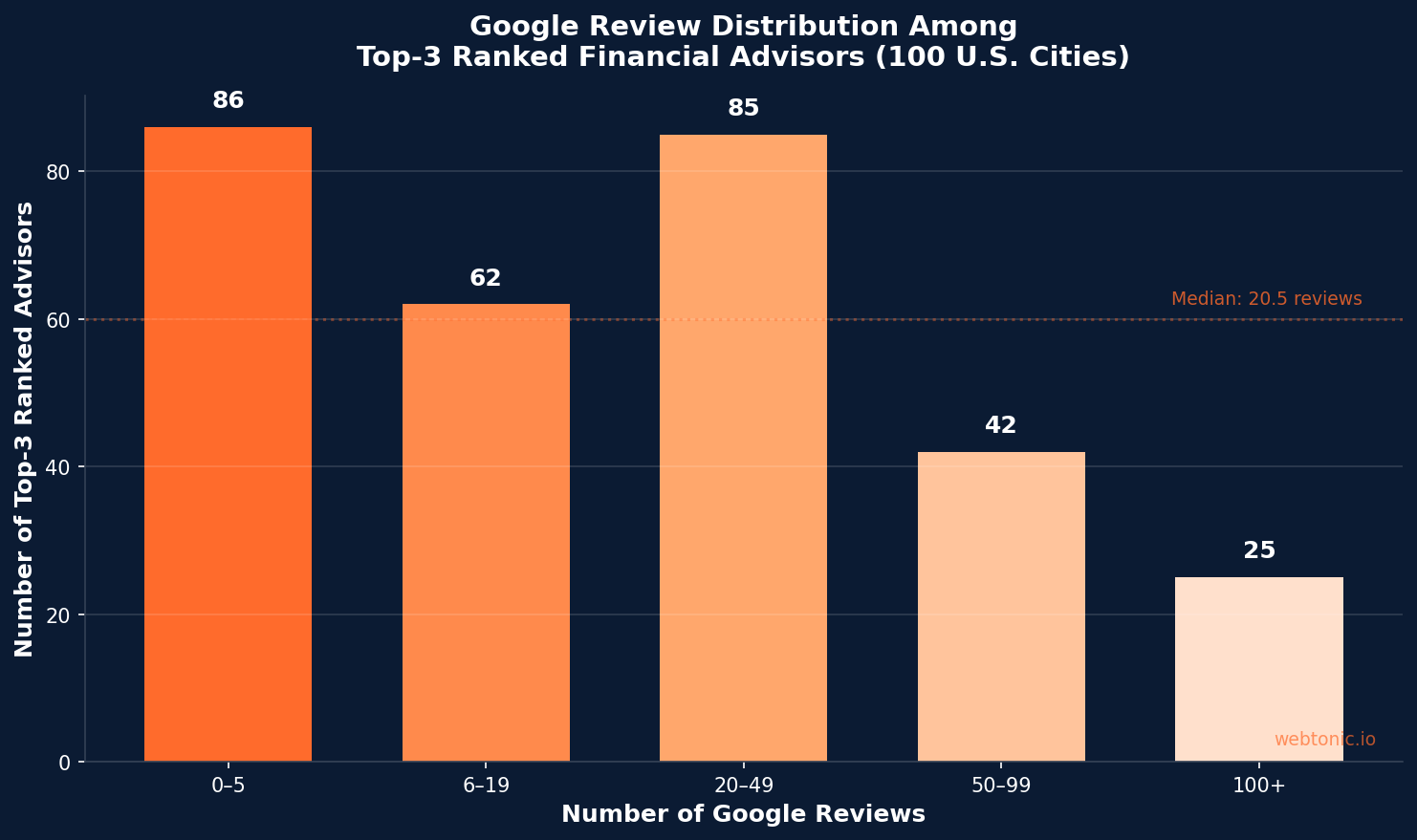
A comprehensive study by Advisor Rankings analyzed Google Business Profile data across 100 U.S. cities, examining the top 3 local results for financial advisors in each market. The findings reveal a clear relationship between review volume and ranking position:
- Top-3 ranked financial advisors averaged 45.6 Google reviews
- Advisors ranked 4th–5th averaged only 18.67 reviews — less than half the top-3 average
- Only 4 out of all top-3 ranked advisors had zero reviews
- The median review count among top-3 advisors was 20.5
The distribution of review counts among top-3 advisors shows significant variation, with room to compete at every stage:
| Review Count Range | Number of Top-3 Advisors | Percentage |
|---|---|---|
| 0–5 reviews | 86 | 28.7% |
| 6–19 reviews | 62 | 20.7% |
| 20–49 reviews | 85 | 28.3% |
| 50–99 reviews | 42 | 14.0% |
| 100+ reviews | 25 | 8.3% |
Google Business Profile Optimization Statistics
GBP profile completeness is the number-one local ranking factor according to Whitespark's 2024 Local Search Ranking Factors report, ranking ahead of review count and link signals. For financial advisors, this means filling every available field — categories, services, hours, photos, and description — directly impacts Map Pack visibility.
Key GBP optimization statistics for financial advisory firms include:
- 86% of consumers use Google Maps to find local businesses at least once a month (BrightLocal, 2024), making Maps visibility a primary discovery channel for advisory prospects.
- Firms in the Map Pack receive 7× more clicks than those in positions 4–10 of organic results (OJay Media, citing Sterling Sky case studies, 2024).
- Firms with unclaimed or thin GBP listings can see Map Pack movement in 6–10 weeks after optimization, citation cleanup, and review generation (Authority Specialist, 2026).
- NAP (name, address, phone) consistency across directories is a foundational local ranking factor — inconsistencies from old listings, office moves, or rebranding suppress local visibility until corrected.
For growth-focused advisory firms, GBP optimization represents the fastest path to local visibility gains. While organic SEO may take 9–14 months, Map Pack improvements can be visible within weeks of profile optimization and active review generation.
According to Defiance Analytics' RIA acquisition research, 77% of consumers always or regularly read online reviews when browsing for local businesses (BrightLocal, 2025), and financial advisory services rank among the top categories where review quality influences decision-making. For advisors specifically, review recency matters as much as volume — prospects evaluating trust-sensitive services prioritize reviews from the past 6–12 months over older testimonials.
Multi-location advisory practices face additional complexity. Each office location needs its own verified GBP listing with unique content, photos, and review profiles. Firms that duplicate descriptions across locations see weaker Map Pack performance than those investing in location-specific optimization, because Google's algorithm penalizes identical content across co-located listings.
Local Search Behavior in Financial Services
Most wealth management search behavior begins with location-modified or credential-based queries, not generic brand terms. Prospects searching for financial advisors typically use queries like "financial advisor near me," "fee-only financial advisor [city]," or "CFP [city]" — all of which trigger the local Map Pack.
According to Authority Specialist's analysis of 41 advisory practices, organic search tends to produce higher-intent leads than paid search for trust-sensitive advisory services. Firms ranking well for broad terms like "financial planner near me" often underperform on AUM-specific queries where conversion intent is highest.
Practices publishing YMYL-compliant content with verified author credentials convert organic visitors at 1.8–3.2× the rate of those without attribution — a critical factor in regulated industries where trust signals directly influence lead quality.
Mobile search behavior amplifies the importance of local optimization. Over 60% of "financial advisor near me" searches occur on mobile devices, and mobile searchers are more likely to contact a firm within 24 hours of their initial search. Firms with mobile-optimized websites and click-to-call GBP buttons capture a disproportionate share of these high-intent interactions compared to those relying on desktop-oriented experiences.
Location-modified searches also carry significantly higher conversion intent than generic queries. Searches including a city name or "near me" convert at 2–3× the rate of broad informational queries like "what does a financial advisor do," making local SEO one of the highest-ROI channels for advisory practices focused on client acquisition rather than brand awareness.
AI Search Visibility for Financial Advisors
AI-generated search features are reshaping how advisory prospects discover firms. According to OpenLens (2026), key AI visibility benchmarks for financial advisors include:
- AI referral traffic represents 0.85% of total sessions for financial advisory sites — below the cross-industry average of 1.2%.
- AI Overviews trigger on 25.79% of Google searches in the financial advisory vertical, meaning one in four relevant queries generates an AI-generated response.
- Financial services holds a 27.3% share of AI-generated voice, followed by banks at 26.2% and insurance at 21.7%.
These numbers indicate that while AI search is still a small traffic source, its 25.79% trigger rate means advisory firms need to optimize for AI visibility alongside traditional search advertising strategies. Structured data, E-E-A-T signals, and comprehensive content are the primary factors determining whether a firm appears in AI-generated answers.
Local SEO Timeline for Financial Advisors
| Milestone | Typical Timeline | Primary Drivers |
|---|---|---|
| GBP Map Pack movement | 6–10 weeks | Profile optimization, citation cleanup, reviews |
| Local service keywords (e.g., "advisor in [city]") | 3–5 months | Content creation, local links, on-page SEO |
| Broad competitive terms | 6–12+ months | Sustained backlink growth, digital PR |
| Multi-location visibility | 9–18 months | Location pages, city-specific content, separate GBPs |
Ranking for local service keywords typically takes 3–5 months for firms with moderate domain authority and a clean technical foundation. High-competition broad terms realistically require 6–12 months or longer in most metro markets, dependent on sustained backlink growth and domain authority (Authority Specialist, 2026).
Multi-location practices face a longer runway. Achieving consistent visibility across 3+ office locations typically requires 9–18 months of coordinated effort, including separate GBP profiles for each location, city-specific landing pages, and localized review generation strategies. Advisory networks that centralize their local SEO operations see more consistent results than those delegating optimization to individual branch offices without a unified playbook.
The timeline also depends on competitive density. Advisors in metro areas with 50+ competing firms need significantly stronger backlink profiles and review velocity than those in smaller markets with fewer than 15 direct competitors. In saturated markets, achieving top-3 Map Pack visibility may require domain authority scores of 30+ combined with 40+ recent reviews — thresholds that take sustained investment to reach (Defiance Analytics).
Best Practices for Financial Advisor Local SEO
- Claim and fully complete your Google Business Profile — completeness is the number-one local ranking factor, ahead of review count and links.
- Build a systematic review generation process — top-3 ranked advisors average 45.6 reviews. Even reaching 20+ puts you above the median.
- Ensure NAP consistency across all directories — inconsistencies from old listings or office moves suppress local rankings until corrected.
- Publish location-specific content — city-specific service pages targeting "financial advisor in [city]" queries with YMYL-compliant credentials.
- Monitor AI visibility alongside traditional rankings — with 25.79% of queries triggering AI Overviews, structured data and comprehensive content are increasingly important for discovery.
- Track organic lead attribution over 12+ months — organic search drives 38–54% of qualified prospect inquiries for established firms, but early-stage touchpoints are often undercounted in last-click attribution models.
- Invest in data-driven local SEO — combine GBP optimization with experienced advisory marketing specialists to accelerate Map Pack visibility and organic lead flow.
Related reading
- Financial Advisory Technical SEO Statistics: 2026 Core Web Vitals & Site Performance Data
- Financial Advisor SEO Statistics: 70+ Data Points on Rankings, Traffic & ROI (2026)
- E-Commerce Local SEO Statistics: 80+ Search & GBP Benchmarks (2026)
- Local SEO Services services at Web Tonic
Frequently Asked Questions
How many Google reviews does a financial advisor need to rank in the top 3 locally?
Research across 100 U.S. cities shows the median review count among top-3 ranked financial advisors is 20.5, with an average of 45.6. However, 86 top-3 advisors had just 0–5 reviews, indicating that reviews are important but not the sole ranking factor. GBP completeness, NAP consistency, and local link signals also play critical roles.
What is the most important local SEO ranking factor for financial advisors?
According to Whitespark's 2024 Local Search Ranking Factors report, GBP profile completeness is the number-one factor — ahead of review count, link signals, and on-page SEO. Fully completing all GBP categories, services, hours, photos, and descriptions directly impacts Map Pack visibility.
How long does it take for financial advisors to see results from local SEO?
Firms with unclaimed or thin GBP listings can see Map Pack movement in 6–10 weeks after optimization, citation cleanup, and review generation. Local service keywords typically take 3–5 months, while high-competition broad terms require 6–12+ months of sustained effort.
How does AI search impact local SEO for financial advisors?
AI Overviews trigger on 25.79% of financial advisory searches, but AI referral traffic currently represents only 0.85% of total sessions. Firms should optimize for AI visibility through structured data and comprehensive content while continuing to prioritize traditional local ranking factors.
Is local SEO more effective than paid search for financial advisors?
Organic search tends to produce higher-intent leads than paid search for trust-sensitive advisory services. Practices with verified author credentials convert organic visitors at 1.8–3.2× the rate of those without. However, paid search delivers immediate visibility, making a combined approach most effective for advisory firms.
Sources
advisorrankings.io/how-many-google-reviews-top-ranked-financial-advisors-actually-have
authorityspecialist.com/industry/professional/financial-advisor/seo-statistics
authorityspecialist.com/industry/professional/financial-planner/seo-statistics
ojaymediamarketing.com/blog/google-business-profile-for-financial-advisors
openlens.com/blog/en/ai-visibility-financial-advisors-2026
authorityspecialist.com/industry/professional/financial-advisor/seo-roi
defiance-analytics.com/blog/ria-acquisition-playbook


