



Table of contents
Nearly half of all Google searches — 46% — carry local intent, and 76% of mobile users who conduct a local search visit a physical store within 24 hours. For e-commerce brands with any physical presence, local SEO is not optional. Here are 80+ statistics that reveal how local search, Google Business Profile, and voice search drive real foot traffic and revenue for retail and ecommerce businesses in 2026.
Key Takeaways
- 46% of all Google searches have local intent — nearly half of everything searched is someone looking for something nearby (BrightLocal / BizIQ).
- Complete Google Business Profile listings earn 7× more clicks and 70% more in-store visits than incomplete profiles (Google, 2026).
- ~800 million "near me" queries happen in the US every month, with "near me" queries growing 900% over two years (RankLocalToday / Google).
- Review signals account for 15–17% of local pack ranking weight, making reviews the third-largest ranking factor after GBP signals and on-page optimization (Moz).
- 58% of voice searches have local intent, and GBP profiles with FAQ content rank 23% more often in voice results (BrightLocal / SEJ).
E-Commerce Local SEO Benchmarks at a Glance
| Metric | Benchmark | Source |
|---|---|---|
| Google searches with local intent | 46% | BrightLocal / BizIQ |
| Mobile local searchers visiting a store in 24h | 76% | Google / BizIQ |
| Monthly "near me" searches (US) | ~800 million | RankLocalToday, 2026 |
| Complete GBP click advantage | 7× more clicks | Google, 2026 |
| GBP Maps views growth YoY | +61% | BizIQ / SOCi, 2026 |
| Review signal ranking weight (local pack) | 15–17% | Moz Local Search Factors |
| Voice searches with local intent | 58% | BrightLocal / SEJ |
| Organic search share of retail traffic | 31–49% | Authority Specialist |
Google Business Profile Performance Statistics
Google Business Profile is the cornerstone of local SEO for ecommerce retailers. Searchlab's 2026 GBP statistics report (compiled from Google, BrightLocal, Whitespark, SOCi, Moz, and ReviewTrackers data) reveals the scale of the opportunity:
- Complete GBP profiles earn 7× more clicks and 70% more in-store visits than incomplete ones (Google, 2026)
- GBP Maps views grew 61% year-over-year, while Google Search GBP views grew 28% (SOCi, 2026)
- 93% of consumers have made a purchase after reading reviews — with half spending less than $500 (BrightLocal LCRS 2026)
- 60% of mobile users contact a business straight from the search results, usually via click-to-call (Affinco)
- Locations responding to 90%+ of reviews rank 15–25% higher in Local Pack results compared to locations with under 50% response rates, independent of star ratings (HI Agency)
The data is clear: GBP optimization is not a one-time setup task. Businesses that actively manage their profiles — adding posts, responding to reviews, updating hours, and uploading photos — will see measurably better nearby rankings. QuickSEO's 2026 analysis confirms that profile completeness and freshness are among the top ranking signals for Google's proximity-based algorithm.
Local Search Behavior and Consumer Data
Understanding how consumers use local search reveals why retail ecommerce brands need both an online and local SEO strategy. Affinco's 2026 local SEO statistics aggregate the most significant behavioral data:
| Consumer Behavior | Statistic | Source |
|---|---|---|
| US consumers searching locally weekly | 80% | Affinco, 2026 |
| Mobile local search → store visit (24h) | 76% | Google / BizIQ |
| Mobile local search → call or visit (same day) | 88% | Affinco, 2026 |
| Local search → purchase (within a week) | 28% | |
| "Near me" query growth (2-year) | +900% | Google data |
| "Open now near me" search growth | +400% | Google data |
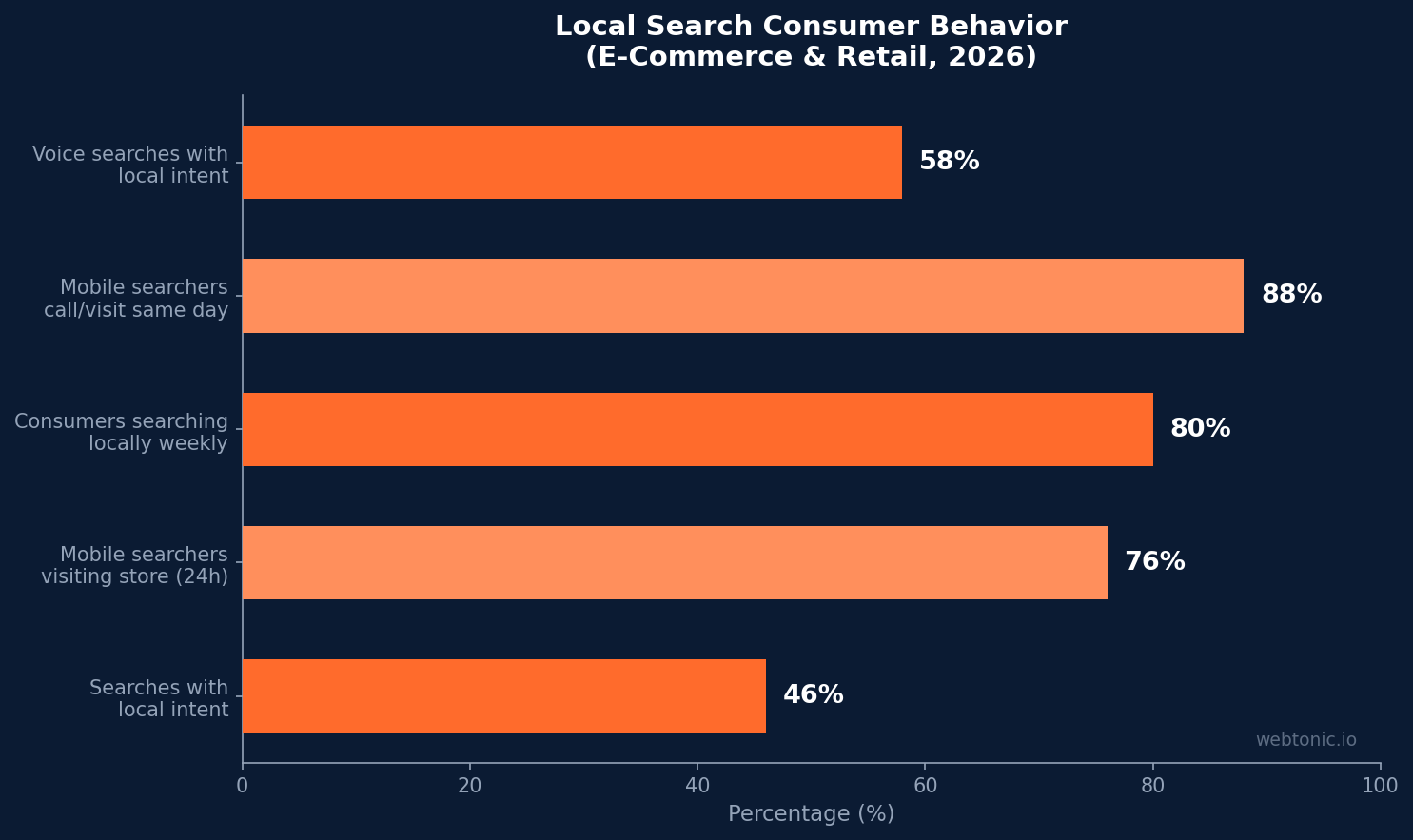
The RankLocalToday 2026 report puts the "near me" volume in perspective: approximately 800 million "near me" searches happen in the US every single month. For ecommerce retailers with physical locations, each of these searches represents a potential customer actively looking to buy — the highest-intent traffic source available.
Local Pack and Google Maps Statistics
The Google Local Pack (the three-listing map box that appears in local search results) captures a disproportionate share of clicks. Authority Specialist's analysis of 34 retail stores shows that the local pack captures click share comparable to or exceeding the combined standard organic results below it.
- Retail stores with fully built-out location pages and consistent citations appear in the local pack at roughly 2× the rate of stores relying on GBP alone (Authority Specialist)
- Organic search drives 31–49% of website traffic for local retail stores, with local search being the primary channel for foot traffic
- Direction clicks rose 9.5% year-over-year — double the prior year's growth — even as total retail views declined 5.3% (Rio SEO 2026 Local Search Report)
- Google Maps views barely moved (+0.5%) while phone clicks fell 9.6% and website clicks dropped 5.9%, suggesting consumers increasingly navigate directly to stores via Maps rather than calling or visiting websites first

For ecommerce brands operating physical stores, this shift has a concrete implication: optimizing for Maps visibility (accurate pins, complete business information, fresh photos) matters more than driving website clicks from local search. The average local consumer is using Google Maps as a navigation tool, not a research tool — they have already decided to visit.
Review Statistics and Their Impact on Local Rankings
Reviews are the third-largest ranking factor for the local pack — and the most controllable one. SOCi's research found that businesses see a near 3% lift in GBP conversions for every 10 new reviews, making review solicitation a direct revenue activity rather than administrative overhead.
| Review Metric | Impact | Source |
|---|---|---|
| Review signals (ranking weight) | 15–17% of local pack | Moz |
| GBP conversion lift per 10 new reviews | ~3% | SOCi |
| Consumers reading reviews before purchase | 93% | BrightLocal, 2026 |
| Review response rate → ranking boost | 15–25% higher at 90%+ response rate | HI Agency |
| Consumers frustrated by fake reviews | 31% | BrightLocal, 2026 |
The review landscape has a trust problem: 31% of consumers report frustration with fake reviews (BrightLocal LCRS 2026). For legitimate ecommerce businesses, this is actually an advantage — authentic, detailed reviews from real customers create a trust signal that competitors using fake reviews cannot replicate. Platform detection algorithms are also improving, meaning fake reviews carry increasing risk of GBP suspension.
Voice Search and Local SEO
Voice search is quietly reshaping local SEO. The statistics paint a clear picture:
- 58% of voice searches have local intent — "near me" or location-based queries (BrightLocal)
- Voice searches have grown 35% year-over-year since 2023 (Google)
- 31% of all Google searches are now voice queries (Digital Applied)
- GBP profiles with FAQ content rank 23% more often in voice results (BrightLocal / SEJ)
- 40.7% of voice search answers come from featured snippets (Digital Applied)
- Voice queries average 9 words, compared to 3–4 words for typed searches (Digital Applied)
For ecommerce and retail businesses, voice search optimization means structuring GBP content around conversational questions — "Where can I buy [product] near me?" and "What stores are open now near [location]?" — while also building FAQ sections on location pages that match natural language patterns. As AI-powered search assistants like Gemini become the default interface for local queries, businesses with structured data and comprehensive GBP profiles will dominate voice results.
Multi-Location E-Commerce SEO Benchmarks
Authority Specialist's 2026 analysis of 35 multi-location retail chains provides critical benchmarks for ecommerce brands operating multiple stores. The data shows clear patterns in how multi-location retail brands perform versus single-location stores:
| Metric | Single Location | Multi-Location (10+) |
|---|---|---|
| Local pack appearance rate | 18–25% | 35–50% |
| Organic traffic share | 31–38% | 40–49% |
| Citation consistency rate | 72% | 58% |
| Average review count per location | 45–80 | 120–350 |
| GBP completeness score | 65% | 78% |
The biggest challenge for multi-location ecommerce brands is citation consistency — the accuracy of business name, address, and phone number across directories and data aggregators. While multi-location brands appear in the local pack at nearly twice the rate of single-location stores, their lower citation consistency (58% vs. 72%) creates a drag on rankings. Brands that invest in citation management tools and directory management platforms will close this gap and unlock additional visibility in nearby results.
Platform differences also affect local SEO performance. Shopify, WooCommerce, and Magento each handle crawlability, structured data, and location pages differently. Ecommerce brands running on Shopify report easier GBP integration due to native store locator SEO apps, while Magento stores typically require more custom development work for multi-location optimization. Regardless of platform, the data consistently shows that dedicated location pages with unique, locally relevant content outperform generic store locator pages by a significant margin in local search rankings.
Local SEO Services Market and Investment Data
The global SEO services market reached $88 billion in 2026, with local SEO representing a growing share as more businesses recognize its direct revenue impact (Affinco). For retail ecommerce brands, the investment case is straightforward:
- Local SEO requires 2–5 new referring domains per month — far fewer than national ecommerce SEO (10–25) but with higher conversion rates due to purchase intent
- Organic search drives 31–49% of retail traffic for stores with strong local presence (Authority Specialist)
- 88% of mobile local searchers visit or call a store within a day, making local SEO the highest-intent channel after branded paid search
- Direction clicks grew 9.5% in 2026, the fastest-growing GBP interaction metric, indicating consumers are using local search as a navigation tool, not just a research tool
Related reading
- E-Commerce Technical SEO Statistics (2026): Core Web Vitals, Speed & Schema Data
- Enterprise SEO vs Traditional SEO: E Commerce Enterprise SEO Statistics
- What SEO Strategists Should Budget for International E-Commerce Data
- Local SEO Services services at Web Tonic
FAQ
What percentage of Google searches have local intent?
46% of all Google searches carry local intent — nearly half of everything searched on Google is someone looking for something near them. This includes "near me" searches, which have grown 900% in two years and now total approximately 800 million queries per month in the US alone.
How important is Google Business Profile for e-commerce?
Critical. Complete GBP profiles earn 7× more clicks and 70% more in-store visits than incomplete profiles (Google, 2026). GBP Maps views grew 61% year-over-year, and businesses that respond to 90%+ of reviews rank 15–25% higher in the local pack. For ecommerce brands with physical locations, GBP is the single most impactful SEO investment.
How do reviews affect local search rankings?
Review signals account for 15–17% of local pack ranking weight (Moz), making them the third-largest factor after GBP signals and on-page optimization. SOCi found a near 3% lift in GBP conversions for every 10 new reviews. The response rate matters too — locations responding to 90%+ of reviews rank significantly higher than those with lower response rates.
What is the impact of voice search on local SEO?
58% of voice searches have local intent, and voice queries have grown 35% year-over-year since 2023. GBP profiles with FAQ content rank 23% more often in voice results. Since 40.7% of voice answers come from featured snippets, structuring your content around conversational questions is a high-leverage tactic for local visibility.
How much traffic does organic search drive for retail stores?
Organic search drives 31–49% of website traffic for local retail stores (Authority Specialist, 34-store sample). When combined with the fact that 76% of mobile users who conduct a local search visit a physical location within 24 hours, local SEO becomes the highest-intent traffic source available for retailers with brick-and-mortar locations.
Sources
Affinco — Local SEO Statistics 2026
Searchlab — Google Business Profile Statistics 2026
RankLocalToday — Local SEO Statistics 2026
Authority Specialist — Retail Store SEO Benchmarks 2026
Rio SEO — 2026 Local Search Report
QuickSEO — Local SEO in 2026: 46% of Searches Have Local Intent
BrightLocal — Local Consumer Review Survey 2026
Digital Applied — Voice Search Statistics 2026


