



Table of contents
Key Takeaways
- Fertility clinic Meta Ads achieve a 1.72% CTR and 2.8× ROAS on Facebook and Instagram combined, per Benchmarketing 2026 industry benchmarks.
- Video testimonials from real patients are the highest-performing creative format for IVF clinics, outperforming static imagery during the 3–12 month patient consideration window (Tandem Medical Marketing).
- A single video awareness campaign reached 187,000+ people and drove 2,100+ conversions with CTR 11× above industry benchmark for a reproductive health nonprofit (MtoM Consulting, 2026).
- Landing page conversion rate for fertility clinics averages 6.2%, with top-quartile pages reaching 2–3× the median — the single highest-leverage CPA reduction lever (Benchmarketing).
- Before/after gallery lead magnets converted at 32% to consultation bookings for a med spa using compliant funnel architecture, versus account restrictions for direct before/after ads (Practice Growth Co).
- Google Ads CPA for fertility clinics averages $112.00 with a 5.28% CTR and 6.8% conversion rate on search campaigns (Benchmarketing).
- IVF patient acquisition costs range from $150–$600 per lead depending on treatment type, justified by per-patient lifetime value of $40,000–$80,000 (Tandem Medical Marketing).
Fertility Clinic Advertising Benchmarks at a Glance
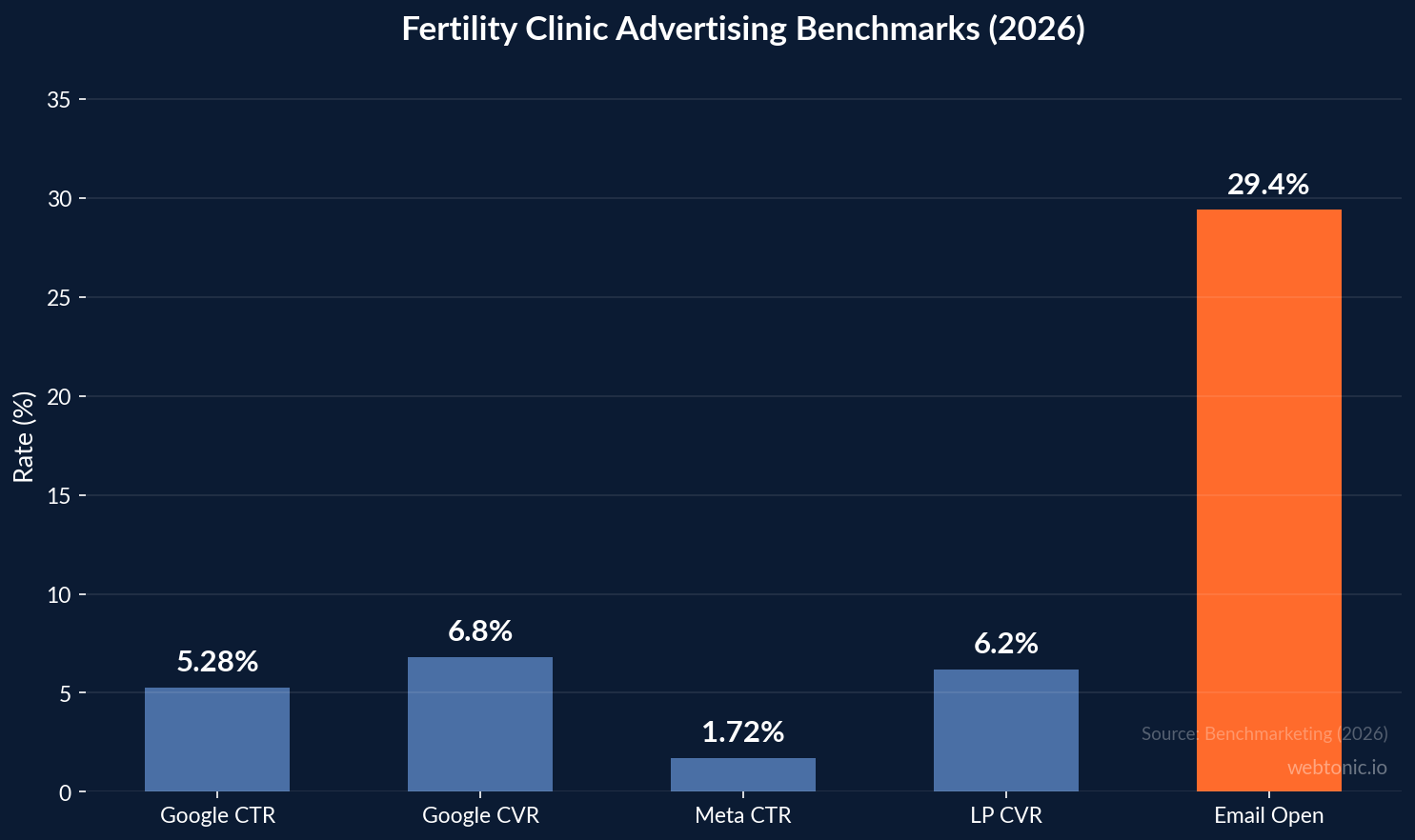
Fertility and IVF marketing operates in a unique advertising environment where emotional sensitivity, regulatory scrutiny, and high patient lifetime value converge. According to Benchmarketing (2026), fertility clinic advertising benchmarks across major channels show strong performance relative to healthcare averages, driven by the high-intent, research-intensive nature of IVF patients.
Fertility Clinic Advertising Benchmarks by Channel (2026)
| Channel | Metric | Benchmark | Context |
|---|---|---|---|
| Google Ads – Search | CTR | 5.28% | Search intent campaigns |
| Google Ads – Search | CPA | $112.00 | Form fill / contact submission |
| Google Ads – Search | CVR | 6.8% | Form fill / contact submission |
| Google Ads – Search | CPC | $9.84 | Average cost per click |
| Meta Ads | CTR | 1.72% | Facebook + Instagram combined |
| Meta Ads | ROAS | 2.8× | 7-day click attribution |
| Email Marketing | Open Rate | 29.4% | Industry average open rate |
| Landing Pages | CVR | 6.2% | Form fill / contact submission |
Video Creative Performance in Fertility Marketing
Video creative dominates high-performing fertility ad campaigns because IVF patients make decisions based on emotional trust built over months, not impulse clicks. Tandem Medical Marketing (2026) identifies video testimonials from real patients as the highest-performing creative format, noting that Meta reaches fertility patients during the 3–12 month consideration window — before they ever search for a specific clinic.
The MtoM Consulting Repro46 case study (2026) provides campaign-level evidence of video creative performance in the reproductive health space. A story-driven video campaign produced across multiple formats — full version (1:30), 30-second cut, and 10–15 second bumper edits — delivered exceptional results across Meta and Google/YouTube:
- 187,000+ unique people reached across Oklahoma
- 35,000+ total clicks from paid media
- 2,100+ conversions (social follows + email subscriptions)
- CTR 11× above industry benchmark
- Reach increased 10% between reporting periods as targeting and creative rotation were optimized
The campaign's messaging framework tested three creative angles simultaneously: personal/narrative ("Magon's Story: 600 Miles for Medical Care"), rights/advocacy, and safety-first framing. Text overlays reinforced key moments for muted mobile viewing — critical given that the majority of Meta video is consumed on mute. The campaign split across Meta (primary engagement and clicks) and Google/YouTube (completed views and cost-efficient reach).
Healthcare Ad Creative Compliance and Strategy
Fertility ad creative operates under three constraints that make it harder than any other healthcare advertising specialty, according to Practice Growth Co (2026):
- Platform policy restrictions — Meta prohibits creative that implies dramatic physical transformation, suggests a "before" state is shameful, or makes specific outcome claims. Automated enforcement is inconsistent: what gets approved one week may get flagged the next with identical creative.
- HIPAA and patient privacy — Featuring real patient results requires documented authorization more rigorous than most clinics realize. Even indirect identifiers (a recognizable feature, a named testimonial without proper release) create legal exposure.
- Low-intent audience — Unlike Google search ads, Meta audiences are in a passive state. The creative must stop the scroll, establish relevance, and motivate action from someone who was not thinking about fertility treatment a moment ago.
The Practice Growth Co case study illustrates the compliance challenge clearly. Two med spas ran Meta Ads with identical before/after photos. The first used direct before/after comparisons in ads — the account received policy restrictions within two weeks, degrading performance across all campaigns. The second used a single outcome image in the ad paired with a landing page gallery behind a lead form. The result: 47 gallery requests in the first month, with a 32% consultation booking rate from that lead pool. Same photos, compliant execution, dramatically better outcome.
Creative Format Performance Hierarchy
The evidence across multiple fertility marketing sources reveals a consistent creative performance hierarchy for IVF and reproductive health advertising.
Fertility Ad Creative Format Performance Ranking
| Format | Best Use Case | Key Metric | Compliance Risk |
|---|---|---|---|
| Patient Video Testimonial | Top-of-funnel awareness | 11× CTR benchmark | Low (with proper release) |
| Physician Portrait + Statement | Trust building, authority | Strong consultation CVR | Very low |
| Single Outcome Image | Aesthetic specialties | 32% consult booking rate | Low (no side-by-side) |
| Gallery Lead Magnet Funnel | Before/after proof | 47 requests/month | Very low (gated) |
| Direct Before/After in Ad | Not recommended | Account restriction risk | High |
Patient Acquisition Cost Economics
IVF advertising economics differ fundamentally from other healthcare specialties because of the extraordinary patient lifetime value. A single IVF cycle in the US costs $15,000–$25,000 including medications, according to Tandem Medical Marketing. Many patients undergo 2–3 cycles. Add frozen embryo transfers, PGT-A testing, egg freezing, and donor egg programs, and per-patient revenue can reach $40,000–$80,000 over the treatment journey.
That lifetime value justifies marketing CPLs of $150–$600 per lead depending on treatment type — numbers that would be unjustifiable in almost any other medical specialty. Google Ads search campaigns for IVF-specific keywords typically run $150–$350 CPL for treatment campaigns (40–50% of budget), while condition-based campaigns (PCOS, endometriosis, low AMH) and insurance/cost campaigns run lower CPL but target earlier-stage patients.
The competitive landscape intensifies the pressure on ad creative quality. IVF patients now compare against PE-backed fertility networks (Kindbody, CCRM, Shady Grove/US Fertility), hospital-affiliated programs with institutional budgets, and increasingly international clinics offering the same treatments at 30–70% lower cost. The creative differentiator for individual clinics is specificity: specific success rate transparency, specific physician credentials, and specific patient population expertise that generic competitors cannot match.

Creative Testing Framework for Fertility Clinics
Effective ad creative testing in the fertility space requires a consultation-booking-rate evaluation metric, not cost per lead. Practice Growth Co (2026) emphasizes that a creative variant that costs more per lead but produces a higher consultation rate is the better performer — a principle that applies uniquely to high-LTV specialties like IVF.
The recommended three-phase testing framework for fertility ad creative:
- Phase 1: Hook Testing — Test 3–5 opening hooks (first 3 seconds of video, first line of copy) with identical body content. Evaluate on thumb-stop rate and video hold rate, not clicks. Timeline: 7–10 days per round.
- Phase 2: Format Testing — Test winning hooks across formats (single image, carousel, video testimonial, physician portrait). Evaluate on consultation booking rate from landing page. Timeline: 14–21 days.
- Phase 3: Angle Testing — The MtoM case study tested personal/narrative, rights/advocacy, and safety-first messaging simultaneously. Test 2–3 messaging angles with the winning hook+format combination. Evaluate on downstream patient quality.
Platform-Specific Creative Strategies
Each advertising platform requires different creative adaptation for fertility clinics, though the core messaging should remain consistent across channels.
Platform Creative Requirements for Fertility Clinics
| Platform | Primary Creative Format | Budget Allocation | Key Creative Requirement |
|---|---|---|---|
| Google Search | RSAs with success rates | 40–50% | Lead with physician credentials + free consultation |
| Meta (FB + IG) | Video testimonials, single image | 25–30% | Emotional resonance, text overlays for muted viewing |
| YouTube | Skippable in-stream (1:30 + 30s) | 10–15% | Completed views, cost-efficient reach |
| Display/Retargeting | 10–15s bumper edits | 5–10% | Frequency-building, brand recall |
Best Practices for Fertility Ad Creative
- Lead with patient stories, not clinical language — Video testimonials outperform all other formats because IVF patients make decisions based on emotional trust built over 3–12 months of research.
- Use a gallery lead magnet instead of direct before/after ads — Gate compelling proof behind a contact form on a landing page. This approach generated 47 requests/month with 32% booking conversion versus account restrictions for direct ads.
- Evaluate creative on consultation booking rate, not CPL — A higher-CPL creative that converts more leads into consultations produces better ROI in a $40K–$80K LTV specialty.
- Produce multiple video lengths from one shoot — Full narrative (1:30), condensed high-impact (30s), and bumper (10–15s) cuts maximize platform performance from a single production investment.
- Add text overlays for muted viewing — The majority of Meta video is consumed on mute. Overlays reinforcing key emotional moments are critical for mobile-first placements.
- Test messaging angles systematically — Personal/narrative, clinical authority, and outcome transparency angles each resonate differently with fertility patient segments.
- Ensure HIPAA-compliant patient releases — Documentation requirements for featuring real patients are more rigorous than most clinics realize. Verify release coverage before launching creative.
- Target the consideration window, not just intent — Meta reaches patients during the 3–12 month research phase before they search. Allocate 25–30% of budget to awareness creative that builds trust before the clinic selection phase.
UK Regulatory Landscape for Fertility Advertising
Fertility clinics advertising in regulated markets face additional creative constraints. The UK Advertising Standards Authority (ASA) has specifically targeted misleading claims in paid ads for fertility clinics, issuing enforcement reports on success rate misrepresentation and unsubstantiated treatment claims. Clinics must ensure that all outcome claims in ad creative are substantiated, clearly contextualized, and not misleading — a standard that applies equally to social media ads, Google search ads, and display campaigns. The ASA's targeted monitoring has proven effective in improving compliance across the fertility sector.
Related reading
- Fertility & IVF Video Marketing Statistics (2026 Benchmarks)
- Fintech Ad Creative Stats 2026
- Fitness Ad Creative Statistics: UGC, Video & Testing Benchmarks (2026)
- Branding services at Web Tonic
Frequently Asked Questions
What is the average cost per lead for fertility clinic advertising?
Fertility clinic advertising CPL ranges from $150–$600 depending on treatment type and advertising channel. Google Ads search campaigns for IVF-specific keywords typically run $150–$350 CPL, while the industry median CPA on Google Ads is $112.00. These costs are justified by per-patient lifetime values of $40,000–$80,000 over the treatment journey, making fertility one of the highest-LTV medical specialties for advertising.
What ad creative works best for IVF clinics?
Video testimonials from real patients are the highest-performing creative format for fertility clinics. A reproductive health video campaign achieved CTR 11× above industry benchmark and reached 187,000+ people. For Meta Ads specifically, the recommended approach is single outcome images paired with gallery lead magnets on landing pages — this approach generated 47 gallery requests/month with a 32% consultation booking rate, while direct before/after ads risk account restrictions.
What is the average CTR for fertility clinic Meta Ads?
Fertility clinic Meta Ads (Facebook + Instagram combined) average 1.72% CTR with a 2.8× ROAS on 7-day click attribution, according to Benchmarketing's 2026 industry benchmarks. Google Ads search campaigns achieve a higher 5.28% CTR due to active patient intent. Branded campaigns typically reach 2–3× the median CTR.
How should fertility clinics test ad creative?
Use a three-phase testing framework: Phase 1 tests 3–5 opening hooks on thumb-stop rate (7–10 days), Phase 2 tests winning hooks across formats evaluated on consultation booking rate (14–21 days), and Phase 3 tests 2–3 messaging angles on downstream patient quality. The critical rule is to evaluate on consultation booking rate, not cost per lead — a higher-CPL variant that converts more consultations is the better performer in high-LTV specialties.
Are before/after photos allowed in fertility clinic ads?
Direct before/after comparisons in Meta Ads carry high compliance risk and can trigger account restrictions. The recommended approach is a compliant gallery funnel: use a single compelling outcome image in the ad creative, then gate the full before/after gallery behind a lead form on a landing page. One practice using this approach generated 47 gallery requests in the first month with 32% consultation booking rate, while a competitor using direct before/after ads received account restrictions within two weeks.
Sources
benchmarketing.org — Fertility Clinics Marketing Benchmarks 2026
tandemmedicalmarketing.com — IVF Marketing 2026 Playbook
tandemmedicalmarketing.com — Fertility & IVF Marketing
practicegrowthco.com — Healthcare Meta Ads Creative
mtomconsulting.com — Repro46 Case Study
asa.org.uk — Enforcement Report: Fertility Clinic Ads
charlieoscar.com — Flo Health Creative Case Study


