Table of contents
Family law landing pages convert at a median 6.3%, per Unbounce's 2025 Conversion Benchmark Report - almost exactly the all-industry baseline. The bigger swing sits downstream of the click: Clio's 2024 Legal Trends Report found 48% of law firms unreachable by phone at all. This report prices both halves of that funnel.
Key Takeaways
- Family law landing pages convert at a median 6.3%, per Unbounce 2025.
- Disability law matches it at 6.3%; immigration trails at 5.6%.
- Paid search converts at 8.3% against 4.8% for paid social.
- Email traffic converts at just 2.7% for legal landing pages.
- Google traffic converts at 8.6% versus 2.8% for Bing.
- Instagram converts at roughly 13% against 7.3% for Facebook.
- Mobile drives 88% of legal landing page traffic.
- Mobile converts at 21% against 15.9% for desktop.
- College-level copy converts best in legal, at 7.2%.
- Attorneys & Legal Services average $9.87 CPC on Google Ads in 2026.
- Average cost per lead for the category is $131.63.
- 48% of law firms were unreachable by phone when Clio's shoppers called.
- Only 40% of calls that connected were answered live.
- Just 33% of email inquiries received a reply.
- Attorneys & Legal Services CTR is 5.87% on Google search ads.
- ABA Model Rule 7.1 bars unjustified result expectations in any test copy.
- Florida requires paid legal ad review 20 days before use.
The benchmark: 6.3%, and what sits on either side of it
Unbounce's 2025 Conversion Benchmark Report, built from over 57 million tracked conversions, puts the median family law landing page conversion rate at 6.3% - within a rounding error of the 6.6% baseline across every industry it tracks. Disability law sits at the identical 6.3%, while immigration law trails at 5.6%, the softest of the three practice areas Unbounce breaks out inside legal.
The median understates the spread. Unbounce's own range data for adjacent legal subcategories runs from under 1% to over 20% for the same practice area, which means a page sitting exactly on 6.3% has already told you almost nothing about whether it is well built.
| Practice area (legal, Unbounce 2025) | Median conversion rate | vs. all-industry baseline |
|---|---|---|
| All industries | 6.6% | Baseline |
| Family law | 6.3% | -0.3 pts |
| Disability law | 6.3% | -0.3 pts |
| Immigration law | 5.6% | -1.0 pts |
Traffic source decides more than page design
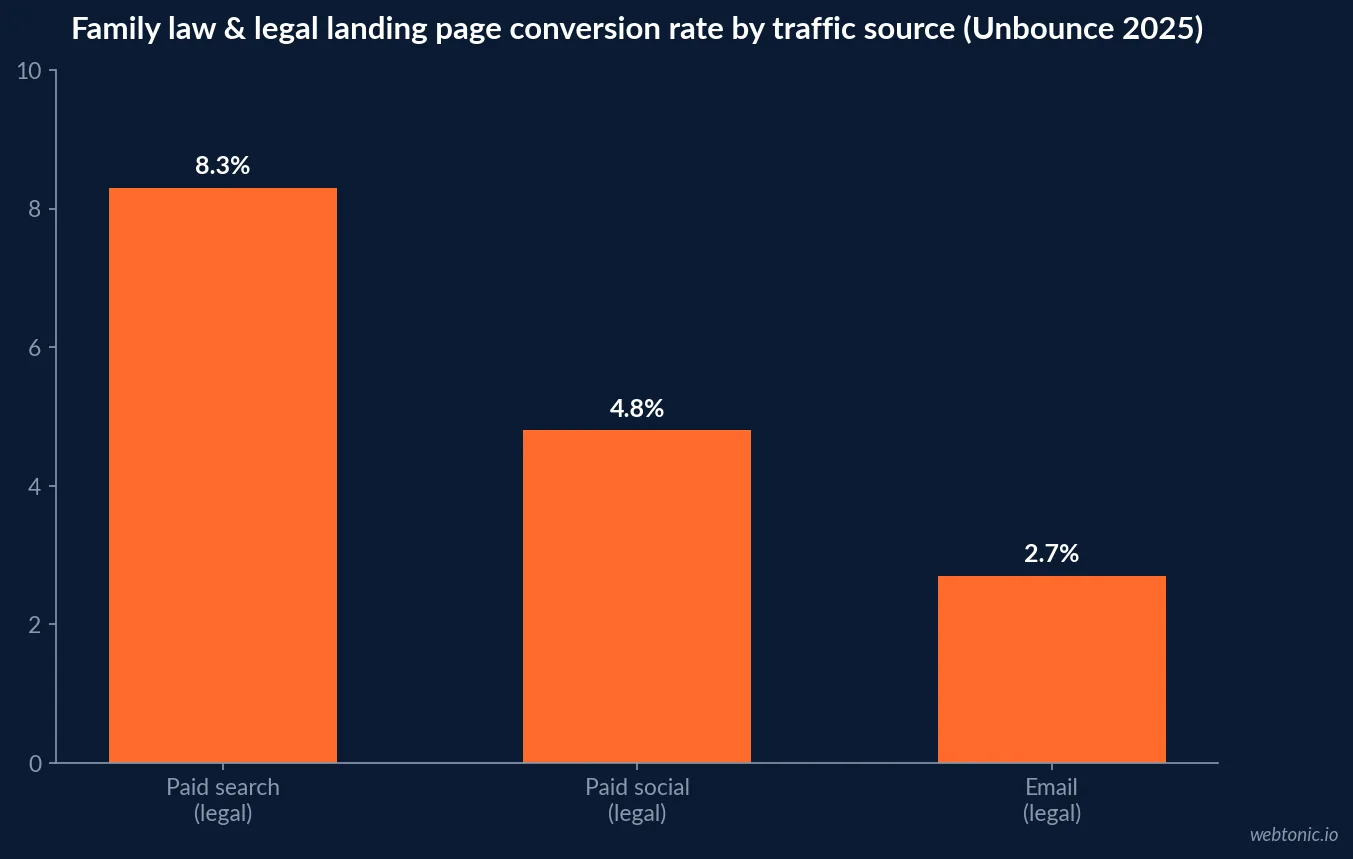
Across the legal vertical, paid search converts at a median 8.3%, nearly double paid social's 4.8% and more than three times email's 2.7%, per Unbounce. Inside paid search, Google converts at 8.6% against Bing's 2.8% - a 3x gap. Inside paid social, Instagram converts at roughly 13%, almost double Facebook's 7.3%.
That ranking should set the media mix before it sets the page copy: a family law firm splitting spend evenly across search and social is routing half its budget toward the channel converting at half the rate.
| Traffic source | Median conversion rate | Source |
|---|---|---|
| Paid search (legal) | 8.3% | Unbounce 2025 |
| Google search specifically | 8.6% | Unbounce 2025 |
| Bing search specifically | 2.8% | Unbounce 2025 |
| Instagram (paid social) | ~13% | Unbounce 2025 |
| Facebook (paid social) | 7.3% | Unbounce 2025 |
| 2.7% | Unbounce 2025 |
Mobile is the majority - and the higher-converting device
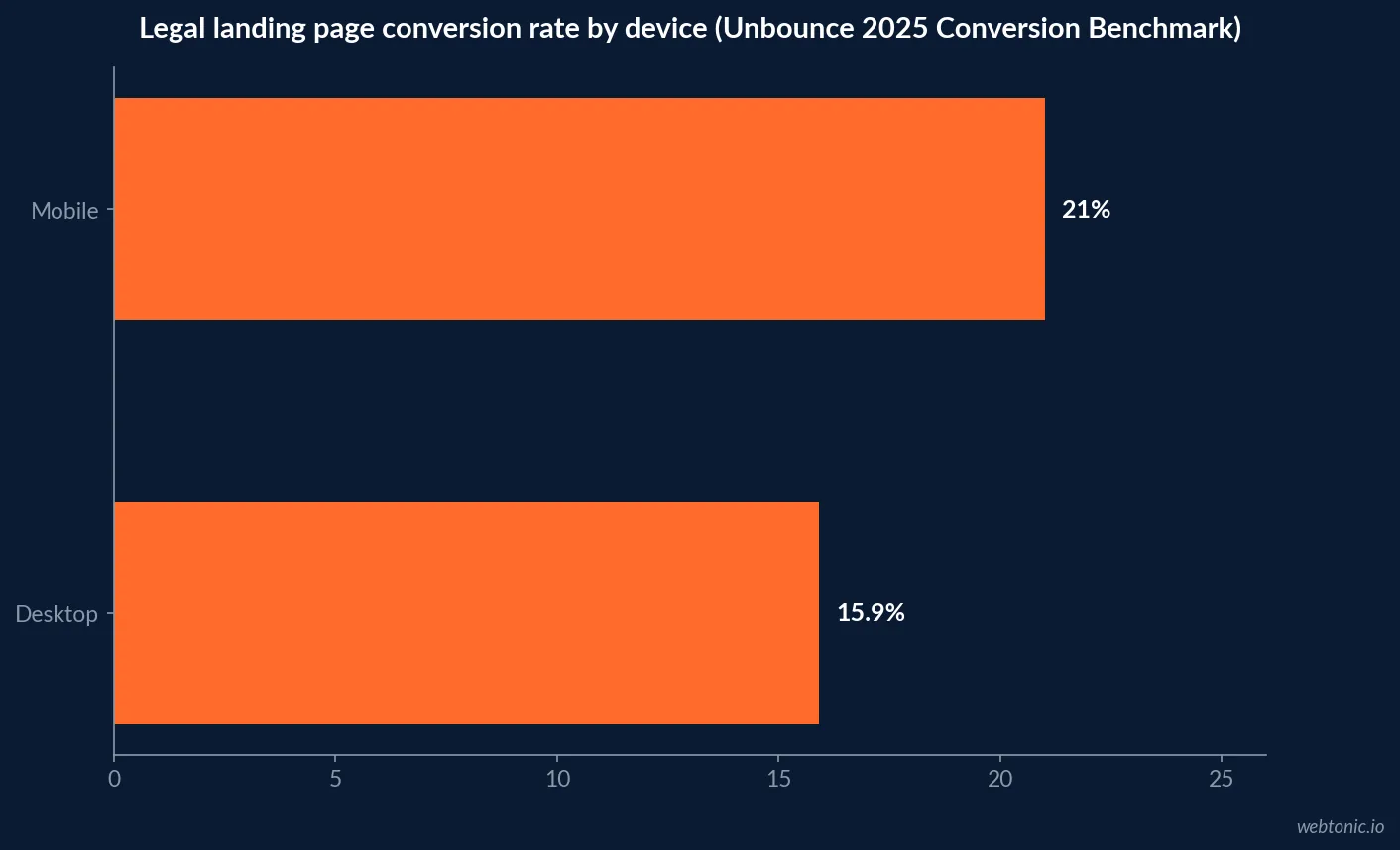
88% of legal landing page visits arrive on mobile, and mobile traffic converts 32% better than desktop in this vertical - 21% against 15.9%, per Unbounce. That is the reverse of most industries in the same report, where desktop still edges out mobile. For a family law intake page, that argues for testing click-to-call placement above the fold and trimming form fields before touching anything else.
Unbounce also found that higher word counts and college-reading-level copy convert best in legal, at 7.2% - a pattern that runs against the shorter-is-better assumption that holds in most consumer verticals, and one worth testing directly rather than importing from another industry's playbook.
| Device / copy variable (legal vertical) | Conversion rate | Note |
|---|---|---|
| Mobile traffic share | 88% of visits | Unbounce 2025 |
| Mobile conversion rate | 21% | Unbounce 2025 |
| Desktop conversion rate | 15.9% | Unbounce 2025 |
| College-reading-level copy | 7.2% | Highest-converting reading level tested |
What the click costs before it even reaches the landing page
WordStream's 2026 Google Ads Benchmarks, built from over 13,000 search campaigns, puts Attorneys & Legal Services at a $9.87 average CPC - the single highest of the 23 industries tracked - against a 5.87% CTR and a 5.55% conversion rate. That combination produces an average cost per lead of $131.63, nearly double the $70.11 all-industry average. Every percentage point of conversion rate a family law landing page adds is worth more here than in almost any other category simply because the traffic underneath it is so expensive.
| Metric (Attorneys & Legal Services, Google Ads 2026) | Figure | All-industry average |
|---|---|---|
| Click-through rate | 5.87% | 6.66% |
| Cost per click | $9.87 | $5.26 |
| Conversion rate | 5.55% | 7.52% |
| Cost per lead | $131.63 | $70.11 |
The leak the conversion rate doesn't show
A landing page conversion is a form submission or a call started, not a retained client. Clio's 2024 Legal Trends Report sent researchers to contact 500 real US law firms by phone and email. The results: 48% of firms were unreachable by phone even after leaving a message, and among calls that did connect, only 40% were answered live. Email fared worse - just 33% of inquiries got a response at all.
Run those numbers against the $131.63 average cost per lead above and the arithmetic gets uncomfortable fast: a firm converting a landing page at 6.3% but failing to answer half its calls is paying full price for leads it structurally cannot close.
| Intake step (Clio 2024, n=500 firms) | Result | Cost implication |
|---|---|---|
| Firms reached by phone at all | 52% | 48% of ad spend hits a dead line |
| Calls answered live | 40% | Majority go to voicemail or nothing |
| Email inquiries answered | 33% | Two in three leads get silence |
| Rate quoted on the call | 41% | Most callers still leave without pricing |
What a state bar will and won't let you test
ABA Model Rule 7.1 bars any communication "likely to create an unjustified expectation about results the lawyer can achieve" - which rules out headline variants built around a settlement figure or a stated win rate as a CRO test, since the comment to the rule specifically flags client endorsements about outcomes as a risk area. The Florida Bar's advertising guidelines go further for paid placements: ads targeted to consumers with no prior relationship to the firm must be filed with the bar's Ethics and Advertising Department, and video or audio creative needs a physical copy mailed in before a firm gets a compliance opinion back.
Practically, that means the safest CRO levers on a family law page are structural - form length, click-to-call placement, proof format, reading level - rather than claims-based. Save the claims testing for what the rule actually allows: process description, responsiveness commitments, and credentials that are "objectively verifiable."
| Rule / requirement | Issuing body | What it rules out for CRO testing |
|---|---|---|
| Model Rule 7.1 - false or misleading communication | American Bar Association | Headlines implying a predictable outcome or result |
| Model Rule 7.1 comment on endorsements | American Bar Association | Client testimonials referencing case outcomes without a disclaimer |
| Advertising filing requirement | The Florida Bar | Untested paid creative running before review |
| Comparison substantiation requirement | ABA Model Rule 7.1(c) | Unverified "best" or "top-rated" comparison claims |
The trust signal that has to exist before the click
Landing page copy can only do so much if the firm has no visible reputation behind it. BrightLocal's 2025 Local Consumer Review Survey found that consumer use of Google for reading local business reviews climbed back to 87% after dipping to 81% the year before, and that 40% of consumers check at least two review sites before deciding, while 27% now stop at just one - a share that is rising, not falling. For a family law landing page, that means the review count and star rating sitting next to the CTA button are doing measurable pre-click work that no amount of headline testing replaces.
Cross-referencing that with WordStream and LocaliQ's shared 2026 dataset - both publish the same underlying campaign analysis - confirms the category's expense is consistent across sources: LocaliQ's 2026 Search Advertising Benchmarks independently report the same $9.87 average CPC for Attorneys & Legal Services that WordStream publishes, which is the kind of cross-source agreement worth double-checking before a firm commits a media plan to a single vendor's number.
| Trust signal (BrightLocal 2025) | Figure |
|---|---|
| Consumers using Google to read local reviews | 87% |
| Consumers checking at least two review sites | 40% |
| Consumers stopping at just one review site | 27% |
| US adults using local news outlets for reviews | 48% |
Where the CRO budget should go first
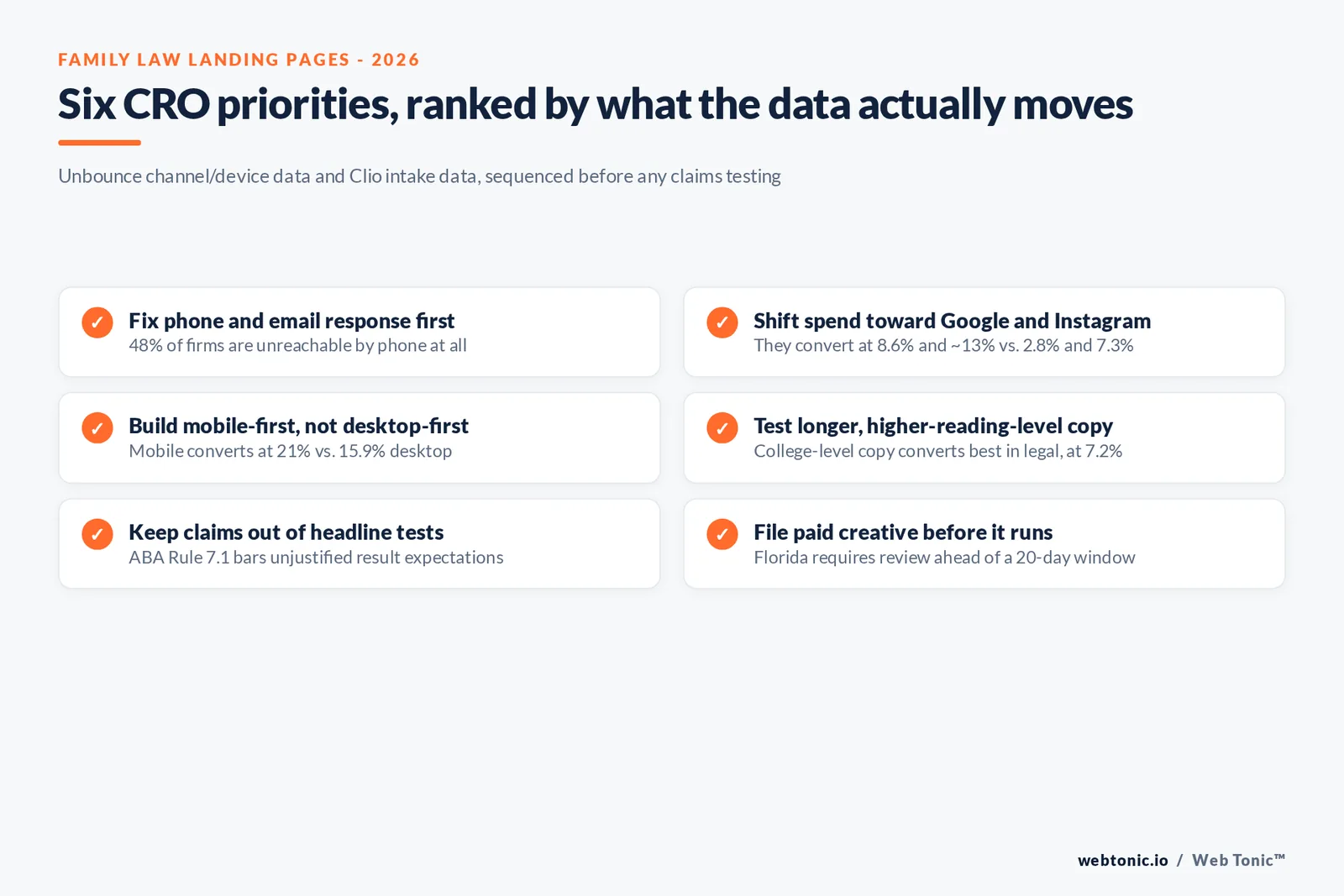
Given the data above, the highest-leverage sequence for a family law landing page is: fix phone and email responsiveness before touching the page (the $131.63 cost per lead is wasted on an unanswered call), then shift spend toward Google search and Instagram inside the existing budget rather than adding new channels, then test mobile-first form length and click-to-call placement, and only then run headline and proof-format tests that stay inside Rule 7.1. Our growth marketing practice works inside the family law industry vertical and builds that sequencing into the media plan before a single ad runs, and our conversion rate benchmarks across other verticals show the same intake-before-page pattern outside legal.
Firms that want the two halves of this funnel - the ad account and the intake process - priced and rebuilt together can talk to us directly, and firms curious what a comparable cost-per-lead problem looks like industry-wide can check our cost-per-lead breakdown by industry.
Frequently Asked Questions
What is a good conversion rate for a family law landing page?
Unbounce's 2025 Conversion Benchmark Report puts the median at 6.3%, just under the 6.6% all-industry baseline and identical to disability law. Immigration law trails slightly at 5.6%. Treat 6.3% as the floor to beat, not the target - the same report shows most pages in this bracket ranging from roughly 0.8% to over 20%, so a page sitting at the median still has real room to move.
Which traffic source converts best for a family law page?
Paid search, by a wide margin. Unbounce reports a median conversion rate of 8.3% for paid search traffic against 4.8% for paid social and 2.7% for email, and Google-sourced traffic converts at 8.6% versus 2.8% for Bing. On paid social specifically, Instagram traffic converts at roughly 13% against 7.3% for Facebook - almost double.
Does mobile or desktop convert better for family law leads?
Mobile, which is unusual. Unbounce's cross-industry data shows mobile driving 88% of legal landing page traffic and converting 32% better than desktop - roughly 21% against 15.9%. Most other industries see the reverse, which argues for testing mobile-first form length and click-to-call placement before anything else on a family law page.
Why does the conversion rate not equal the number of retained clients?
Because the funnel leaks hardest right after the form fires. Clio's 2024 Legal Trends Report sent shoppers to 500 real firms and found 48% unreachable by phone at all, only 40% picked up when called, and just 33% of email inquiries got a reply. A page converting at 8% but landing in a firm with no intake process is worth less than a page converting at 5% with same-day callbacks.
What can a family law firm not say in a CRO test?
Anything a landing page test would normally reach for first: a stated win rate, a dollar figure from a past settlement, or a client testimonial about outcome without a disclaimer. ABA Model Rule 7.1 bars communications likely to create an unjustified result expectation, and several state bars - Florida among them - require paid ad creative to be filed for review before it runs. Test headline framing and proof format, not case results.
Sources
Unbounce - Legal industry conversion rate benchmarks, 2025
WordStream - Google Ads Benchmarks 2026
Clio - 2024 Legal Trends Report
American Bar Association - Model Rule 7.1
The Florida Bar - Advertising Guidelines for Networking Sites
BrightLocal - Local Consumer Review Survey 2025
LocaliQ - Search Advertising Benchmarks for Every Industry, 2026