Table of contents
Exact match keywords use square brackets — [running sneakers] — and tell Google Ads to enter the auction only on lookups that carry the same sense or demand as the wording. It is the narrowest of the three matching options, and the only one whose reported numbers describe a single buying goal rather than a cloud of related ones.
Key Takeaways
- Google defines the strict type as covering requests with the same sense or same purpose, not identical characters, so a bracketed row can serve on reordered, pluralised and paraphrased lookups.
- Quality Score is built from historical impressions on lookups that exactly match the wording, which is why changing the match type never moves the score.
- Broader options nest: a quote-matched keyword catches everything its bracketed twin catches, plus more, so duplicating the same words across all three types adds no reach.
- Average cost per click on Google Search sits near $2.69 against $0.63 on the Display Network, so tight lookup control matters most where clicks are expensive.
- Google handles roughly 91% of the world's search traffic, and its API exposes only 4 keyword match enums — UNSPECIFIED, UNKNOWN, EXACT, PHRASE, BROAD — which is the entire vocabulary you have to work with.
- The search terms report only shows requests with enough activity to protect user privacy, so a bracketed keyword with tiny volume can look like it never served.
- A 6-pass audit on a 90-day window is enough to prove whether bracket targeting is earning its place in an account or just duplicating rows.
What the brackets actually promise
The promise is the job to be done, not spelling. Google's keyword matching options documentation states that ads "may show on searches that have the same meaning or same intent as the keyword," and that of the three options the bracketed one "gives you the most steering over who views your ad, but reaches fewer searches." Rule 1 — brackets buy steering, not literal string matching.
The Google Ads API enum reference confirms how small the vocabulary is: the keyword field accepts EXACT, PHRASE and BROAD plus two placeholder values. Rule 2 — there are only 3 usable settings, so every structural idea you have has to be expressed with those three plus exclusions.
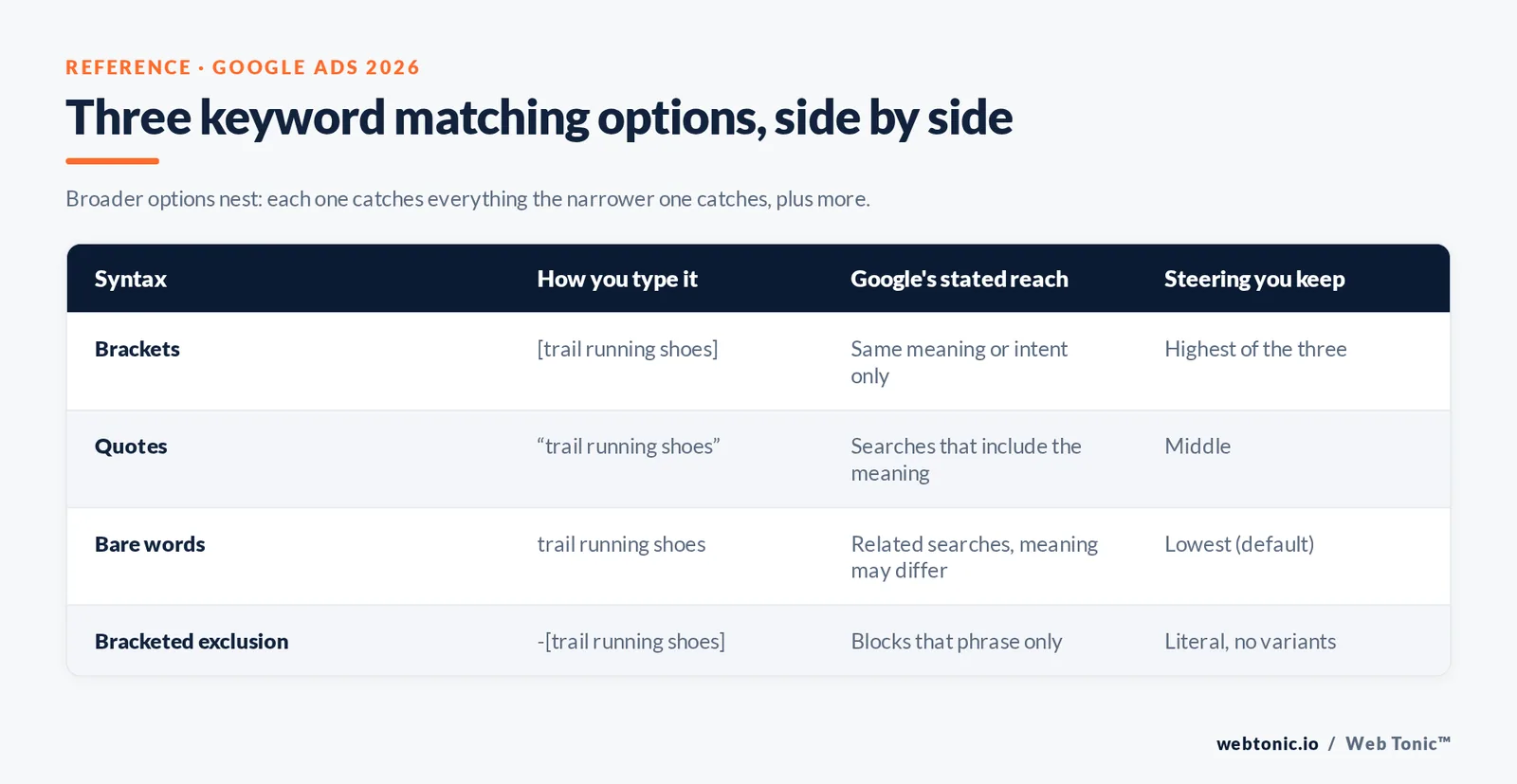
| Syntax | How you type it | Google's stated reach | Steering you keep |
|---|---|---|---|
| Brackets | [trail running sneakers] | Same sense or purpose only | Highest of the three |
| Quotes | "trail running sneakers" | Searches that include the wording | Middle |
| Bare words | trail running shoes | Related lookups, meaning may differ | Lowest, default setting |
| Bracketed exclusion | -[trail running shoes] | Blocks that wording only | Literal, no close variants |
The nesting rule most bracket lists ignore
Google is explicit that broader options are supersets: a quoted keyword "will match all the searches as the same keyword in an exact match," and a bare keyword matches everything the quoted and bracketed versions do "plus additional related searches." Fact 1 — adding the same 3 words in all 3 formats buys 0 extra reach. Google also confirms that near-identical entries such as red car and car red are treated as duplicates, and only the one with the higher Ad Rank is used.
That single sentence kills the old single-keyword-ad-group habit. If you want per-goal control now, the lever is 1 tightly scoped ad group per offer plus exclusions — not three copies of the same words. Our own breakdown of keyword match types walks the full comparison; this page is about the narrow end of it.
| What you add | Extra searches gained | Extra bids in the auction | Verdict |
|---|---|---|---|
| Bracketed twin of a quoted keyword | None | Still 1 bid per auction | Redundant row |
| Quoted twin of a bare term | None | Still 1 bid per auction | Redundant row |
| Reversed word order | None, treated as duplicate | 1 bid, higher Ad Rank wins | Redundant row |
| Genuinely different goal | Yes | 1 bid | Keep, in its own ad group |
| Bracketed exclusion of a bad lookup | Removes waste | No bid on that lookup | Keep |
Why brackets change reporting, not Quality Score
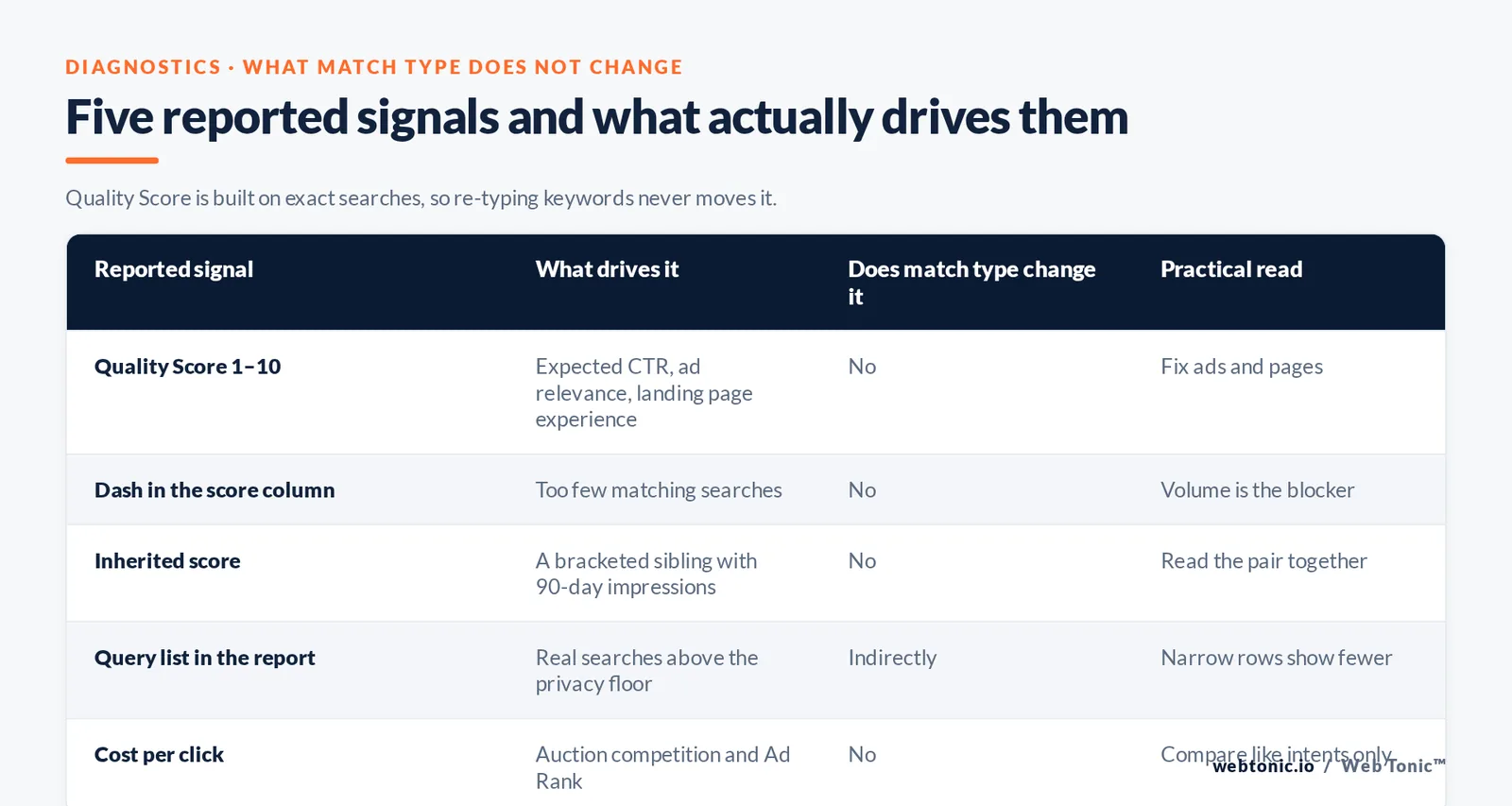
This is the most misunderstood part of the setting, and it comes straight from Google's Quality Score documentation: the score is "based on historical impressions for exact searches of your keyword, therefore changing keyword match types will not impact Quality Score." Fact 2 — a 1-to-10 diagnostic that ignores your match type cannot be fixed by re-typing keywords.
Two further details are worth pinning to the wall. A bare-words term can inherit a score from a bracketed sibling in the same ad group that has impressions in the last 90 days. And a dash in the column means there were not enough matching searches to compute anything — a volume problem, not a quality problem.
| Reported signal | What drives it | Does match type change it | Practical read |
|---|---|---|---|
| Quality Score 1–10 | Expected CTR, ad relevance, landing page experience | No | Fix ads and pages, not brackets |
| Dash in the score column | Too few matching searches | No | Volume is the blocker |
| Inherited score on a bare term | A bracketed sibling with 90-day impressions | No | Read the pair together |
| Query list in the report | Real searches above the privacy floor | Yes, indirectly | Narrow rows show fewer lookups |
| Cost per click | Auction competition and Ad Rank | No, but demand mix shifts it | Compare like intents only |
What tight targeting costs, and when the premium is worth it
Narrow rows tend to sit on the most commercial requests, which are also the priciest. Semrush's Google Ads cost analysis puts the cross-industry average at $2.69 per click on Search and $0.63 on Display. Limit 1 — at $2.69 a click, 100 wasted clicks is $269, which is the entire argument for request control in one line.
| Scenario | Monthly budget | Why narrow targeting pays | Why it may not |
|---|---|---|---|
| Brand defence | Any | Protects a known-purpose lookup at low cost | Little upside beyond your own name |
| High-cost professional services | $3,000+ | One $40 click on the wrong demand hurts | Volume can be too thin to learn |
| Small local budget | Under $1,500 | Spend lands only on core demand | Automated bidding gets little data |
| Ecommerce long tail | $5,000+ | Isolates proven converting lookups | Misses new demand shapes |
| New market test | $1,000–$3,000 | Clean read on one goal | Slow signal, few conversions |
| Broad awareness push | Any | Rarely the right tool | Reach is the goal, not control |
Google's own guidance is that automated bidding works best where the request set is wide, because auction-time signals are what the models trade on. That does not rule out narrow rows — it means you should expect them to be a control mechanism, with looser rows doing discovery beside them. Our growth marketing team usually runs the two side by side in one campaign rather than in separate ones.
Reading the search terms report like an auditor
The lookup terms report is the only honest record of what your brackets caught. Google notes it lists terms "that have received a significant number of clicks", withholding low-volume queries for privacy. Trap 1 — missing rows are a privacy floor, not proof of 0 impressions. Segment by keyword, not by campaign, or you will attribute a loose row's waste to a narrow one.
| Column to add | What a bad number looks like | Likely cause | First fix |
|---|---|---|---|
| Search term vs keyword | Term differs in meaning | Close variant drift | Add a bracketed exclusion |
| Added / excluded status | Blank on high spenders | Nobody is triaging the report | Weekly 20-minute pass |
| Match type of the served row | Loose row winning the lookup | Higher Ad Rank on the loose twin | Restructure the ad group |
| Conversions by term | Spend with 0 conversions over 90 days | Wrong demand | Exclude and rewrite the ad |
| Impressions on the narrow row | Zero for 30 days | Below the volume floor | Merge into a wider row |
Once excluded, remember exclusions behave literally: a blocked row stops that wording, not its variants. The full mechanics are in our guide to negative keywords in Google Ads.
Five worked examples on one phrase
Take [women's trail running shoes]. Fact 3 — 5 real query shapes land differently against the same 4 words, and the pattern generalises to any bracketed row you own.
| Query a shopper types | Likely to match | Why | What to do about it |
|---|---|---|---|
| Phrase: womens trail running shoes | Yes | Missing apostrophe, same intent | Nothing |
| Phrase: trail running shoes for women | Yes | Reordered, same meaning | Nothing |
| Phrase: womens trail running shoe | Yes | Singular form, same intent | Nothing |
| Phrase: best trail running shoes womens 2026 | Likely | Same intent, more specific | Watch conversion rate |
| Phrase: womens trail running shoes repair | Possible | Adjacent intent, different job | Exclude the service word |
How narrow rows behave next to automated campaign types
Routing matters when a fully automated campaign shares the account. Google's Performance Max documentation describes it as complementing keyword-based Search campaigns across YouTube, Display, Discover, Gmail, Maps and Search — 6 surfaces from 1 campaign. In practice your bracketed rows are the part of the account you still steer by hand, which is why they should hold your highest-intent and most defensible queries.
| Account element | Who controls the query | Where brackets fit | Reporting you get |
|---|---|---|---|
| Search campaign, narrow rows | You | Core commercial intents | Keyword-level detail |
| Search campaign, loose rows | Google plus your exclusions | Discovery | Query report |
| Fully automated retail campaign | No keyword control | Asset and category insights | |
| Exclusion lists | You | Guardrails around both | Blocked-term audit |
| Brand terms | You | Almost always bracketed | Clean brand read |
If you are stitching this reporting together across campaign types, that is a data intelligence job more than a keyword job — the account view and the campaign view rarely agree until someone reconciles them.
The same setting on the other paid-lookup platforms
Google carries roughly 91% of global search traffic according to StatCounter, but the remaining share still converts, and each platform words the setting differently. Microsoft publishes its own advertiser guidance on the Microsoft Advertising blog, and Apple Search Ads applies the concept to App Store searches instead of web queries. Practitioner coverage of ongoing changes is tracked in the Search Engine Land Google Ads library.
| Platform | Where the query happens | Notes on strict targeting | Import risk |
|---|---|---|---|
| Google Ads | Web and partner search | Same meaning or intent | Baseline |
| Microsoft Advertising | Bing and partners | Familiar bracket syntax, different volumes | Imported bids can be too high |
| Apple Search Ads | App Store searches | Applies to app discovery, not web pages | Very different intent mix |
| Retail media search | Marketplace product search | Query set is narrower and buy-ready | Feed quality dominates |
| Site search on your own store | Your search box | No auction, pure merchandising | None |
A 6-pass audit for bracketed keywords
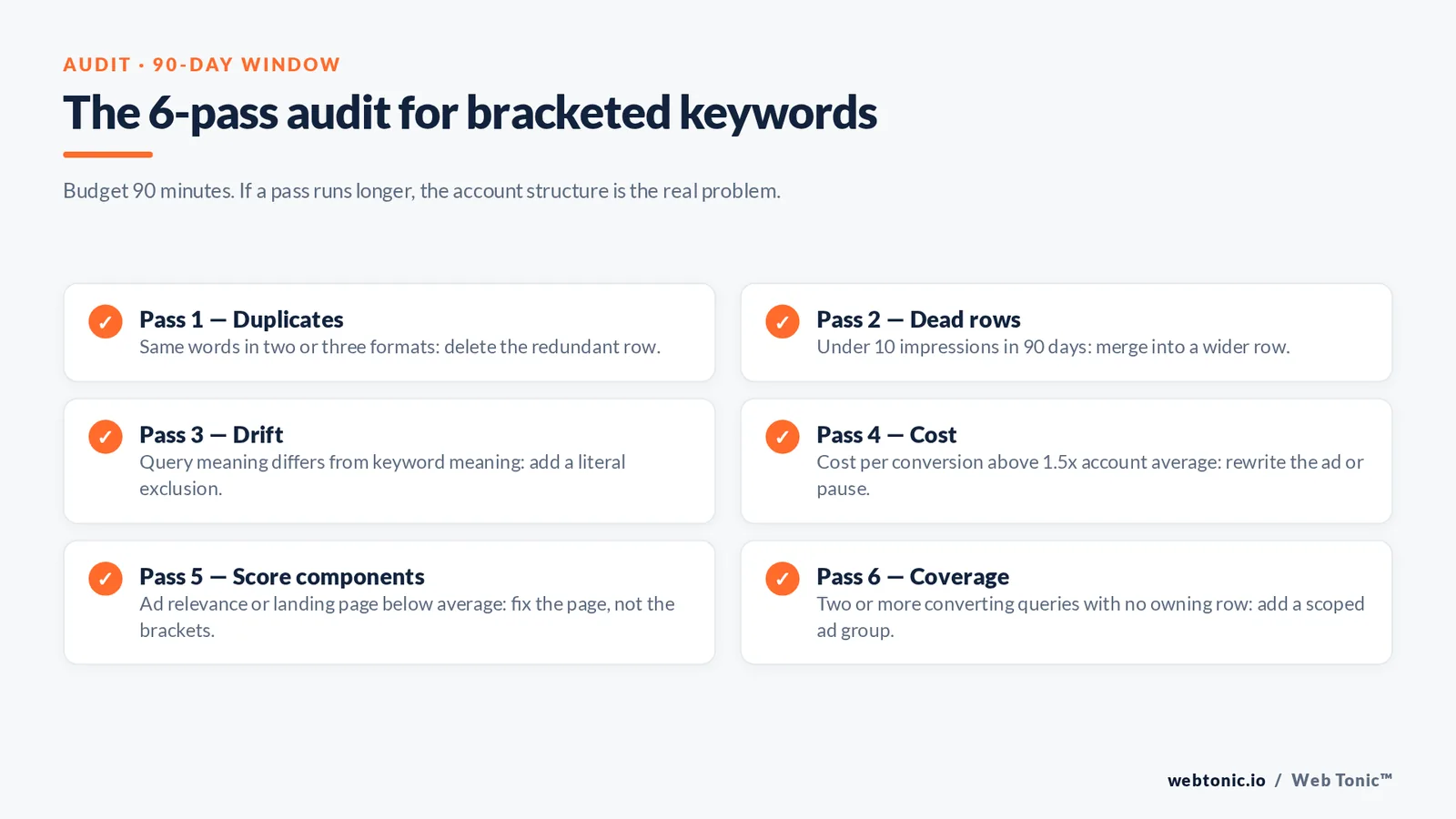
Run this on a rolling 90-day window, which is also the lookback Google uses for score components. Limit 2 — budget 90 minutes; if a pass takes longer, the account structure is the real problem.
| Pass | What you check | Threshold to act | Action |
|---|---|---|---|
| Pass 1 — duplicates | Same words in 2 or 3 formats | Any duplicate pair | Delete the redundant row |
| Pass 2 — dead rows | Impressions over 90 days | Under 10 impressions | Merge into a wider row |
| Pass 3 — drift | Query meaning vs keyword meaning | Any mismatch with spend | Add a literal exclusion |
| Pass 4 — cost | Cost per conversion vs account average | Over 1.5x average | Rewrite ad or pause |
| Pass 5 — score components | Ad relevance and landing page columns | Any below average | Fix the page, not the brackets |
| Pass 6 — coverage | Converting queries with no owning row | 2 or more per month | Add a scoped ad group |
For teams running the audit for the first time, expect the first two passes to clear the most rows — accounts inherited from an agency commonly carry 3 formats of the same 40 keywords. If you want a second pair of eyes, talk to us before you delete anything.
Four traps that make tight targeting look worse than it is
Trap 2 — comparing a narrow row's cost per click against a loose row's is a category error: the narrow row is sitting on buy-now demand, so a higher price per click is expected and often correct.
| Trap | What it looks like in the account | Why it misleads | Correction |
|---|---|---|---|
| Trap 3 — brackets as a bid strategy | Narrow rows bid 3x higher by habit | Auction pricing does the work | Let the strategy set bids |
| Trap 4 — one row per shopper phrase | Hundreds of near-identical rows | Duplicates share 1 bid anyway | Consolidate by intent |
| Trap 5 — no exclusion layer | Drift blamed on the match type | Exclusions are the real control | Build a weekly exclusion routine |
| Trap 6 — brand and generic in one ad group | Brand conversions flatter the generics | Blended numbers hide waste | Split brand out |
The API side of this is worth knowing if you report at scale: the Google Ads API exposes the match type as a field on the keyword resource, so a nightly pull can flag duplicate triplets automatically instead of a human scrolling the interface. Pairing that with a revenue view is exactly the workflow we describe in our guide to increasing online sales.

FAQ
Are exact match keywords more expensive than broad ones?
Per click, usually yes, but not because of the setting. Bracketed rows tend to hold the most commercial queries, and those auctions are the most contested. Semrush puts the cross-industry Search average near $2.69 per click; the mix of intent you are buying explains the gap far better than the syntax does.
Does switching a keyword to brackets improve Quality Score?
No. Google states plainly that the score is based on historical impressions for exact searches of the keyword, so changing the match type will not move it. Improve expected click-through rate, ad relevance and landing page experience instead.
Why is my bracketed keyword getting queries that are not identical?
Because the standard is meaning and intent, not characters. Reordered words, plurals, misspellings and implied phrasing all qualify. If a variant carries a different job to be done, block it with a literal exclusion rather than deleting the row.
Should I still build one ad group per keyword?
Rarely. Google treats near-duplicate entries as duplicates and uses only the highest Ad Rank version, and you get one bid per auction regardless. Group by intent and offer, then use exclusions for precision.
How many bracketed keywords should a small account run?
Fewer than most people expect. Start with the 10 to 30 queries you can prove convert, keep a looser discovery row beside them, and let the query report tell you which new intents deserve their own scoped ad group.
Sources
Google Ads Help — About keyword matching options; About Quality Score for Search campaigns; About the search terms report; About Performance Max campaigns. Google Ads API — KeywordMatchTypeEnum reference and API getting-started documentation. Semrush — Google Ads cost analysis. StatCounter Global Stats — search engine market share. Microsoft Advertising blog. Apple Search Ads. Search Engine Land — Google Ads library. All figures retrieved August 2026.