Table of contents
Yes - and the 2026 data makes the case more strongly than most other channels can. Litmus and Omnisend both put average email ROI at USD 36 to 42 per dollar spent, but the spread between that average and what leading programs achieve is where the real 2026 story sits.
Key Takeaways
- Average email ROI is USD 36-42 per dollar spent.
- Retail and e-commerce email ROI runs USD 45 per dollar.
- Travel, tourism and hospitality lead all industries at USD 53 per dollar.
- Omnisend's paid-plan merchants averaged USD 79 per dollar in 2025.
- The all-industry average open rate is 35.63%.
- The all-industry average click rate is 2.62%.
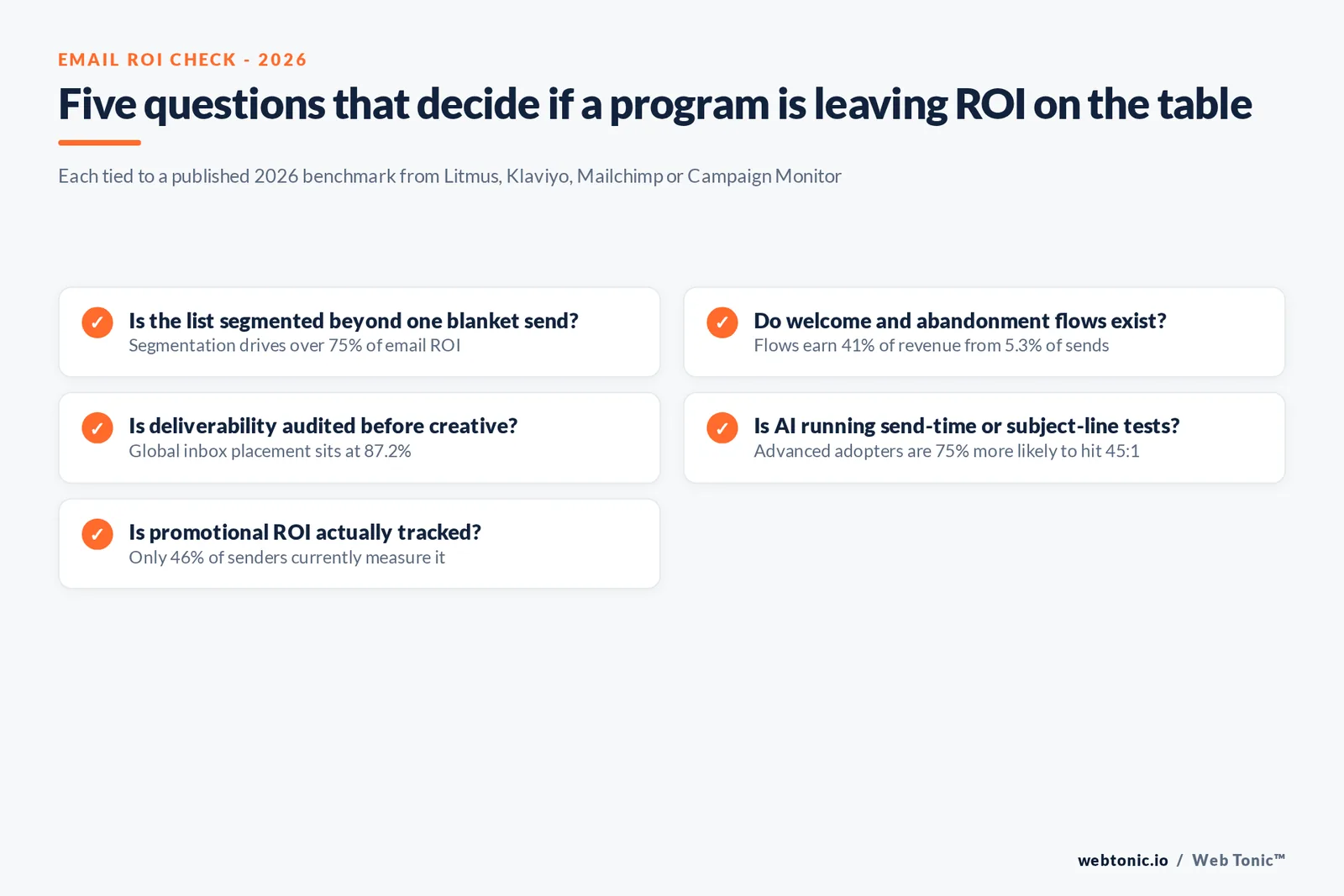
- Automated flows drive 41% of email revenue from 5.3% of sends.
- Flow revenue per recipient is roughly 18 times higher than campaigns.
- 48% of flow revenue comes from first-time buyers.
- Segmented campaigns capture more than 75% of all email ROI.
- Segmented campaigns can lift revenue by 760%.
- Segmented emails drive 30% more opens and 50% more clicks.
- Global average inbox placement was 87.2% in 2025.
- Advanced AI adopters are 75% more likely to hit 45:1 ROI.
- Only 12% of organizations have deep AI integration.
- Email touches 74-83% of marketers at every customer journey stage.
- Email is 39.3% of B2B marketers' channel mix and ranks second on ROI.
- Only 46% of senders even measure promotional email ROI.
The headline verdict: what email returns per dollar in 2026
Two independent 2026 sources land on nearly the same number. Litmus's State of Email 2026 report and Omnisend's 2026 ROI benchmark both put the industry average at USD 36 to 42 per dollar spent, a 3,600% to 4,200% return. Merchants on Omnisend's paid plans outperform that baseline, averaging USD 79 per dollar in 2025 - almost double the industry mean, driven by more automation and segmentation rather than a different audience.
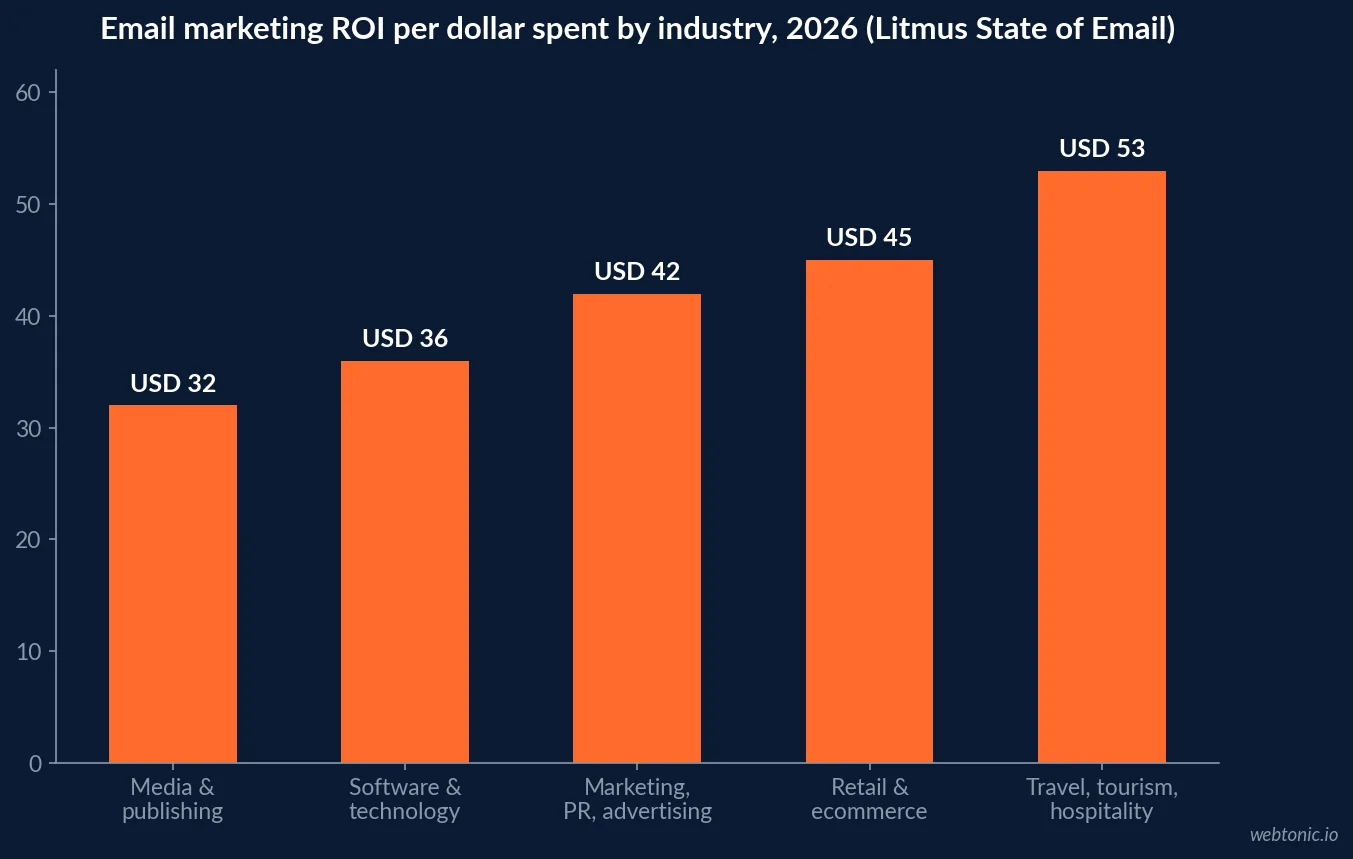
ROI varies meaningfully by sector. Litmus's industry breakdown, cited by Omnisend, puts travel, tourism and hospitality highest at USD 53 per dollar, followed by retail and ecommerce at USD 45, marketing and PR at USD 42, software and technology at USD 36, and media and publishing lowest at USD 32.
| Industry (2026) | Average ROI per USD spent | Source |
|---|---|---|
| Travel, tourism, hospitality | USD 53 | Litmus State of Email 2026 |
| Retail and ecommerce | USD 45 | Litmus State of Email 2026 |
| Marketing, PR, advertising | USD 42 | Litmus State of Email 2026 |
| Software and technology | USD 36 | Litmus State of Email 2026 |
| Media and publishing | USD 32 | Litmus State of Email 2026 |
| Omnisend paid-plan merchants, 2025 | USD 79 | Omnisend |
Open and click rates: the baseline most programs still measure against
Mailchimp's cross-industry benchmark data puts the all-users average unique open rate at 35.63% and click rate at 2.62%. Both numbers move sharply by vertical: non-profits lead on open rate at 40.04% and click rate at 3.27%, while e-commerce sits at the bottom on both, at 29.81% opens and 1.74% clicks - a gap that reflects transactional, high-frequency sending more than weak creative.
The comparison that matters for any single sender is against its own industry line, not the blended average, since a 30% open rate is underperforming for a non-profit but roughly on target for an e-commerce program.
| Industry | Avg. open rate | Avg. click rate | Unsubscribe rate | Source |
|---|---|---|---|---|
| Non-profits | 40.04% | 3.27% | 0.18% | Mailchimp |
| Education and training | 35.64% | 3.02% | 0.18% | Mailchimp |
| Business and finance | 31.35% | 2.78% | 0.15% | Mailchimp |
| Ecommerce | 29.81% | 1.74% | 0.19% | Mailchimp |
| All users, blended | 35.63% | 2.62% | 0.22% | Mailchimp |
Automation is where the revenue actually concentrates
Klaviyo's 2026 benchmark, drawn from over 183,000 customer accounts, finds automated flows generate nearly 41% of total email revenue from just 5.3% of sends, with average revenue per recipient roughly 18 times higher than standard campaigns. Flows also convert new customers more effectively: 48% of flow-driven revenue comes from first-time buyers, against only 16% for broadcast campaigns, which makes welcome, browse-abandonment and cart-recovery flows the highest-leverage builds in most programs.
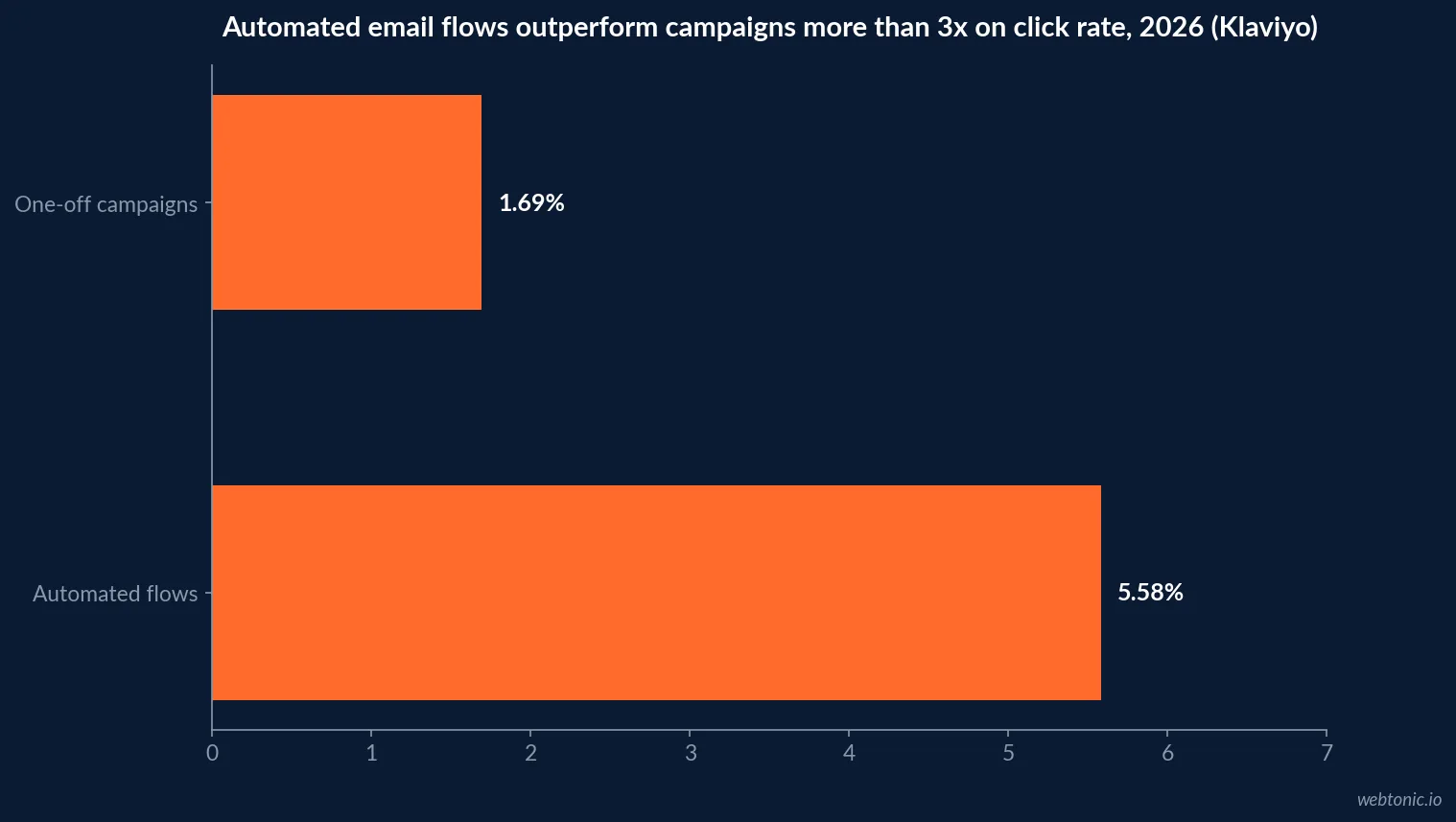
Engagement follows the same pattern - flows deliver over 3 times higher click rates (5.58% versus 1.69% for campaigns) and roughly 13 times higher placed order rates, evidence that timing and relevance outweigh raw send volume.
| Metric (2026) | Automated flows | One-off campaigns | Source |
|---|---|---|---|
| Share of total email revenue | ~41% | ~59% | Klaviyo |
| Share of total sends | 5.3% | 94.7% | Klaviyo |
| Click rate | 5.58% | 1.69% | Klaviyo |
| Share of revenue from first-time buyers | 48% | 16% | Klaviyo |
Segmentation is the single highest-leverage lever left
Campaign Monitor's data attributes more than 75% of all email ROI to segmented, targeted or triggered campaigns rather than blanket sends, and cites marketer-reported revenue lifts as high as 760% from segmentation. HubSpot's 2026 data adds a cleaner, apples-to-apples figure: segmented emails drive 30% more opens and 50% more clickthroughs than unsegmented sends to the same list.
The mechanism is straightforward - a segmented send matches content to a narrower, more relevant audience, so the same creative performs better without any change to subject line or design. It is also the cheapest of the levers on this page, since most email platforms already support list segmentation without an additional tool purchase.
| Segmentation impact (2026) | Figure | Source |
|---|---|---|
| Share of email ROI from segmented campaigns | >75% | Campaign Monitor |
| Revenue lift from segmentation, reported | up to 760% | Campaign Monitor / DMA |
| Open rate lift, segmented vs. unsegmented | +30% | HubSpot 2026 |
| Click-through lift, segmented vs. unsegmented | +50% | HubSpot 2026 |
| Personalized subject line open lift | +26% | Campaign Monitor |
Deliverability sets the ceiling before any of this can work
None of the above matters if the email never reaches the inbox. Validity's 2026 Email Deliverability Benchmark Report puts the global average inbox placement rate at 87.2% for 2025, a 3.7 percentage-point improvement year over year, with the average spam complaint rate down to 0.06% - well under the newly tightened 0.1% threshold major mailbox providers now expect. That improvement is a direct result of bulk-sender authentication requirements from Google, Yahoo and Microsoft rolled out over the past two years, not a change in subscriber behavior.
The practical read: a program with strong open and click benchmarks but weak deliverability is optimizing a number that a smaller, unmeasured audience actually sees. Deliverability audits belong before creative or segmentation work, not after.
| Deliverability metric, 2025-26 | Figure | Source |
|---|---|---|
| Global average inbox placement rate | 87.2% | Validity 2026 Benchmark Report |
| Year-over-year improvement | +3.7 pts | Validity 2026 Benchmark Report |
| Average spam complaint rate | 0.06% | Validity 2026 Benchmark Report |
| New spam complaint expectation ceiling | <0.1% | Validity 2026 Benchmark Report |
AI is widening the gap between leaders and the rest
Litmus's State of Email 2026 report, surveying over 500 marketing professionals across the US, UK, Australia and New Zealand, finds that advanced AI adopters are 75% more likely to achieve ROI above 45:1 than teams without deep AI integration. Yet the same report finds only 12% of organizations describe their AI maturity as fully integrated, with 17% reporting either a paused AI initiative or none at all - meaning the ROI gap documented above is available to most programs, but few have actually claimed it yet.
The DMA's 2026 Marketer Email Tracker frames why the opportunity is worth chasing: email already reaches 74-83% of marketers at every stage of the customer journey and accounts for roughly a fifth of marketing budgets, which 66% of marketers plan to increase further in 2026. AI adoption inside email is optimization of an already-dominant channel, not a bet on a new one.
Where email ranks against every other channel
HubSpot's State of Marketing 2026 report, based on over 1,500 marketers surveyed, ranks email marketing second among B2B channels at 39.3% adoption, behind only website/blog/SEO at 48.4% and ahead of organic social at 38.6%. On return specifically, email again ranks second by ROI at 23.6% of marketers naming it a top-three ROI channel, behind website/SEO at 30.2% and ahead of paid social at 23.3%.
The gap between adoption and measurement is the honest caveat here: a separate 2026 industry survey of over 1,200 email senders found only 46% actively track promotional email ROI and 43% track transactional ROI, meaning a large share of the programs reporting strong results are doing so on partial data.
| Channel ranking (B2B, 2026) | Adoption / ROI rank | Figure | Source |
|---|---|---|---|
| Website / blog / SEO | #1 adoption, #1 ROI | 48.4% adoption, 30.2% top-3 ROI | HubSpot 2026 |
| Email marketing | #2 adoption, #2 ROI | 39.3% adoption, 23.6% top-3 ROI | HubSpot 2026 |
| Organic social media | #3 adoption | 38.6% adoption | HubSpot 2026 |
| Paid social media | #3 ROI | 23.3% top-3 ROI | HubSpot 2026 |
How often should a program actually send
MailerLite's 2026 analysis of over 12 billion emails sent across more than 1.4 million campaigns finds that open rate stays fairly consistent for anything between once a month and twice a week, and only drops off meaningfully once sending moves to a daily cadence. In practice, 52% of businesses send at least weekly and 10.8% send daily, while 89% send at least monthly - the floor cadence below which list decay and disengagement accelerate.
The finding reframes a common internal debate: the fear of "sending too much" is generally overstated up to a few times a week, while sending too rarely is the more common way a program quietly loses the segmentation and automation gains documented above.
By share of businesses: 10.8% send daily, 52% send weekly or more often, 36.3% send one to three times a month, and 11.1% send less than monthly - a distribution MailerLite's data suggests is skewed toward under-sending rather than over-sending relative to the cadence that actually protects engagement.
The measurement gap costs money before the AI gap does
Before chasing the AI-driven ROI gap documented above, most programs have a more basic problem. A 2026 industry report analyzing over 400 billion emails processed through Sinch Mailgun's infrastructure alongside a 1,200-sender survey finds only 46% of senders track promotional email ROI and 43% track transactional ROI. Among the minority who do measure, the results are strong: 60% of senders tracking promotional ROI report returns above 10:1, and 13% report returns above 40:1 - matching the Litmus and Omnisend industry averages cited earlier.
The report's own caution is worth repeating: exceptionally high self-reported ROI can indicate underinvestment as much as excellence, since a program running on a shoestring budget will show a larger ratio even when absolute revenue is small. ROI per dollar and revenue in absolute terms need to be read together, not as substitutes for each other.
So, is it still worth it?
The 2026 data says yes without much ambiguity: a channel returning USD 36 to 42 per dollar, ranking second on both adoption and ROI among B2B marketers, with an improving deliverability baseline and a documented AI gap most competitors have not closed yet. The honest caveat is measurement, not performance - nearly half of senders are not tracking the number that would tell them whether they are closer to the USD 32 floor or the USD 79 ceiling documented above.
For teams weighing where the next marketing dollar goes, our growth marketing team builds the segmentation and automation layer this data points to, and our guide to what paid search costs is a useful reference for comparing acquisition channels against the ROI figures above. Talk to us if email revenue looks flat against these benchmarks.
Frequently Asked Questions
Is email marketing still worth it in 2026?
Yes, by a wide margin against other channels. Litmus's State of Email 2026 report and Omnisend's 2026 benchmark both put the industry average return at USD 36 to 42 for every dollar spent, and HubSpot's State of Marketing 2026 survey has marketers ranking email second only to website/SEO on both usage and ROI, ahead of every paid channel measured. The number that actually varies is not whether email works, but how much of that return a given program is capturing.
What is a good email open rate in 2026?
Mailchimp's cross-industry data puts the all-users average unique open rate at 35.63%, with non-profits highest at 40.04% and e-commerce lowest at 29.81% - open rate is heavily industry-dependent, so compare against your own vertical rather than the blended average. Click rate tells a tighter story: 2.62% across all users, with non-profits again leading at 3.27% and e-commerce at 1.74%.
How much more revenue do automated emails generate than one-off campaigns?
Substantially more per email sent. Klaviyo's 2026 benchmark, built from over 183,000 customer accounts, finds automated flows generate nearly 41% of total email revenue from just 5.3% of total sends, with revenue per recipient roughly 18 times higher than standard campaigns. Flows also convert new customers at a much higher rate: 48% of flow-driven revenue comes from first-time buyers, against 16% for campaigns.
Does segmentation actually change email performance?
By a wide margin. Campaign Monitor's data attributes more than 75% of all email ROI to segmented, targeted or triggered campaigns rather than one-size-fits-all sends, and cites marketer-reported revenue increases as high as 760% from segmented campaigns compared with unsegmented ones. HubSpot's 2026 data adds that segmented emails drive 30% more opens and 50% more clickthroughs than unsegmented sends - the single highest-leverage change most email programs can still make.
How is AI changing email marketing ROI in 2026?
It is widening the gap between leaders and everyone else. Litmus's State of Email 2026 report, based on over 500 marketing professionals surveyed, finds advanced AI adopters are 75% more likely to achieve ROI above 45:1, yet just 12% of organizations report that depth of AI integration. The DMA's 2026 Marketer Email Tracker adds that email already sits at every stage of the customer journey for 74-83% of marketers, so the AI opportunity is optimization within an already-embedded channel, not a new one.
Sources
Litmus - State of Email 2026 report
Omnisend - Email Marketing ROI: 2026 Benchmarks
Mailchimp - Email Marketing Benchmarks & Industry Statistics
Klaviyo - 2026 Email Marketing Benchmarks by Industry
Campaign Monitor - Why Segmentation Matters in Email Marketing
Validity - 2026 Email Deliverability Benchmark Report
HubSpot - The Top Marketing Channels of 2026, According to Marketers
DMA - Marketer Email Tracker 2026