Table of contents

Webflow powers approximately 493,000 active websites globally, with 831 education companies using the platform — representing one of the fastest-growing CMS adoption segments in the learning industry. As education and coaching businesses prioritize design quality, page speed, and conversion optimization, Webflow's visual development approach is displacing WordPress for institutions that need professional sites without developer bottlenecks. Here are the verified statistics on Webflow adoption, performance, and market position for education brands in 2026.
The shift toward no-code and visual development platforms in education is accelerating. As institutions face growing pressure to deliver mobile-first experiences, meet Core Web Vitals thresholds, and compete for organic search visibility against aggregators and AI-generated search results, the choice of CMS platform has become a strategic enrollment decision rather than a purely technical one. The data below covers Webflow's position in this landscape, its advantages for specific education verticals, and how it compares to alternative platforms on the metrics that matter most for student acquisition and coaching client conversion.
Key Takeaways
- 831 education companies currently use Webflow, making education one of the platform's top industry verticals by adoption volume (Web Radar).
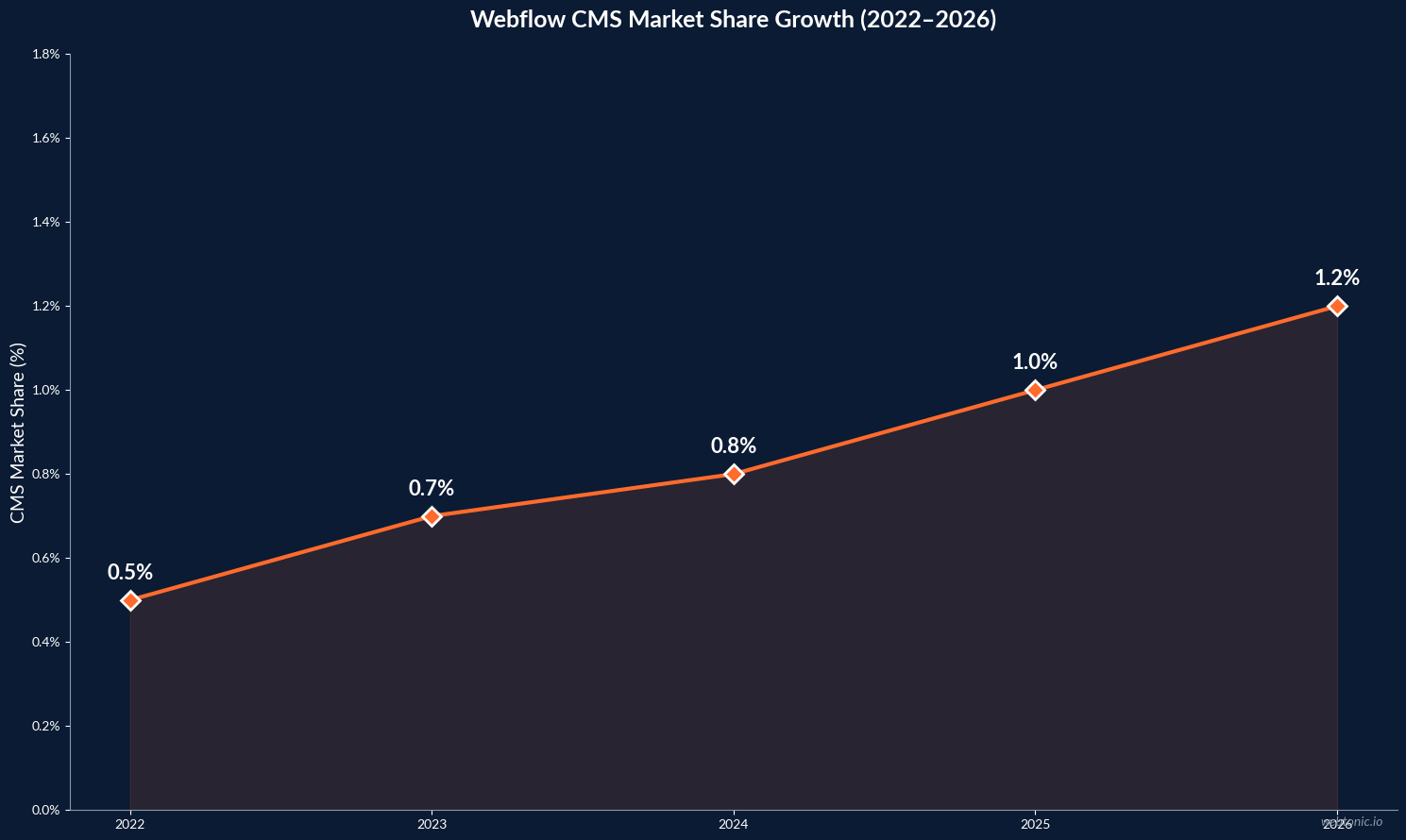
- Webflow powers 1.2% of all CMS-built websites, up from under 0.5% in 2022, representing a 140%+ growth trajectory over three years (Enricher.io).
- Webflow sites earned a 32% lift in conversion rate compared to WordPress in a three-year comparative study, generating approximately $58,000 more revenue over the period (Krishaweb).
- Only 48% of mobile websites pass all three Core Web Vitals as of 2025, making CMS performance a critical factor for education sites where 64%+ of traffic is mobile (CO Consulting).
- 493,000+ active Webflow sites are live globally, with the platform achieving 66% revenue growth in 2024 and continuing to expand into enterprise and education markets (Outside the Box).
- 87% of Gen Z feel unprepared for the workforce and evaluate education programs largely through digital presence, making website quality a direct enrollment factor (Modern Campus).
- Science and education represents 1.64% of Webflow's site distribution by vertical, the fourth-largest category after technology, business services, and finance (The Alien Design).
Webflow Market Share and Growth Statistics
Webflow has established itself as a mainstream CMS platform, moving well beyond its original niche among designers and startups. The platform now powers websites across virtually every industry, with education emerging as a significant adoption vertical.
| Metric | 2024 | 2026 | Change |
|---|---|---|---|
| Active Websites | ~400,000 | ~493,000 | +23% |
| CMS Market Share | 0.8% | 1.2% | +50% |
| Education Companies | ~600 | 831 | +38% |
| E-commerce Stores | ~15,100 | 15,694 | +4% |
| Revenue Growth (Annual) | 66% | Est. 40–50% | Maturing |
| US Adoption (Sites) | ~140,000 | 160,696 | +15% |
The United States leads Webflow adoption with 160,696 websites, followed by the United Kingdom (14,891) and Germany (14,510) (Popupsmart). Webflow's total user base is now estimated at 60,875 companies tracked across major analytics databases, representing approximately 2.06% of all monitored websites (Web Radar).
Why Education Brands Choose Webflow
The education sector has specific website requirements that make Webflow particularly attractive compared to WordPress or custom-built alternatives. Coaching businesses, universities, and online course providers benefit from Webflow's combination of design flexibility, built-in hosting, and CMS capabilities without the maintenance burden of traditional platforms.
- Design-first approach — education websites need to communicate credibility and professionalism. Webflow's visual editor allows performance-focused design teams to build custom layouts without compromising on brand quality or conversion optimization.
- No plugin dependency — WordPress education sites typically require 15–25 plugins for forms, SEO, security, caching, and LMS integration. Each plugin creates potential conflicts, security vulnerabilities, and performance degradation. Webflow bundles hosting, SSL, CDN, and CMS natively.
- Built-in CMS for programs and courses — Webflow's Collections feature allows education brands to create structured databases of programs, courses, faculty, and testimonials that update dynamically across the site.
- Faster time to launch — coaching businesses and online course providers report 40–60% faster site launches with Webflow compared to custom WordPress builds, since design and development happen simultaneously in a single interface.
- Webflow for Classroom program — Webflow actively targets the education sector with its classroom program, positioning itself as a gateway to building future users among students and educators (Pootlepress).
Website Performance: Webflow vs. WordPress for Education
Page speed and Core Web Vitals directly impact both user experience and search rankings — critical factors for education sites competing for organic visibility. The data shows significant performance differences between CMS platforms that education brands should consider before committing to a technology stack.
| Performance Metric | Webflow | WordPress | Industry Avg. |
|---|---|---|---|
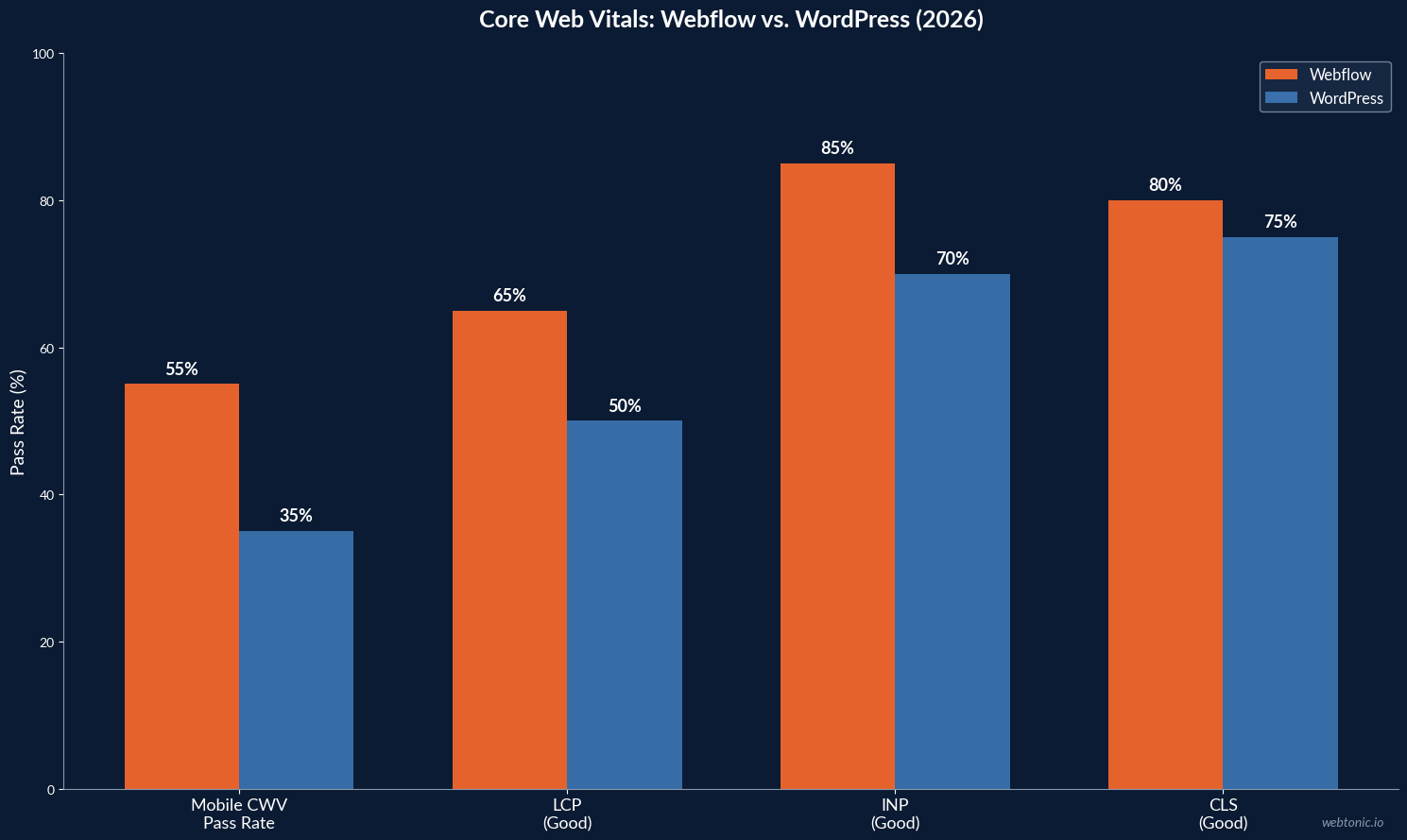
| Mobile CWV Pass Rate | ~55% | ~35% | 48% |
| LCP (Mobile, Good) | ~65% | ~50% | 62% |
| INP (Good) | ~85% | ~70% | 77% |
| CLS (Good) | ~80% | ~75% | 81% |
| Conversion Rate Lift | +32% | Baseline | — |
The 32% conversion rate lift observed with Webflow sites over a three-year period is attributed to better page speed, cleaner code output, and superior mobile responsiveness — not just design quality. Every 100ms improvement in LCP produces an estimated 8% conversion improvement for education and e-commerce sites (CO Consulting).
Webflow vs. Other Website Builders for Education
Education brands evaluating website platforms need to consider more than just cost. Design quality, scalability, SEO capabilities, and integration with enrollment systems all play roles in the decision. Webflow ranks among the top options for higher education and coaching brands that prioritize conversion and brand credibility.
| Platform | CMS Market Share | Education Ranking | Best For |
|---|---|---|---|
| WordPress | 59.1% | #1 overall volume | LMS, large content sites |
| Webflow | 1.2% | #3 for higher ed branding | Design-led coaching & program sites |
| Wix | 3.8% | #1 for K-12 | Simple school websites |
| Squarespace | 3.0% | #2 for coaching | Portfolio-style coaching sites |
| Custom Build | N/A | Enterprise only | Large universities with dev teams |
Custom-built sites deliver the highest conversion lift (72% over three years) but at dramatically higher cost — approximately $580,000 over the same period compared to Webflow's $58,000 incremental revenue gain at a fraction of the development investment (Krishaweb). For most coaching businesses and mid-sized educational institutions, Webflow offers the best return on investment when factoring in both performance gains and total cost of ownership.
Digital Presence Statistics for Education Brands
The quality of an education brand's website directly influences enrollment decisions. Prospective students increasingly evaluate institutions through their digital experience before making any direct contact, making website performance a first-impression factor.
- 53% of education website sessions originate from organic search, making SEO performance critical for student acquisition. Webflow's clean semantic HTML output and built-in meta controls give education sites an advantage in organic visibility.
- 62% of education website traffic comes from mobile devices, making responsive design and mobile Core Web Vitals pass rates essential for retaining prospective students (CO Consulting).
- 78% of higher education searches now trigger AI Overviews, and structured content with strong technical foundations (schema markup, fast load times, proper heading hierarchy) increases visibility in these AI-generated results (Vardot).
- Inquiry-to-enrollment conversion from AI-assisted search rose from 1% to 9.7% between 2024 and 2025, indicating that education websites optimized for AI discoverability gain a significant enrollment advantage.
- 52.3% of education website traffic comes from organic sources overall, reinforcing the importance of CMS platforms that produce search-engine-friendly output without extensive technical SEO configuration.
Webflow for Coaching and Online Course Businesses
Coaching businesses have different website requirements than traditional educational institutions. They need conversion-optimized landing pages, integrated scheduling, payment processing, and content marketing capabilities — all areas where Webflow has significant advantages.
- Coaching is the #1 recommended use case for Webflow among website builder comparison sites, ranking above WordPress for design quality and ease of use in the coaching niche (Hack'celeration).
- Coaches who migrated from WordPress to Webflow report simplified workflows, elimination of plugin conflicts, and reduced maintenance time by 5–10 hours per month, freeing capacity for client-facing work.
- Webflow's native form builder and integrations (Zapier, Make, ActiveCampaign) allow coaches to build complete enrollment funnels without third-party form tools or custom development.
- 44 live Webflow stores operate in the Sports Coaching & Training category alone, with 70.5% using Instagram integration — demonstrating that coaching businesses actively use Webflow as their primary web platform (Store Leads).
For coaching brands investing in paid advertising or Google Ads, Webflow's landing page capabilities are particularly valuable. The platform allows rapid creation and testing of dedicated landing pages for specific campaigns without requiring developer involvement for each variation.
SEO and Content Marketing on Webflow for Education
Search engine optimization is critical for education websites, where 53% of all sessions originate from organic search. Webflow provides built-in SEO tools that eliminate the need for third-party plugins, giving education brands a streamlined approach to technical and on-page optimization.
- Automatic sitemap generation and clean URL structures — Webflow generates XML sitemaps automatically and produces readable, hierarchical URLs that search engines favor. Education sites benefit from clear URL patterns like /programs/mba or /courses/leadership-coaching.
- Built-in meta tag and Open Graph controls — every page and CMS item includes editable meta titles, descriptions, OG images, and canonical URLs without requiring SEO plugins. This eliminates the WordPress pattern of relying on Yoast or RankMath for basic on-page controls.
- Schema markup through custom code injection — education sites can add Course, EducationalOrganization, and FAQPage schema directly through Webflow's custom code fields, improving visibility in rich search results and AI Overviews.
- Blog and content hub capabilities — Webflow's CMS Collections allow education brands to build structured content hubs organized by program type, subject area, or audience segment. This supports topical authority strategies that growth marketing teams use to drive organic enrollment traffic.
The combination of clean code output, fast load times, and native SEO controls gives Webflow-built education sites a measurable organic search advantage over plugin-dependent WordPress installations. Education brands that pair strong Webflow foundations with content-driven search strategies achieve the strongest long-term enrollment pipelines.
Webflow Pricing and Total Cost for Education Sites
Understanding the true cost comparison between Webflow and alternatives requires looking beyond monthly subscription fees. Total cost of ownership includes design, development, hosting, maintenance, security, and plugin licensing — areas where Webflow frequently delivers better value than WordPress despite higher sticker prices.
| Cost Component | Webflow (Annual) | WordPress (Annual) |
|---|---|---|
| Platform / Hosting | $228–$396 | $48–$420 (hosting) |
| SSL Certificate | Included | Free–$100 |
| CDN | Included (Fastly) | $0–$200 (Cloudflare) |
| Essential Plugins | N/A | $200–$800 |
| Security / Updates | Included | $100–$500 (maintenance) |
| Design Changes | Self-service | $50–$150/hr developer |
| Estimated Total | $228–$396 | $398–$2,170 |
For coaching businesses and small educational institutions, Webflow's all-inclusive pricing eliminates the hidden costs that make WordPress more expensive than its free-software positioning suggests. The 5–10 hours per month saved on maintenance alone often justifies the platform choice for solo coaches and small teams who cannot afford dedicated webmasters.
Migration Considerations: Moving to Webflow
Education brands considering a move from WordPress or another platform to Webflow should plan for a structured migration process. The key considerations are:
- Content migration — Webflow does not offer a one-click WordPress import. Education sites with hundreds of program pages, blog posts, and faculty profiles need a planned content migration with URL mapping to preserve SEO equity.
- 301 redirects are critical — every existing URL must redirect to its Webflow equivalent. Education sites that skip this step lose accumulated search authority and break inbound links from partner institutions, directories, and publications.
- LMS integration limitations — Webflow does not natively support Learning Management Systems like LearnDash, Moodle, or Canvas. Institutions requiring in-platform course delivery should consider Webflow for the marketing site with a separate LMS subdomain rather than attempting to replicate LMS functionality in Webflow.
- Form and CRM integration — Webflow forms integrate natively with popular CRM platforms through Zapier and Make. Education brands should map their enrollment funnel (inquiry → application → enrollment) before migration to ensure all conversion tracking survives the platform switch.
- Timeline and budget — a typical coaching or small education site migration takes 4–8 weeks. Large institutional sites with 500+ pages may require 3–6 months of planning and execution.
Related reading
- The State of Landing Pages & CRO in Education & Coaching: 2026 Stats & Trends
- Shopify for Education & Coaching: Statistics & Benchmarks (2026)
- Education WordPress Statistics: Benchmarks & Data for 2026
- Custom Web Development services at Web Tonic
Frequently Asked Questions
How many education companies use Webflow?
Approximately 831 education companies currently use Webflow, making it one of the platform's top industry verticals. Science and education represents 1.64% of all Webflow sites by vertical distribution. Adoption is growing as more institutions prioritize design quality and page performance over the extensive plugin ecosystem offered by WordPress.
Is Webflow better than WordPress for education websites?
Webflow delivers 32% higher conversion rates than WordPress over a three-year period and typically achieves better Core Web Vitals scores, particularly on mobile. WordPress remains the better choice for institutions requiring extensive LMS integration (LearnDash, Moodle) or managing very large content libraries. For coaching businesses and program-focused education sites, Webflow offers the strongest design-to-conversion pipeline.
What is Webflow's market share in 2026?
Webflow powers approximately 1.2% of all CMS-built websites and 0.8% of all websites on the internet, with roughly 493,000 active sites globally. While significantly smaller than WordPress (59.1%), Webflow has grown 140%+ over three years and achieved 66% revenue growth in 2024, indicating continued rapid expansion.
How does Webflow affect website performance for education sites?
Webflow sites typically achieve ~55% mobile Core Web Vitals pass rates, above the global average of 48%. The platform's built-in CDN, optimized code output, and managed hosting eliminate many of the performance issues that plague WordPress sites relying on multiple plugins. Education sites on Webflow see measurably faster load times and better mobile responsiveness.
Is Webflow good for coaching business websites?
Yes — Webflow is the #1 recommended platform for coaching websites on major comparison sites due to its design flexibility, built-in form handling, and conversion-optimized templates. Coaches benefit from reduced maintenance overhead (5–10 fewer hours/month vs. WordPress) and the ability to create professional-quality landing pages without developer assistance.
Sources
the-web-radar.com/technologies/webflow
enricher.io/blog/webflow-market-share-statistics
krishaweb.com/wordpress-vs-webflow-vs-custom-build
christopholivierconsulting.com/page-speed-statistics
outsidethebox.agency/blog/webflow
popupsmart.com/blog/webflow-statistics
thealien.design/webflow-usage-statistics
moderncampus.com/cms-for-universities
hackceleration.com/best-website-builders-coaches
vardot.com/higher-education-website-trends-2026