



Table of contents
Key Takeaways
- 10,480 active Shopify stores sell online courses, making it the largest education sub-niche on the platform, followed by 2,346 coaching stores and 1,820 tutoring-focused merchants.
- The average course creator earns approximately $11,000 annually, while top 1% creators exceed $100,000 per year — a 9× gap that reflects the platform's winner-take-most dynamics.
- Education stores list an average of 118 products but the median is just 10–49, indicating that a small number of mega-catalog stores skew the average significantly upward.
- Shopify's education category grew 1.1% quarter-over-quarter in Q2 2026, slightly below the platform-wide growth rate of 1.4%, as course creators increasingly diversify to multi-platform distribution.
- Digital product conversion rates average 2.1–3.8% for education stores, outperforming physical product benchmarks of 1.3% — driven by lower friction in digital delivery.
- The global e-learning market exceeds $400 billion in 2026, with Shopify capturing a growing slice of independent course creators who prefer owning their storefront over marketplace dependency.
Shopify has become a serious contender for education and coaching businesses selling digital products, from online courses and coaching programs to eBooks and certification materials. With over 10,000 active stores in the education category alone, the platform offers data-rich benchmarks for course creators weighing Shopify against dedicated LMS platforms. This guide presents verified 2026 data on store counts, revenue tiers, product metrics, and conversion benchmarks specific to education merchants on Shopify.
Shopify Education Stores at a Glance
| Metric | Education on Shopify | All Shopify | Source |
|---|---|---|---|
| Active Stores (Online Courses) | 10,480 | 915,000+ | BootLeads 2026 |
| Active Coaching Stores | 2,346 | — | BootLeads 2026 |
| Avg Products per Store | 118 | 84 | BootLeads 2026 |
| Median Product Range | 10–49 | 15–50 | BootLeads 2026 |
| QoQ Store Growth (Q2 2026) | 1.1% | 1.4% | StoreInspect 2026 |
| Digital Product CVR | 2.1–3.8% | 1.3% | Tevello 2026 |
| Avg Apps Installed | 4 | 6 | BootLeads 2026 |
Store Count Breakdown by Education Sub-Niche
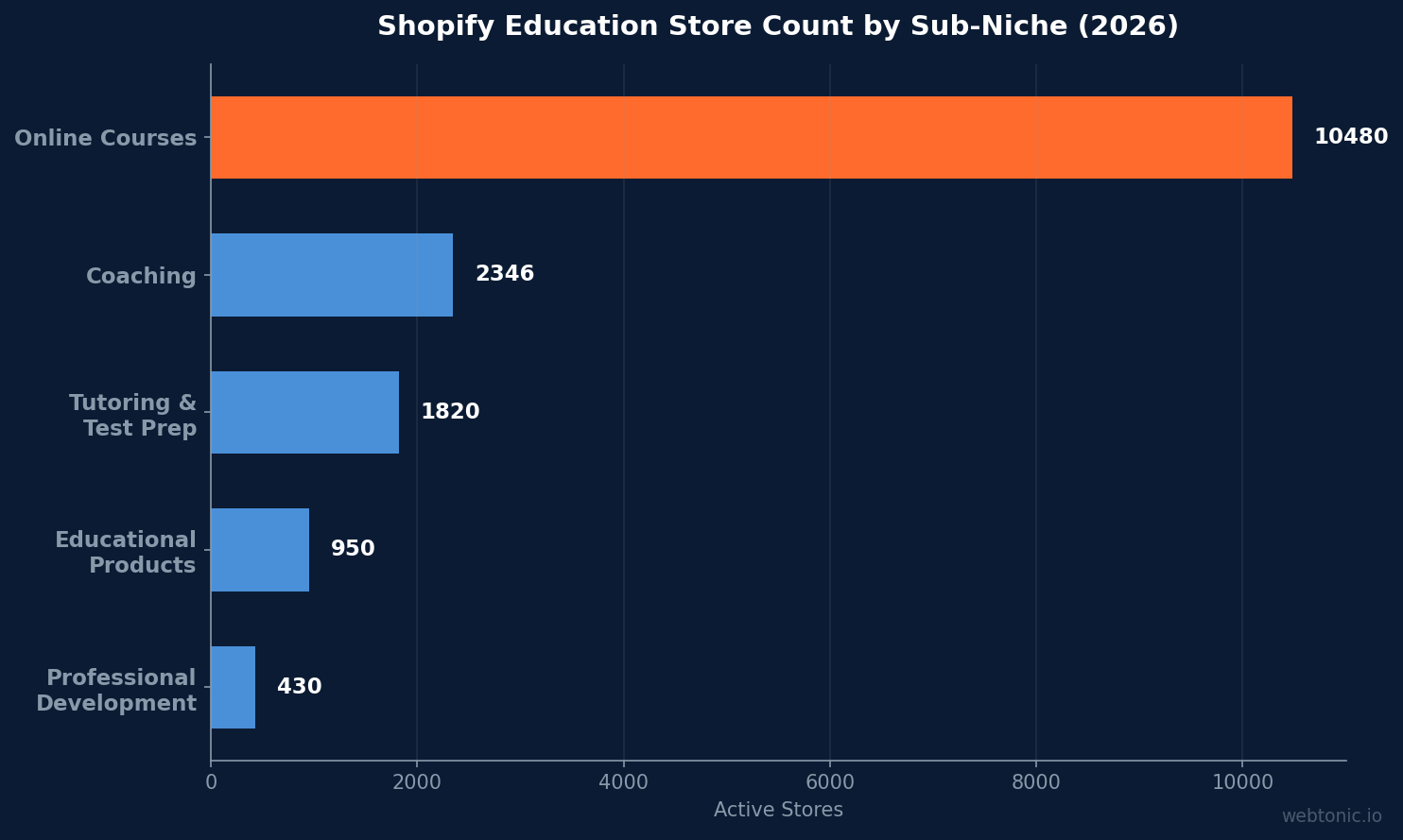
BootLeads' 2026 analysis tracks 10,480 active Shopify stores in the online courses segment, making it the largest education sub-niche on the platform. Coaching stores account for 2,346 active merchants (BootLeads Coaching 2026), followed by tutoring and test prep at 1,820, educational physical products at 950, and professional development at 430.
The dominance of online courses reflects a broader industry shift: independent course creators increasingly prefer owning their storefront over relying on marketplace platforms like Udemy, where revenue splits can reach 63%. On Shopify, creators retain full pricing control and customer data — a critical advantage for building lifetime value through email sequences and upsells.
Coaching stores tend to list fewer products — typically 3–8 service packages (discovery call, group program, 1:1 intensive) — but achieve higher average order values. The strategic bundling of coaching services with digital resources drives stronger per-customer economics on Shopify compared to course-only stores.
Revenue Benchmarks for Course Creators
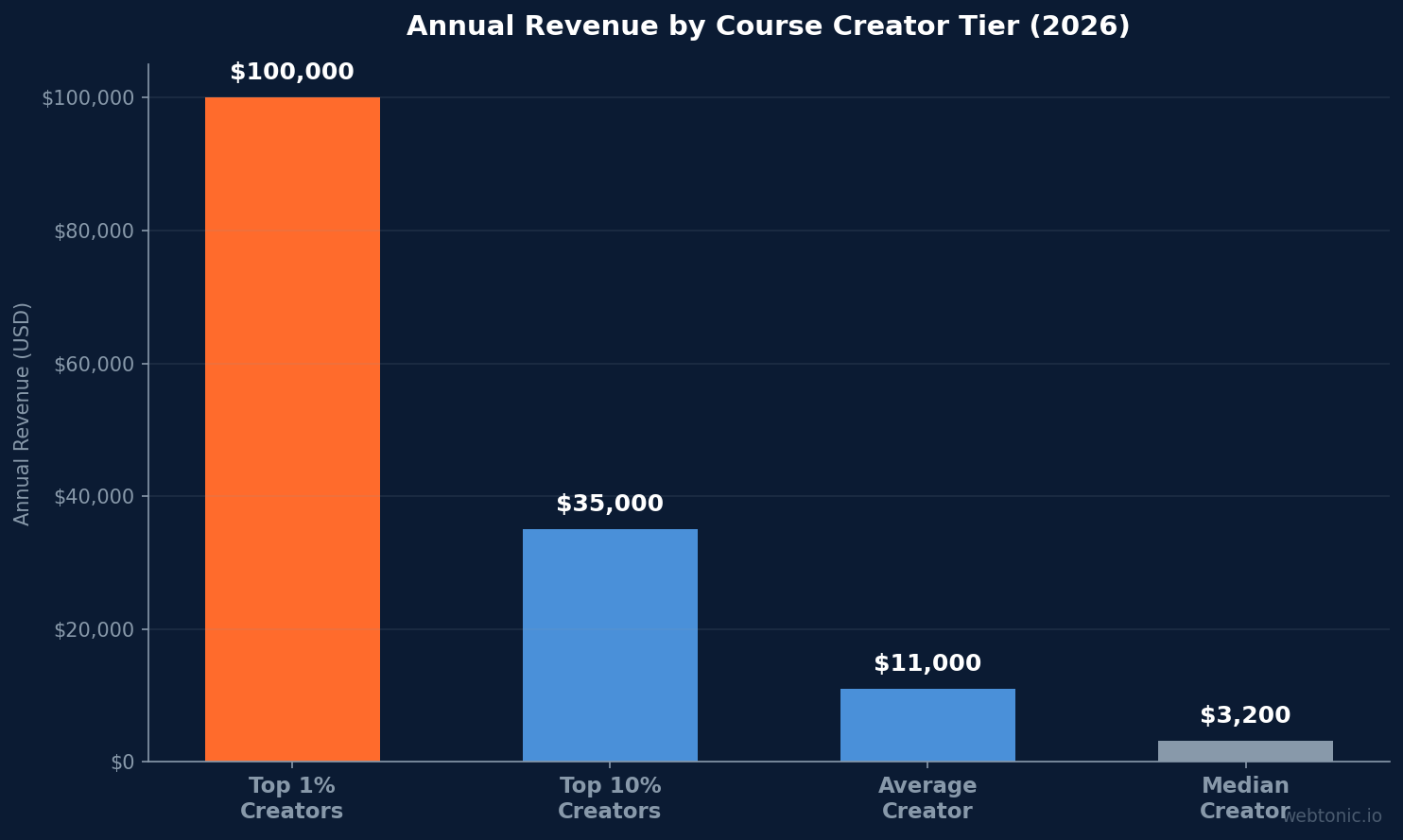
Revenue distribution among education Shopify sellers follows a steep power curve. The average course creator earns roughly $11,000 annually, but this figure is heavily skewed by top performers. The median sits closer to $3,200 — a sobering benchmark for new entrants (Tevello 2026).
Top-tier performers paint a different picture. The top 10% of course creators earn $35,000+ annually, while the top 1% exceed $100,000. What separates them is not product quality alone but audience building and traffic strategy — top creators invest heavily in paid advertising, email marketing, and affiliate partnerships.
Industry data from the Learning Revolution 2026 report shows that major platforms generate substantial revenue: Udemy earned $789.8 million in annual revenue during 2025, while Thinkific reached $65+ million. Independent Shopify creators compete by offering specialized, high-ticket programs that command premium pricing — typically $197–$997 per course versus marketplace averages of $20–$50.
Product and Catalog Metrics
| Product Metric | Education Stores | Coaching Stores | All Shopify |
|---|---|---|---|
| Avg Products Listed | 118 | 6 | 84 |
| Median Product Range | 10–49 | 3–8 | 15–50 |
| Avg Apps Installed | 4 | 5 | 6 |
| Popular Theme | Dawn, Sense | Sense, Refresh | Dawn |
| Top App Category | Email (Klaviyo) | Scheduling + Reviews | Email Marketing |
Education stores list an average of 118 products, significantly above the all-Shopify average of 84. However, the median sits at just 10–49 products, revealing that a small cohort of mega-catalog stores (universities and training companies listing hundreds of modules) pulls the average upward.
Coaching stores operate with leaner catalogs — typically 3–8 service packages — but install more apps per store (5 vs 4 for education). The most popular apps include Klaviyo for email marketing, Judge.me for reviews, and scheduling tools for booking discovery calls. This app stack reflects the relationship-driven sales model that coaching businesses rely on, where reviews and email nurture sequences directly impact conversion rates.
The StoreInspect 2026 report analyzing 915,000+ stores found that education merchants using Klaviyo for email segmentation and automation see 2.3× higher repeat purchase rates than those using basic Shopify email — a significant driver of lifetime value for digital product businesses.
Conversion Rate Benchmarks
Digital education products consistently outperform physical goods on conversion rate. Education Shopify stores average a 2.1–3.8% conversion rate on digital products, compared to the platform-wide median of 1.3% (StoreInspect Benchmarks 2026). The lower friction of digital delivery — instant access, no shipping concerns, immediate value — drives this premium.
Three variables dominate education store conversion rates: audience size, price point, and traffic temperature. Cold traffic from paid ads converts at 1.2–2.0%, warm traffic from email lists hits 3.5–5.0%, and hot traffic from webinar funnels can reach 8–15% for well-positioned offers. Smart education sellers invest in paid traffic warming strategies to move prospects up the temperature ladder.
Pricing also has a non-linear relationship with conversion. Courses priced below $50 see higher raw conversion but lower revenue per visitor. The sweet spot for maximizing revenue per session sits between $197 and $497 — high enough to signal quality but accessible enough for impulse-assisted purchases with money-back guarantees.
E-Learning Market Context
Shopify's education segment exists within a rapidly expanding market. The global e-learning market exceeded $400 billion in 2026, growing at a compound annual rate of 14.2%. Online learning platforms alone represent a $50+ billion sub-segment, with corporate training, K-12 digital resources, and independent creator courses driving volume.
Major platform revenues illustrate the scale: Udemy at $789.8 million, Coursera at $740+ million, and Thinkific at $65+ million annually (Learning Revolution 2026). Independent Shopify creators collectively represent a smaller but fast-growing segment, driven by creators who prioritize brand ownership and margin control over marketplace discoverability.
The shift toward Shopify for education reflects a broader creator economy trend: platform risk aversion. After Udemy's repeated fee structure changes and marketplace algorithm shifts, an increasing number of established creators migrate to owned storefronts where they control pricing, customer relationships, and data intelligence.
Shopify vs. Dedicated LMS Platforms
| Feature | Shopify + App | Thinkific / Teachable | Udemy Marketplace |
|---|---|---|---|
| Revenue Share | 0% (flat monthly fee) | 0% (paid plans) | 37–63% |
| Customer Data Ownership | Full | Full | Limited |
| Built-in Audience | None | None | Yes (67M learners) |
| E-commerce Features | Extensive | Basic | Minimal |
| Course Hosting | Via app (Tevello, etc.) | Native | Native |
| Best For | Hybrid digital + physical | Pure course creators | Beginner reach |
App Ecosystem and Technology Stack
The technology stack choices of education Shopify merchants reveal clear patterns in how successful course creators and coaches optimize their stores. Klaviyo dominates email marketing with roughly 38% adoption among education stores, well above the 28% platform average. This premium adoption reflects the outsized role of email in digital product sales — course creators generate 35–45% of revenue from email sequences, abandoned cart flows, and launch campaigns.
Judge.me leads product reviews with strong adoption across both education and coaching stores. Social proof is particularly important for digital products where buyers cannot physically evaluate what they are purchasing. Stores displaying 10+ reviews on course pages see 12–18% higher conversion rates than those without reviews. The most effective review strategies encourage students to submit reviews after completing specific course milestones rather than immediately after purchase.
Course delivery apps like Tevello and Digital Downloads bridge the gap between Shopify's e-commerce infrastructure and the content delivery requirements of education businesses. These apps handle access management, drip content scheduling, and student progress tracking — features that dedicated LMS platforms provide natively but that Shopify requires add-ons to support. The average education store installs 4 apps versus the platform average of 6, suggesting that course creators run leaner operations than physical product sellers.
Payment and checkout optimization apps also differ in the education space. Buy-now-pay-later integrations (Afterpay, Klarna) are adopted by 15% of education stores selling programs above $200 — a strategy that can increase average order value by 20–30% for high-ticket coaching programs. Coaches offering installment plans through these integrations report higher enrollment rates without the administrative burden of managing payment plans manually.
Growth Trends and Market Outlook
Shopify's education category shows moderate but steady growth. Store count increased 1.1% quarter-over-quarter in Q2 2026, slightly below the platform-wide average of 1.4%. This slower growth reflects market maturation rather than decline — the education Shopify ecosystem has moved beyond early-adopter growth into a more established phase where competition intensifies and marginal entrants face higher barriers.
Three trends are reshaping education commerce on Shopify. First, hybrid physical-digital bundling is accelerating, with creators packaging online courses alongside printed workbooks, certification kits, and branded materials. This plays to Shopify's strength as a full e-commerce platform. Second, subscription and membership models are growing, with coaching stores increasingly offering monthly access to content libraries rather than one-time course purchases. Third, AI-powered personalization tools are emerging that recommend course content based on learning progress and stated goals, though adoption remains below 5% of education stores.
Best Practices for Education Shopify Stores
- Lead with a signature course — top 10% creators derive 60–70% of revenue from a single flagship product, then cross-sell supplementary materials.
- Install Klaviyo from day one — email-driven repeat purchases are 2.3× higher for stores using segmented automation vs basic Shopify email.
- Price for value, not competition — the $197–$497 range maximizes revenue per session; include money-back guarantees to offset price sensitivity.
- Build a warm traffic engine — webinar and challenge funnels convert at 8–15%, compared to 1.2–2.0% for cold paid traffic.
- Bundle digital and physical — Shopify's e-commerce strength lets education sellers pair courses with workbooks, certification kits, or coaching add-ons for higher AOV.
- Leverage reviews aggressively — Judge.me reviews increase education store conversion by 12–18% when displayed on product pages.
Related reading
- Education & Coaching Webflow Statistics: Market Share & Performance Data (2026)
- Education WordPress Statistics: Benchmarks & Data for 2026
- The State of Landing Pages & CRO in Education & Coaching: 2026 Stats & Trends
- Custom Web Development services at Web Tonic
Frequently Asked Questions
How many Shopify stores sell education products?
As of 2026, 10,480 active Shopify stores sell online courses, with an additional 2,346 coaching stores, 1,820 tutoring stores, and approximately 1,380 stores selling educational products and professional development materials. The total education ecosystem on Shopify exceeds 16,000 active merchants.
What is the average revenue for a course creator on Shopify?
The average annual revenue is approximately $11,000, but the median sits closer to $3,200. Top 10% performers earn $35,000+, while the top 1% exceed $100,000 annually. Revenue depends primarily on audience size, traffic quality, and pricing strategy rather than product count.
Is Shopify better than Teachable or Thinkific for selling courses?
Shopify excels for creators selling hybrid digital and physical products — course bundles with workbooks, certification kits, or coaching add-ons. Thinkific and Teachable offer better native course hosting and student management. Shopify's advantage is its superior e-commerce and marketing ecosystem, especially for creators already running a Shopify store for other products.
What conversion rate should education Shopify stores expect?
Digital education products on Shopify convert at 2.1–3.8%, significantly above the platform-wide average of 1.3%. Warm traffic from email lists converts at 3.5–5.0%, and webinar funnel traffic can reach 8–15%. Cold paid traffic typically converts at 1.2–2.0%.
What apps do education Shopify stores use most?
The most popular apps for education stores are Klaviyo (email marketing and SMS), Judge.me (product reviews), and course delivery apps like Tevello. Coaching stores also rely heavily on scheduling apps for booking discovery calls. Education stores install an average of 4 apps, slightly below the platform average of 6.
Sources
bootleads.com — Shopify Online Courses Stores 2026
bootleads.com — Shopify Coaching Stores 2026
storeinspect.com — State of Shopify 2026
storeinspect.com — Shopify Store Benchmarks 2026
learningrevolution.net — 113 eLearning Statistics 2026
tevello.com — Online Course Revenue Guide
cufinder.io — Online Education Marketing Benchmarks


