



Table of contents
Education and coaching businesses consistently outperform most industries in email marketing, with open rates 17% above the cross-sector average and click-through rates that rank among the top three verticals. This guide compiles the latest 2026 benchmarks from Mailchimp, HubSpot, Omnisend, and specialized education marketing studies to help you measure your campaigns against real performance data.
Key Takeaways
- 25.1% average open rate for education emails — 17% above the 21.5% all-industry average (Mailchimp 2026)
- 4.1% click-through rate — only government/nonprofits score higher at 4.1% (Mailchimp 2026)
- $36–$42 ROI per dollar spent on email marketing across industries; automated flows push this to $79 for optimized senders (Omnisend 2026)
- 760% more revenue from segmented campaigns vs. non-segmented sends (DMA 2026)
- 37% of email-generated sales come from automated sequences despite making up only 2% of total sends (Omnisend 2026)
- 50–65% open rates for student onboarding email sequences — the highest-performing education campaign type
- 30.4% open rate for executive coaching email campaigns, with a 3.2% conversion rate (Benchmarketing 2026)
Education Email Marketing Benchmarks at a Glance
| Metric | Education Average | Above Average | Excellent | All-Industry Avg |
|---|---|---|---|---|
| Open Rate | 25.1% | 30%+ | 37%+ | 21.5% |
| Click-Through Rate | 4.1% | 5.5%+ | 8%+ | 2.6% |
| Click-to-Open Rate | 16.8% | 20%+ | 26%+ | 10.5% |
| Enrolment Conversion Rate | 1.2% | 2.5%+ | 5%+ | N/A |
| Bounce Rate | 0.6% | <0.4% | <0.2% | 0.55% |
| Unsubscribe Rate | 0.15% | <0.10% | <0.05% | 0.20% |
| List Growth Rate | 3%/mo | 5%+/mo | 8%+/mo | 2.5%/mo |
Sources: Email Calculator Education Benchmarks, Searchlab Email Statistics 2026
Open Rates and Engagement by Campaign Type
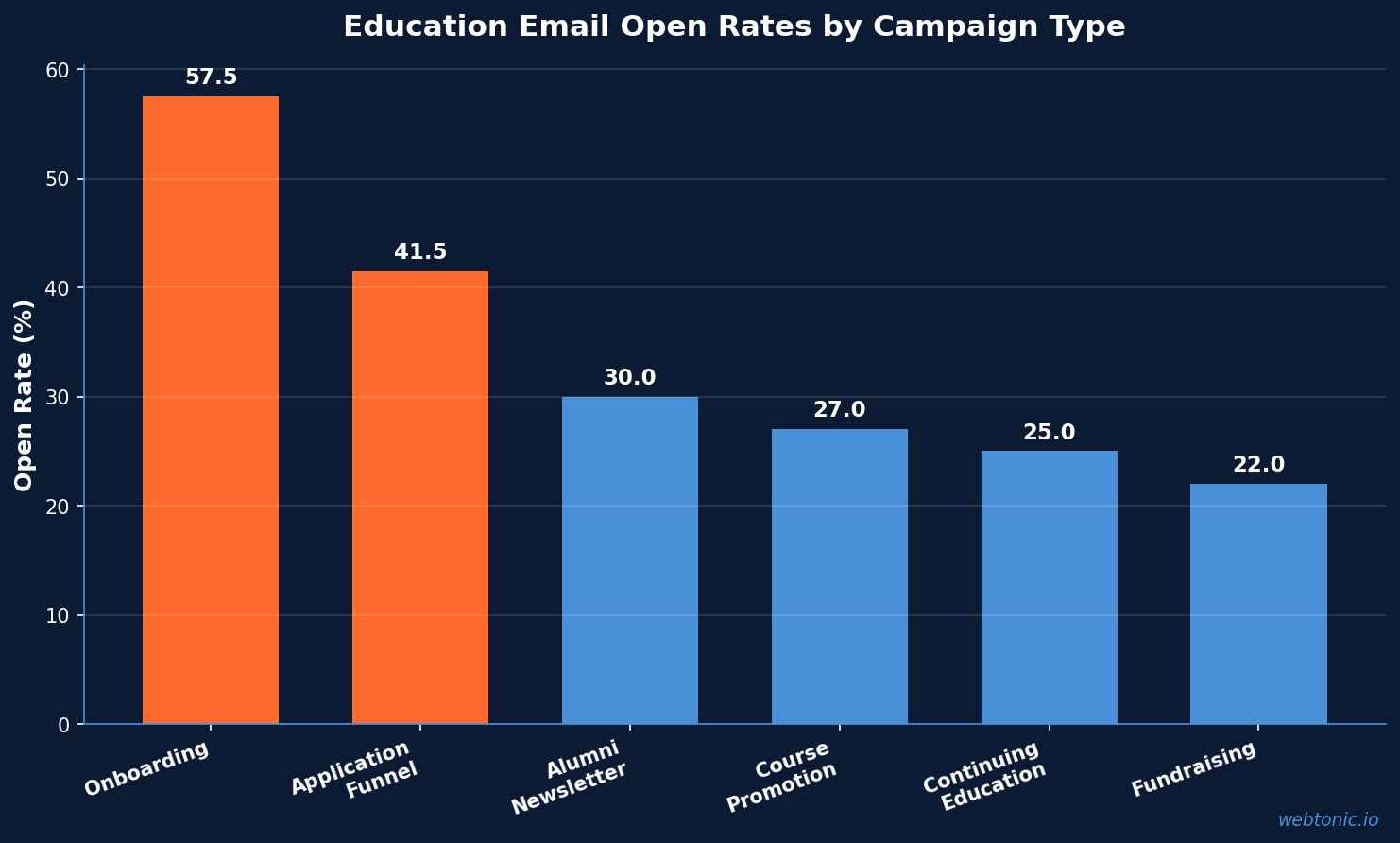
Not all education emails perform equally. Student onboarding sequences achieve 50–65% open rates, the highest of any campaign type, because recipients have just taken a high-commitment action (enrollment) and expect follow-up communication. Application funnel emails follow at 35–50% open rates with 8–15% CTR, driven by urgency and decision-stage intent.
| Campaign Type | Open Rate | CTR | Conversion Rate |
|---|---|---|---|
| Student Onboarding | 50–65% | 12–20% | 5–10% |
| Application Funnel | 35–50% | 8–15% | 10–25% |
| Alumni Newsletter | 28–38% | 4–8% | 1–3% |
| Course Promotion | 22–32% | 4–7% | 2–5% |
| Webinar/Event Invite | 25–35% | 5–9% | 10–20% |
| Continuing Education | 22–30% | 3–6% | 2–4% |
| Donation/Fundraising | 20–30% | 3–5% | 0.5–1.5% |
Source: Email Calculator Education Benchmarks
Email Marketing ROI and Revenue Impact
Email remains the highest-ROI channel in marketing. The industry average ROI is $36–$42 for every dollar spent, according to Omnisend's 2026 benchmark report. Merchants on optimized paid plans averaged $79 per dollar spent — nearly double the benchmark.
For coaching businesses specifically, the economics are even more compelling. Automated welcome sequences and nurture flows drive 37% of all email-generated sales while accounting for just 2% of total sends. Executive coaching firms report 30.4% email open rates with a 3.2% conversion rate, translating to a cost per acquisition of $284 — viable given coaching program price points of $2,000–$15,000 (Benchmarketing 2026).
Companies investing in coaching see an average ROI of 5.7x their initial investment, with 86% of organizations recouping their coaching spend (WifiTalents 2026). Email serves as the primary nurture channel that converts coaching prospects from awareness to booked discovery calls.
Segmentation and Personalization Statistics
The single biggest lever in education email marketing is segmentation. Segmented campaigns generate 760% more revenue than non-segmented sends, according to the DMA Segmentation Study 2026. Despite this, only 39% of email marketers apply advanced segmentation (Litmus State of Email 2026).
| Personalization Tactic | Performance Lift | Adoption Rate |
|---|---|---|
| First Name in Subject Line | +26% open rate | 72% |
| Purchase-Based Recommendations | +45% CTR | 34% |
| Location-Based Content | +29% conversion | 28% |
| Dynamic Content Blocks | +52% conversion | 22% |
| Behavioral Triggers | 8x conversion vs. batch | 31% |
| Advanced Segmentation | +101% CTR, 760% revenue | 39% |
Sources: HubSpot Personalization Report, Searchlab/Litmus/Klaviyo 2026
Coaching Industry Email Benchmarks
The coaching sector operates differently from institutional education. Individual coaches rely heavily on email to nurture high-ticket sales funnels, while coaching platforms use automation at scale.
- 30.4% open rate for executive coaching email campaigns — 42% above the all-industry average (Benchmarketing 2026)
- Organic content marketing produces leads at 50–70% lower cost than paid advertising for coaching services (Careertrainer.ai 2026)
- 3% average conversion rate from organic content for coaching services, with email nurture sequences as the primary conversion mechanism
- Less than 20% of individual coaches use paid advertising; the majority rely on email lists, referrals, and organic social
- Coaching business revenue grew 12% in the last two years, with email automation cited as a key growth driver (WifiTalents)
Automation and CRM Performance Data
Automated email flows outperform manual campaigns by a wide margin. According to Omnisend, automated sequences drive 37% of all email-generated revenue from just 2% of sends. For education and coaching businesses, the most impactful automated flows are:
- Welcome sequences — 50–65% open rate, setting engagement expectations and delivering lead magnets
- Application reminders — behavioral triggers that achieve 8x higher conversion than batch emails
- Course completion follow-ups — driving upsells to advanced programs at 2–5% conversion rates
- Re-engagement campaigns — recapturing lapsed subscribers with 15–22% open rates
Higher education institutions allocate 2–3% of operating budgets to marketing, with 68% of that budget flowing to digital channels including email (CuFinder 2026). The average higher education marketing budget is $4.15 million, making email — with its $36–$42 ROI per dollar — the most capital-efficient channel in the mix.
Education vs. Other Industries: Email Performance Comparison
| Industry | Open Rate | CTR | CTOR | Unsubscribe Rate |
|---|---|---|---|---|
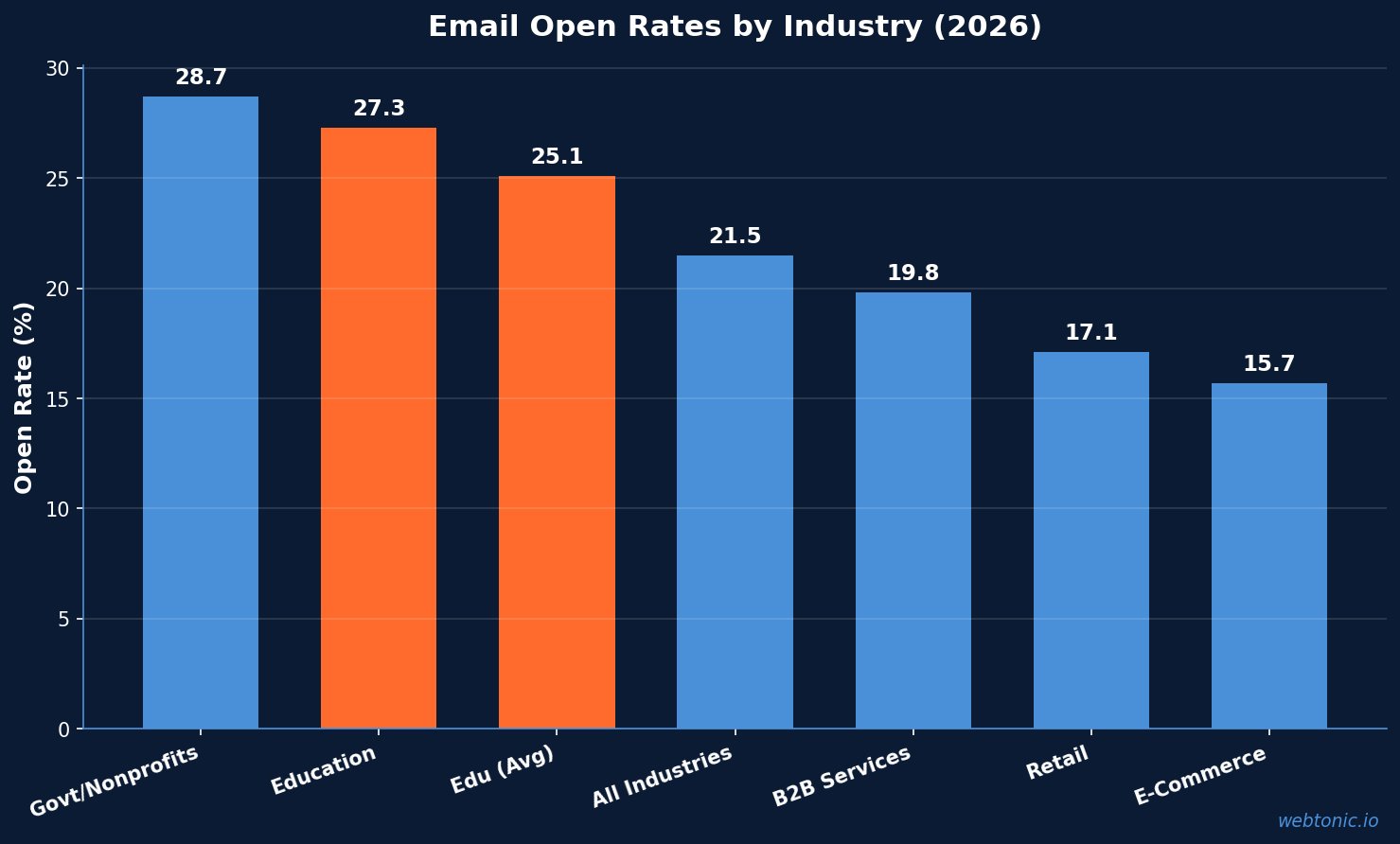
| Government/Nonprofits | 28.7% | 4.1% | 14.3% | 0.10% |
| Education | 27.3% | 3.6% | 13.2% | 0.12% |
| Healthcare | 23.4% | 3.0% | 12.8% | 0.17% |
| B2B Services | 19.8% | 2.4% | 12.1% | 0.22% |
| All Industries | 21.5% | 2.6% | 10.5% | 0.20% |
| Retail | 17.1% | 1.8% | 10.5% | 0.25% |
| E-Commerce | 15.7% | 1.9% | 12.1% | 0.27% |
Source: Mailchimp Email Marketing Benchmarks 2026
Education institutions that benchmark their email performance against these industry standards gain a clear competitive advantage. With open rates 17% above the cross-sector average and click-through rates among the top three verticals, the education sector has a natural engagement advantage that compounds when combined with proper automation infrastructure. The key opportunity remains in the gap between current adoption (only 39% using advanced segmentation) and proven impact (760% revenue lift from segmentation) — closing this gap represents the single largest ROI opportunity in education email marketing today.
Best Practices for Education and Coaching Email Campaigns
- Segment by lifecycle stage — prospective students, current enrollees, alumni, and donors respond to fundamentally different messaging. Segmented sends deliver 760% more revenue.
- Automate onboarding and application sequences — these achieve 2–8x better performance than batch sends and require minimal ongoing maintenance.
- Personalize beyond first names — program-specific recommendations (+45% CTR), location-based content (+29% conversion), and behavioral triggers (8x conversion) all compound.
- Maintain list hygiene — target bounce rates below 0.4% and unsubscribe rates below 0.10%. Education's naturally engaged audience makes this achievable.
- Use proven email platforms — Omnisend users on paid plans report $79 ROI per dollar vs. the $36–$42 industry average, highlighting the impact of platform capability.
- Test send frequency — coaching businesses that email 2–3 times per week see 18% higher revenue than weekly senders, but monitor unsubscribe rates as a ceiling indicator.
- Leverage data and analytics — track CTOR (click-to-open rate) alongside open rate to isolate content quality from subject line performance.
Higher Education Email Budget and Channel Allocation
The global education marketing services industry is valued at $1.07 billion in 2026, projected to reach $1.68 billion by 2035 at a CAGR of 6.7% (Click-Vision 2026). Within this market, email remains the highest-ROI channel, but its share of total marketing spend varies by institution type.
Higher education institutions allocate 2–3% of operating budgets to marketing, with approximately 68% of that budget flowing to digital channels including email, paid search, and social advertising. The average higher education marketing budget is $4.15 million, split roughly evenly between staffing and non-staff expenses (CuFinder 2026).
For coaching businesses, marketing budgets tend to be smaller but email typically captures a larger share. Individual coaches spend $200–$1,500 per month on email platforms, while coaching firms allocate 15–25% of total marketing spend to email automation and CRM tools. The ROI justification is straightforward: with coaching program price points of $2,000–$15,000, even a single conversion from an automated email sequence can deliver 10–50x return on the platform cost.
Email Platform Adoption and Technology Trends
The choice of email platform significantly impacts performance. Omnisend users on paid plans averaged $79 ROI per dollar spent — nearly double the $36–$42 industry benchmark — highlighting how platform capability, automation depth, and deliverability infrastructure compound into measurable revenue differences.
Key technology trends shaping education email marketing in 2026 include:
- AI-powered send time optimization — platforms that analyze individual recipient behavior to determine optimal delivery times report 12–18% higher open rates compared to batch scheduling
- Predictive enrollment scoring — universities using CRM-integrated email platforms can score prospects based on engagement patterns, prioritizing high-intent leads for recruitment team follow-up
- Interactive email elements — embedded forms, polls, and image carousels within emails increase engagement by 25–40% compared to static layouts, though adoption remains below 20% in education
- Cross-channel attribution — education marketers increasingly connect email engagement data with enrollment outcomes, enabling accurate ROI measurement across 6–18 month decision cycles
- List hygiene automation — automated sunset policies for disengaged subscribers maintain deliverability scores and keep bounce rates below the 0.4% above-average threshold
The coaching industry has been particularly quick to adopt behavioral trigger automation. Sequences triggered by specific actions — webinar attendance, resource downloads, pricing page visits — convert at 8x the rate of batch-and-blast campaigns, making them essential for high-ticket service providers who need to build trust over multiple touchpoints before a sale.
The combination of high open rates, strong engagement, and measurable ROI makes email the foundation of education and coaching marketing stacks. Institutions and coaching businesses that invest in proper segmentation infrastructure, automated sequences, and ongoing list hygiene consistently outperform those relying on manual batch sends — often by margins of 3–5x on revenue per subscriber.
Related reading
- Education & Coaching Analytics Statistics: 2026 Market Data, ROI Metrics & Industry Benchmarks
- Attribution & BI for Education & Coaching: 78+ Statistics & Benchmarks (2026)
- Education & Coaching Dashboards & Reporting Statistics: Key Data Points for 2026
- Email Marketing services at Web Tonic
Frequently Asked Questions
What is the average email open rate for education in 2026?
The average email open rate for the education sector is 25.1% in 2026, above the 21.5% all-industry average. Application-related emails reach 35–50%, while student onboarding sequences average 50–65%.
How does email marketing ROI compare for coaching businesses?
Email marketing delivers an average ROI of $36–$42 per dollar spent across all industries. Coaching businesses using automated welcome and nurture sequences report ROI figures exceeding $50 per dollar, driven by high-ticket service conversion.
What click-through rate should education emails achieve?
Education email CTR averages 4.1% in 2026, well above the 2.6% all-industry benchmark. Above-average education campaigns reach 5.5%+, while application funnel emails can achieve 8–15% CTR.
How much does segmentation improve email performance?
Segmented email campaigns generate 760% more revenue than non-segmented sends. They also achieve 101% higher click-through rates and 26% higher open rates when using personalized subject lines.
What is a good unsubscribe rate for education emails?
The average education email unsubscribe rate is 0.15%. Below 0.10% is considered above average, and below 0.05% is excellent. Rates above 0.5% signal list fatigue or frequency issues.
Sources
emailcalculator.com/benchmarks/education-email-marketing
searchlab.nl/en/statistics/email-marketing-statistics-2026
omnisend.com/blog/email-marketing-roi
benchmarketing.org/benchmarks/industries/executive-coaching
cufinder.io/blog/benchmarks/higher-education
searchinfluence.com/blog/2026-higher-education-marketing-benchmarks
wifitalents.com/career-coaching-industry-statistics
careertrainer.ai/en/reports/coaching-programs-statistics
ghlbusinesscoachingsnapshot.com/blog/state-of-business-coaching-2026


