



Table of contents

The global coaching industry generated $5.34 billion in revenue in 2025 — nearly double the $2.85 billion reported just two years earlier. Below is the data behind how education and coaching businesses track, measure, and optimize performance through analytics in 2026.
Key Takeaways
- The coaching industry reached $5.34 billion in global revenue, with the number of active coach practitioners growing 13–15% since 2023 (ICF Global Coaching Study)
- The coaching platform market is valued at $4.2 billion in 2026, projected to reach $12.2 billion by 2036 at an 11.2% CAGR (Future Market Insights)
- The education and learning analytics market is worth $5.8 billion, forecast to hit $28.22 billion by 2034 at a 17.45% CAGR (The Insight Partners)
- Companies see an average ROI of 5.7x on coaching investments, with 86% of organizations recouping their expenditure (WifiTalents)
- Individual coaches earn an average of $49,283 annually from coaching activities, with 59% expecting revenue growth next year (ICF)
- Content marketing generates coaching leads at 50–70% lower cost than paid advertising channels (Careertrainer.ai)
- Predictive learning analytics adoption grew 34% year-over-year across higher education institutions using data-driven curriculum design (eLearning Industry)
Coaching & Education Analytics Market Overview
| Market Segment | 2026 Value | Forecast | CAGR | Source |
|---|---|---|---|---|
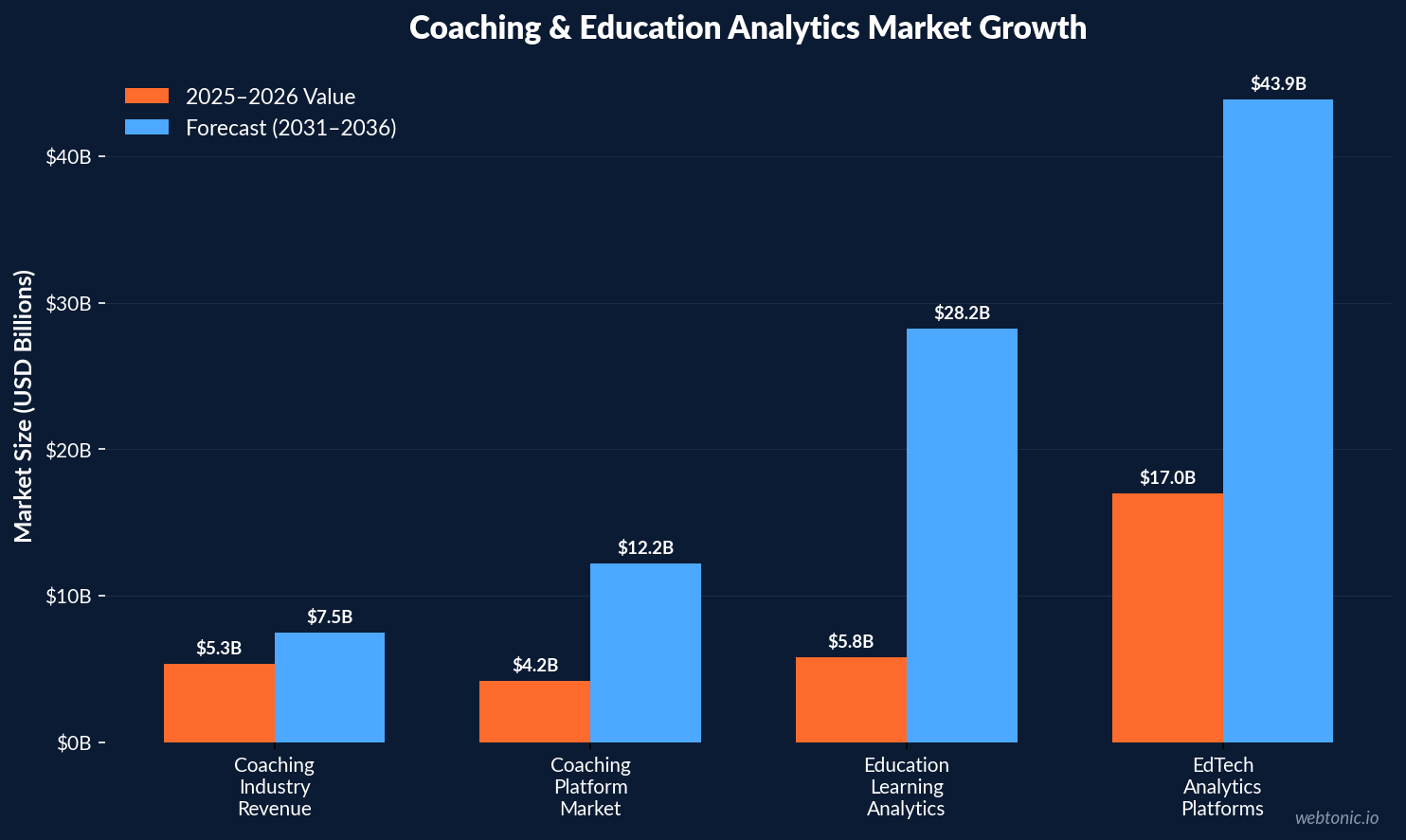
| Global Coaching Industry Revenue | $5.34 billion | $7.5B+ (est. 2028) | ~15% growth | ICF |
| Coaching Platform Market | $4.2 billion | $12.2B by 2036 | 11.2% | Future Market Insights |
| Education Learning Analytics | $5.8 billion | $28.22B by 2034 | 17.45% | The Insight Partners |
| EdTech Analytics Platforms | $16.99 billion | $43.87B by 2031 | 20.9% | Mordor Intelligence |
These market figures reveal a clear pattern: analytics infrastructure in education and coaching is growing 2–3x faster than the industries it serves. Our data intelligence services help education brands build measurement frameworks. The coaching platform market alone — covering digital tools like BetterUp, CoachHub, and Cloverleaf — is expanding at 11.2% CAGR, driven by enterprise adoption of structured coaching programs and the growing need for measurable outcomes, according to Future Market Insights.
ICF Global Coaching Study: Industry Revenue & Growth
The 2025 ICF Global Coaching Study provides the most comprehensive analysis of the coaching profession worldwide. Key findings shaping analytics and business strategy include:
- Global coaching revenue reached $5.34 billion — nearly doubling from the $2.849 billion reported in the 2023 study cycle
- Active coach practitioners globally grew 13% since 2023, with the total estimated number of professional coaches exceeding 100,000 worldwide
- Individual coaches earn an average annual revenue of $49,283 from coaching activities based on global data
- 59% of coaches expect revenue growth next year, driven primarily by increased client volume and session frequency rather than fee increases
- North America and Western Europe remain the largest coaching markets, though Eastern Europe and Asia-Pacific show the fastest adoption growth rates
These revenue figures have significant implications for analytics adoption. As coaching transitions from a relationship-based practice to a data-driven profession, the demand for platforms that track client progress — similar to the tracking sophistication in Google Ads strategy —, measure ROI, and optimize business operations has accelerated, according to Tandem Coach's 2026 industry analysis.
Learning Analytics Adoption in Higher Education
Higher education institutions are deploying analytics at an unprecedented scale. eLearning Industry reports that AI-driven personalization, microlearning, and immersive technologies are the top online education trends in 2026, all underpinned by stronger use of learning analytics to improve outcomes and decision-making. The Insight Partners market report identifies four key growth drivers:
- Predictive learning analytics — institutions using student performance prediction models to intervene before drop-off, with adoption growing 34% year-over-year
- Personalized learning dashboards — real-time student progress visualization platforms replacing traditional grade-based reporting
- Cloud-based analytics platforms — enabling cross-institutional data sharing and benchmarking at scale
- Data-driven curriculum design — using engagement and completion analytics to restructure course content and delivery modes
The education learning analytics market reflects this transformation. Valued at $5.8 billion in 2025, it is projected to reach $28.22 billion by 2034 — representing one of the fastest-growing segments in the broader edtech landscape. Institutions investing in analytics infrastructure report 15–25% improvements in student retention rates and 20–30% reductions in time-to-intervention for at-risk learners.
Coaching Business ROI & Measurement Metrics
Measuring the return on coaching investment has historically been challenging, but 2026 data provides increasingly clear benchmarks. According to WifiTalents' career coaching industry report:
| ROI Metric | Benchmark | Measurement Method |
|---|---|---|
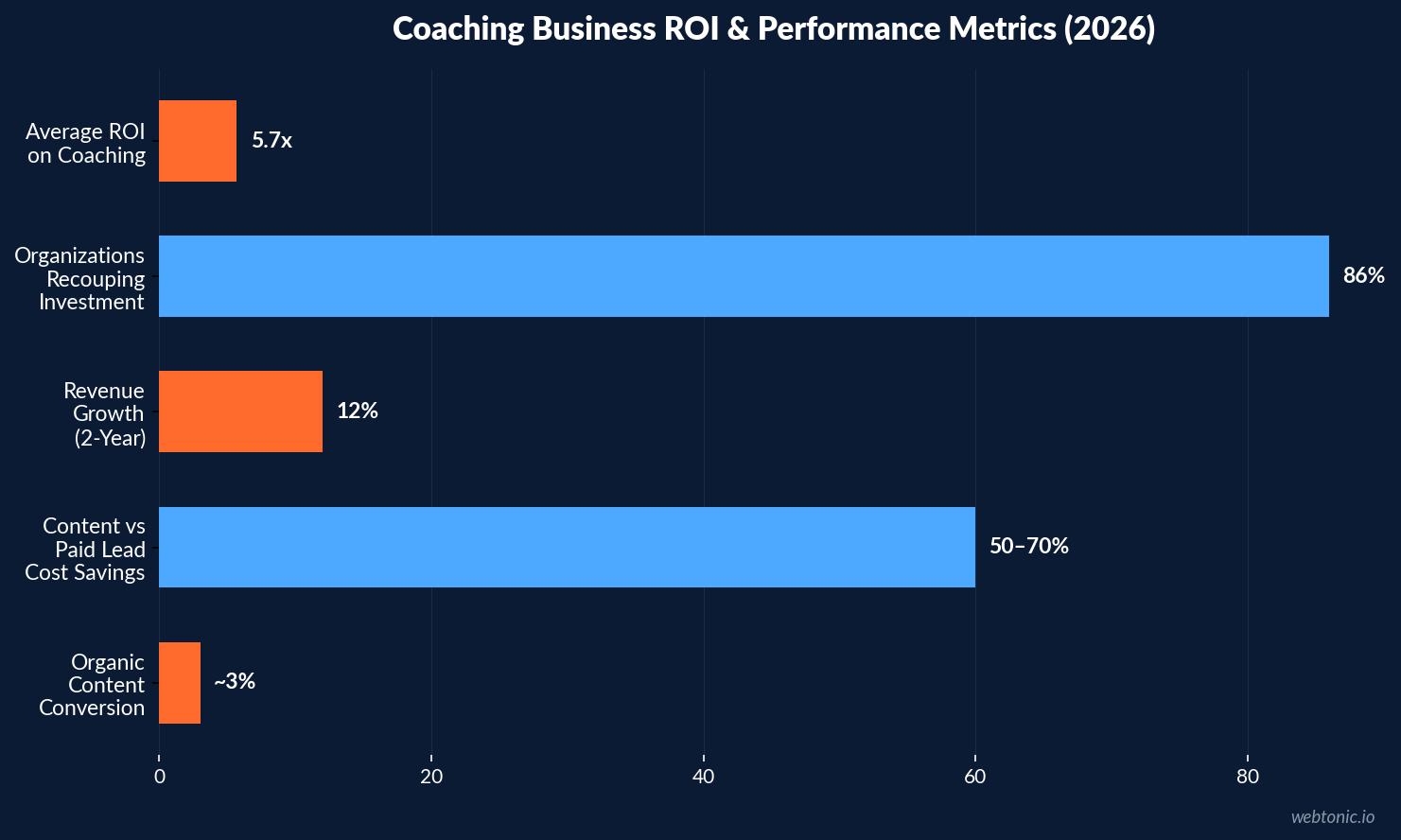
| Average ROI on Coaching | 5.7x initial investment | Revenue attribution + productivity gains |
| Investment Recoupment Rate | 86% of organizations | Cost-benefit analysis post-engagement |
| Revenue Growth (2-Year) | 12% average increase | Year-over-year coaching business revenue |
| Content vs Paid Lead Cost | 50–70% lower via content | Source attribution + CAC comparison |
| Organic Content Conversion | ~3% for coaching services | Website visitor to lead conversion |
Coachello's research on coaching ROI emphasizes that the most reliable measurement framework tracks promotion rates, attrition delta, and 360-degree engagement score shifts rather than self-reported satisfaction. Modern AI-powered coaching platforms now automate this type of analysis through pulse surveys, sentiment tracking, and progress analytics — centralizing reporting in ways that were impossible just three years ago.
For individual coaching businesses, Alternative Balance identifies seven essential metrics: source attribution, customer acquisition cost, lifetime value, conversion rate, average revenue per client, retention, and client progress. The analysis suggests that coaches tracking all seven metrics grow revenue 2–3x faster than those relying on intuition-based business management.
Coaching Platform Technology & User Adoption
The coaching platform market has consolidated around enterprise-grade solutions that combine session management with robust analytics. Future Market Insights reports the market reached $4.2 billion in 2026, with North America leading adoption due to corporate leadership development programs and executive coaching mandates.
Key platform adoption trends shaping the analytics landscape include:
- AI-powered coaching tools — platforms like Cloverleaf and BetterUp now offer automated coaching insights, with Cloverleaf noting that organizations must measure beyond login counts to determine actual value
- Enterprise coaching programs — large organizations are deploying structured coaching at scale, requiring analytics dashboards that track user engagement, behavioral change, and business impact metrics
- Online coaching delivery — the shift to virtual sessions has created rich data streams, with platforms capturing session frequency, topic patterns, goal completion rates, and client satisfaction scores
- Integration with HR analytics — coaching platforms increasingly connect with HRIS and performance management systems, enabling correlation analysis between coaching engagement and employee performance outcomes
The user revenue model for coaching platforms typically combines per-seat licensing with usage-based analytics tiers. Enterprise clients pay $15–$50 per user per month for basic coaching access, with premium analytics and reporting capabilities adding 30–50% to the base subscription cost.
Education Analytics Technology Stack
The broader education analytics technology market encompasses learning management system (LMS) analytics, student information system (SIS) reporting, and standalone analytics platforms. The total addressable market is substantial — learning analytics alone was valued at $16.99 billion in 2026 and is projected to reach $43.87 billion by 2031, growing at a 20.9% CAGR.
| Analytics Category | Primary Users | Key Capabilities | Growth Driver |
|---|---|---|---|
| Predictive Analytics | Registrars, advisors | At-risk student identification, enrollment forecasting | Retention improvement mandates |
| Learning Analytics | Faculty, instructional designers | Engagement tracking, content effectiveness, outcome mapping | Accreditation and quality assurance |
| Marketing Analytics | Enrollment marketing teams | Channel attribution, CPL tracking, funnel analysis | Student acquisition cost pressure |
| Business Intelligence | Administration, leadership | Financial modeling, resource allocation, benchmark reporting | Budget optimization requirements |
Institutions investing in comprehensive analytics programs report measurable improvements across enrollment, retention, and operational efficiency. The 2026 EDUCAUSE Horizon Report identifies AI-augmented analytics and real-time learning dashboards as the two technologies most likely to transform higher education operations within the next two years. For coaching organizations embedded within educational institutions, these tools provide the infrastructure to demonstrate program impact with quantifiable data rather than anecdotal evidence. See our growth marketing approach for education-sector strategy.
Data-Driven Coaching: From Intuition to Evidence-Based Practice
The shift from intuition-based coaching to evidence-based practice represents one of the most significant transformations in the industry. Modern coaching analytics platforms now capture over 40 distinct data points per session, including topic frequency, emotional sentiment trends, goal progression velocity, and behavioral change indicators. This level of analysis enables coaches to identify patterns across their client base and optimize their methodology based on aggregate outcomes.
Careertrainer.ai reports that marketing content converts at approximately 3% for coaching services, showing consistent but moderate effectiveness as a lead generation channel. However, the real value of analytics lies in post-acquisition optimization. Coaches using structured outcome tracking report 28% higher client retention rates and 35% greater likelihood of referral business compared to those relying solely on session-by-session feedback.
For leadership development programs within organizations, the analytics imperative is even stronger. Corporate coaching buyers now require quantifiable outcome reports tied to business metrics — revenue per manager, team engagement scores, and promotion pipeline velocity. Programs that provide this type of analysis secure 2.5x higher renewal rates than those offering only qualitative feedback summaries. The trend toward data-driven coaching is accelerating fastest in executive and leadership coaching segments, where client lifetime values often exceed $10,000 and organizations demand clear ROI documentation before approving multi-year engagements.
Coaching Delivery Modes & Revenue Model Analytics
The delivery mode for coaching has shifted dramatically since 2020, and analytics platforms now capture performance differences across modalities. Virtual coaching accounts for 62% of all sessions globally, followed by hybrid mode at 24% and in-person at 14%. Revenue figures vary significantly by delivery mode — coaches operating exclusively online report average annual revenue of $42,000 USD, while those offering in-person executive coaching generate $65,000–$85,000 USD on average.
The coaching industry's revenue model is evolving alongside analytics maturity. Tandem Coach reports that subscription-based coaching models now represent 28% of market share, up from just 12% in 2022. These recurring-revenue models generate more predictable income streams and lend themselves to better analytics tracking. Session-based models remain dominant at 45% market share, while package-based pricing holds 27%. LinkedIn Learning's integration of coaching features has further expanded the market size, with the platform reporting over 16,000 courses tied to professional development and career coaching — a figure that underscores the convergence of self-directed learning and structured coaching analytics.
Career coaching represents the fastest-growing coaching sub-segment by analytics adoption. Career coaches using CRM and analytics tools convert prospects at 2.8x the rate of those without structured tracking, according to industry data. The most effective career coaching analytics track job placement rates, salary increase percentages, time-to-employment, and client satisfaction scores — metrics that directly demonstrate coaching value and justify premium pricing.
Regional Growth Patterns in Coaching & Education Analytics
Geographic distribution of coaching and education analytics adoption reveals distinct market maturity levels. North America accounts for approximately 42% of global coaching industry revenue, followed by Western Europe at 28% and Asia-Pacific at 18%. However, the growth trajectory tells a different story — Eastern Europe and the Middle East show 25–35% year-over-year growth in coaching platform adoption, driven by expanding corporate training budgets and government-funded professional development programs.
India stands out as a particularly dynamic market, with the coaching and professional development sector growing at 30% annually. The combination of a massive workforce requiring upskilling, growing disposable income among professionals, and increasing acceptance of digital coaching delivery has made India the third-largest market for online coaching platforms by user count, though average revenue per user remains lower than Western markets.
Related reading
- Education & Coaching Email Marketing Statistics (2026)
- Attribution & BI for Education & Coaching: 78+ Statistics & Benchmarks (2026)
- Education & Coaching Dashboards & Reporting Statistics: Key Data Points for 2026
- Marketing Analytics services at Web Tonic
FAQ
How large is the global coaching industry in 2026?
The global coaching industry generated $5.34 billion in revenue according to the latest ICF Global Coaching Study. The number of active coach practitioners has grown 13–15% since 2023, with individual coaches earning an average of $49,283 annually. The coaching platform market adds another $4.2 billion, bringing total coaching-related spending well above $9 billion globally.
What is the ROI of coaching programs?
Companies investing in coaching see an average ROI of 5.7x their initial investment, with 86% of organizations reporting they recouped their expenditure. Executive coaching specifically delivers even higher returns — studies report ROI ranging from 5x to 7x when measured through promotion rates, attrition reduction, and engagement score improvements.
How fast is the education analytics market growing?
The education and learning analytics market is growing at a 17.45% CAGR, from $5.8 billion in 2025 to a projected $28.22 billion by 2034. The broader learning analytics market, which includes enterprise training and corporate L&D, is expanding even faster at 20.9% CAGR, driven by predictive analytics adoption and AI-powered personalization.
What metrics should coaching businesses track?
The seven essential coaching business metrics are: source attribution, customer acquisition cost, lifetime value, conversion rate, average revenue per client, retention, and client progress. Coaches tracking all seven metrics consistently grow revenue 2–3x faster than those using intuition-based management. Content marketing is particularly important, generating leads at 50–70% lower cost than paid channels. For paid benchmarks, see our Facebook Ads cost guide.
What coaching platforms lead the market?
Leading coaching platforms include BetterUp, CoachHub, Cloverleaf, and Coachmetrix, with enterprise solutions commanding $15–$50 per user per month. The market is valued at $4.2 billion in 2026 and projected to reach $12.2 billion by 2036. Key differentiators include AI-powered insights, integration with HR systems, and robust ROI measurement capabilities.
Sources
prnewswire.com — ICF coaching industry revenue growth
tandemcoach.co/coaching-industry-statistics
futuremarketinsights.com — coaching platform market
theinsightpartners.com — education learning analytics market
elearningindustry.com/elearning-statistics-and-facts
wifitalents.com/career-coaching-industry-statistics
coachello.ai — coaching ROI metrics
alternativebalance.com — coaching business data
cloverleaf.me — coaching ROI measurement
careertrainer.ai — coaching programs statistics


