Table of contents
Key Takeaways
- IVF clinics investing 8–12% of revenue in marketing during growth phases see the strongest patient acquisition returns, with cost per consultation ranging from $80–$250 depending on market competition (BSPKN, 2026).
- Organic search drives 45–60% of total website traffic for high-performing fertility clinics, while paid channels (Google Ads + Meta Ads) generate the highest volume of booked consultations at a combined 65% share (Authority Specialist; ICG, 2026).
- The average cost per IVF patient acquisition is $200–$400 — extremely profitable against a $15,000–$25,000 cycle value, making fertility marketing ROI among the most favorable in healthcare (Medical Marketing Firm, 2026).
- Video testimonials from real patients are the highest-performing creative format across both Meta and YouTube, with clinics using patient journey narratives seeing up to 243% growth in qualified leads (Tandem Medical Marketing, 2026).
- The digital reproductive health market is projected to reach $16–18 billion by 2033, expanding at a 17.5% CAGR — signaling massive growth in digital patient acquisition channels (Probity Market Insights, 2026).
Fertility Digital Marketing Benchmarks at a Glance
| Channel / Metric | Benchmark | Source |
|---|---|---|
| Google Ads CPC | $9.84 | Benchmarketing, 2026 |
| Google Ads CTR | 5.28% | Benchmarketing, 2026 |
| Google Ads CVR | 6.8% | Benchmarketing, 2026 |
| Google Ads CPA | $112 | Benchmarketing, 2026 |
| Meta Ads CTR | 1.72% | Benchmarketing, 2026 |
| Meta Ads ROAS | 2.8x | Benchmarketing, 2026 |
| Email Open Rate | 29.4% | Benchmarketing, 2026 |
| Landing Page CVR | 6.2% | Benchmarketing, 2026 |
| SEO Traffic Share | 45–60% | Authority Specialist, 2026 |
| Mobile Search Share | 65–80% | Authority Specialist, 2026 |
Patient Acquisition Cost and Lifetime Value Economics
The financial dynamics of fertility marketing differ fundamentally from most healthcare verticals. A single IVF cycle costs $15,000–$25,000, making even aggressive acquisition costs highly profitable. According to Medical Marketing Firm, fertility marketing budgets typically range from $2,000–$6,000 per month, with a $200–$400 CPA delivering exceptional return on investment.
The economics become even more compelling when considering lifetime value. Tandem Medical Marketing reports that at $20,000 per cycle, one additional patient per month from marketing improvements generates $240,000 in annual revenue. Multi-cycle return rates of 40–65% further amplify the value of each acquired patient, as patients who complete one cycle frequently return for additional treatment.
Competitive-metro IVF clinics allocate significantly more to paid search: $5,000–$15,000 per month for Google Ads, scaling to $10,000–$20,000 in high-density markets like NYC, LA, San Francisco, and Chicago. Large networks with six or more reproductive endocrinologists may invest $20,000–$60,000 monthly across regional campaigns.
Budget Allocation and Channel Mix Strategy
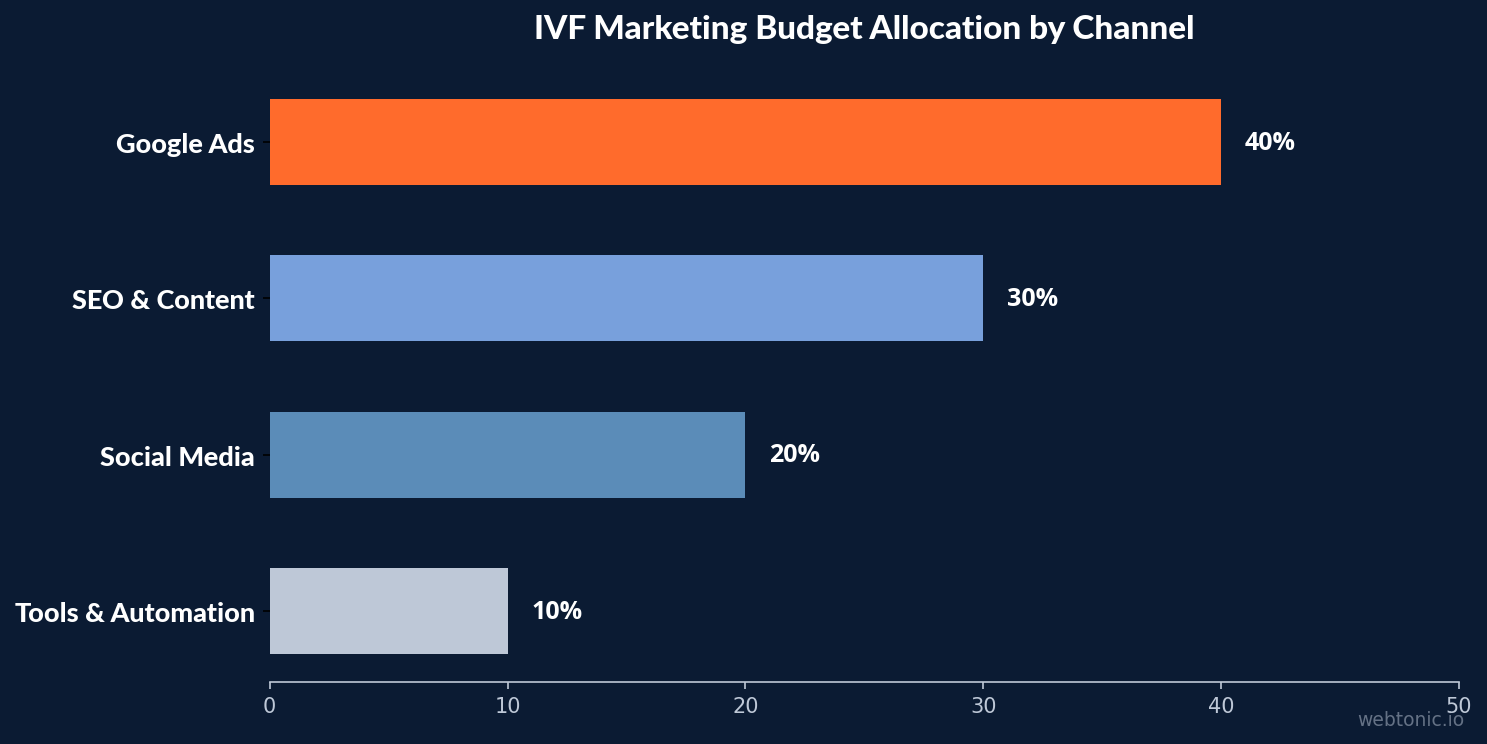
Effective fertility clinic marketing requires a multi-channel approach, with allocation percentages varying based on clinic size and growth objectives. Industry data from Healthcare DMS recommends a standard allocation framework:
| Channel | Budget Share | Primary Role |
|---|---|---|
| Google Ads | 40% | High-intent lead generation |
| SEO & Content | 30% | Organic authority building |
| Social Media Marketing | 20% | Trust-building and retargeting |
| Tools & Automation | 10% | Analytics, CRM, and workflows |
Alternative frameworks from Stethon Digital Marketing suggest a more aggressive paid-first approach: 60–70% to high-intent Google Search and Performance campaigns, 20% to retargeting across Meta, Display, and YouTube, and 10–15% to education and brand authority content. This model works best for clinics prioritizing immediate consultation volume over long-term organic growth.
What matters most, according to Irresist.io, is measuring booked consultations rather than raw leads — tracking inquiry-to-booked rate, booking completion rate, time-to-first-response, and cost per consultation rather than surface metrics like traffic or impressions. Explore our growth marketing services to see how a data-driven approach improves patient acquisition.
Organic Search and SEO Performance Data
SEO remains the highest-ROI long-term channel for fertility clinics. Data from Authority Specialist's analysis of 34 fertility centers reveals that organic search generates 45–60% of total website traffic for top-performing clinics. Conversion rates from organic search leads to initial consultations range from 3–8% depending on content depth and landing page quality.
Local Map Pack visibility influences approximately 40–55% of all local appointment inquiries, making Google Business Profile optimization critical for fertility practices. Mobile search volume for local fertility services now represents 65–80% of total search queries, underscoring the need for mobile-first website experiences.
The timeline for SEO investment varies by market density. According to Authority Specialist, most clinics see measurable keyword ranking improvements within 3–6 months, but significant patient inquiry increases and ROI typically materialize between 9–12 months. One case study from BSPKN documented a 52% increase in organic consultation requests within 6 months and a 78% improvement in consultation-to-booking rate through speed-to-lead optimization.
Paid Advertising Performance Across Channels
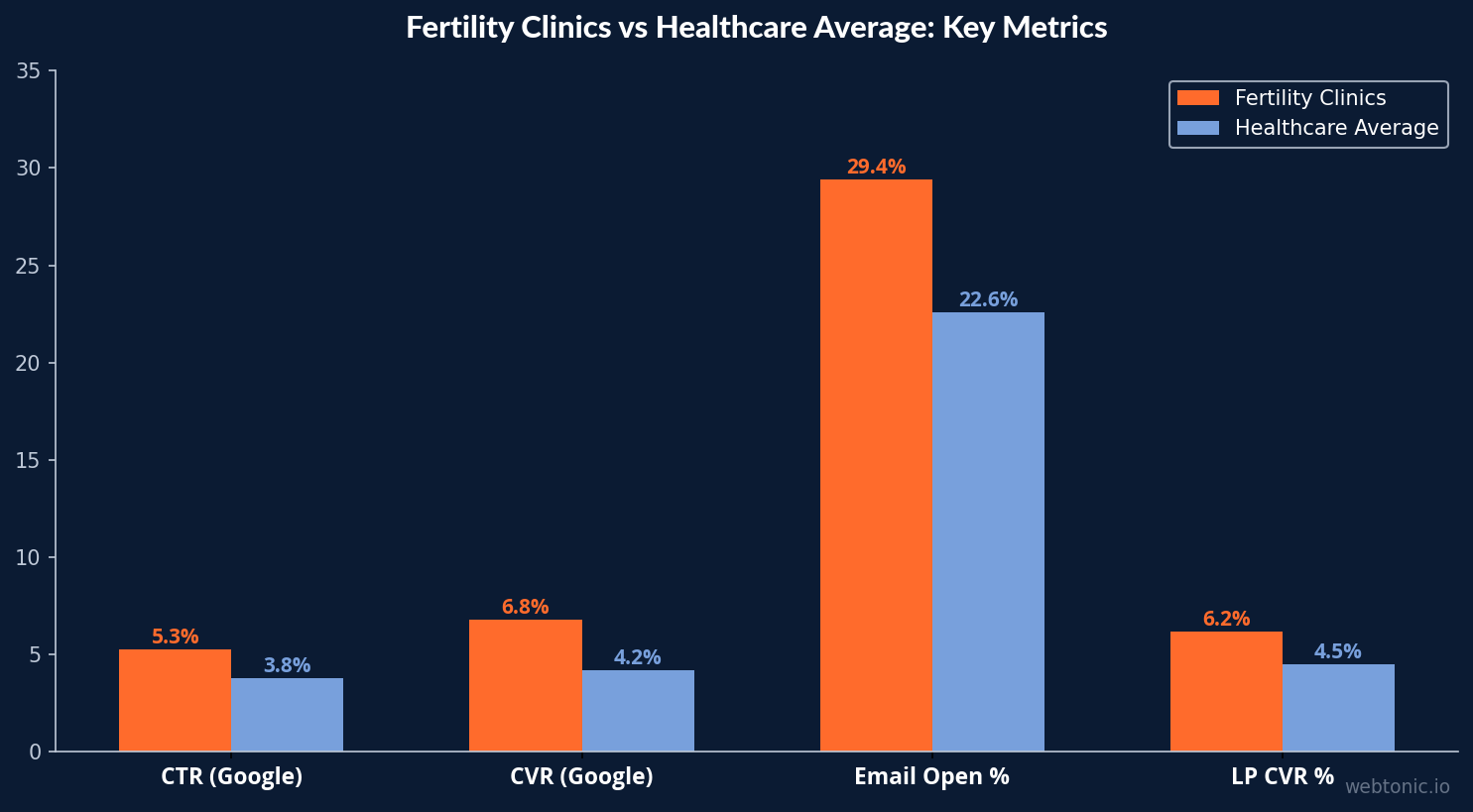
Paid advertising delivers the most immediate results for fertility clinics, with Google Ads capturing high-intent searches and Meta Ads building awareness during the 3–12 month consideration window. According to Benchmarketing, fertility clinic Google Ads achieve a 5.28% click-through rate — above the healthcare average — with a $9.84 CPC and 6.8% conversion rate.
On Meta platforms, fertility clinics see a 1.72% CTR with a 2.8x ROAS. Tandem Medical Marketing notes that video testimonials from real patients are the highest-performing creative format, with Meta reaching patients before they actively search during the extended consideration window. Cost per lead varies significantly by market: $150–$350 CPL for domestic high-intent campaigns and $80–$220 for international clinics targeting US patients.
Case study results demonstrate the compounding impact of multi-channel strategies. LIV Fertility Center grew qualified leads by 243% and sustains 8.2x ROAS across a 2+ year partnership, generating 120 qualified leads per month at $74–$118 CPL. Read our guide on Facebook Ads pricing and budgeting for broader context on paid social investment.
The Patient Journey and Digital Touchpoints
Understanding the fertility patient journey is critical for marketing strategy. Unlike most healthcare verticals, IVF patients conduct 3–12 months of research before contacting a clinic. This extended decision cycle creates unique challenges and opportunities for digital marketers.
According to Inbound Medic, fertility patient journeys span 6–18 months across multiple touchpoints, creating attribution complexity that makes tracking difficult. The highest-performing landing pages focus on reducing uncertainty — pricing transparency, success rates, egg freezing pathways, and failed IVF recovery options — rather than generic service descriptions.
A key barrier identified by ICG is cost anxiety: 42% of prospective patients delay treatment due to upfront cost concerns and fear of undisclosed charges. Clinics that address pricing directly on landing pages see measurably higher consultation booking rates. The real growth driver, notes Irresist.io, is stronger high-intent landing pages focused on decision-stage content (pricing, success rates, egg freezing) rather than more top-of-funnel traffic.
Digital Reproductive Health Market Growth
The broader digital health ecosystem continues to accelerate fertility marketing investment. Probity Market Insights projects the global digital sexual and reproductive health market to reach $16–18 billion by 2033, expanding at a 17.5% CAGR from 2025 to 2033. The women's digital health market specifically grew from $4.36 billion in 2025 to $5.28 billion in 2026, a 20.9% year-over-year increase according to The Business Research Company.
This market expansion translates directly to increased competition for patient acquisition. Clinics that invest in comprehensive data intelligence capabilities — attribution modeling, CRM integration, and multi-touch analytics — gain measurable advantages over competitors still relying on last-click reporting.
| Market Segment | 2025 Value | Projected Growth | CAGR |
|---|---|---|---|
| Digital SRH Market | — | $16–18B by 2033 | 17.5% |
| Women's Digital Health | $4.36B | $5.28B (2026) | 20.9% |
| Female Repro Digital Therapy | $2.03B | $12.0B by 2035 | ~19% |
| Digital Advertising (Global) | $311.86B | $354.9B (2026) | 13.8% |
Conversion Optimization and Speed-to-Lead
Speed-to-lead is arguably the most impactful conversion lever for fertility clinics. BSPKN documented a 78% improvement in consultation-to-booking rate through speed-to-lead optimization alone, paired with 2–4 new Google reviews per week through structured reputation management.
The conversion funnel data from ICG's portfolio of 20+ IVF clinics reveals the true drop-off points: from 3,008 raw leads, only 725 (24.1%) qualified, 248 scheduled appointments, 112 visited, and 41 converted (1.36% of original leads). This funnel data underscores why tracking cost per qualified lead matters more than raw CPL.
Landing page optimization produces the most immediate results. Benchmarketing reports a 6.2% landing page conversion rate for fertility clinics — competitive with the broader healthcare average. Clinics using dedicated landing pages for specific treatments (IVF, egg freezing, IUI) consistently outperform those sending traffic to general service pages. Read more about our performance creative approach to landing page design.
AI Search Visibility and Emerging Channels
AI-powered search is reshaping how patients discover fertility clinics. Research from Authority Specialist reveals that only 17% of fertility providers are named in AI-generated answers (across ChatGPT, Claude, and Gemini), creating both a threat to organic traffic and an opportunity for early movers.
The shift toward AI-mediated search means clinics need to build what FertilitySEO Expert calls a "strategic framework built on three pillars" — clinical authority, content depth, and structured data — rather than the traditional keyword-first approach. Clinics that invest in comprehensive FAQ content, procedure explainers, and success rate data position themselves for both traditional and AI-powered discovery channels.
Fertility vs. General Healthcare Digital Marketing Comparison
| Metric | Fertility Clinics | Healthcare Average | Advantage |
|---|---|---|---|
| Google Ads CTR | 5.28% | 3.2–4.5% | +17–65% |
| Google Ads CVR | 6.8% | 3.5–5.0% | +36–94% |
| Email Open Rate | 29.4% | 21.6–24.8% | +19–36% |
| Patient LTV | $40,000–$80,000 | $5,000–$15,000 | 3–8x higher |
| Research Cycle | 3–12 months | Days–weeks | Longer nurture needed |
| CPA Profitability | $200–$400 | Varies widely | Highly profitable |
Best Practices for Fertility Clinic Digital Marketing
- Invest 8–12% of revenue in marketing during growth phases, allocating 40% to Google Ads, 30% to SEO, and 20% to social (BSPKN; Healthcare DMS, 2026).
- Measure cost per booked consultation, not cost per lead — raw CPL misleads clinics because lead-to-patient conversion rates vary 3x between channels (Irresist.io, 2026).
- Use video testimonials as primary creative across Meta and YouTube, focusing on real patient journey narratives for maximum engagement (Tandem Medical Marketing, 2026).
- Optimize for mobile-first experiences since 65–80% of fertility searches happen on mobile devices (Authority Specialist, 2026).
- Address pricing transparency on landing pages directly — 42% of patients delay due to cost anxiety (ICG, 2026).
- Implement speed-to-lead protocols to improve consultation-to-booking rates by up to 78% (BSPKN, 2026).
- Build AI search visibility through comprehensive FAQ content and structured data — only 17% of providers currently appear in AI answers (Authority Specialist, 2026).
- Track multi-cycle return rates (40–65%) in LTV calculations to justify acquisition costs against total patient value (Tandem Medical Marketing, 2026).
Related reading
- Automotive Digital Marketing Statistics: 2026 Benchmarks & Trends
- Construction Materials Digital Marketing Strategy Trends: Data-Driven Insights for 2026
- Countertops Digital Marketing Statistics: The Complete 2026 Report
- Marketing Strategy Consulting services at Web Tonic
FAQ
How much should a fertility clinic spend on digital marketing?
Most fertility clinics invest $2,000–$6,000 per month on digital marketing, scaling to $10,000–$20,000 in competitive metro areas. Industry guidance suggests allocating 8–12% of revenue during growth phases, with Google Ads receiving the largest share (40%) due to high-intent search capture. The investment is justified by high patient lifetime values of $40,000–$80,000.
What is a good cost per lead for IVF marketing?
Cost per lead for IVF marketing typically ranges from $150–$350 for domestic high-intent campaigns and $80–$220 for international clinics targeting US patients. However, cost per booked consultation is a more meaningful metric because lead-to-patient conversion rates can vary by 3x between channels. A $350 lead that converts at 11% is more profitable than a $150 lead converting at 3%.
Which digital marketing channel delivers the best ROI for fertility clinics?
Google Ads delivers the highest immediate ROI with a 5.28% CTR and 6.8% conversion rate, but organic SEO provides the best long-term returns at 45–60% of total traffic with zero marginal cost per click. The most successful clinics run both simultaneously — paid for immediate lead volume and SEO for compounding organic growth. Meta Ads fills a unique role by reaching patients during the 3–12 month consideration window before they search.
How long does it take for SEO to work for fertility clinics?
Most fertility clinics see measurable keyword ranking improvements within 3–6 months, with significant patient inquiry increases and ROI materializing between 9–12 months. One documented case achieved a 52% increase in organic consultation requests within 6 months. The timeline depends on market competition, content investment, and baseline domain authority.
What role does AI search play in fertility clinic marketing?
AI-powered search engines (ChatGPT, Claude, Gemini) are emerging as discovery channels, but currently only 17% of fertility providers are named in AI-generated answers. Clinics that invest in comprehensive content, structured data (FAQ schema, procedure details), and clinical authority position themselves for both traditional and AI-mediated patient acquisition.
Sources
benchmarketing.org/benchmarks/industries/fertility-clinics
authorityspecialist.com – IVF Clinic SEO Benchmarks 2026
tandemmedicalmarketing.com – IVF Marketing 2026 Playbook
medicalmarketingfirm.com – Fertility & IVF Marketing Budget
irresist.io – What Actually Drives Booked Consultations
bspkn.co – Fertility Clinic Marketing 2026
healthcaredms.com – IVF Digital Marketing India 2026
ichelonconsulting.com – IVF Marketing Complete Guide
probitymarketinsights.com – Digital SRH Market Forecast
fertilityseo.expert – AI SEO Guide for Fertility Clinics