Table of contents
Canada has 170,307 active Shopify stores against 74,660 on WooCommerce, a 2.28-to-1 ratio, according to a Storeleads census pulled in mid-2026. That makes Canada the most Shopify-dominant of the major English-speaking e-commerce markets - ahead of even the United States, despite Shopify's Ottawa headquarters explaining only part of the gap.
Key Takeaways
- Canada has 170,307 active Shopify stores as of the 2026-06-01 Storeleads pull.
- WooCommerce runs 74,660 Canadian stores in the same census.
- Shopify out-counts WooCommerce 2.28 to 1 in Canada.
- 3,853 Canadian stores (2.26%) run Shopify Plus, matching the U.S. Plus density.
- Ottawa hosts 4.9% of Canadian Shopify stores against 3.5% of the population.
- Klaviyo runs email marketing on 12.7% of Canadian Shopify stores (21,637 stores).
- Combined BNPL penetration is only 6.25%, split across four providers.
- No single BNPL provider in Canada clears 3% installed share.
- Retail e-commerce was 6.1% of total Canadian retail trade in December 2025.
- Monthly e-commerce sales ran CAD 4.0-4.3 billion from August to December 2025.
- 78% of Canadian shoppers name free shipping their top purchase factor, per Canada Post.
- More than half of Canadians have already used AI while shopping online, per Novatize x Léger.
- 63% of Canadians say they are inclined to use AI in their purchase journey.
- Apparel is the largest Shopify category in Canada at 19.9% of stores.
Shopify vs WooCommerce: the actual store count
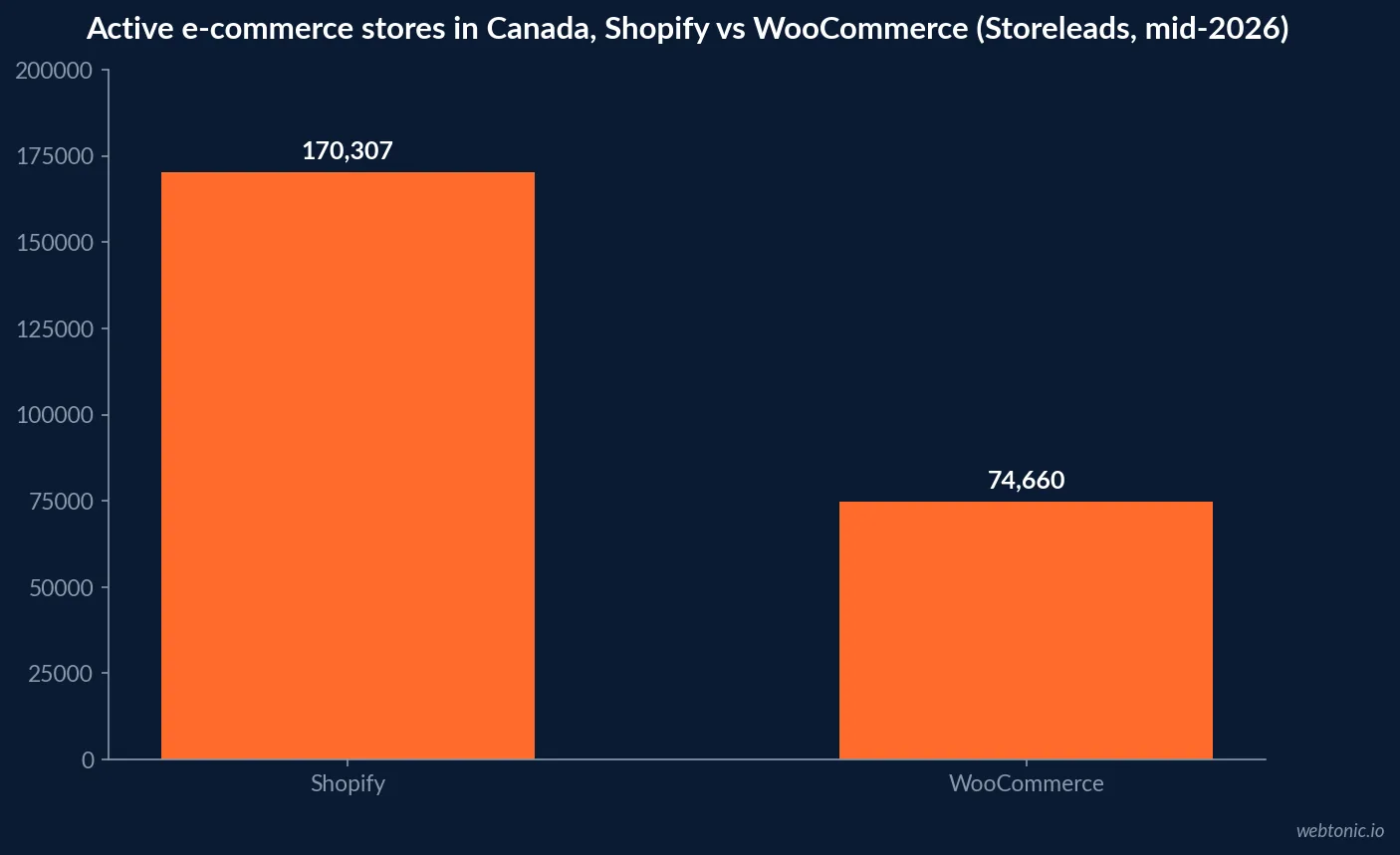
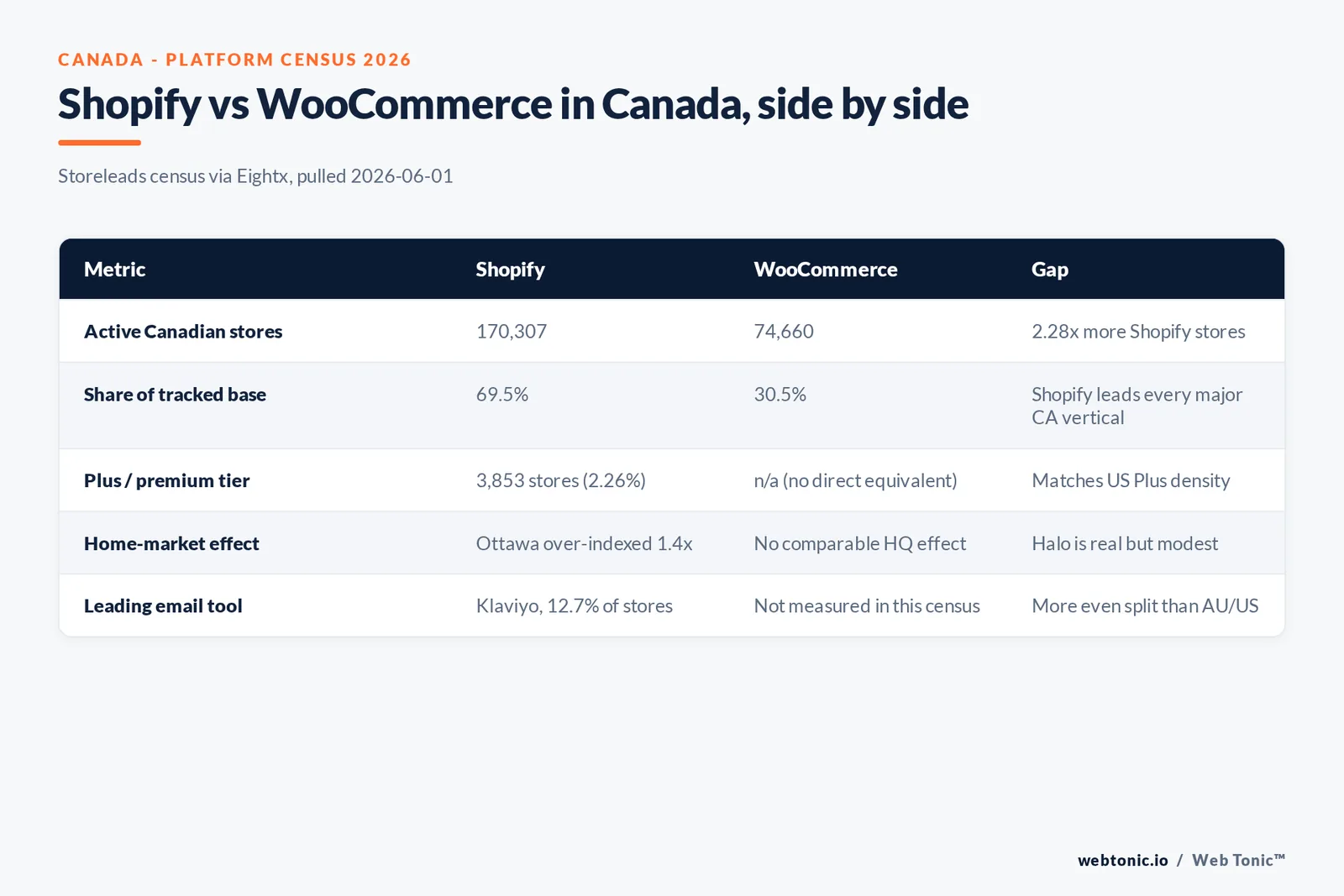
Statistics Canada's retail-trade releases are the standard macro reference, but they say nothing about which platform Canadian merchants are actually building on. A live store census run by Eightx using Storeleads' API on 2026-06-01 counted 170,307 active Canadian Shopify stores against 74,660 on WooCommerce - a 2.28-to-1 ratio in Shopify's favor. That makes Canada more Shopify-dominant than the United States (roughly 2.0-to-1) or Australia (1.82-to-1), the other major Storeleads-tracked English-speaking markets.
| Platform | Active Canadian stores | Share of the two-platform base | Source |
|---|---|---|---|
| Shopify | 170,307 | 69.5% | Storeleads via Eightx, 2026-06-01 |
| WooCommerce | 74,660 | 30.5% | Storeleads via Eightx, 2026-06-01 |
| Shopify Plus (subset) | 3,853 | 2.26% of Shopify base | Storeleads via Eightx |
Why Shopify's home-market advantage is real but smaller than it looks
Shopify is headquartered at 151 O'Connor Street in Ottawa, and the data shows a measurable but modest home-market halo: 4.9% of Canadian Shopify stores are based in Ottawa, against roughly 3.5% of the national population, an over-index of about 1.4x. That is nowhere near large enough to explain a national 2.28-to-1 platform gap - most of Shopify's Canadian lead comes from the rest of the country, not the capital.
What runs alongside the platform: email and payments
The same census shows Klaviyo as the leading paid email marketing tool on Canadian Shopify stores at 12.7% penetration (21,637 stores), with Mailchimp at 6.5%. That is a notably more even split than in Australia, where Klaviyo's penetration reaches 21.4% - Canadian DTC brands are more evenly divided between the two tools than other English-speaking Shopify markets.
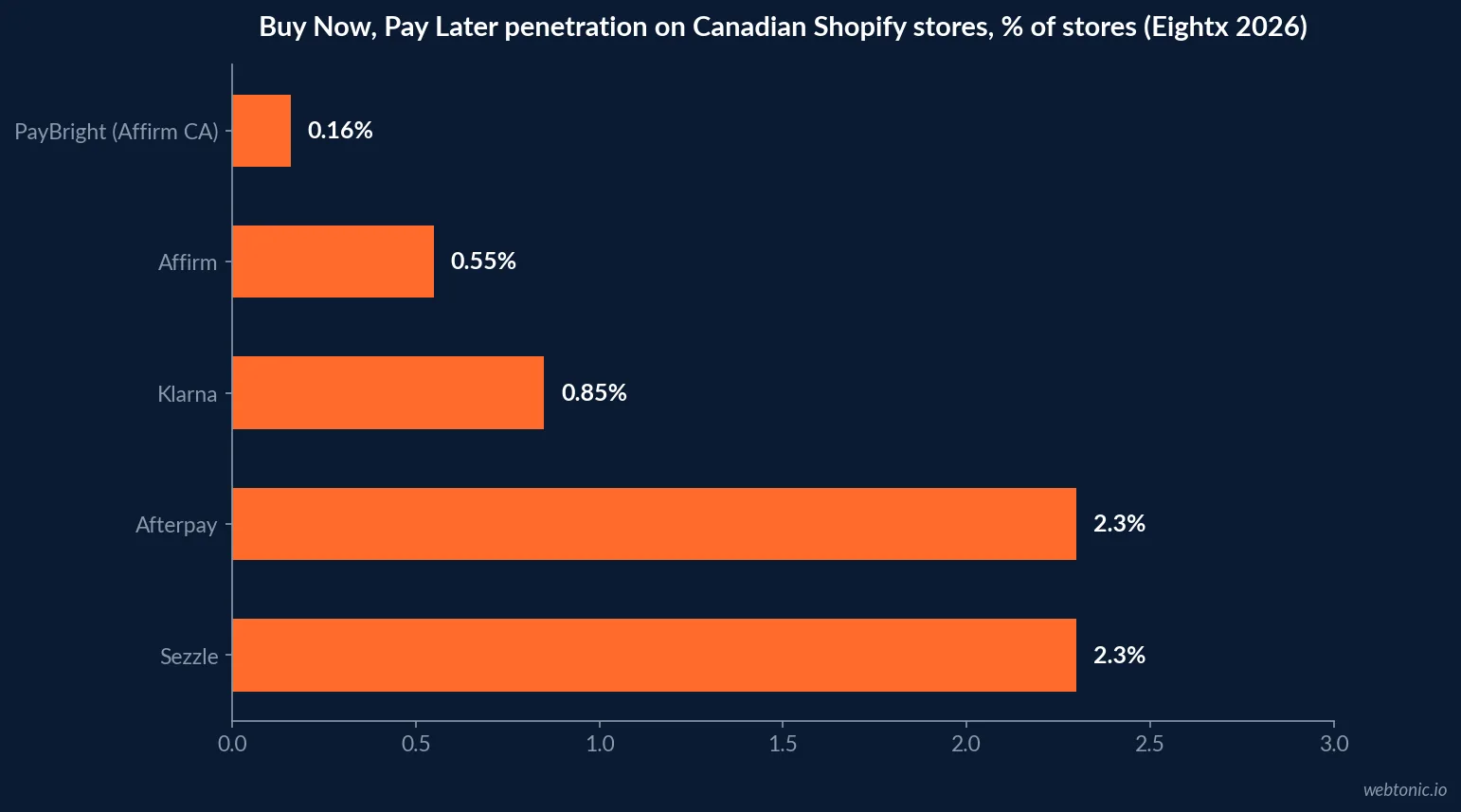
Buy Now, Pay Later tells a similar fragmentation story. Canada is, per Eightx, "the most BNPL-fragmented major Shopify market we have measured": Sezzle and Afterpay each sit at 2.3% installed share, Klarna at 0.85%, Affirm at 0.55% and PayBright (Affirm's Canadian brand) at 0.16%. Combined BNPL penetration across all four is just 6.25% - compare that with Afterpay alone controlling 26.3% of Australian Shopify stores.
| Tool / provider | Canadian Shopify penetration | Category |
|---|---|---|
| Klaviyo | 12.7% (21,637 stores) | Email marketing |
| Mailchimp | 6.5% | Email marketing |
| Sezzle | 2.3% | Buy Now, Pay Later |
| Afterpay | 2.3% | Buy Now, Pay Later |
| Klarna | 0.85% | Buy Now, Pay Later |
| Affirm | 0.55% | Buy Now, Pay Later |
| PayBright (Affirm CA) | 0.16% | Buy Now, Pay Later |
What Statistics Canada's own numbers say about the wider market
Statistics Canada's December 2025 retail trade release put seasonally adjusted retail e-commerce sales at CAD 4.3 billion, 6.1% of total retail trade, up from 5.8% in November. Earlier months in the same reporting run showed e-commerce ranging from CAD 4.0 to 4.3 billion monthly and between 5.7% and 6.2% of total retail trade - a narrower band than the Census Bureau's comparable U.S. figures because Statistics Canada's retail trade base differs in scope.
Broader estimates that define "online retail" more loosely put the market bigger still: Landmark Global's analysis puts Canadian e-commerce at roughly 14.5% of total retail sales and CAD 75-80 billion in value, with 34% of purchases originating from cross-border sellers - a reminder that, as with the U.S. market, "share of retail" depends entirely on which retail base is being divided.
| Month (2025) | Retail e-commerce (SA) | Share of total retail trade |
|---|---|---|
| August | CAD 4.3B | 6.1% |
| September | CAD 4.1B | 5.9% |
| October | CAD 4.1B | 6.0% |
| November | CAD 4.0B | 5.7% |
| December | CAD 4.3B | 6.1% |
What the census can't tell you about your own store
Every figure in the Storeleads census is a count of stores, not a measure of revenue, traffic or profitability - a Shopify store with one sale a month counts the same as one doing seven figures. That matters for how the 2.28-to-1 platform ratio should be read: it says where Canadian merchants choose to build, not where Canadian e-commerce revenue actually concentrates. Statistics Canada's retail-trade releases, by contrast, measure dollars but say nothing about platform - the two data sets answer different questions and neither substitutes for the other.
Shoppers still buy on shipping, and now on AI
Canada Post's own commissioned research, covering 5,000 Canadian consumers, found 78% naming free shipping as the top factor influencing their online purchase decisions - the single most consistent lever Canadian merchants can pull regardless of which platform they run.
A newer behavior is showing up fast: the Novatize x Léger 2026 eCommerce Trends Report, surveying 1,525 Canadians, found more than half have already used an AI tool such as ChatGPT, Gemini or Copilot while shopping online, and 63% say they are inclined to use AI as part of their purchase journey going forward.
How Canada compares with other Storeleads-tracked markets
Line up the three major English-speaking Shopify markets Eightx has censused and Canada's Shopify lead is the widest of the three: 2.28-to-1 in Canada, against roughly 2.0-to-1 in the United States and 1.82-to-1 in Australia. Plus penetration, by contrast, is nearly identical across all three at 2.2% to 2.4% of the base - the premium tier scales with store count everywhere, but WooCommerce's competitiveness against Shopify varies meaningfully by market.
Shopify's own Q4 2024 Investor Overview Deck shows Canada at roughly 5% of its global merchant base, geographically dwarfed by the U.S. (44%) and EMEA (31%) despite Shopify being a Canadian company - most of Shopify's own growth has come from outside the country it was built in.
| Market | Shopify : WooCommerce ratio | Shopify Plus share | Source |
|---|---|---|---|
| Canada | 2.28 : 1 | 2.26% | Storeleads via Eightx |
| United States | ~2.0 : 1 | 2.26% | Storeleads via Eightx |
| Australia | 1.82 : 1 | 2.40% | Storeleads via Eightx |
| Shopify global merchant base | n/a | 2.10% (global Plus density) | Shopify Investor Deck / Storeleads |
Ottawa's home-market effect, in absolute numbers
Separately from the Eightx national census, Storeleads' own city-level report counts 8,387 live Shopify stores in Ottawa specifically - a useful absolute number behind the "4.9% of the national base" figure cited above, and a reminder that even a measurable home-market halo still leaves the overwhelming majority of Canadian Shopify stores built somewhere else entirely.
Zoomed out to the global platform market, W3Techs tracks WooCommerce at 48.4% of all e-commerce websites worldwide and 11.7% of all websites whose CMS it can detect - a global picture where WooCommerce actually leads, which makes Canada's 2.28-to-1 Shopify tilt more of an outlier than the domestic numbers alone suggest.
| Global vs Canadian platform picture | Figure | Source |
|---|---|---|
| WooCommerce share of e-commerce sites worldwide | 48.4% | W3Techs |
| WooCommerce share of all websites worldwide | 11.7% | W3Techs |
| Shopify : WooCommerce ratio, Canada only | 2.28 : 1 (Shopify leads) | Storeleads via Eightx |
| Shopify stores in Ottawa specifically | 8,387 | Storeleads |
The category and city picture behind the platform numbers
Apparel is the single largest category on Canadian Shopify at 19.9% of stores in the Eightx census, ahead of every other top-level category tracked. Combined with Ottawa's modest over-index and the wide Klaviyo-Mailchimp split described above, the picture that emerges is a market where platform choice, category and tooling are all more evenly distributed than a single headline number like "170,307 Shopify stores" suggests on its own.
None of these figures move quickly. Storeleads and similar stack-detection census tools re-pull the data periodically, so a snapshot dated 2026-06-01 should be treated as accurate for planning purposes through the following one to two quarters, not as a live feed - platform migrations at the scale needed to shift a 2.28-to-1 national ratio take years, not months, to show up in a re-pull. Treat the numbers on this page the same way you would a census: directionally reliable for a full planning cycle, and worth a fresh pull before locking in a multi-year platform commitment or a full replatforming project, especially before a peak season.
What this means for a Canadian stack decision
The store-count data argues Shopify by default for most new Canadian storefronts, but WooCommerce still runs nearly a third of the tracked base, and the platform gap says nothing about your specific vertical, budget for transaction fees, or need for a fully owned WordPress stack. What the data does make clear is that email tooling (Klaviyo over Mailchimp) and shipping cost transparency matter more to conversion than the platform argument itself. Our growth marketing practice builds channel and stack plans for Canadian and U.S. DTC brands alike; see also our take on what paid social costs when budgeting the acquisition side of a Canadian launch, and our data and analytics practice for benchmarking a store's own numbers against the figures on this page.
Frequently Asked Questions
Does Shopify or WooCommerce lead in Canada?
Shopify does, by a wide margin. A Storeleads census pulled by Eightx on 2026-06-01 counted 170,307 active Shopify stores in Canada against 74,660 on WooCommerce - a 2.28-to-1 ratio that makes Canada the most Shopify-dominant of the major English-speaking markets, ahead of the United States (about 2.0-to-1) and Australia (1.82-to-1).
Why is Shopify so dominant specifically in Canada?
Partly geography: Shopify is headquartered at 151 O'Connor Street in Ottawa, and Ottawa is over-indexed by roughly 1.4x versus its share of the national population - 4.9% of Canadian Shopify stores sit in Ottawa against about 3.5% of the population. The home-market effect is real, though smaller than the headline gap between Shopify and WooCommerce suggests.
How much of Canadian retail happens online?
Statistics Canada's monthly retail trade releases put seasonally adjusted e-commerce at 5.7% to 6.1% of total retail trade through late 2025, on monthly e-commerce sales of roughly CAD 4.0 to 4.3 billion. Other estimates that use a broader online-retail definition, such as Landmark Global's, put the figure closer to 14.5% and value the market at roughly CAD 75-80 billion.
What tools run alongside Shopify in Canada?
Klaviyo leads paid email marketing tools on Canadian Shopify stores at 12.7% penetration (21,637 stores), with Mailchimp at 6.5%, per the same Storeleads census. Buy Now, Pay Later is unusually split: Sezzle and Afterpay each sit at 2.3% of stores, with Klarna at 0.85% and Affirm at 0.55% - no single provider clears 3%, the most fragmented BNPL market Eightx has measured.
Are Canadian shoppers using AI to shop online?
Yes, and quickly. The Novatize x Léger 2026 eCommerce Trends Report found more than half of Canadians have already used an AI tool in an online shopping context, and 63% say they are inclined to use AI as part of their purchasing journey - a shift retailers building 2027 roadmaps should plan storefront and content structure around now.
Sources
Eightx - Shopify's backyard: the Canadian Shopify landscape, 2026 Storeleads census
Statistics Canada - The Daily, Retail trade, December 2025
Statistics Canada - Retail trade, October 2025
Landmark Global - Essential facts about Canadian e-commerce in 2026
Canada Post - Think Like an E-commerce Leader consumer research
Novatize - AI and eCommerce: Canadians' shopping habits, 2026 (Novatize x Léger)