Table of contents
Australians spent a record AUD 82.6 billion online in 2025, up 14% year over year, according to Australia Post's eCommerce Report 2026. Growth is holding up, but the average basket size just hit a record low - a combination that should reshape how e-commerce teams plan next year's budget line by line.
Key Takeaways
- Australians spent a record AUD 82.6 billion online in 2025, up 14% YoY.
- 9.8 million households shopped online in 2025, a new participation record.
- NAB's Online Retail Sales Index measured AUD 66.23 billion for the 12 months to September 2025, up 14.2% YoY.
- Online retail was 14.9% of total Australian retail sales on NAB's stricter measure.
- Q4 FY26 online spend was AUD 21.9 billion, up 14% YoY and a quarter of all retail spend.
- Average basket size fell to a record low of AUD 90 in Q4 FY26.
- 7.2 million households shopped online marketplaces in 2025, 73% of all online shoppers.
- Australia has 152,323 active Shopify stores, per a Storeleads census.
- Shopify out-counts WooCommerce 1.82 to 1 in Australia.
- Afterpay sits on 26.3% of Australian Shopify stores, the highest BNPL penetration measured anywhere.
- Klaviyo runs marketing on 21.4% of Australian Shopify stores.
- 71% of Australians plan to shop EOFY sales in 2026, matching 2025's rate.
- 83% of Australians say they are more price-conscious than a year ago, per PayPal.
- Nearly all Australian adults (99.7%) use at least one device to go online.
The headline number: a record year, two ways to measure it
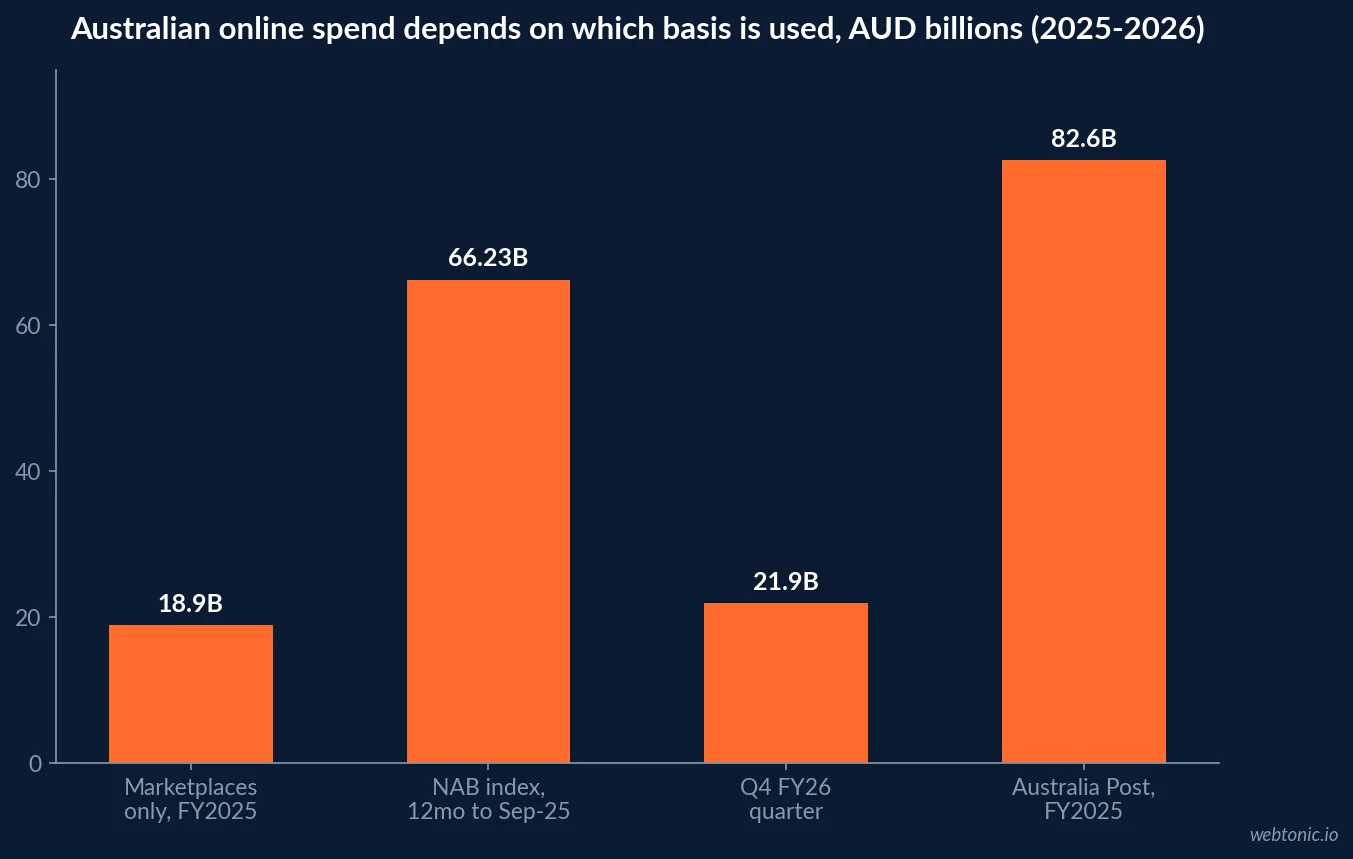
Australia Post's eCommerce Report 2026 recorded Australians spending a record AUD 82.6 billion online in 2025, up 14% year on year, with 9.8 million households shopping online - a new participation record, with 41% of households shopping online at least fortnightly. Using a narrower "pure online retail transactions" definition, NAB's Online Retail Sales Index measured the 12 months to September 2025 at AUD 66.23 billion, also up 14.2% year over year, putting online retail at roughly 14.9% of total Australian retail trade.
Both trackers agree on the growth rate; they disagree on the base, the same pattern seen in the U.S. and Canadian markets. Budget owners should treat Australia Post's figure as the "everything shoppers buy online" ceiling and NAB's as the stricter "online retail transactions" floor.
| Tracker | Period | Online spend | YoY growth | Basis |
|---|---|---|---|---|
| Australia Post | Full year 2025 | AUD 82.6B | +14% | Broad online spend, all categories |
| NAB Online Retail Sales Index | 12 months to Sep 2025 | AUD 66.23B | +14.2% | Pure online retail transactions |
| Australia Post | Q4 FY26 (quarterly) | AUD 21.9B | +14% | Broad online spend, quarterly |
| Australia Post marketplaces | Full year 2025 | AUD 18.9B | +13% | Online marketplace spend only |
Growth is holding, but the average order is shrinking
The number budget owners should watch closest is basket size, not the headline spend. Australia Post's Q4 FY26 Quarterly eCommerce Update recorded AUD 21.9 billion spent online in the quarter, up 14% year over year and representing a quarter (25%) of all retail spend - but average basket sizes fell to a record low of AUD 90 as shoppers grew more cautious. Marketplaces held their share of that behavior: 7.2 million households shopped at online marketplaces in 2025, 73% of all online shoppers, at a flat average basket of AUD 56.37.
The budget implication is direct: a plan built only on last year's average order value will overstate 2027 revenue even if unit volumes and conversion both grow, because the per-order dollar figure is moving the wrong way.
| Q4 FY26 metric | Figure | Trend |
|---|---|---|
| Total online spend | AUD 21.9B | +14% YoY |
| Share of total retail spend | 25% | Record high |
| Average basket size | AUD 90 | Record low |
| Marketplace shoppers | 7.2M households / 73% of online shoppers | Flat share |
| Marketplace average basket | AUD 56.37 | Flat YoY |
Platform and payment budget: Shopify, WooCommerce and Afterpay
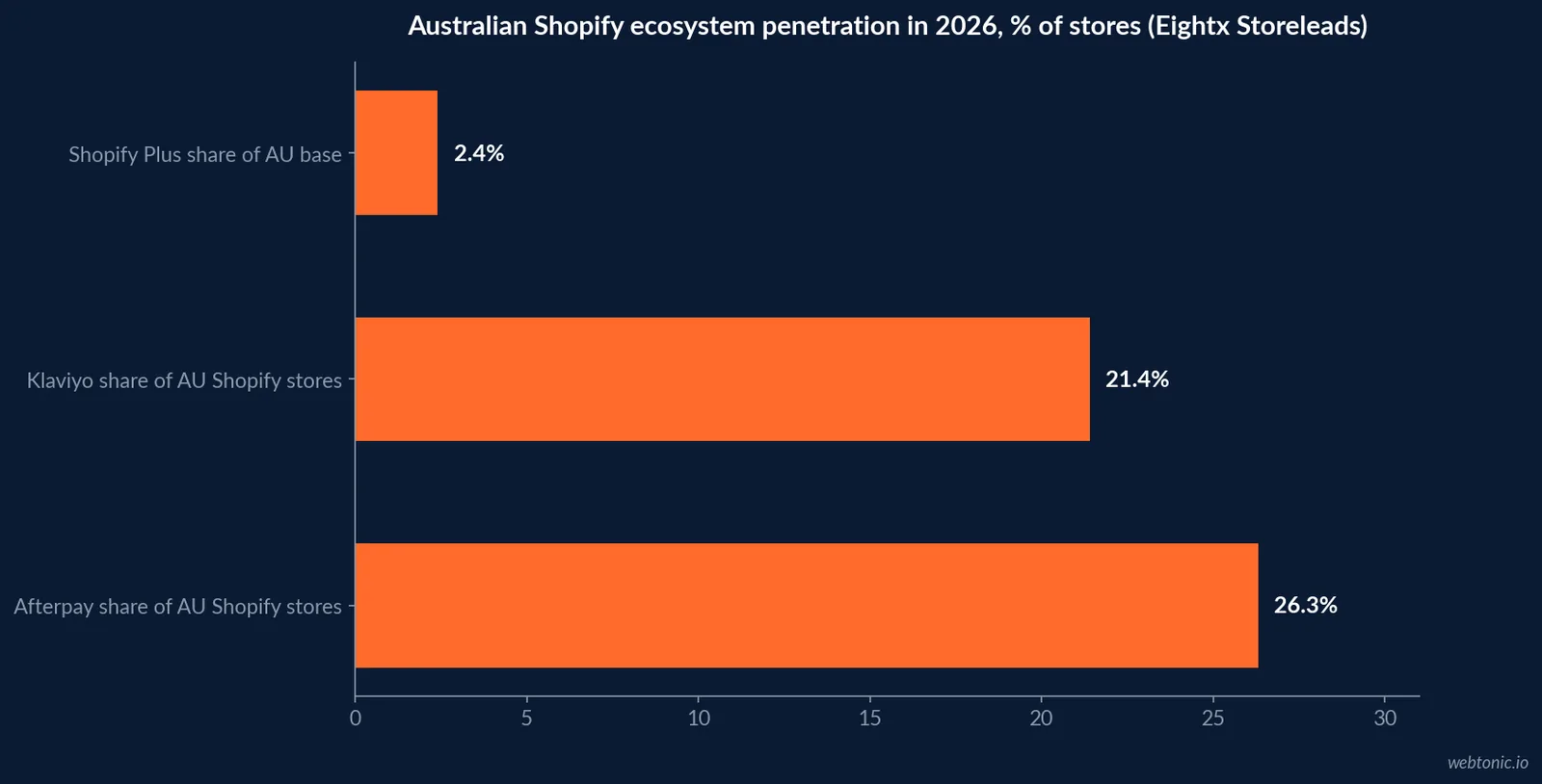
A Storeleads census run by Eightx counted 152,323 active Shopify stores in Australia, out-counting WooCommerce by 1.82 to 1. 3,653 of those stores (2.40%) run Shopify Plus, slightly above the 2.10% global Plus density. The standout budget line, though, is payments: Afterpay sits on 26.3% of Australian Shopify stores (40,124 installs) - the highest Buy Now, Pay Later penetration measured in any Shopify market on earth, according to Eightx. A checkout without Afterpay in Australia is now the outlier, not the norm.
On the marketing-tool line, Klaviyo runs on 21.4% of Australian Shopify stores (32,675 stores) against 7.6% for Mailchimp - a penetration gap 2.8 times wider than the next competitor, worth budgeting as close to a default line item rather than a discretionary test.
| Line item | Australian benchmark | Budget implication |
|---|---|---|
| E-commerce platform | Shopify out-counts WooCommerce 1.82 to 1 | Default to Shopify unless a specific reason argues otherwise |
| Shopify Plus | 2.40% of AU Shopify base | Reserve for scaling brands, not the default tier |
| Buy Now, Pay Later | Afterpay on 26.3% of AU Shopify stores | Budget the integration and fee as a checkout cost of doing business |
| Email marketing platform | Klaviyo on 21.4% of AU Shopify stores | Treat as the default tool, not a test |
| Top category | Apparel at 21.5% of AU Shopify stores | Benchmark creative and promo cadence against apparel norms |
What the store-count data can't tell a budget owner
The Storeleads and Plug2Data counts above measure how many stores run each platform, not how much revenue moves through them - a single large retailer on WooCommerce can outspend thousands of small Shopify stores in media budget. Treat the 1.82-to-1 ratio as a signal about where the ecosystem (apps, agencies, freelancers, payment integrations) is built for, not as a revenue forecast on its own; pair it with Australia Post's and NAB's dollar figures before sizing a category-level plan.
The retail moment worth budgeting around: EOFY
PayPal's 2026 EOFY research found 71% of Australians plan to shop End of Financial Year sales, matching 2025's participation rate, even as 83% say they are more price-conscious than a year ago. 74% say cost-of-living pressure makes them more likely to shop sales events specifically, and 59% of EOFY shoppers plan to spend the same or more than in 2025. Nearly half (49%) plan to buy something for themselves, and a third (33%) are using EOFY as a head start on Christmas shopping - useful context for planning creative and inventory ahead of the June sale window rather than only around the November-December peak most global calendars default to.
How the Australian platform mix compares globally
Australia's Shopify lean is not unique to Australia, but it is unusually strong. A cross-market count from Plug2Data, tracking 296,288 online stores in Australia, puts Shopify at 51.7% of tracked stores against WooCommerce's 27.7% - a figure that corroborates Eightx's 1.82-to-1 ratio from a different data pull and vendor. Compare that with the global picture: W3Techs puts WooCommerce at 48.4% of e-commerce sites worldwide, meaning Australia's market runs opposite to the global default, another reason budget assumptions imported from a US or European playbook can misfire locally.
| Source | Shopify share | WooCommerce share | Scope |
|---|---|---|---|
| Plug2Data | 51.7% | 27.7% | 296,288 tracked Australian online stores |
| Eightx (Storeleads) | ~64.6% of the two-platform base | ~35.4% | Shopify vs WooCommerce only, 1.82:1 |
| W3Techs | n/a (global average lower) | 48.4% | All e-commerce websites worldwide |
What the internet-use base looks like behind the spending numbers
The spending figures above sit on top of a near-universal online population. Nearly all Australian adults, 99.7%, used at least one device to go online in the six months to 2025, up from 90% in 2019 - meaning the growth budget owners are chasing is coming almost entirely from existing internet users spending differently, not from a still-growing pool of new shoppers coming online for the first time. That argues for budget weighted toward conversion and retention rather than pure top-of-funnel reach, where the addressable audience has essentially stopped expanding.
| Population metric | Figure | Trend since 2019 |
|---|---|---|
| Australian adults using at least one device online | 99.7% | Up from 90% in 2019 |
| Households shopping online in 2025 | 9.8 million | New participation record |
| Households shopping online marketplaces | 7.2 million (73% of online shoppers) | Flat share YoY |
What a 12-month look-back adds that a single report can't
NAB's index and Australia Post's report cover overlapping but not identical windows - NAB's most recent published 12-month total runs to September 2025, while Australia Post's headline figure is a full calendar year and its quarterly update covers FY26 Q4. Reading all three together, rather than quoting whichever single figure a vendor pitch leads with, is the only way to see both the steady ~14% growth rate and the basket-size warning sign in the same picture.
Where official statistics fit in
The Australian Bureau of Statistics' retail trade series tracks turnover including online sales inside a broader retail trade measure, but does not publish the kind of standalone quarterly "e-commerce share of retail" headline that the U.S. Census Bureau does - which is why industry trackers built on transaction and delivery data, like NAB and Australia Post, carry more of the e-commerce-specific narrative in Australia than the official statistics agency itself.
What to put in next year's budget
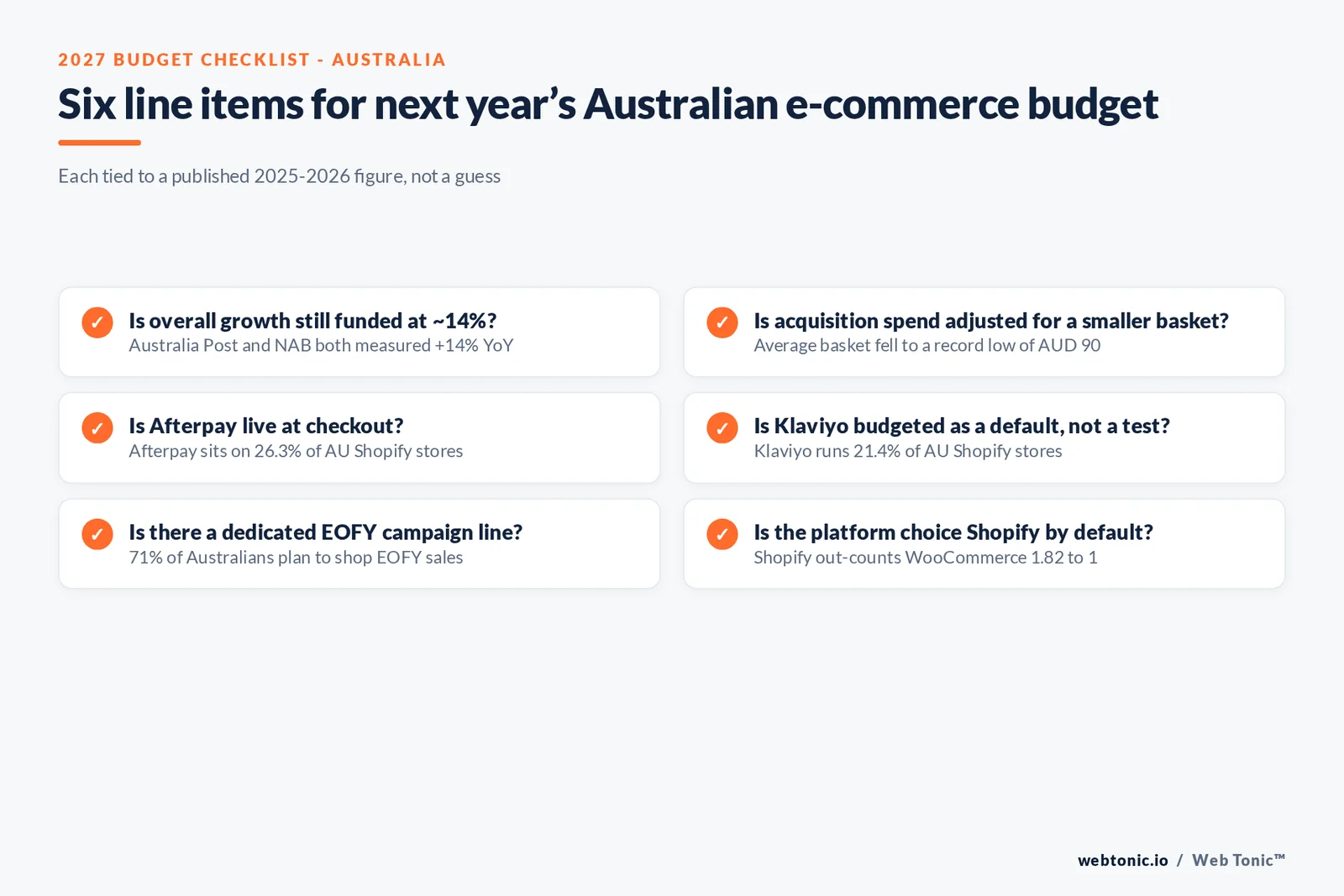
Four things a 2027 Australian e-commerce budget should assume, based on the data above: growth continues at roughly 14% (both trackers agree), average order value keeps falling so acquisition spend needs to work harder per order, Afterpay is now a checkout cost of doing business rather than a nice-to-have, and EOFY deserves a dedicated campaign budget separate from the November-December peak. Our growth marketing practice builds exactly these market-specific plans, and our guide to Google Ads pricing is a useful reference when sizing the acquisition line against a shrinking basket. Our data and analytics practice can build the basket-size and channel-mix tracking a plan like this needs month to month.
Frequently Asked Questions
How much do Australians spend online in a year?
Australia Post's eCommerce Report 2026 recorded a record AUD 82.6 billion spent online in 2025, up 14% year over year, with 9.8 million households shopping online - a new participation record. NAB's Online Retail Sales Index measured the 12 months to September 2025 at AUD 66.23 billion, up 14.2% year over year, using a narrower definition of pure online retail transactions.
Is online spending growth in Australia slowing down?
Growth is holding but the basket is shrinking. Australia Post's Q4 FY26 update recorded AUD 21.9 billion spent online, still up 14% year over year and a quarter of all retail spend, but the average basket size fell to a record low of AUD 90 as shoppers became more cautious and price-conscious.
Should an Australian e-commerce team budget more for Shopify or WooCommerce?
Shopify, based on installed base: a Storeleads census counted 152,323 active Australian Shopify stores against roughly half that on WooCommerce, an 1.82-to-1 ratio. Budget should also account for Afterpay: it sits on 26.3% of Australian Shopify stores, the highest Buy Now, Pay Later penetration Eightx has measured in any Shopify market worldwide.
What retail moment should Australian e-commerce budgets prioritize?
End of Financial Year (EOFY) sales, based on PayPal's 2026 research: 71% of Australians plan to shop EOFY sales, the same rate as 2025, even though 83% say they are more price-conscious than a year ago. 74% say cost-of-living pressure makes them more likely to shop sales events specifically, and 59% plan to spend the same or more than in 2025.
What does Australia's official retail data say versus industry reports?
The Australian Bureau of Statistics tracks retail turnover including online sales inside its broader retail trade series but does not publish a single official 'online share' headline the way the U.S. Census Bureau does. That gap is why industry trackers like NAB and Australia Post, which use their own transaction and delivery data respectively, are the primary sources budget owners cite for e-commerce-specific figures in Australia.
Sources
Australia Post - eCommerce Report 2026
Australia Post - Quarterly eCommerce Update, FY26 Q4
NAB - Online Retail Sales Index, September 2025
Australian Bureau of Statistics - Retail Trade, Australia
Eightx - The Australian Shopify landscape 2026, Storeleads census
PayPal - eCommerce Index 2026 (Australia)
PayPal Newsroom - EOFY shopping research, Australia 2026