Table of contents

E-commerce brands lose an average of 21% of their conversion data to platform signal loss, yet the attribution software market is projected to reach $25.65 billion by 2036. These e-commerce marketing attribution statistics show exactly where tracking breaks, which models recover the most revenue, and how leading brands are adapting in a privacy-first landscape.
Key Takeaways
- Multi-touch attribution models cut e-commerce ad waste by up to 73% compared to single-touch approaches
- Meta experiences 32% average signal loss post-iOS 17, while Google Ads loses only 11%
- 60–70% of EU web traffic now blocks or limits third-party cookies by default
- Server-side tracking recovers 20–40% of missed conversions that client-side pixels cannot capture
- Google Ads commands 38.3% of attributed e-commerce revenue, the largest single-channel share in May 2026
- Time-decay attribution yields 3.7× ROAS versus 3.2× for last-click in head-to-head comparisons
- The attribution software market grew from $5.37B to a projected $25.65B at a 14.2% CAGR through 2036
E-Commerce Attribution Benchmarks at a Glance
| Metric | Value | Source |
|---|---|---|
| Attribution Software Market (2025) | $5.37 billion | GII Research |
| Projected Market Size (2036) | $25.65 billion (14.2% CAGR) | GII Research |
| Multi-Touch Ad Waste Reduction | Up to 73% | Ecommerce Times |
| Meta Signal Loss (Post-iOS 17) | 32% avg. (range 18–48%) | GrowWithBA |
| Google Ads Signal Loss | 11% avg. (range 5–22%) | GrowWithBA |
| TikTok Signal Loss | 24% avg. (range 14–35%) | GrowWithBA |
| EU Traffic Blocking 3P Cookies | 60–70% | Elido |
| Server-Side Recovery Rate | 20–40% of missed conversions | Releva AI |
| CAPI Adoption (Meta Advertisers) | ~60% | GrowWithSakib |
| Server-Side Tracking Adoption | 70% of marketers | Gartner 2025 |
Attribution Channel Mix: How E-Commerce Revenue Splits in 2026
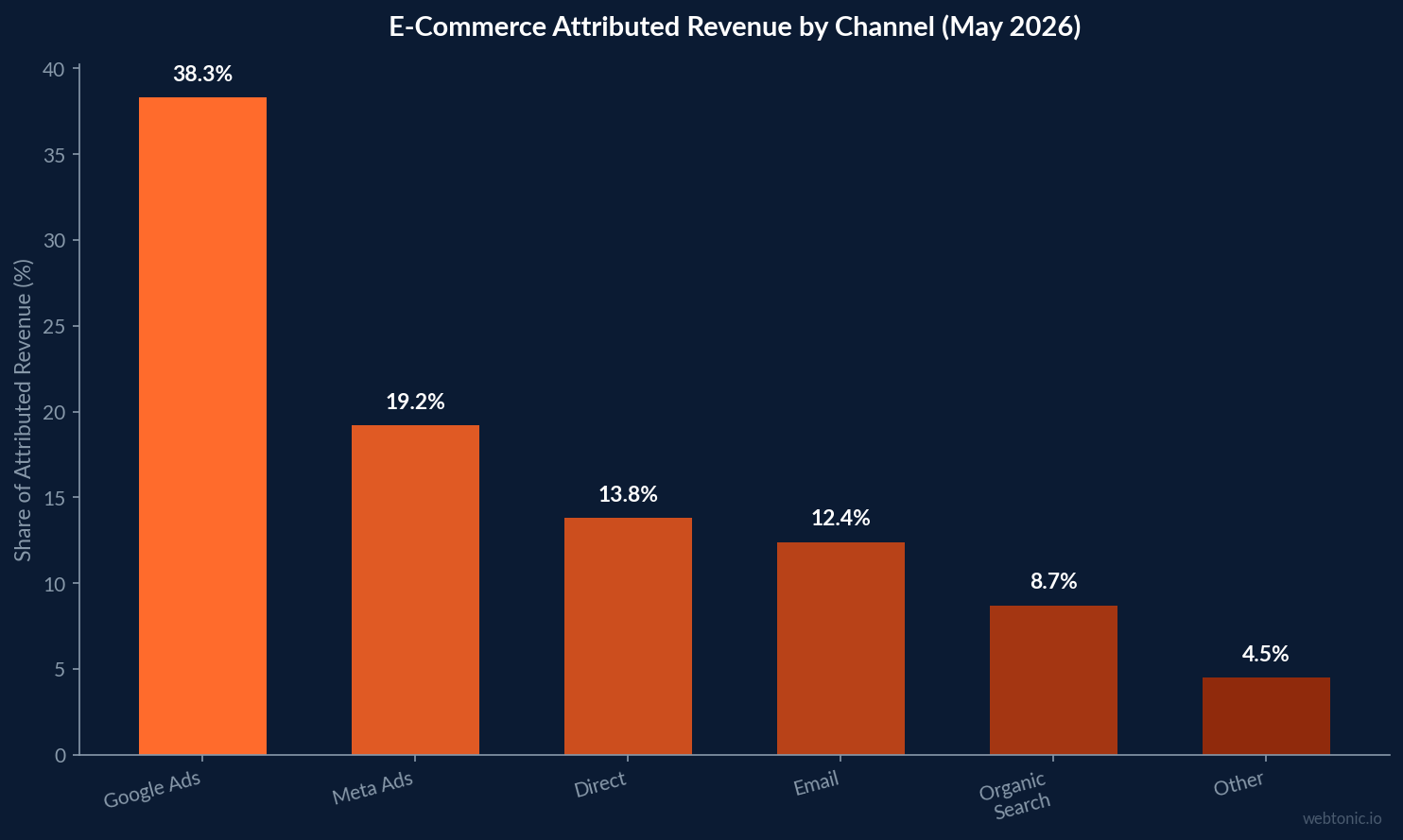
A ThoughtMetric benchmarking report tracks attributed revenue across thousands of e-commerce stores on a monthly basis. In May 2026, Google Ads captured 38.3% of attributed revenue, edging up from 38.1% in April. Meta Ads held 19.2%, while Direct traffic dropped to 13.8% from 14.6% the prior month — a 5.5% month-over-month decline. Other and custom channels accounted for 4.5%, declining 4.3% from the previous month.
Email marketing contributed 12.4% of attributed revenue, and organic search provided 8.7%. These shifts highlight how paid channels — especially Google Ads — continue to dominate e-commerce attribution, while direct traffic's share erodes as attribution models improve at crediting upstream touchpoints. For brands running both Google Ads and Meta Ads, the channel-mix data underscores why multi-touch models outperform last-click measurement: direct traffic often masks the paid channel that actually initiated the customer journey.
| Channel | May 2026 Share | Apr 2026 Share | MoM Change |
|---|---|---|---|
| Google Ads | 38.3% | 38.1% | +0.5% |
| Meta Ads | 19.2% | 18.9% | +1.6% |
| Direct | 13.8% | 14.6% | −5.5% |
| 12.4% | 12.1% | +2.5% | |
| Organic Search | 8.7% | 8.9% | −2.2% |
| Other/Custom | 4.5% | 4.7% | −4.3% |
Platform Signal Loss: The Attribution Gap by Channel
A 150-brand study by GrowWithBA quantified the attribution gap across major advertising platforms in 2026. Attribution has become the most disagreed-upon number in marketing — Meta reports one set of conversions, Google reports another, and CFOs struggle to reconcile the discrepancy. The study's findings reveal the structural causes behind this confusion.
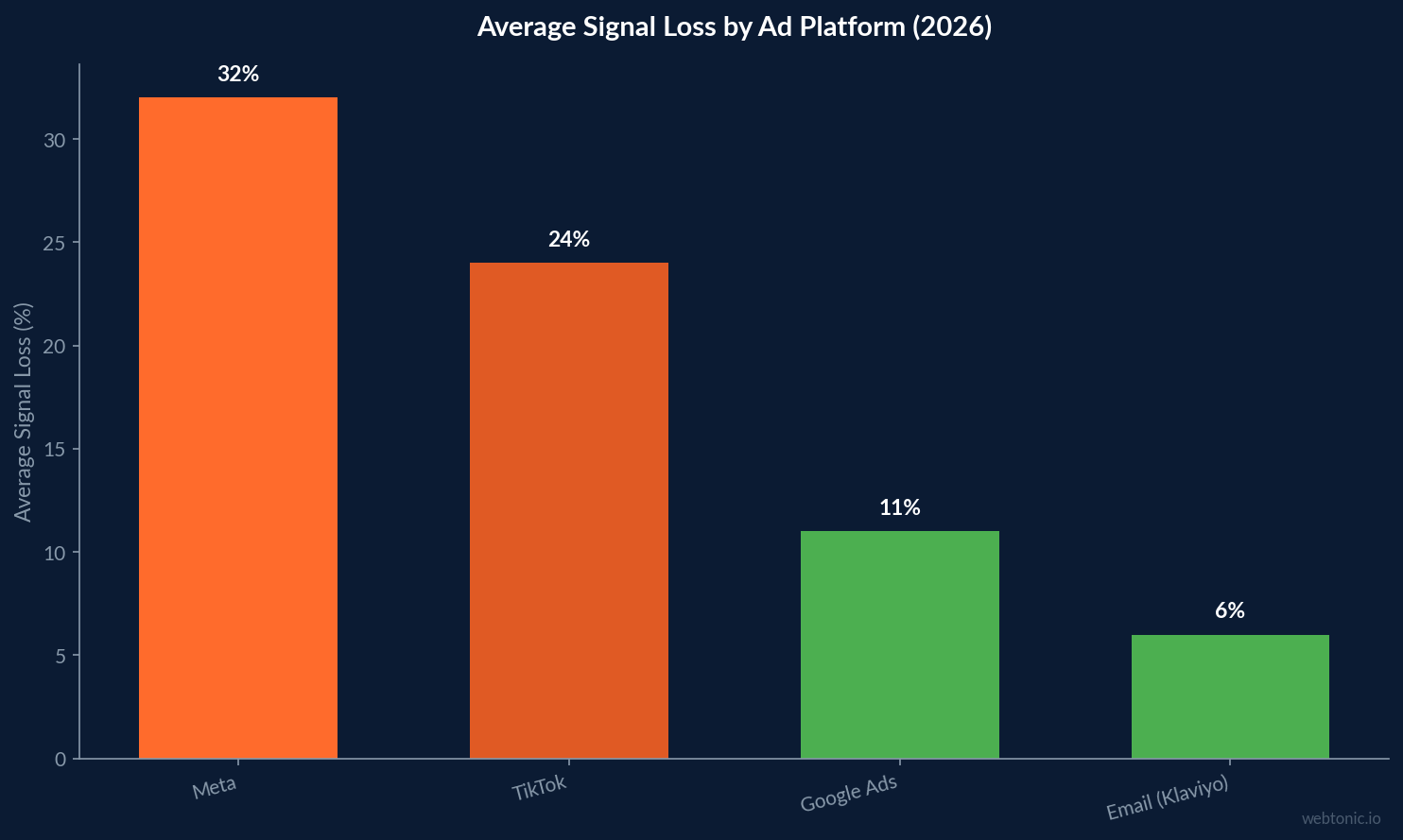
Meta suffers the worst signal loss at 32% on average, with some brands seeing up to 48% of conversions go untracked after iOS 17 privacy changes. This means that for every 100 conversions Meta reports, roughly 47 additional conversions actually occurred but were never attributed back to the platform, causing brands to systematically underinvest in their Meta campaigns.
Google Ads reports only 11% average signal loss (range 5–22%), benefiting from first-party search intent data that survives cookie restrictions. TikTok sits in the middle at 24% signal loss (range 14–35%), while email platforms like Klaviyo experience just 6% signal loss thanks to fully first-party tracking infrastructure. These discrepancies explain why brands using a single platform's attribution consistently misallocate growth marketing budgets toward channels that appear to perform best simply because they lose less tracking data.
| Platform | Avg. Signal Loss | Range | Key Driver |
|---|---|---|---|
| Meta (Facebook/IG) | 32% | 18–48% | iOS 17 ATT framework |
| TikTok | 24% | 14–35% | Limited first-party data |
| Google Ads | 11% | 5–22% | First-party search intent |
| Email (Klaviyo) | 6% | N/A | Fully first-party tracking |
Multi-Touch vs. Single-Touch Attribution Performance
Research from Ecommerce Times found that multi-touch attribution models reduce e-commerce ad waste by up to 73% compared to single-touch approaches. Furniture retailer ModernSpace implemented multi-touch attribution in February 2026 and discovered their Pinterest advertising was driving 23% more value than last-click measurement showed, leading them to reallocate $18,000 monthly with results visible within six weeks.
According to AnyTrack, switching from last-click to first-click attribution on a live e-commerce account caused remarketing purchases to jump 150% — not because more sales happened, but because the model finally credited the correct campaigns for driving initial awareness. Meanwhile, EsellSphere recommends most e-commerce stores use GA4's data-driven model as their primary attribution framework with last-click as a comparison baseline, since single-touch models systematically over-credit one channel while under-crediting others.
The practical implication is significant: brands that switch from last-click to time-decay attribution see an average ROAS jump from 3.2× to 3.7×, because upper-funnel channels like content marketing and social awareness finally receive the credit they deserve. This shift often unlocks budget for awareness-stage investments that last-click models have systematically undervalued for years.
| Model | Avg. ROAS | Best For | Key Limitation |
|---|---|---|---|
| Last-Click | 3.2× | Bottom-funnel measurement | Over-credits retargeting |
| First-Click | 2.8× | Awareness channel valuation | Over-credits discovery |
| Linear | 3.5× | Equal-weight touchpoint analysis | Treats all steps equally |
| Time-Decay | 3.7× | Recency-weighted journeys | Undervalues top-of-funnel |
| Data-Driven (GA4) | Varies | ML-based credit distribution | Requires conversion volume |
Cookieless Tracking and Server-Side Attribution Adoption
With 60–70% of EU web traffic blocking or limiting third-party cookies by default, according to Elido, e-commerce brands are accelerating their shift to first-party data strategies at an unprecedented pace. Apple's ITP 2.3, Firefox Enhanced Tracking Protection, and Chrome's ongoing third-party cookie phase-out together have fundamentally changed how attribution data flows from browser to ad platform, making traditional pixel-based tracking increasingly unreliable.
Releva AI reports that transitioning to server-side tracking recovers 20–40% of missed pageviews and conversions that client-side pixels fail to capture. This is not incremental data — it represents purchases that were actually happening but never appeared in ad platform dashboards, causing brands to unknowingly cut profitable campaigns that appeared underperforming.
Adoption is accelerating rapidly across the industry. Approximately 60% of active Meta advertisers have implemented CAPI (Conversions API), and 70% of marketers have adopted some form of server-side tracking according to Gartner's 2025 Marketing Technology Survey. Brands using server-side tracking combined with Enhanced Conversions recover 71% of cookie-deprecated conversions, compared to just 41% for partial implementations and only 18% for Consent Mode alone, per Visionary Marketing. The difference between full and partial implementation — a 30 percentage point gap — represents tens of thousands of dollars in recovered attribution data for mid-size e-commerce brands.
AI-Powered Attribution: Accuracy and Market Growth
A Presenc AI study comparing AI-powered and traditional attribution found that machine learning models provide a calibrated, always-on cross-channel view that periodic lift testing alone cannot deliver. The two approaches are complementary — AI attribution provides calibrated estimates for ongoing budget decisions, while lift tests validate those estimates at regular intervals to prevent model drift.
GA4 now defaults to data-driven attribution, which uses machine learning to distribute credit based on actual conversion patterns rather than arbitrary rules. This shift is reshaping how e-commerce brands evaluate their data intelligence investments and assess channel-level performance across increasingly complex customer journeys.
The global marketing attribution software market was valued at $5.37 billion in 2025 and is projected to reach $25.65 billion by 2036 at a 14.2% CAGR, according to GII Research. This explosive growth reflects the industry-wide transition from rule-based models to AI-driven solutions capable of handling cross-device, cross-platform customer journeys in an increasingly cookieless tracking environment.
Attribution Best Practices for E-Commerce Brands
- Implement server-side tracking alongside client-side pixels — brands using both recover up to 71% of cookie-deprecated conversions versus just 18% for Consent Mode alone, representing a 4× improvement in data recovery
- Use data-driven attribution as your primary model — GA4's ML-based approach distributes credit based on actual conversion patterns rather than arbitrary last-click or first-click rules
- Run quarterly attribution audits across all platforms — the 150-brand study found that attribution disagreement across platforms costs brands an average of 21% of their optimization potential each quarter
- Compare at least three attribution models side by side — time-decay attribution delivers 3.7× ROAS versus 3.2× for last-click, revealing hidden value in upper-funnel awareness channels
- Invest in a unified measurement stack — the attribution software market is growing at 14.2% CAGR specifically because fragmented tools create expensive blind spots in channel evaluation
- Set platform-specific signal loss expectations — budget Meta at 32% under-reporting and Google Ads at 11% to align ad spend decisions with true conversion performance
- Prioritize first-party data collection across all owned channels — email attribution with platforms like Klaviyo loses only 6% of signal, proving that owned channels provide the most reliable measurement baseline
E-Commerce vs. Other Industries: Attribution Maturity Comparison
E-commerce leads most industries in attribution sophistication because every transaction is digitally traceable from impression to purchase. While 72% of organizations overall have invested in analytics tools in the past 12 months (per Gitnux), e-commerce brands face unique multi-channel complexity: the average online purchase journey involves 6–8 touchpoints across paid, organic, email, and direct channels before a conversion occurs.
Unlike B2B or SaaS — where sales cycles span months and attribution windows stretch to 90+ days — e-commerce attribution must account for rapid impulse purchases alongside longer consideration windows for high-ticket items. This dual requirement is why e-commerce analytics platforms are growing at 15.66% CAGR, reaching a projected $60.59 billion by 2030, according to Research and Markets. E-commerce brands need more sophisticated attribution than nearly any other industry because they operate across more channels, with shorter decision cycles, and higher measurement stakes per marketing dollar invested.
Frequently Asked Questions
What is e-commerce marketing attribution?
E-commerce marketing attribution is the process of identifying which marketing touchpoints — ads, emails, social posts, organic search — contribute to a purchase. According to Enalitica, a complete attribution record tracks the first and last touchpoints, the triggering keyword, and the exact revenue generated per order. Modern attribution goes beyond simple last-click by distributing credit across the entire customer journey using data-driven models.
Which attribution model is best for e-commerce?
Data-driven attribution in GA4 is the recommended default for most e-commerce stores in 2026. It uses machine learning to distribute credit based on actual conversion patterns rather than arbitrary rules. Among rule-based alternatives, time-decay delivers the highest average ROAS at 3.7× compared to 3.2× for last-click and 2.8× for first-click models.
How much conversion data are e-commerce brands losing?
On average, e-commerce brands lose approximately 21% of their conversion data across platforms due to signal loss. Meta suffers the worst at 32% average signal loss post-iOS 17, while Google Ads loses only 11%. Server-side tracking can recover 20–40% of these missed conversions, and brands using both server-side tracking and Enhanced Conversions recover up to 71% of cookie-deprecated conversions.
What is server-side tracking and why does e-commerce need it?
Server-side tracking sends conversion data directly from your server to ad platforms, bypassing browser-based restrictions that block or limit third-party cookies. With 60–70% of EU web traffic now blocking third-party cookies by default, server-side implementations recover critical attribution data that client-side pixels miss entirely. Approximately 60% of active Meta advertisers have already implemented CAPI for server-side tracking.
How large is the marketing attribution software market?
The global marketing attribution software market was valued at $5.37 billion in 2025 and is projected to reach $25.65 billion by 2036, growing at a 14.2% CAGR according to GII Research. The broader e-commerce analytics market is even larger, valued at $29.28 billion in 2025 and projected to reach $60.59 billion by 2030.
Sources
ThoughtMetric – E-Commerce Attribution Benchmarks (May 2026)
GrowWithBA – The Attribution Crisis: 150-Brand Study
Ecommerce Times – Multi-Touch Attribution Cuts Ad Waste by 73%
AnyTrack – First Click vs Last Click Attribution
EsellSphere – Attribution Modeling for Ecommerce (2026)
Elido – Cookieless Attribution Explained
Releva AI – Server-Side Tracking for Ecommerce
Visionary Marketing – Cookieless Tracking Statistics 2026
Presenc AI – AI vs Traditional Attribution Accuracy
GII Research – Attribution Software Market Size
Enalitica – Ecommerce Attribution Guide
Gitnux – Business Analytics Industry Statistics