Table of contents
The named purchase figure is 44%: that share of US weekly podcast listeners said they bought a product after hearing a podcast ad in Edison's Q1 2025 data. The "most listeners" claim holds only for broader actions, which 76% of weekly consumers report. This page sets out each figure with its base and year.
Key Takeaways
- 44% of weekly podcast listeners have bought after a podcast ad (Edison, Q1 2025).
- That is up from 34% in Q1 2020.
- 76% of weekly podcast consumers have taken any action on a podcast ad (Edison 2026).
- 22% of prime podcast users made an immediate purchase (Sounds Profitable, 2025, n=5,005).
- 85% of heavy listeners have acted on a podcast ad (Cumulus/Signal Hill, 2022).
- Retail e-commerce took 8.7% of podcast ad revenue in IAB's 2023 study.
- US e-commerce reached 17.1% of retail sales in Q2 2026 (Census Bureau).
- Self-serve audio budgets start at USD 250 (SiriusXM Media AudioGo).
Purchase claims and their scope
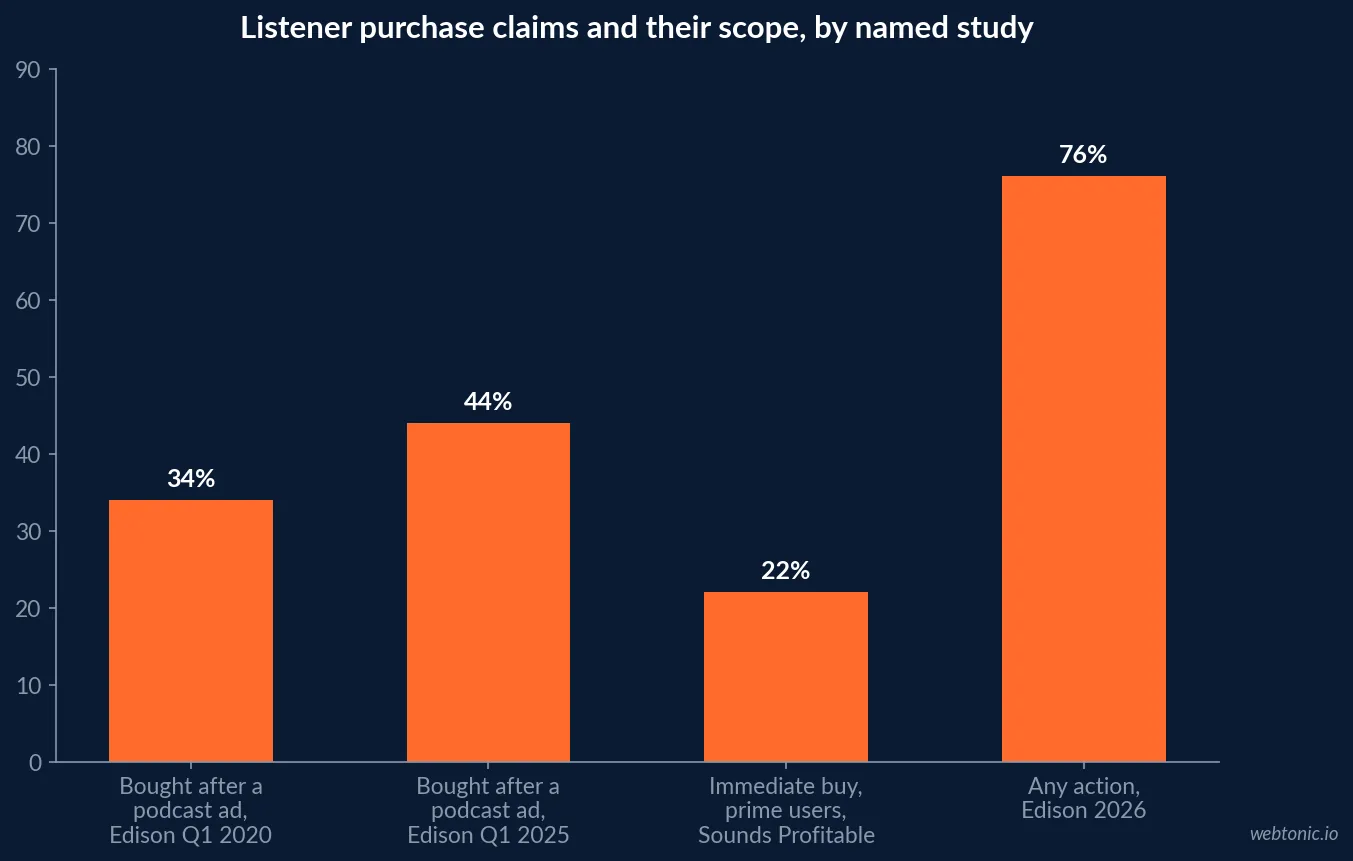
Headline podcast purchase statistics are often quoted without their base. The table lists each purchase or action figure used on this page with who was asked, when, and by whom. None of these studies isolates e-commerce shoppers or online stores; they describe podcast listeners in general.
| Claim | Figure | Base | Issuer and period |
|---|---|---|---|
| Purchased after a podcast ad | 44% | US weekly podcast listeners 13+ | Edison Podcast Metrics, Q1 2025 |
| Purchased after a podcast ad | 34% | US weekly podcast listeners 13+ | Edison Podcast Metrics, Q1 2020 |
| Took any action on a podcast ad | 76% | US weekly podcast consumers 13+ | Edison, Q2 2025-Q1 2026 |
| Immediate purchase | 22% | Prime podcast users, of 5,005 adults | Sounds Profitable/Signal Hill, Jan-Feb 2025 |
| Took any action (heavy listeners) | 85% | Listeners 6+ hours a week | Cumulus/Signal Hill, Oct 2022 |
The 44%: Edison's purchase figure
Edison Research's Podcast Consumer 2025 report asked US weekly podcast listeners aged 13+ whether, as a result of hearing a sponsorship or ad on a podcast, they had purchased a product. 44% said yes in Q1 2025, against 34% in Q1 2020, a rise of 10 points in five years.
The figure is self-reported and cumulative: it measures whether a listener has ever bought after a podcast ad, not the conversion rate of any single campaign. It is the closest public number to the headline claim, and it stops short of a majority.
The 76%: action, not only purchase
The Podcast Consumer 2026 reports that 76% of weekly podcast consumers aged 13+ have acted as a result of hearing a podcast ad. Actions include visiting a company or product website, recommending a product, gathering more information, purchasing, and using a promo code mentioned in the show. The majority figure in the headline belongs here: most listeners act, and a large minority buy.
The full 2026 report breaks two of those actions down by age. Website visits run at 66% for ages 13-34 and 67% for 35-54, falling to 45% for 55+. Recommending a product runs at 58%, 56% and 28%. For a store whose buyers are under 55, the site-visit rate is the more relevant number.
| Action after a podcast ad (Edison, Q2 2025-Q1 2026) | Age 13-34 | Age 35-54 | Age 55+ |
|---|---|---|---|
| Visited a company or product website | 66% | 67% | 45% |
| Recommended the product | 58% | 56% | 28% |
Immediate purchase among heavy users
The Advertising Landscape: Driving to Action study from Sounds Profitable and Signal Hill Insights surveyed 5,005 US adults online in January and February 2025, weighted to census data. Among prime podcast users, near-daily users for whom podcasts rank in their top four ad-supported media, National Public Media's summary reports 22% made an immediate purchase in response to a podcast ad, 28% discussed a product with others, 27% searched for more information and 26% visited the brand's social media.
That 22% is the most conservative purchase figure here and the most useful for forecasting: it describes a direct response, from the most engaged segment, in a recent six-month window.
| Prime podcast users' response (Sounds Profitable, 2025) | Share |
|---|---|
| Discussed the product with others | 28% |
| Searched for more information about the brand | 27% |
| Visited the brand's social media | 26% |
| Made an immediate purchase | 22% |
Heavy listeners act more
In the Cumulus Media and Signal Hill Insights Podcast Download survey of October 2022, 76% of weekly podcast listeners and 85% of heavy listeners, those listening six or more hours a week, said they had taken some action after hearing a podcast ad. The same survey found 48% of weekly listeners would prefer an ad voiced by the show's host. The pattern across all three studies is consistent: frequency of listening goes together with response, which is why frequency and show fit matter more than raw download counts.
Retail's share of podcast ad revenue
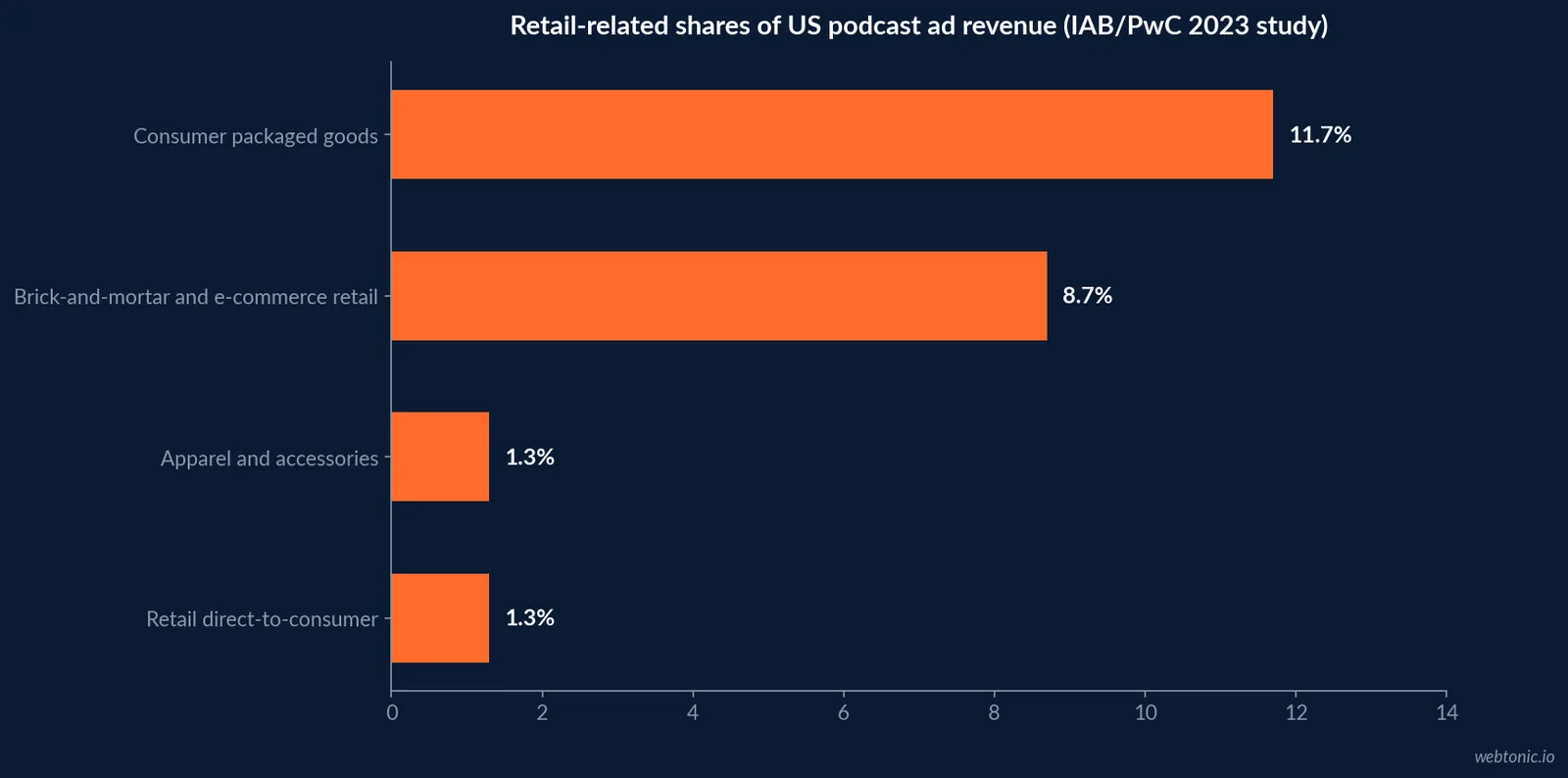
IAB's US Podcast Advertising Revenue Study for 2023, prepared by PwC and published in May 2024, breaks revenue down by advertiser category. Brick-and-mortar and e-commerce retail took 8.7%, apparel and accessories 1.3% and retail direct-to-consumer 1.3%, with consumer packaged goods at 11.7%. IAB noted CPG and retail shares had risen 4 and 5 points respectively since 2021.
Total podcast revenue has grown since: the IAB/PwC full-year 2025 report puts it at USD 2.9 billion, up 17.6%. The category split for 2025 is not published in that report, so the 2023 shares are the latest available.
The e-commerce demand side
The Census Bureau's Quarterly Retail E-Commerce Sales report put US retail e-commerce at USD 340.2 billion in Q2 2026, seasonally adjusted, up 3.8% on the quarter and 12.2% on Q2 2025, while total retail grew 6.7%. E-commerce accounted for 17.1% of total retail sales.
Those figures describe the market, not podcast results. They matter because online stores are the retail segment best placed to use the codes and URLs podcast attribution depends on.
Growth rates side by side
Podcast advertising and online retail are both growing faster than the markets around them. US podcast ad revenue rose 17.6% in 2025 to USD 2.9 billion, while US e-commerce grew 12.2% year on year in Q2 2026 against 6.7% for total retail. The table places those official and trade-body figures next to each other; it shows two markets expanding at the same time, not that one causes the other.
| Indicator | Latest figure | Growth | Issuer and period |
|---|---|---|---|
| US podcast ad revenue | USD 2.9 billion | +17.6% | IAB/PwC, 2025 |
| US digital audio ad revenue | USD 8.4 billion | Not restated here | IAB/PwC, 2025 |
| US retail e-commerce sales | USD 340.2 billion | +12.2% year on year | Census Bureau, Q2 2026 |
| US total retail sales | USD 1,986.5 billion | +6.7% year on year | Census Bureau, Q2 2026 |
| E-commerce share of retail | 17.1% | Quarterly share | Census Bureau, Q2 2026 |
Attribution: promo codes and their limits
Podcast downloads pass no click data, so e-commerce brands usually track with a show-specific promo code, a vanity URL and a post-purchase "how did you hear about us" question. Edison counts using a promo code among the actions in its 76% figure. Codes undercount: listeners who buy days later, forget the code or buy in a marketplace are missed.
No public study reports an e-commerce podcast conversion rate, CPA or ROAS, and this page does not estimate one. A store's own code redemptions plus survey responses, compared with a pre-campaign baseline, are the benchmark.
Entry costs and disclosure
SiriusXM Media says its self-serve AudioGo platform lets brands start with budgets as low as USD 250, with voice actors from USD 10. Amazon Ads sells audio ads on a CPM basis through self-service Amazon DSP or managed service, including programmatic Wondery podcast inventory, a natural route for stores already selling on Amazon.
When a host endorses a product they were given or paid to use, the FTC's Endorsement Guides, 16 CFR Part 255, require disclosure of that material connection under section 255.5. Scripts that say "I use this every day" must be true.
What a first store test can cost
Public rate cards give a store the building blocks of a test without any agency quote. Libsyn Ads, the marketplace formerly known as AdvertiseCast, says a typical 30-second spot runs USD 10 to 50 per thousand downloads, with shorter spots cheaper and 60-second spots dearer, and higher CPMs for business audiences. Rates are normally set on average downloads per episode within 30 days of release. A show averaging 5,000 downloads at a USD 25 CPM would therefore price a 30-second read at about USD 125 per episode, arithmetic on the published range rather than a quote.
| Test component (vendor pages) | Published figure | Source |
|---|---|---|
| 30-second spot CPM | USD 10-50 per thousand downloads | Libsyn Ads |
| Self-serve audio minimum | USD 250 | SiriusXM Media AudioGo |
| Voice actor for a produced spot | From USD 10 | SiriusXM Media AudioGo |
| Programmatic podcast inventory | CPM via Amazon DSP | Amazon Ads |
| Example: 5,000 downloads at USD 25 CPM | About USD 125 per episode | Arithmetic on the Libsyn range |
E-commerce podcast checklist
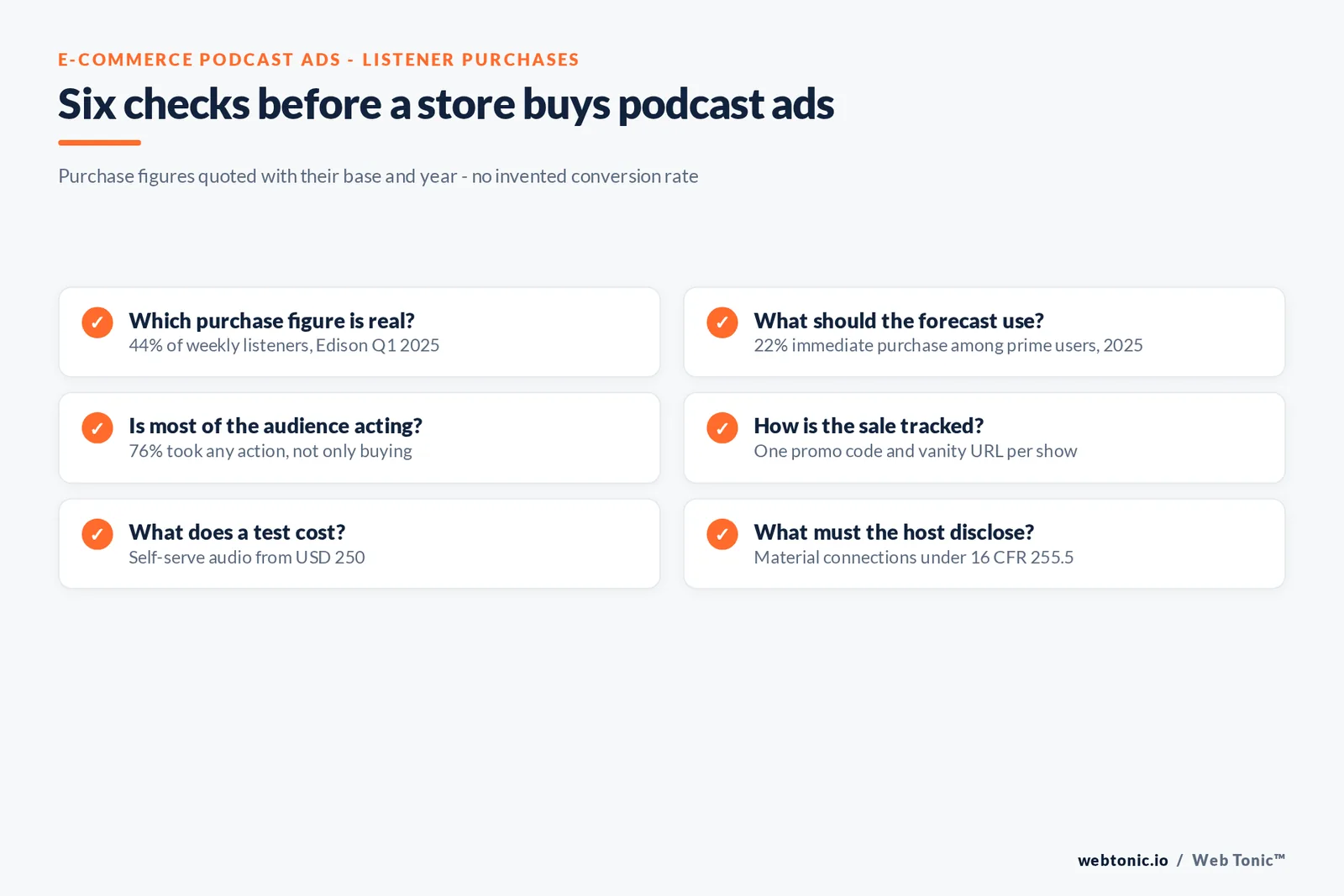
- Quote the base. 44% of weekly listeners have bought, not 44% of any audience.
- Forecast conservatively. Use the 22% immediate-purchase figure among primes.
- Give every show its own code. Promo codes are part of Edison's action list.
- Add a checkout survey. Codes miss delayed and code-less buyers.
- Test at the floor. AudioGo starts at USD 250.
- Disclose. 16 CFR 255.5 covers host endorsements.
Our data intelligence team connects promo-code and survey data to store revenue, and our growth marketing team plans channel tests. For more e-commerce channel data see our e-commerce CTV statistics, e-commerce SMS marketing statistics and e-commerce influencer and UGC data.
Frequently Asked Questions
Do most listeners really buy after hearing a podcast ad?
It depends on what counts as acting. In Edison Podcast Metrics, 44% of US weekly podcast listeners aged 13+ said they had purchased a product after hearing a podcast sponsorship or ad (Q1 2025), up from 34% in Q1 2020. That is a large minority, not a majority. The majority figure is broader: 76% of weekly podcast consumers have taken any action, including visiting a website or using a promo code, per The Podcast Consumer 2026.
How many podcast listeners make an immediate purchase?
The Sounds Profitable and Signal Hill Insights Advertising Landscape study, an online survey of 5,005 US adults in January and February 2025, found 22% of prime podcast users made an immediate purchase in response to a podcast ad. Primes are near-daily users for whom podcasts are one of their top four ad-supported media.
What share of podcast ad money comes from retail?
IAB's podcast revenue study for 2023, published May 2024, put brick-and-mortar and e-commerce retail at 8.7% of podcast ad revenue, apparel and accessories at 1.3% and retail direct-to-consumer at 1.3%, and noted retail's share was up 5 points since 2021. No study publishes an e-commerce podcast CPM, conversion rate or ROAS.
How do e-commerce brands attribute podcast sales?
Mostly with promo codes, vanity URLs and post-purchase surveys, because podcast downloads do not pass click data. Edison lists using a promo code among the actions its 76% figure covers. Codes undercount: listeners who buy later or without the code are missed, so a how-did-you-hear survey at checkout is the usual complement.
What is the minimum budget to test audio ads for a store?
SiriusXM Media says its self-serve AudioGo platform accepts budgets as low as USD 250, with voice actors from USD 10. Amazon sells audio ads on a CPM basis through self-service Amazon DSP or managed service. Host-read sponsorships on individual shows are usually quoted per episode or per thousand downloads.
Sources
Edison Research - The Podcast Consumer 2025
Edison Research - The Podcast Consumer 2026
Edison Research - The Podcast Consumer 2026 report (PDF)
Sounds Profitable and Signal Hill Insights - The Advertising Landscape: Driving to Action (2025)
National Public Media - Driving to Action summary
Cumulus Media and Signal Hill Insights - Podcast Download, Fall 2022
IAB/PwC - US Podcast Advertising Revenue Study, FY2023 (May 2024)
IAB/PwC - Internet Advertising Revenue Report, Full Year 2025
US Census Bureau - Quarterly Retail E-Commerce Sales, Q2 2026
Libsyn Ads - Podcast advertising marketplace (vendor rate guidance)
SiriusXM Media - How much does it cost to advertise on a podcast
Amazon Ads - Audio ads
eCFR - 16 CFR Part 255, FTC Endorsement Guides