Table of contents
UGC-specific bookings more than doubled from 15% to 35% of ecommerce creator campaigns in a single year, while the average price per campaign fell. That is the headline shift in Collabstr's own 2026 marketplace data, and it changes how a DTC brand should budget the channel - less per piece, more pieces, and a growing share of that content built for product pages and paid whitelisting rather than a creator's own feed.
Key Takeaways
- UGC campaigns grew from 15% to 35% of engagements on Collabstr's platform, year over year.
- TikTok-specific campaigns fell from 41% to 21% of engagements over the same period.
- Instagram leads at 40% of engagements, still the top platform for ecommerce creator work.
- The average UGC campaign costs USD 197, down 5.7% from USD 209 a year earlier.
- 80% of all engagements cost under USD 300 (Collabstr, 21,000+ collaborations analyzed).
- Over 40% of UGC buyers spend under USD 5,000 total on the channel.
- Twitch creators ask the most per engagement at USD 398, but the average payout is only USD 127.
- YouTube pays the highest average payout at USD 255 per engagement.
- Skilled Trades is the priciest niche at USD 309 per engagement, ahead of Education at USD 307.
- Men earn about 24% more per engagement than women on the same platform (Collabstr).
- 97% of shoppers consult multiple sources before buying (Bazaarvoice Shopper Experience Index 2026).
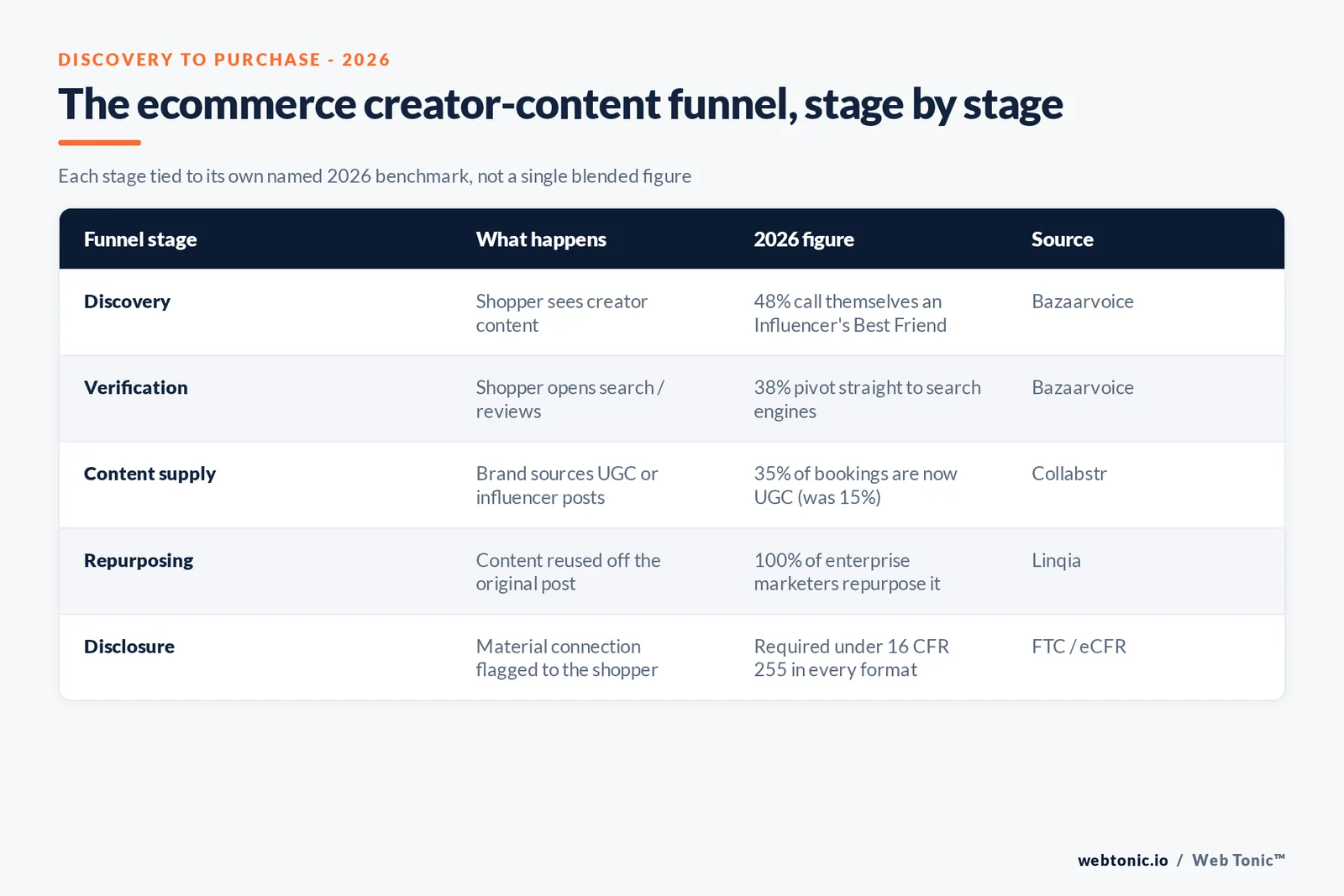
- 48% of shoppers are an "Influencer's Best Friend" during discovery, but 38% pivot straight to search to verify.
- 100% of enterprise marketers repurpose influencer content beyond the creator's own page (Linqia 2026).
- 81% say repurposed creator content outperforms brand-made assets (Linqia 2026).
- 62% of enterprise marketers are raising influencer budgets in 2026; 33% plan to spend over USD 5 million.
UGC is taking share from platform-specific influencer campaigns
Collabstr's 2026 Influencer Marketing Report, built from over 472,000 packages and 21,000 collaborations on its own marketplace, shows the clearest structural shift in ecommerce creator spend in years: platform-agnostic UGC campaigns grew from 15% to 35% of total engagements, while TikTok-specific campaigns halved from 41% to 21%. Instagram held its lead at 40% of engagements. The report ties the TikTok drop partly to the uncertainty around the 2024 divestiture law and the January 2025 US outage, but the UGC rise looks structural rather than a reaction to any single platform event - brands are increasingly buying content itself, meant to be repurposed on product pages and paid ads, rather than buying a specific creator's feed placement. That mirrors the cross-industry pattern in our influencer marketing statistics hub, just concentrated harder in ecommerce.
| Platform / format (Collabstr 2026) | Share of engagements | YoY change |
|---|---|---|
| 40% | Roughly flat | |
| UGC (platform-agnostic) | 35% | Up from 15% (+133%) |
| TikTok | 21% | Down from 41% (-49%) |
| YouTube | 3% | Up 1 point |
| X (Twitter) | 1% | Roughly flat |
What creators actually charge, by platform
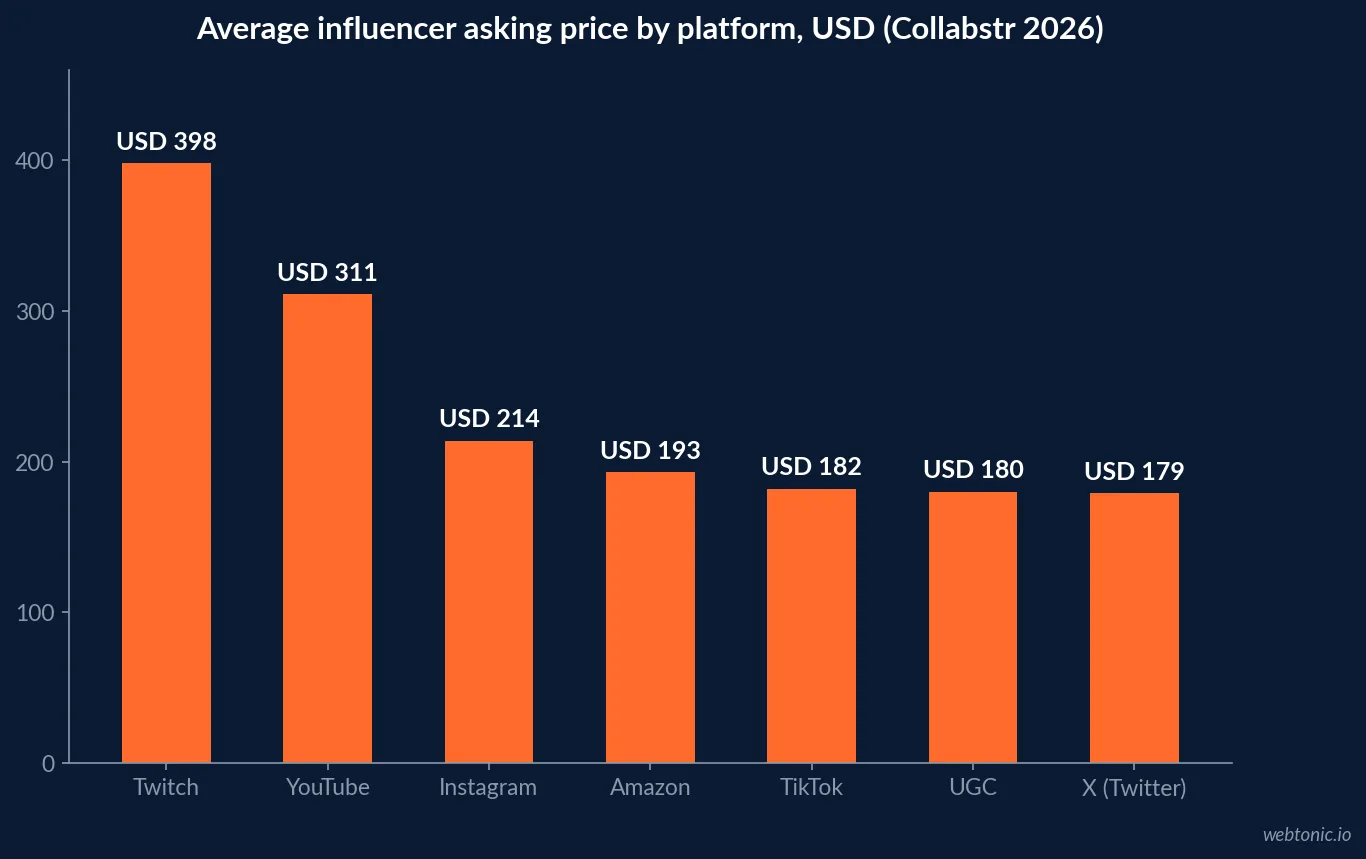
Collabstr's own platform-pricing data shows a wide gap between what creators ask and what they are actually paid. Twitch creators ask USD 398 on average but are paid USD 127 - the widest asking-to-payout gap of any platform in the report - while YouTube commands the highest actual payout at USD 255 against a USD 311 average ask. UGC creators, working outside a platform-specific feed, ask USD 180 and are paid USD 154, one of the tighter negotiation gaps in the dataset.
| Platform (Collabstr 2026) | Average asking price | Average actual payout | Gap |
|---|---|---|---|
| Twitch | USD 398 | USD 127 | USD 271 (68%) |
| YouTube | USD 311 | USD 255 | USD 56 (18%) |
| USD 214 | USD 193 | USD 21 (10%) | |
| Amazon | USD 193 | USD 88 | USD 105 (54%) |
| TikTok | USD 182 | USD 186 | Negligible |
| UGC (platform-agnostic) | USD 180 | USD 154 | USD 26 (14%) |
| X (Twitter) | USD 179 | USD 76 | USD 103 (58%) |
The niches ecommerce brands pay the most for
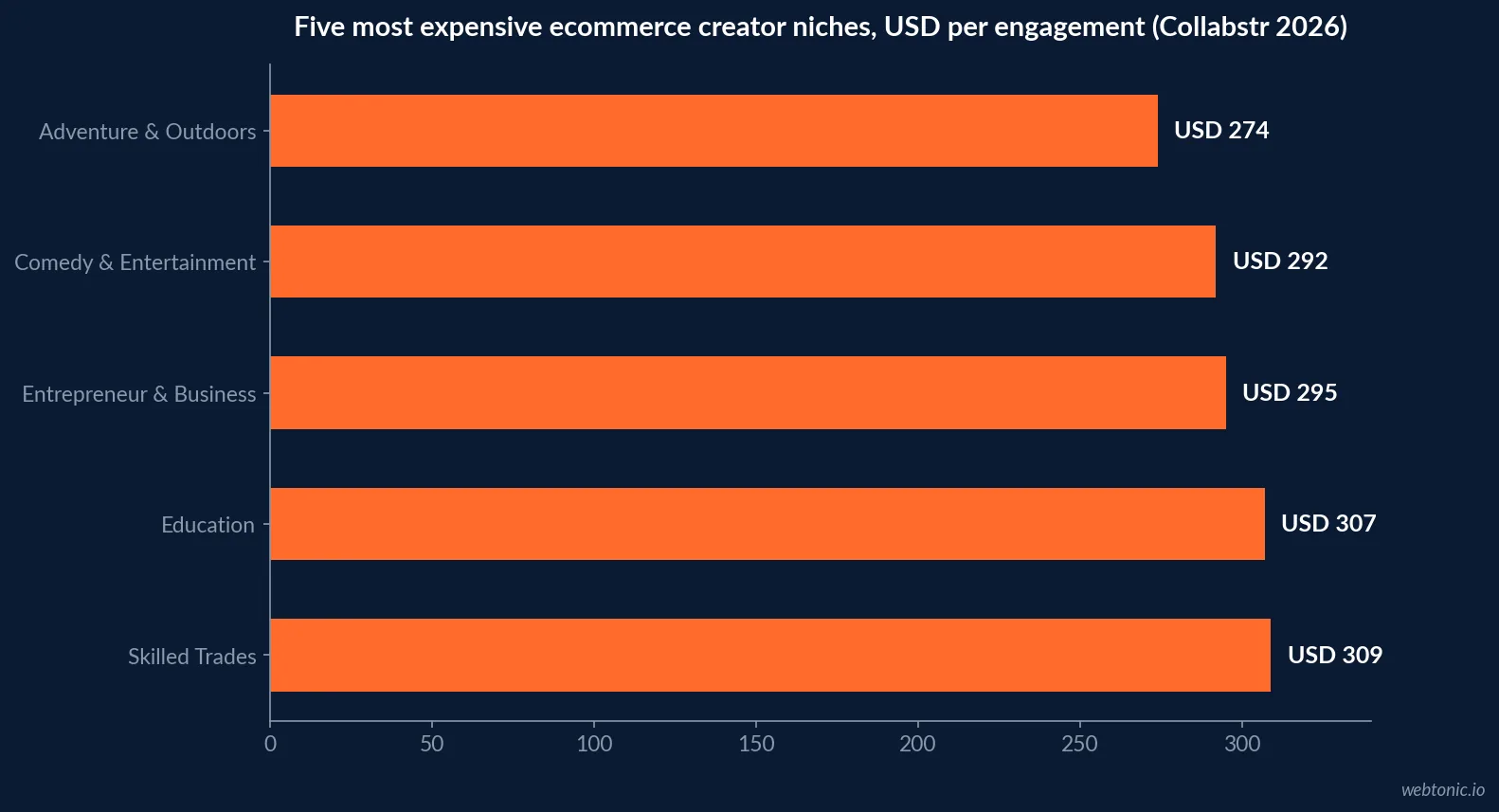
Collabstr's niche-level pricing shows the highest average rates cluster around expertise-heavy categories rather than the largest audiences. Skilled Trades tops the list at USD 309 per engagement, ahead of Education at USD 307, Entrepreneur & Business at USD 295, Comedy & Entertainment at USD 292, and Adventure & Outdoors at USD 274. The pattern the report draws out: audiences that are hard to reach any other way, or that expect a demonstrated skill before they trust a recommendation, command a premium over raw follower count.
| Niche (Collabstr 2026) | Average price per engagement |
|---|---|
| Skilled Trades | USD 309 |
| Education | USD 307 |
| Entrepreneur & Business | USD 295 |
| Comedy & Entertainment | USD 292 |
| Adventure & Outdoors | USD 274 |
The influencer gets the click, the review closes the sale
Bazaarvoice's 20th-edition Shopper Experience Index (2026) is the clearest evidence that influencer discovery and purchase decisions are two separate moments, not one. 97% of shoppers now consult multiple sources before buying, and while 48% identify as an "Influencer's Best Friend" during the discovery stage, 38% immediately turn to a search engine during the research phase that follows - opening multiple tabs specifically to find independent reviews and any negative feedback the influencer's post did not mention. This is why UGC and review content on the product detail page matter as much as the discovery-stage creator spend that gets a shopper there in the first place.
| Shopper behavior (Bazaarvoice Shopper Experience Index 2026) | Share of respondents |
|---|---|
| Consult multiple sources before buying | 97% |
| Need 2-3 sources before feeling safe to buy | 60% |
| Need 4 or more sources | 37% |
| Identify as an 'Influencer's Best Friend' at discovery | 48% |
| Turn to search engines during the research phase | 38% |
How enterprise ecommerce marketers are running the program
Linqia's 2026 State of Influencer Marketing survey, fielded to over 200 enterprise marketers, finds creator content has become an asset class rather than a one-off post: 100% of respondents repurpose influencer content beyond the creator's own page - onto product pages, paid social, and email - and 81% say that repurposed content outperforms brand-created assets. Measurement is the visible weak point: 79% struggle to measure ROI and 48% cite attribution specifically as their biggest gap, even as 62% plan to increase influencer budgets in 2026 and a third plan to spend over USD 5 million.
| Metric (Linqia 2026 State of Influencer Marketing, n=200+ enterprise marketers) | Result |
|---|---|
| Repurpose creator content beyond its original post | 100% |
| Say repurposed content outperforms brand-made assets | 81% |
| Struggle to measure influencer ROI | 79% |
| Cite attribution as the biggest measurement gap | 48% |
| Plan to increase influencer budget in 2026 | 62% |
| Plan to spend over USD 5 million in 2026 | 33% |
| Use AI to generate ideas, briefs, or streamline workflow | 74% |
| Still avoid virtual/AI influencers entirely | 89% |
The disclosure rule that applies to every one of these formats
None of the pricing or repurposing data above changes what the law requires before that content can run as an ad. The FTC's Endorsement Guides, codified at 16 CFR 255, require a clear and conspicuous disclosure of any material connection between a brand and a creator - payment, free product, or an affiliate link - whenever that connection would affect how a reasonable consumer weighs the endorsement. That rule does not distinguish between a native creator post and the same clip repurposed into whitelisted paid media; if the underlying connection is undisclosed in either format, both are non-compliant.
The cross-industry backdrop, for context
The Influencer Marketing Hub's 2026 Benchmark Report, fielded to 600+ marketing professionals across industries, shows the same expansionary mood at a larger scale: 72.2% expect budgets to rise 50% or more and 65.9% expect payback within a month, including 48.4% within two weeks. On measurement, promo or discount codes lead tool adoption at 45.9%, ahead of affiliate links at 26.0% and native shop features at 25.0% - the same three mechanisms a DTC brand would use to track a UGC-driven product-page lift. Brand awareness remains the top-selected KPI at 55.1%, which is one reason the ROI-measurement gap Linqia found persists even as budgets rise: most programs are still instrumented to prove reach, not revenue.
| Metric (Influencer Marketing Hub 2026, 600+ respondents, cross-industry) | Result |
|---|---|
| Expect budgets to rise 50% or more | 72.2% |
| Expect payback within 1 month | 65.9% |
| Expect payback within 2 weeks | 48.4% |
| Adopt promo/discount codes for measurement | 45.9% |
| Adopt affiliate links for measurement | 26.0% |
| Adopt native shop features for measurement | 25.0% |
| Select brand awareness as top KPI | 55.1% |
What this means for a DTC budget
- Plan for more, smaller pieces - 80% of Collabstr engagements already cost under USD 300, and the UGC share of spend is rising, not falling.
- Budget the negotiation gap by platform - Twitch and Amazon show the widest asking-to-payout spread, so the sticker price is rarely the real cost.
- Fund the product page, not just the feed - Bazaarvoice's data says the review content shoppers seek out after discovery matters as much as the influencer post that started the search.
- Treat repurposing as the default, not the upside - Linqia found 100% of enterprise marketers already do it, so a one-platform usage license is under-scoping the deal from the start.
- Disclose the same way in every format - 16 CFR 255 does not carve out an exception for whitelisted or repurposed content.
Our performance creative team builds that repurposing plan into the brief before a single dollar goes to a creator, and if your measurement setup is the weak point Linqia's data flags, talk to us about closing that attribution gap.
Ecommerce influencer and UGC at a glance
| Metric | 2026 figure | Source |
|---|---|---|
| UGC share of ecommerce creator engagements | 35% (up from 15%) | Collabstr |
| Average UGC campaign cost | USD 197 (down 5.7% YoY) | Collabstr |
| Shoppers consulting multiple sources pre-purchase | 97% | Bazaarvoice |
| Enterprise marketers repurposing creator content | 100% | Linqia |
| Enterprise marketers raising 2026 budgets | 62% | Linqia |
Frequently Asked Questions
What does UGC cost for an ecommerce brand in 2026?
On Collabstr's own marketplace data - drawn from 472,000-plus packages and 21,000 collaborations - the average UGC campaign costs USD 197, down 5.7% from USD 209 a year earlier. Eighty percent of all engagements on the platform, UGC or influencer, cost under USD 300, and more than 40% of UGC buyers are companies spending under USD 5,000 total on the channel.
Is UGC replacing influencer marketing for DTC brands?
It's taking a growing share, not replacing it outright. Collabstr's 2026 report shows UGC-specific campaigns more than doubled from 15% to 35% of platform engagements year over year, while TikTok-specific campaigns dropped from 41% to 21% over the same period. Instagram still leads at 40% of engagements.
Do shoppers actually trust influencer recommendations enough to buy?
With a caveat. Bazaarvoice's 20th-edition Shopper Experience Index (2026) found 48% of shoppers identify as an 'Influencer's Best Friend' during product discovery, but 38% immediately turn to a search engine during the research phase that follows, hunting for independent reviews before buying. The report's own framing is that the influencer gets the click, and the review closes the sale.
What has to be disclosed in a paid UGC or influencer post?
Under the FTC's Endorsement Guides (16 CFR 255, enforced per the FTC's own guidance), any material connection between a brand and a creator - payment, free product, an affiliate relationship - has to be disclosed clearly and conspicuously if it would affect how a reasonable consumer weighs the endorsement. That requirement applies equally to a single Instagram post and to whitelisted or repurposed ad creative built from the same content.
Are ecommerce brands increasing or cutting influencer budgets in 2026?
Increasing, per two independent enterprise surveys. Linqia's 2026 State of Influencer Marketing report (200+ enterprise marketers) found 62% are raising influencer budgets in 2026, with 33% planning to spend over USD 5 million. The Influencer Marketing Hub's 2026 Benchmark Report (600+ respondents) puts that even higher cross-industry, with 72.2% of respondents expecting budgets to rise by 50% or more.
Sources
Collabstr - 2026 Influencer Marketing Report
Bazaarvoice - Shopper Experience Index (2026, 20th edition)
Linqia - 2026 State of Influencer Marketing
FTC - Endorsement Guides: What People Are Asking
eCFR - 16 CFR 255 Endorsement Guides
Influencer Marketing Hub - 2026 Benchmark Report