Table of contents
The honest e-commerce marketing automation budget has two separate lines: what the platform costs, and what its own flow data shows that spend actually returns. Every price below comes from the vendor's own pricing page, and every performance figure comes from the vendor's own benchmark report, not a round-up.
Key Takeaways
- Klaviyo's free plan covers 250 profiles and 500 monthly email sends at no cost.
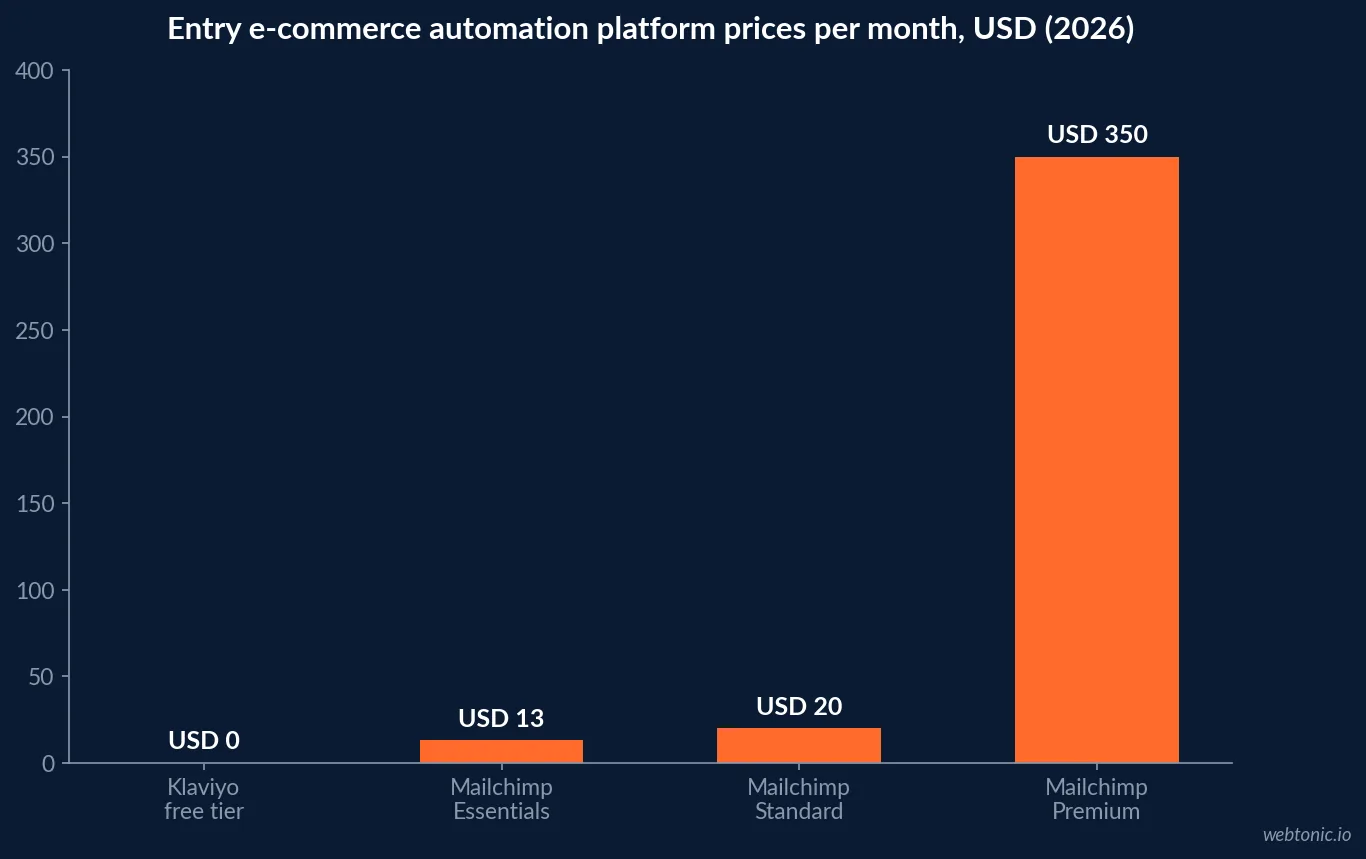
- Mailchimp's Essentials tier starts at USD 13 a month, Standard at USD 20.
- ActiveCampaign's Starter plan begins at USD 15 a month for 1,000 contacts.
- HubSpot Marketing Hub Professional starts at USD 890 a month for three seats.
- HubSpot Enterprise starts at USD 3,600 a month for five seats.
- Professional onboarding carries a USD 3,000 one-time fee on top of the subscription.
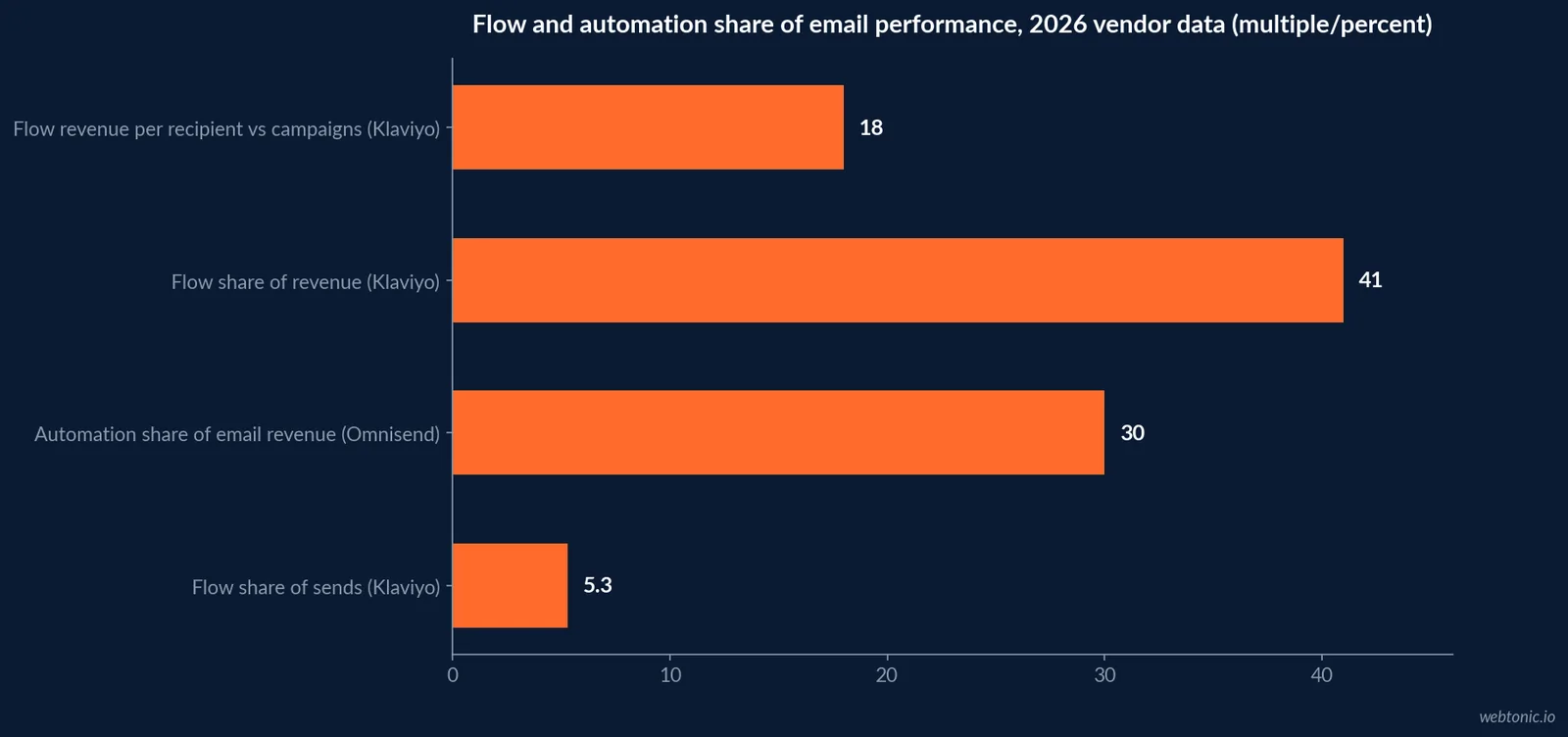
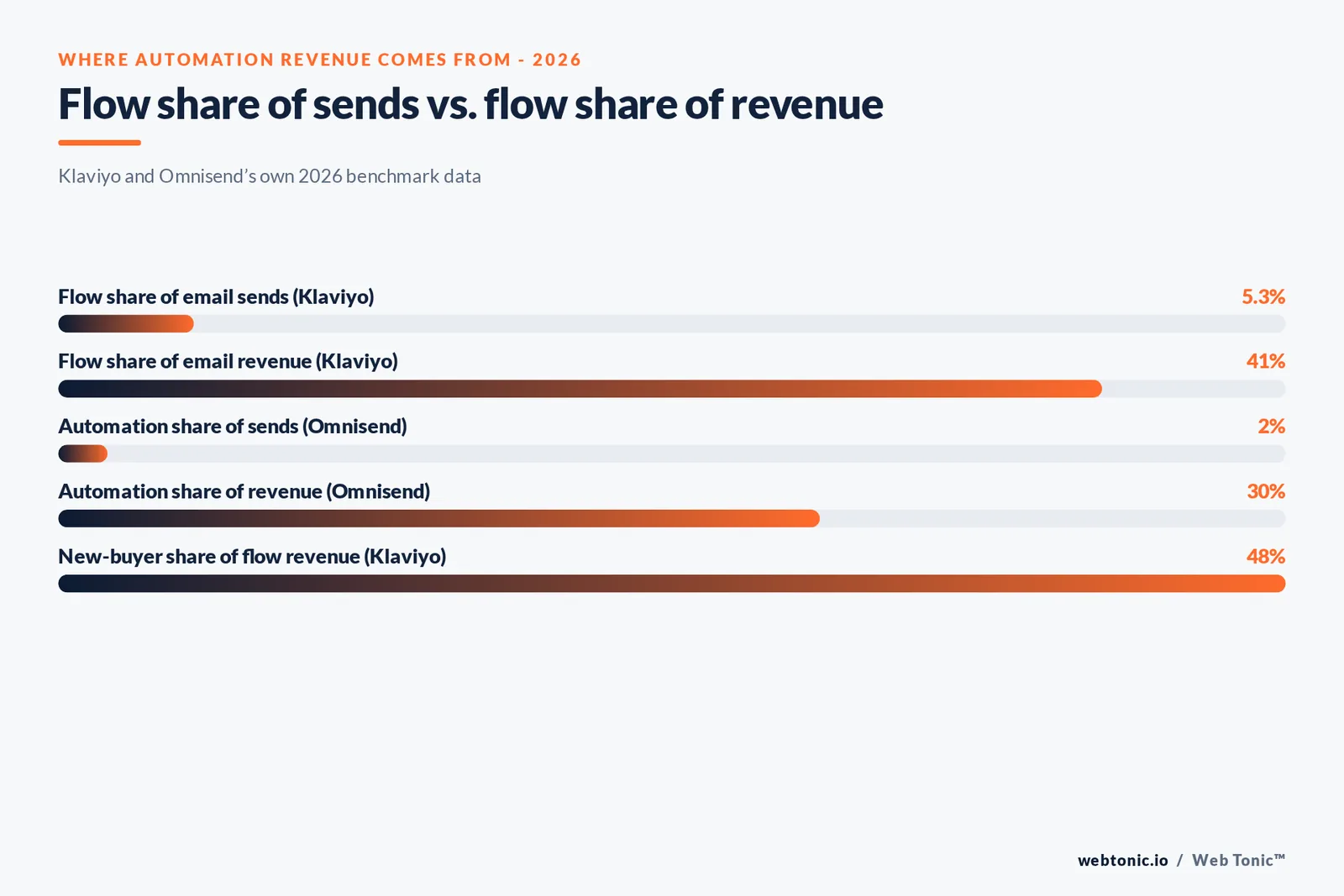
- Flows drive nearly 41% of email revenue from just 5.3% of sends, per Klaviyo.
- Flow revenue per recipient runs nearly 18x higher than campaign revenue.
- Flow click rates are 3x higher: 5.58% versus 1.69% for campaigns.
- Top 10% of flows hit a USD 7.79 revenue-per-recipient ceiling.
- Automations are 2% of Omnisend sends but drive 30% of email-driven revenue.
- Automated emails earn USD 2.87 per send versus USD 0.18 for campaigns, 16x more.
- Automated SMS earns USD 0.74 per send versus USD 0.15 for SMS campaigns.
- 48% of flow revenue comes from new buyers, versus 16% for campaigns.
- SMS marketing volume grew 40% in 2025, on top of 31% growth the year before.
- Combined email, SMS and push return USD 79 per USD 1 spent, per Omnisend's own analysis.
What the platforms actually charge
Every figure here comes from the vendor's own live pricing page, checked directly rather than through a pricing round-up. Klaviyo's pricing page confirms a genuinely free tier - up to 250 active profiles and 500 email sends a month, plus USD 5 of mobile messaging - before any paid upgrade is required. Mailchimp's compare-plans page lists Free (250 contacts, USD 0), Essentials from USD 13 a month, Standard from USD 20, and Premium from USD 350 a month with unlimited contacts.
| Platform (own pricing page, 2026) | Entry price | What it buys | Scales with |
|---|---|---|---|
| Klaviyo | Free up to 250 profiles / 500 sends | Email + SMS automations, reporting | Profile count, message volume |
| Mailchimp Essentials | USD 13/mo | Testing and scheduling tools | Contact count |
| Mailchimp Standard | USD 20/mo | Adds automation, personalization | Contact count |
| Mailchimp Premium | USD 350/mo | Unlimited contacts, priority support | Flat once on this tier |
| ActiveCampaign Starter | USD 15/mo for 1,000 contacts | Entry automation tier (2026) | Contact count |
HubSpot's per-seat model is a different shape entirely
HubSpot's own Product and Services Catalog confirms Marketing Hub Starter at USD 20 a month per seat, Professional starting at USD 890 a month for three core seats (additional seats USD 50 each) plus a USD 3,000 one-time Professional onboarding fee, and Enterprise starting at USD 3,600 a month for five seats (additional seats USD 75 each) with a USD 7,000 onboarding fee. Contact-volume tiers stack on top of every plan. This is a materially different cost shape from Klaviyo or Mailchimp's contact-based pricing, and the two are not directly comparable line for line.
| HubSpot Marketing Hub tier | Base price | Seats included | One-time onboarding |
|---|---|---|---|
| Starter | USD 20/mo per seat | 1 (per seat) | None published |
| Professional | USD 890/mo | 3 core seats | USD 3,000 |
| Enterprise | USD 3,600/mo | 5 core seats | USD 7,000 |
What flow automation returns, per Klaviyo's own data
Klaviyo's 2026 email benchmarks, drawn from more than 183,000 customers, found that while campaigns still drive 94.7% of send volume, flows generate nearly 41% of total email revenue from just 5.3% of sends - with average revenue per recipient nearly 18 times higher than campaigns. Flows also convert better on engagement: 3x higher click rates (5.58% versus 1.69%) and 13x higher placed-order rates. The top 10% of flows reach a revenue-per-recipient ceiling of USD 7.79.
Omnisend's own data tells the same story at a different scale
Omnisend's 2026 ecommerce marketing report, built from 150,000 brands and 27 billion emails sent in 2025, found automations made up just 2% of all email sends yet drove 30% of total email-driven revenue, earning USD 2.87 per send versus USD 0.18 for scheduled campaigns - a 16x difference. On SMS, which grew 40% in volume in 2025 after 31% growth the year before, automated messages earned USD 0.74 per send against USD 0.15 for campaigns, a fivefold gap. A separate internal Omnisend analysis of its merchants found email, SMS and push combined generate USD 79 per USD 1 spent (USD 76 for email alone) - vendor-labelled data, not an independent audit.
| Channel (2026 vendor data) | Automated value per send | Scheduled campaign value per send | Multiple |
|---|---|---|---|
| Email (Omnisend) | USD 2.87 | USD 0.18 | 16x |
| SMS (Omnisend) | USD 0.74 | USD 0.15 | 5x |
| Email revenue per recipient (Klaviyo) | ~18x campaigns | Baseline | ~18x |
| Email click rate (Klaviyo) | 5.58% (flows) | 1.69% (campaigns) | 3.3x |
Where new-customer revenue actually originates
Klaviyo's 2026 data puts a number on a debate that usually runs on instinct: 48% of flow-driven email revenue comes from new buyers, compared with just 16% for campaign-driven revenue. That reinforces welcome, browse-abandonment and cart-abandonment flows as the first-purchase engine, not the next batch send. Budgeting automation spend against that split argues for building the welcome and abandonment flows before adding a fourth weekly campaign.
The compliance line every automated SMS program has to clear
None of the revenue multiples above matter if the message triggering them is not compliant. The FCC's 2023 one-to-one consent rule was due to start on January 27, 2025, but the 11th Circuit vacated it on January 24, 2025 (Insurance Marketing Coalition v. FCC), so it never took effect; automated marketing texts still need the consumer's prior express written consent under the TCPA. Carriers layer their own CTIA messaging principles on top, distinguishing Consumer from Non-Consumer (business) messaging and requiring registered sending identities for the latter. Skipping registration does not lower the automation bill - it gets the account's messages filtered before the revenue multiple above ever applies.
| Compliance requirement | Effective / source | Applies to | Risk of skipping it |
|---|---|---|---|
| One-to-one written consent | FCC, effective Jan 27, 2025 | Marketing texts and robocalls | Illegal message, TCPA liability |
| Registered sender identity (10DLC/A2P) | CTIA Messaging Principles | Non-Consumer (business) SMS | Carrier filtering, poor deliverability |
| Clear opt-out path | TCPA / CTIA | Every automated marketing message | Complaint-driven carrier flags |
What the price tiers do not include
Every published tier above stops at the software license. None of the vendor pages quote implementation time, list-cleaning work, or the cost of building the actual flow templates, product feeds and segmentation logic that make the platform earn its Klaviyo- or Omnisend-level multiples. A store paying HubSpot's USD 890 a month Professional price with three unbuilt flows is paying for capability it has not activated yet - the automation revenue share only shows up once welcome, abandonment and win-back flows are actually built and tested against the store's own catalog.
Where personalization spend fits on top of the platform bill
The platform bill above is only the base layer. Twilio Segment's State of Personalization 2024 survey of 521 B2B and B2C decision-makers at 500-plus-employee companies found 72% already run a customer data platform and 48% a data warehouse specifically to power personalization - infrastructure that sits above an email/SMS platform like Klaviyo or Mailchimp rather than replacing it. That is not an ecommerce-only survey and is now a year old, but it explains why the flow-revenue multiples above increasingly assume a segmentation layer underneath them, not just a send tool.
| Infrastructure layer (Twilio Segment 2024, n=521) | Adoption | Sits above / below the ESP |
|---|---|---|
| Customer data platform (CDP) | 72% | Above - feeds segments into Klaviyo/Omnisend/HubSpot |
| Data warehouse | 48% | Above - source of truth for CDP |
| Belief personalization is invaluable to growth | 89% | Justifies the budget line, not a tool |
Where this fits against the wider automation and retention picture
This page prices the tooling and channel performance side of e-commerce automation specifically. For the cross-industry marketing automation baseline it sits inside, see our marketing automation statistics page; for the email and SMS channel benchmarks behind the Klaviyo and Omnisend figures above, see our email marketing statistics and SMS marketing statistics pages. Our companion breakdown covers the customer-lifecycle side of the same ecommerce business - churn, loyalty and repeat-purchase economics - rather than tooling cost.
Budgeting the platform against the flows it will run
The arithmetic that actually matters is not the plan price alone - it is the plan price against how many flows the store can realistically build and maintain. A brand running only a welcome series and an abandoned-cart flow on a USD 350-a-month Mailchimp Premium plan is paying for headroom it is not using; the same two flows on Klaviyo's free tier, under 250 profiles, cost nothing until the list outgrows the limit. Our growth marketing practice sizes the flow roadmap before the platform tier is picked, not after.
For the retention side of the same lifecycle - churn, loyalty and repeat-purchase economics rather than tooling cost - see our separate breakdown of what e-commerce retention programs should budget for. Talk to us about sizing either piece for your catalog.
Frequently Asked Questions
What does e-commerce marketing automation software actually cost in 2026?
Entry tiers start free to about USD 20 a month: Klaviyo's free plan covers up to 250 profiles and 500 email sends, Mailchimp's Essentials starts at USD 13 a month and its Standard tier at USD 20, and ActiveCampaign's Starter plan begins at USD 15 a month for 1,000 contacts (per ActiveCampaign's own 2026 blog post, replacing its former USD 29 Lite plan). HubSpot's Marketing Hub is priced per seat - Starter at USD 20 a month per seat, Professional starting at USD 890 a month for three core seats plus a USD 3,000 one-time onboarding fee, and Enterprise at USD 3,600 a month for five seats. None of these figures include the list-size surcharges every vendor adds once contact volume grows.
Is flow automation really worth more than campaign sends?
By a wide margin, per each platform's own numbers. Klaviyo's 2026 benchmarks, built from over 183,000 customers, found flows generate nearly 41% of total email revenue from just 5.3% of sends, with revenue per recipient nearly 18 times higher than campaigns. Omnisend's 2026 ecommerce marketing report, from 150,000 brands, found automations were just 2% of email sends but drove 30% of revenue, earning 16 times more per send than scheduled campaigns.
Do SMS automations perform as well as email ones?
Directionally yes, at a smaller scale. Omnisend's 2026 report found automated SMS messages earned an average of USD 0.74 per send versus USD 0.15 for scheduled SMS campaigns - a fivefold difference, smaller than the 16x gap on email but still the highest-value message type in the channel. Any SMS automation program still has to clear the TCPA: the FCC's 2023 one-to-one consent rule was vacated by the 11th Circuit on January 24, 2025, before it took effect, but automated marketing texts still need prior express written consent.
Where does new-customer revenue actually come from in an automated program?
More from flows than from campaigns. Klaviyo's 2026 data shows 48% of flow-driven email revenue comes from new buyers, compared with just 16% for campaign-driven revenue - which puts the weight on welcome, browse and abandonment flows for first-purchase conversion, not on the next promotional blast.
Is it cheaper to run automation in-house or buy a platform outright?
There is no in-house-versus-platform split published for e-commerce specifically, so do not quote one. What is published is the platform cost ladder above and the fact that none of it works without a real product catalog, segmentation and a compliance-checked SMS opt-in flow - the tool is the smaller line item next to the operational setup behind it.
Sources
Klaviyo - Pricing (own page, 2026)
Klaviyo - 2026 Email Marketing Benchmarks by Industry
Mailchimp - Marketing plan comparison (own page)
ActiveCampaign - Making ActiveCampaign more accessible (own blog, pricing update)
HubSpot - Product and Services Catalog (own pricing)
Omnisend - 2026 Ecommerce Marketing Report
FCC - One-to-One Consent Rule for TCPA Prior Express Written Consent FAQs
CTIA - Messaging Principles and Best Practices
Twilio Segment - The State of Personalization 2024