



Table of contents
E-commerce sites need 10–25 new quality referring domains per month to compete for commercial keywords — roughly 2–5× more than local businesses but fewer than SaaS brands. These 75+ link building statistics for 2026 reveal what tactics work, what they cost, and how backlink profiles translate into organic revenue for online stores.
Key Takeaways
- E-commerce sites build links 12% faster than the cross-industry average, thanks to product reviews and affiliate programs (SEMrush).
- The average cost per quality link is $325 for e-commerce, with mid-tier placements (DR 40–60) ranging from $150 to $320 (Collaborator, 2026).
- 64.9% of link builders use guest posting — the single most popular tactic — but only 16% rate it as the most effective method (Authority Hacker / DemandSage).
- Digital PR campaigns earn a 67% success rate with an average DA of 72 on earned links, making them the highest-ROI ecommerce link building strategy (Get Ryze).
- The top Google result has 3.8× more backlinks than positions 2–10, and long-form content earns 77% more links than short articles (Zipdo / Ahrefs).
E-Commerce Link Building Benchmarks at a Glance
| Metric | Benchmark | Source |
|---|---|---|
| New referring domains needed/month | 10–25 | Lifted Websites, 2026 |
| Avg. cost per ecommerce link | ~$325 | Collaborator, 2026 |
| Avg. cost per link (all industries) | $508.95 | Affinco, 2026 |
| Digital PR avg. cost per link | ~$597 | Presslei, 2026 |
| E-commerce link velocity advantage | +12% faster | SEMrush |
| Top-1 result backlink advantage | 3.8× more | Ahrefs / Zipdo |
| Median SEO ROI | 748% | First Page Sage, 2026 |
| Vendor sites meeting quality bar | 1.37% | BuzzStream, 2026 |
Link Building Tactics: Popularity vs. Effectiveness
There is a clear disconnect between what ecommerce SEO professionals use and what actually works. Adbassador's 2026 State of Guest Posting report (covering 800+ publishers) and Authority Hacker's survey of 755 link builders reveal the gap:
| Tactic | Usage Rate | Rated Most Effective | Avg. DA Earned |
|---|---|---|---|
| Guest posting | 64.9% | ~16% | 35–55 |
| Digital PR campaigns | 48.6% | 48.6% | 72 |
| Broken link building | 35% | 12% | 40–60 |
| Resource/link pages | 30% | 8% | 30–50 |
| Product reviews/samples | 28% | 22% | 35–55 |
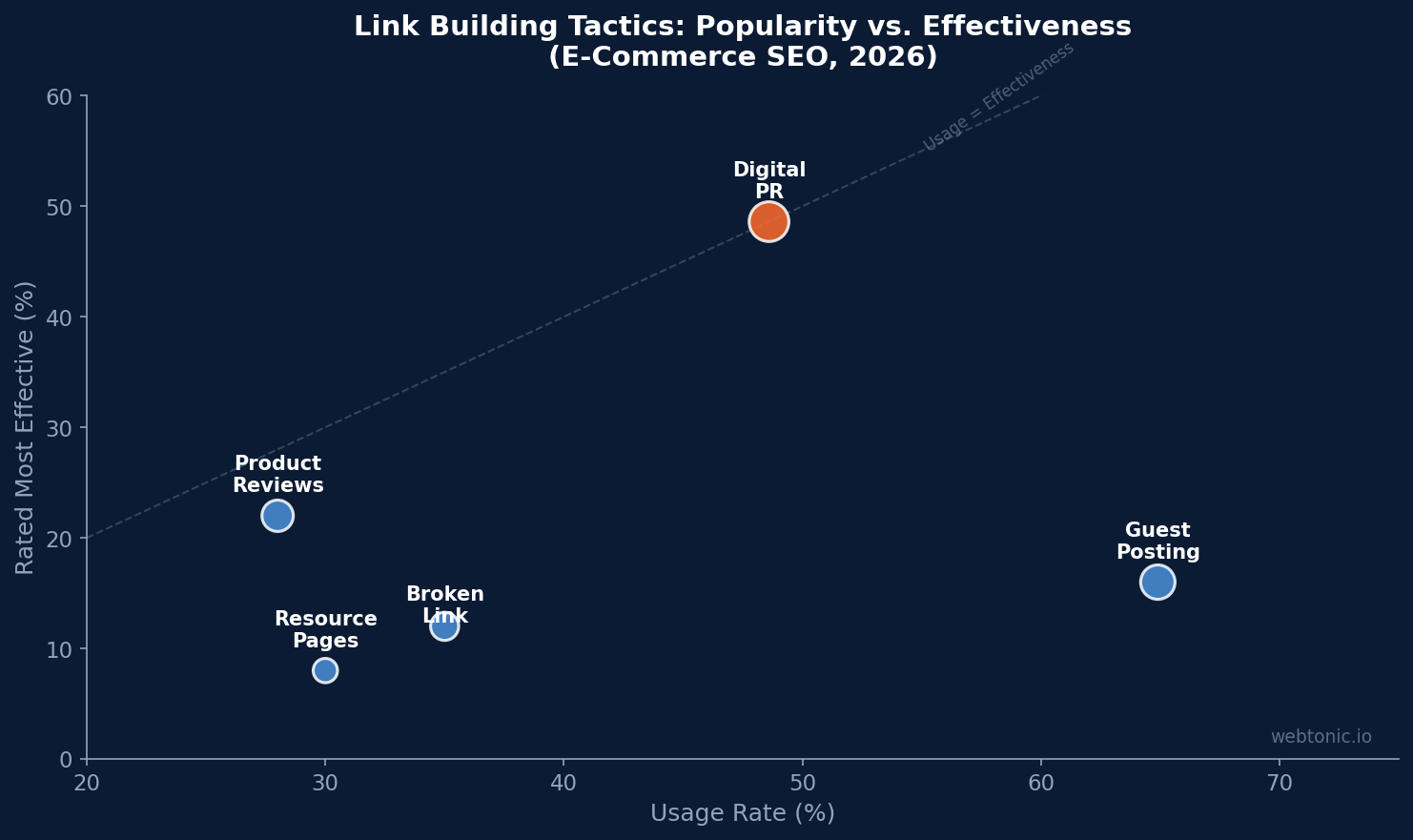
Affinco's 2026 analysis highlights a major shift: digital PR has dethroned guest posting as the top-rated tactic. And here is the statistic that will reshape ecommerce link building strategy: brand mentions predict AI search visibility 3× better than raw backlinks (Ahrefs, 2025). This means the links that also generate brand awareness are now doubly valuable.
Outreach Performance Benchmarks
Most ecommerce link building campaigns run on cold outreach. Link Building Journal's 2026 benchmark data shows what to expect:
- Links acquired per 100 emails sent: bottom quartile under 3, average 5–8, top quartile 10+ (Link Building Journal)
- Reply-to-placement conversion rate: bottom quartile under 20%, average 30–45%, top quartile 55%+
- Keyword or phrase anchors: 56% of monitored backlinks use keyword-rich anchor text (Linkody, 865,000 backlinks)
- 41% of SEO experts consider link building the most difficult part of search engine optimization (Zipdo)
For ecommerce specifically, Get Ryze's 2026 ecommerce outreach study tested 9 patterns and found that digital PR campaigns have a 67% success rate with an average DA of 72 on earned links, far outperforming other link acquisition methods. Product sample outreach costs $50–$300 per placement (including sample value) and earns dofollow product-page links — the hardest page type to build links to organically.
How Many Backlinks Do E-Commerce Sites Need?
The answer depends on competition level. Lifted Websites' 2026 benchmark analysis provides clear referring domain targets by vertical:
| Vertical | Referring Domains Needed/Month | Competition Level |
|---|---|---|
| Local SEO | 2–5 | Low–Medium |
| E-Commerce | 10–25 | High |
| National / SaaS | 15–30+ | Very High |
The quality bar is steep. BuzzStream's 2026 data shows that only 1.37% of vendor sites meet a quality threshold for link placement — meaning ecommerce brands must evaluate roughly 73 prospects to find one that qualifies. Tools like Ahrefs and Google Search Console help marketers track unique referring domains rather than total backlink count, which is the metric that matters for organic rankings.
Link Building Costs and ROI
Quality ecommerce links are not cheap, but the SEO return justifies the investment. Collaborator's 2026 ecommerce data breaks down the economics:
- Average ecommerce link cost: ~$325 — brands targeting mid-tier placements (DR 40–60, niche-relevant) should budget $150–$320 per link
- Cross-industry average cost per link: $508.95 — ecommerce links cost less because product reviews and affiliate content create natural link opportunities (Affinco)
- Digital PR average cost per link: ~$597 — higher upfront cost but links from DR 70+ domains with brand mention value (Presslei)
- Median SEO ROI: 748%, or $7.48 returned for every $1 invested — most campaigns reach measurable ranking impact in 3–6 months (Reporter Outreach / First Page Sage)

The most important metric for ecommerce is revenue per link earned, not total link quantity or average domain authority (Get Ryze). High-quality content marketing — particularly data-driven industry reports — will increase organic traffic and earn editorial links simultaneously. According to SerpBays' 60/30/10 framework, single data releases can earn 5–15 tier-1 placements when the data is genuinely novel.
Content Types That Earn the Most Ecommerce Backlinks
Not all content earns links equally. Search engine rankings correlate strongly with the type and depth of content produced. The data across multiple 2026 studies points to clear winners:
- Long-form content earns 77% more backlinks than short articles (Zipdo / Ahrefs)
- Data-driven reports earn 15–40 editorial mentions per major release over 12–18 months (SerpBays)
- Product review content generates dofollow links at $50–$300 per placement including sample cost — the best ROI for product-page link building (Get Ryze)
- User-generated content (UGC) and social media content create natural link opportunities that search engines value for E-E-A-T signals
- Interactive tools and calculators earn 2–4× more referring domains than static blog posts on equivalent topics
For ecommerce brands specifically, Authority Specialist's 2026 analysis of 41 online stores confirms that product pages are the hardest pages to earn links to organically. Digital marketers will need to use bridge content strategies — linking from high-authority resource pages to product pages internally — to pass link equity where it matters most.
Nofollow vs. Dofollow Links in E-Commerce
Not every backlink carries the same ranking weight. Nofollow links — commonly generated by social media platforms, forums like Reddit, and some guest posting opportunities — do not directly pass PageRank but still contribute to brand visibility and referral traffic. For ecommerce, the split matters:
- Affiliate program links are typically nofollow per Google's guidelines, meaning their SEO value is indirect (traffic + brand signals)
- Product review links from bloggers are usually dofollow, making them the most valuable organic link type for ecommerce product pages
- Editorial links from digital PR campaigns are dofollow 85%+ of the time and carry high authority scores
- User-generated content links (Reddit, community forums) are nofollow but increasingly factor into AI Overviews and search engine E-E-A-T evaluation
According to Searchlab's 2026 link building data, e-commerce sites build links 12% faster than the cross-industry average precisely because product reviews and affiliate programs generate a steady baseline of both dofollow and nofollow backlinks. Smart ecommerce marketers will increase their editorial link acquisition to complement this organic velocity — the combination of volume and quality is what moves rankings on competitive commercial keywords.
The relationship between link building and paid search performance is also becoming clearer: sites with strong organic authority tend to see higher Quality Scores and lower CPCs on branded search terms, creating a compounding benefit from every high-quality link earned.
Link Profile Benchmarks by Industry
E-commerce operates in one of the most competitive link environments. Comparing average referring domains across industries reveals how the ecommerce link building landscape stacks up:
| Industry | Top-10 Avg. Referring Domains | Notes |
|---|---|---|
| E-Commerce | 350 | Amazon, Shopify create massive link equity barriers |
| SaaS | 270 | B2B content marketing dominates backlink acquisition |
| Healthcare | 220 | Medical authority sites command high-quality links |
| Finance | 400 | Highest competition; regulatory content earns links |
| Legal | 220 | Local focus reduces national link competition |
These figures from WebFX's 2026 SEO benchmark report illustrate why ecommerce link building requires sustained effort. Most ecommerce sites will see meaningful movement in three to six months when adding 40–70 new quality referring domains monthly — a rate that most brands can achieve through a combination of digital PR, product reviews, and strategic guest posting.
Link Building and AI Search: The Shifting Landscape
The rise of AI Overviews and generative search engines is reshaping what makes a backlink valuable. Traditional link building focused purely on PageRank — getting any dofollow link from a high-DA website to improve organic rankings. In 2026, the calculus has changed. Brand mentions now predict AI search visibility 3× better than raw backlinks (Ahrefs, 2025), which means the best ecommerce link building strategies also build brand awareness.
For online store owners, this means prioritizing digital PR campaigns and editorial content marketing that generate both a backlink and a brand mention in context. Guest posting on niche-relevant blogs, earning product reviews from trusted creators, and publishing original ecommerce data studies all create the kind of signals that both traditional search engines and AI-powered search products reward. The ecommerce brands that will rank best in 2027 are the ones building multi-signal authority today — combining high-quality backlinks with brand mentions, social proof, and customer reviews across the web.
Related reading
- Ecommerce Reputation and Review Management Statistics, 2026
- E-Commerce App Store Optimization Benchmarks 2026: Conversion Rates and Rankings
- What Data Analysts Should Budget for E-Commerce AEO Statistics
- Link Building Services services at Web Tonic
FAQ
How many backlinks does an e-commerce site need to rank?
E-commerce sites typically need 10–25 new quality referring domains per month to compete for commercial keywords (Lifted Websites, 2026). The exact number depends on competition — highly competitive niches may need 40–70 new referring domains monthly to see measurable ranking improvements within 3–6 months.
How much does a quality e-commerce backlink cost?
The average ecommerce link costs approximately $325, with mid-tier placements (DR 40–60) ranging from $150 to $320 (Collaborator). Digital PR links from high-authority domains (DR 70+) average about $597 per link (Presslei). Product sample outreach offers the best ROI at $50–$300 per placement including product cost.
Is guest posting still effective for e-commerce link building?
Guest posting remains the most popular tactic — used by 64.9% of link builders — but only about 16% rate it as the most effective method (Authority Hacker). Digital PR campaigns are now rated as the top tactic by 48.6% of SEO professionals, earning links with an average DA of 72 compared to guest posting's 35–55 DA range.
What is the ROI of link building for e-commerce?
The median SEO ROI across industries is 748% ($7.48 returned per $1 invested), with most campaigns reaching measurable ranking impact in 3–6 months and stronger compounding returns in months 6–12 (First Page Sage, 2026). The most important metric is revenue per link earned, not total link quantity.
How do backlinks affect AI search visibility?
Brand mentions predict AI search visibility 3× better than raw backlinks (Ahrefs, 2025). This means ecommerce brands should prioritize link building tactics that also generate brand awareness — like digital PR and editorial content — over purely SEO-driven methods like directory submissions or paid links.
Sources
Affinco — Link Building Statistics 2026
Adbassador — State of Guest Posting 2026
Link Building Journal — 50+ Data Points 2026
Linkody — 865,000 Monitored Backlinks 2026
Get Ryze — Ecommerce Backlinks: 9 Outreach Patterns 2026
Collaborator — E-Commerce Link Building Costs 2026
Lifted Websites — How Many Backlinks Do You Need to Rank 2026
Authority Specialist — E-Commerce SEO Benchmarks 2026
Reporter Outreach — Link Building ROI 2026
Searchlab — Link Building Statistics 2026


