Table of contents
An e-commerce analyst can budget AEO from two published inputs: tool list prices, which run from USD 29 to USD 699 a month on the vendor pages we checked, and survey budget shares, where enterprises put 12% of digital budgets into AEO in 2025. No study publishes an e-commerce AEO cost per lead, so the rest of this page sizes the line item with Adobe, Census and Conductor traffic data instead.
Key Takeaways
- OtterlyAI lists USD 29, USD 189 and USD 489 per month for its three plans (monthly billing, Oct 2026).
- Ahrefs Brand Radar's AI Visibility Index starts at USD 199 per month; all models cost USD 699 per month.
- Enterprises gave AEO an average 12% of digital budgets in 2025 (Conductor).
- 94% of surveyed leaders plan to raise AEO investment in 2026.
- Generative AI traffic to US retail sites rose 1,300% year over year in holiday 2024 (Adobe).
- In Adobe's survey, 39% of US consumers had used generative AI for online shopping.
- US e-commerce hit USD 340.2 billion in Q2 2026, 17.1% of retail (Census).
- In retail, SOCi found only 45% overlap between top local-search brands and those AI recommends.
- AI referrals were 1.08% of website traffic across ten industries (Conductor).
The budget inputs that actually exist
Budget requests fail when they cite a benchmark nobody can open. For e-commerce AEO, the honest inventory is short: vendor list prices, one enterprise budget survey, retail traffic growth from Adobe, and market size from the Census Bureau. Everything else, including an AEO CPL or an AI-search conversion rate for stores, is not published by any issuer we could verify, and this page does not estimate one.
| Budget input | Published? | Best figure | Issuer |
|---|---|---|---|
| Tool subscription list price | Yes | USD 29 to USD 699 per month | OtterlyAI, Ahrefs pricing pages |
| AEO share of digital budget | Yes, enterprise | 12% in 2025 | Conductor survey |
| Retail AI traffic growth | Yes | +1,300% YoY, holiday 2024 | Adobe Analytics |
| E-commerce AEO cost per lead | No | Not published | No issuer |
| E-commerce AI-search conversion rate | No | Not published | No issuer |
Tool list prices, checked October 1, 2026
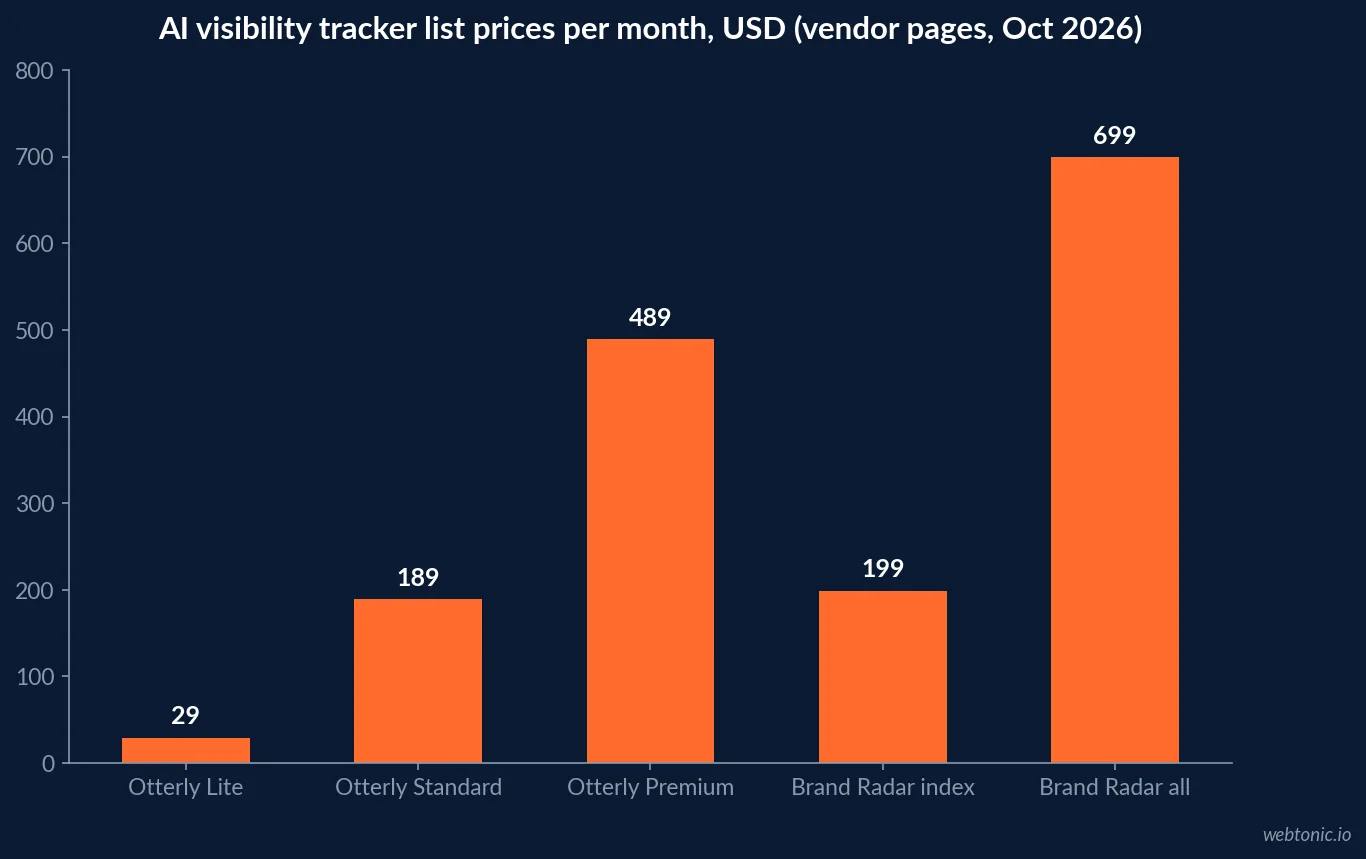
Most of an analyst's direct AEO cost is a tracking subscription. OtterlyAI's pricing page lists Lite at USD 29 per month with 15 search prompts, Standard at USD 189 with 100 prompts and Premium at USD 489 with 400 prompts, all tracking ChatGPT, Google AI Overviews, Perplexity and Microsoft Copilot; annual billing takes 15% off, and Google AI Mode, Gemini and Claude are paid add-ons. Ahrefs Brand Radar lists custom prompt tracking from USD 50 per month, the AI Visibility Index across 449M prompts from USD 199 per month, and USD 699 per month for all models. Peec AI's own product notes describe its Starter plan at roughly USD 85-103 per month for 50 prompts on three engines.
| Vendor and plan | List price per month | Prompts or scope | Source page |
|---|---|---|---|
| OtterlyAI Lite | USD 29 | 15 prompts, 4 engines | otterly.ai/pricing |
| OtterlyAI Standard | USD 189 | 100 prompts, 4 engines | otterly.ai/pricing |
| OtterlyAI Premium | USD 489 | 400 prompts, 4 engines | otterly.ai/pricing |
| Ahrefs Brand Radar custom prompts | From USD 50 | Prompts you define | ahrefs.com/brand-radar |
| Ahrefs Brand Radar AI Visibility Index | From USD 199 | 449M-prompt index | ahrefs.com/brand-radar |
| Ahrefs Brand Radar, all models | USD 699 | All platforms | ahrefs.com/brand-radar |
| Peec AI Starter | ~USD 85-103 | 50 prompts, 3 engines | peec.ai (vendor notes) |
Turning list prices into an annual line
The arithmetic is simple and should be shown in the request. One mid-tier tracker at USD 189 per month is USD 2,268 a year on monthly billing; the same plan billed annually with Otterly's 15% discount is about USD 1,928. The Ahrefs all-models option at USD 699 is USD 8,388 a year. Stores that need prompt coverage in several countries or catalogs multiply by project count, which is where entry-tier prompt limits such as 15 or 50 prompts become the real constraint rather than the dollar figure.
These are subscription costs only. Content production, product data cleanup and analyst time are internal costs that no vendor page prices.
What survey data says about the share of budget
For a percentage-of-budget approach, the only named source is Conductor's State of AEO/GEO report, which surveyed CMOs, VPs and senior directors at enterprise companies. Enterprises allocated an average of 12% of their digital budgets to AEO in 2025; 56% made a significant or high investment, 97% reported a positive impact, and 94% plan to increase investment in 2026. The sample is cross-industry and enterprise-weighted, so a mid-market store should treat 12% as a reference point, not a target.
| Conductor survey finding | Value | Year |
|---|---|---|
| Average share of digital budget to AEO | 12% | 2025 |
| Made significant or high AEO investment | 56% | 2025 |
| Reported positive AEO impact | 97% | 2025 |
| Plan to increase AEO investment | 94% | 2026 plans |
Retail AI traffic: the growth curve analysts must size
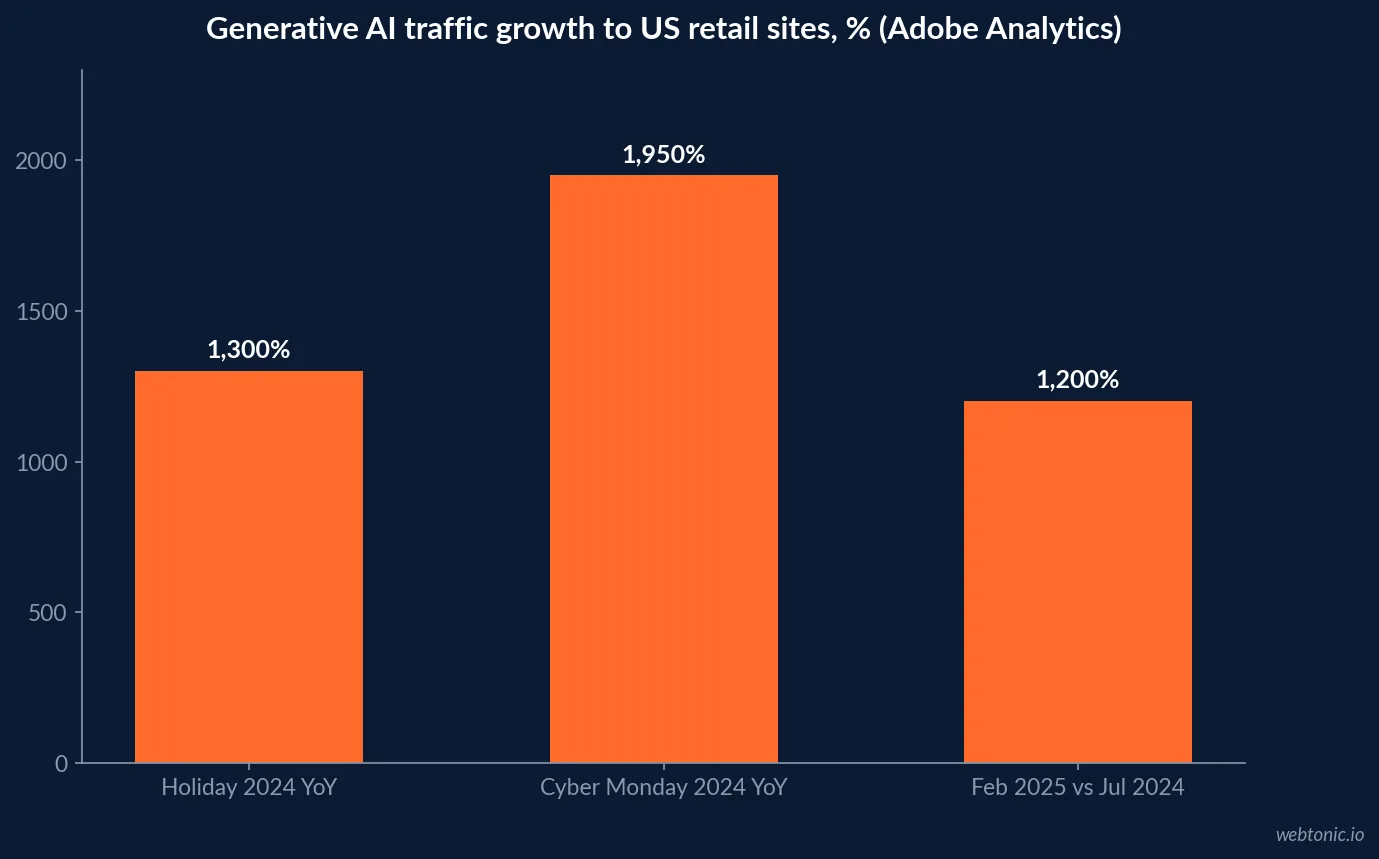
Adobe Analytics, based on more than 1 trillion visits to US retail sites, reported that between November 1 and December 31, 2024, traffic from generative AI sources rose 1,300% year over year, and 1,950% on Cyber Monday. In February 2025 it was up 1,200% versus July 2024, and Adobe said it had been doubling every two months since September 2024 while remaining modest next to paid search or email. In Adobe's survey of 5,000 US consumers, 39% had used generative AI for online shopping and 53% planned to.
Conductor's cross-industry view gives the scale: AI referrals were 1.08% of website traffic, with Consumer Staples at 1.91%, the second highest of its ten sectors. Consumer Staples is a sector label, not an e-commerce cut, so use it as context only.
| Adobe retail metric | Value | Period |
|---|---|---|
| Generative AI traffic to US retail sites | +1,300% YoY | Nov 1 - Dec 31, 2024 |
| Same, Cyber Monday | +1,950% YoY | Cyber Monday 2024 |
| Same, vs July 2024 | +1,200% | February 2025 |
| Consumers who used genAI for shopping | 39% | Adobe survey, 5,000 US adults |
| Consumers planning to use it | 53% | Adobe survey |
The revenue base the line item protects
The Census Bureau put adjusted US retail e-commerce at USD 340.2 billion in Q2 2026, up 12.2% on Q2 2025 and equal to 17.1% of total retail sales of USD 1,986.5 billion. Against that base, even a 1.08% traffic share is material for large catalogs. The base is also where search change bites: on SparkToro's panel, 68.01% of US Google searches ended without a click in early 2026, up from 60.45% in 2024.
Click-loss inputs for the traffic forecast
A budget request usually needs a downside scenario: how much organic traffic could be lost if product and category pages stop earning clicks. Three published figures can feed that model, each with its own scope. Ahrefs measured that an AI Overview now correlates with about 58% lower position-one CTR on December 2025 data, up from 34.5% in its April 2025 run. Pew Research Center found users clicked a traditional result on 8% of visits when an AI summary appeared versus 15% without one, in March 2025. SparkToro's 68.01% zero-click share sets the ceiling for any organic plan.
None of these is an e-commerce-only measurement, and none is causal. Use them as scenario bounds in a forecast, label them as cross-industry, and replace them with the store's own Search Console click-through data as soon as a few months of AI Overview exposure are visible.
| Forecast input | Value | Scope | Issuer |
|---|---|---|---|
| Position-one CTR gap with AI Overview | ~-58% | December 2025 data, informational keywords | Ahrefs |
| Earlier reading of the same gap | -34.5% | April 2025, 300,000 keywords | Ahrefs |
| Result clicks with vs without AI summary | 8% vs 15% | March 2025, 900 US adults | Pew Research Center |
| US Google searches without a click | 68.01% | Jan-Apr 2026 | SparkToro |
Commercial queries now carry AI Overviews
Product research is no longer outside the AI layer. Semrush analyzed more than 600,000 keywords from November 2025 to April 2026 and found AI Overviews on commercial-intent results grew 71%, while transactional-intent appearances fell 5%. Results showing both Google Ads and an AI Overview appeared roughly twice as often as a year before. For a store, that means comparison and best-of queries need visibility tracking, while checkout-intent queries still mostly behave like classic search.
Why local and brand signals still count for retail
Multi-location retailers face a selection problem. SOCi's 2026 Local Visibility Index, a vendor study of more than 350,000 locations across 2,751 brands, found ChatGPT recommends just 1.2% of brand locations against a 35.9% appearance rate in Google's local 3-Pack. In retail specifically, only 45% overlap existed between the most visible enterprise brands in traditional local search and those AI platforms recommend most often, and ChatGPT-recommended locations averaged 4.3-star ratings.
What not to pay for
Google Search Central states there are no additional requirements to appear in AI Overviews or AI Mode, and that sites do not need new machine readable files, AI text files or markup. It specifically advises keeping Merchant Center and Business Profile information up to date. A budget line for proprietary "AI markup" therefore has no support from Google's own documentation; product feed quality does.
An analyst's budget checklist
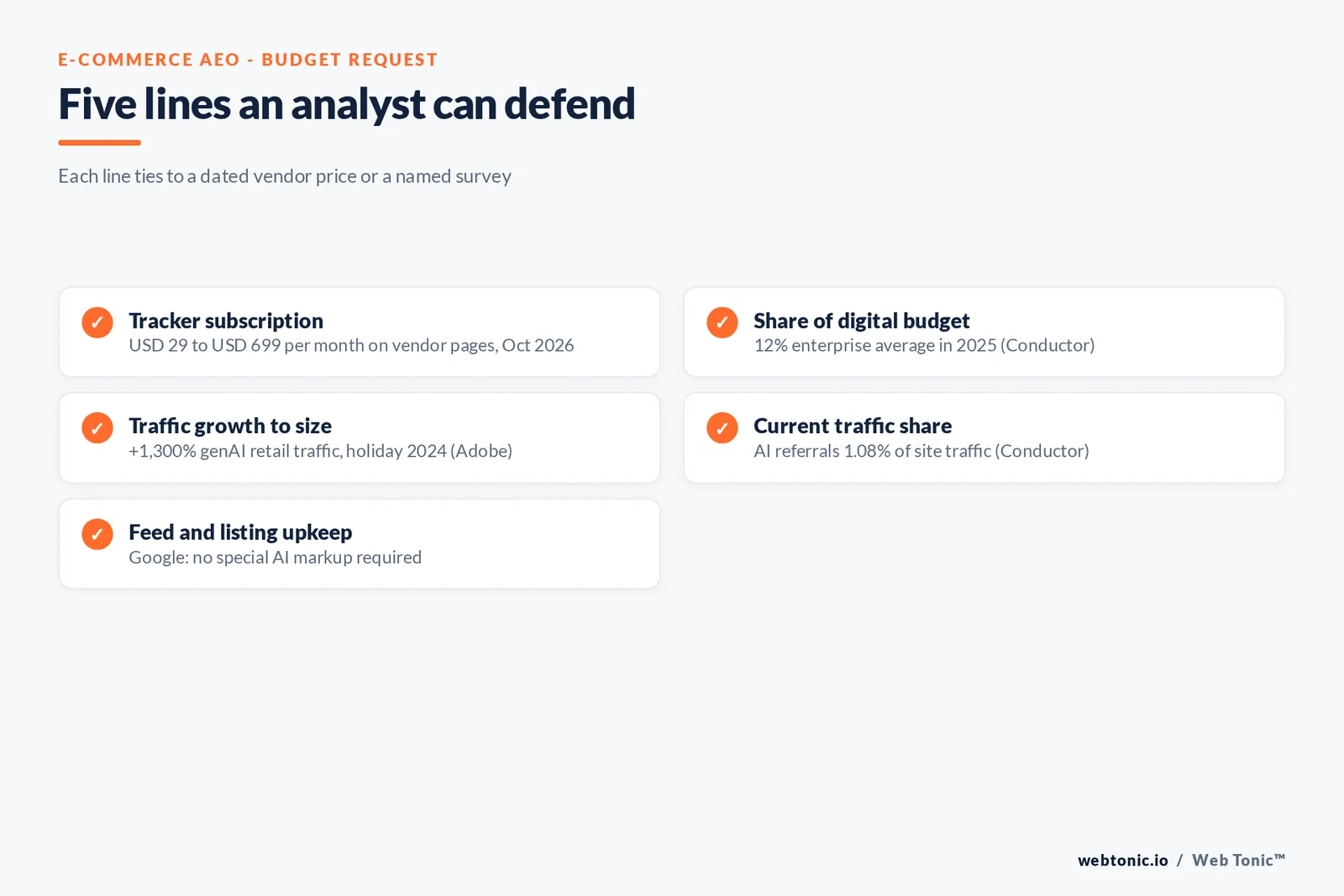
- Price the tracker from the vendor page on the day, with prompt counts, and annualize it.
- Cite 12% as an enterprise survey average, never as an e-commerce benchmark.
- Baseline AI-referred sessions in analytics before asking for more; compare with 1.08%.
- Segment commercial vs transactional queries, given the 71% vs -5% AIO split.
- Fund feed and listing hygiene before any special-markup vendor.
For the cross-industry picture, see our generative engine optimization statistics and e-commerce international SEO data. Analytics setup for AI-referred orders is handled by our data intelligence team, and channel planning by our growth marketing group.
Frequently Asked Questions
How much does an AI visibility tracking tool cost for an online store?
On the vendors' own pricing pages checked on October 1, 2026, OtterlyAI lists Lite at USD 29, Standard at USD 189 and Premium at USD 489 per month billed monthly, and Ahrefs Brand Radar lists its AI Visibility Index from USD 199 per month, custom prompts from USD 50 per month, and USD 699 per month for all models. Prices change often, so re-check the page on the day you budget.
What share of the marketing budget goes to AEO?
Conductor's State of AEO/GEO report found enterprises allocated an average of 12% of their digital budgets to AEO in 2025, with 56% making a significant or high investment and 94% planning to increase it in 2026. The survey covers enterprise leaders across industries; no e-commerce-only budget share is published.
Is generative AI traffic to retail sites large enough to budget for?
It is growing fast from a small base. Adobe Analytics measured generative AI traffic to US retail sites up 1,300% year over year during the November-December 2024 holiday period, and up 1,200% in February 2025 versus July 2024. Conductor puts AI referrals at 1.08% of website traffic across ten industries.
Is there a published AEO conversion rate or CPL for e-commerce?
No. No study we found publishes an e-commerce AEO cost per lead or AI-search conversion rate that can be used as a benchmark. Analysts should measure AI-referred sessions and orders in their own analytics instead of budgeting against an invented rate.
Do stores need special markup to show in AI answers?
Google says no. Its Search Central page states there are no additional requirements or special optimizations to appear in AI Overviews or AI Mode, while recommending that Merchant Center and Business Profile information is kept up to date.
Sources
OtterlyAI, Pricing (checked Oct 1, 2026)
Ahrefs, Brand Radar pricing (checked Oct 1, 2026)
Peec AI, product and pricing notes
Conductor, State of AEO/GEO report
Conductor, 2026 AEO/GEO Benchmarks Report
Adobe Analytics, generative AI traffic to US retail sites (March 2025)
US Census Bureau, Quarterly Retail E-Commerce Sales, Q2 2026
SparkToro, 2026 zero-click study
Ahrefs, Update: AI Overviews Reduce Clicks by 58% (2026)
Pew Research Center, AI summaries and clicks (July 2025)
Semrush, AI Overviews commercial search study (2026)
SOCi, 2026 Local Visibility Index announcement
Google Search Central, AI features and your website