Table of contents

E-commerce reputation is really two separate systems: on-site product reviews that move conversion rate directly, and Google's seller/store rating that most online-only retailers cannot even qualify for the way a brick-and-mortar competitor does. This page keeps those two systems separate and honest about which tools an online-only retailer is actually eligible to use.
Key Takeaways
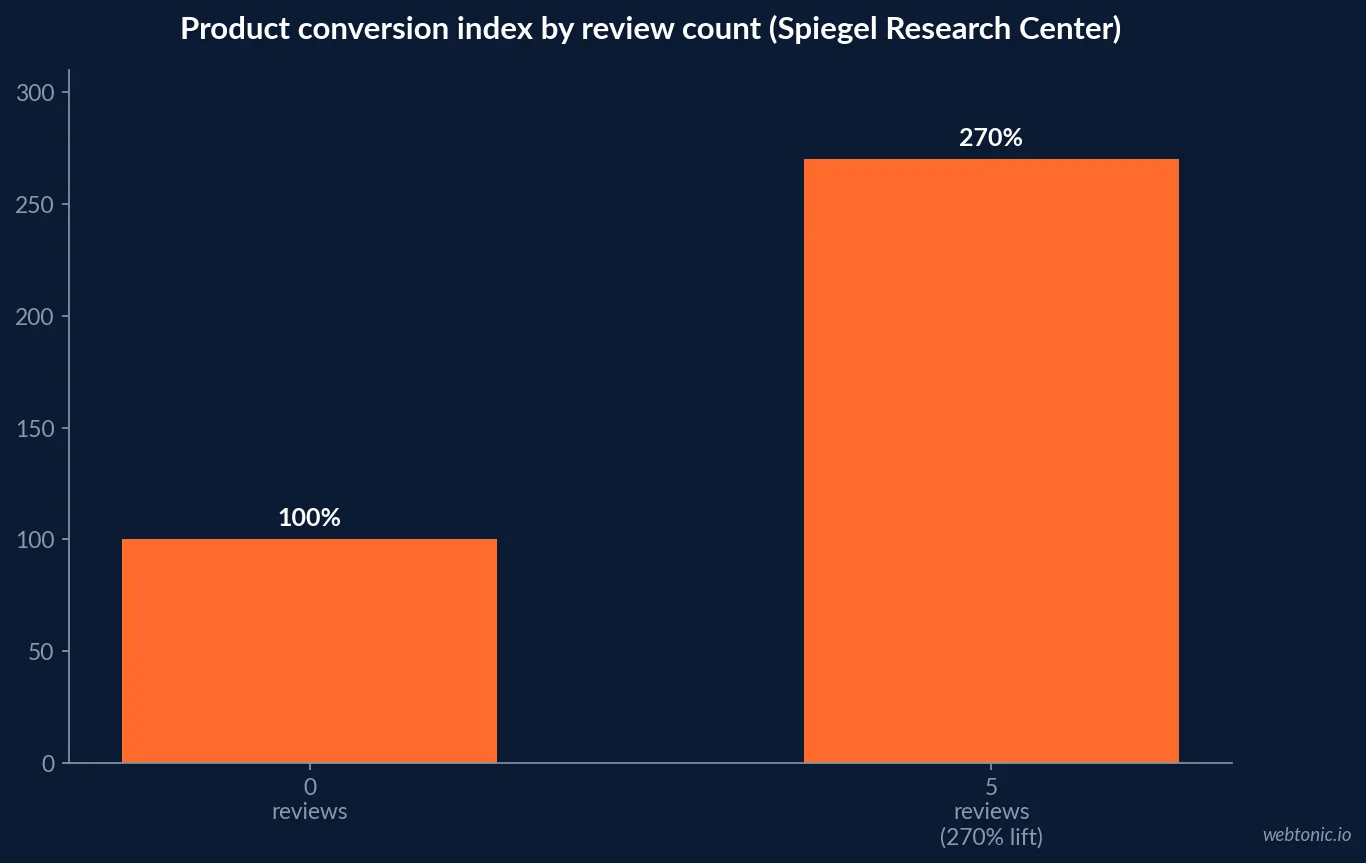
- A product with five reviews converts up to 270% better than one with none.
- The conversion lift is larger for higher-priced, higher-consideration items.
- Displaying reviews at all increased conversion rate in Spiegel/PowerReviews' data.
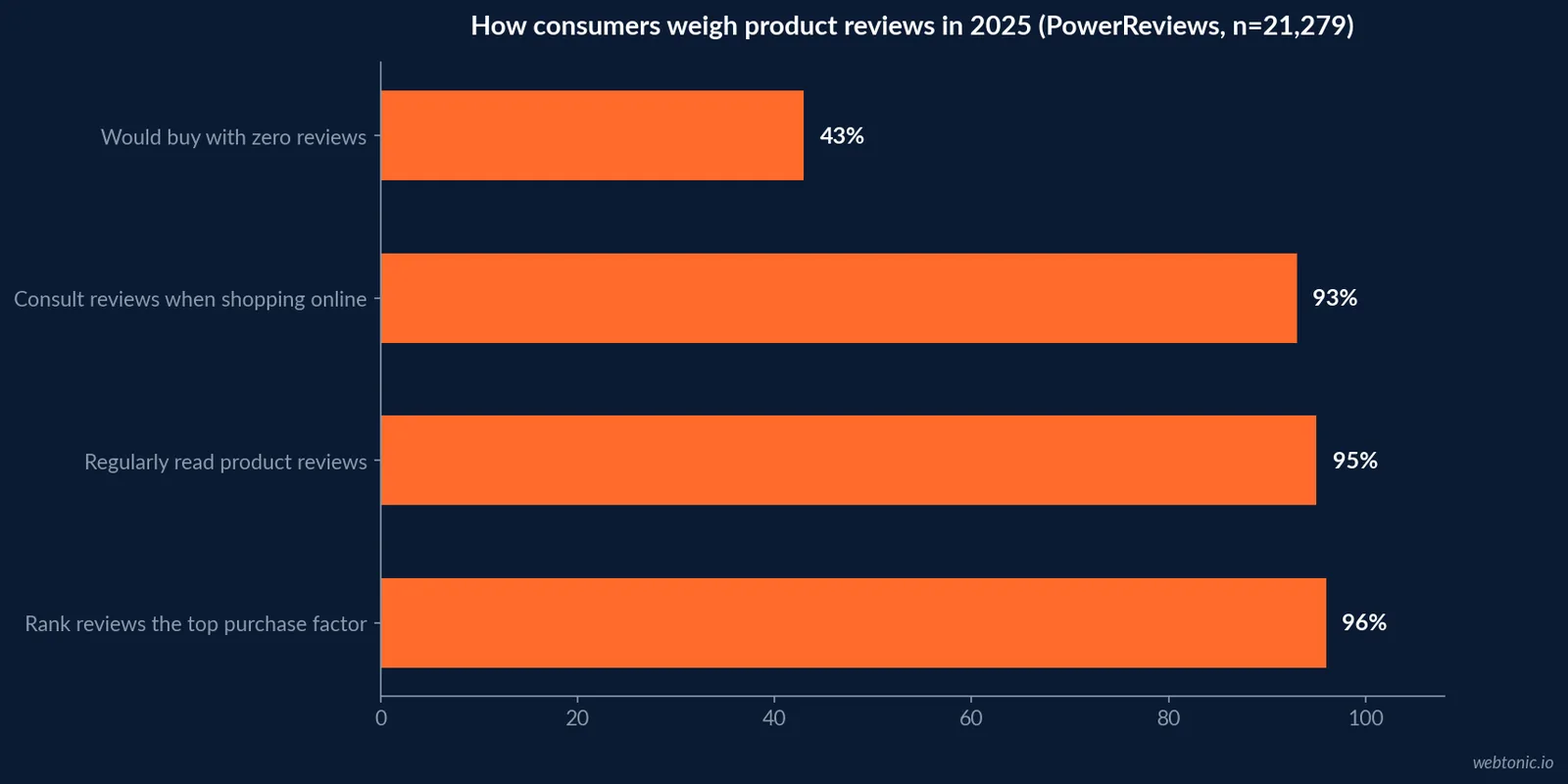
- 95% of consumers say they regularly read product reviews before buying.
- Only 43% would buy a product listed with zero reviews.
- 96% say ratings and reviews are the most influential factor in a purchase decision.
- 93% consult product reviews specifically when shopping online.
- 76% of consumers say they scrutinize products more closely in the current economy.
- 84% of Gen Z shoppers say they research more due to economic conditions.
- Online-only businesses are explicitly listed as ineligible for a Google Business Profile.
- A brand profile through Google Merchant Center is the correct tool for e-commerce-only sellers.
- A 3.5-star minimum is required before a Google seller rating badge can display on text ads.
- Seller ratings lift Search-network click-through by about 2% on average.
- Businesses with both a store and a website qualify for both a Business Profile and a brand profile.
Product reviews are a measured conversion lever, not a nice-to-have
Northwestern University's Spiegel Research Center, working with PowerReviews on purchase data from multiple online retailers, found that as a product accumulates its first reviews, conversion rate rises sharply: a product with five reviews converts at roughly 270% the rate of the identical product with none. The lift is not uniform across price points - Spiegel found it more pronounced for higher-priced and higher-consideration items than for low-cost, low-consideration ones, and that the majority of the conversion gain happens with the very first reviews displayed, not after accumulating hundreds.
PowerReviews' own June 2025 consumer survey, covering 21,279 respondents, reinforces the same pattern from the demand side: 95% say they regularly read product reviews as part of their shopping journey, 93% specifically consult reviews when shopping online, and 96% rank ratings and reviews as the single most influential factor in a purchase decision - ahead of customer photos, search results, or recommendations from friends and family.
| Product-review conversion signal | Figure | Source |
|---|---|---|
| Conversion lift, product with 5 reviews vs. 0 | Up to 270% | Spiegel Research Center / PowerReviews |
| Consumers who regularly read product reviews | 95% | PowerReviews, June 2025 (n=21,279) |
| Consumers who consult reviews specifically when shopping online | 93% | PowerReviews, June 2025 |
| Consumers ranking reviews the most influential purchase factor | 96% | PowerReviews, June 2025 |
| Consumers who would buy a product with zero reviews | 43% | PowerReviews, June 2025 |
The economy is raising the bar, not lowering it
PowerReviews' 2025 data also shows the review-reading habit intensifying under economic pressure: 76% of consumers say they are scrutinizing and researching products more closely in the current economic climate, rising to 84% among Gen Z shoppers specifically. For an e-commerce retailer, that means a thin or missing review section is a more expensive gap to leave open now than it would have been in a looser spending environment - shoppers who are already price-sensitive are also the ones reading reviews hardest before committing.
Why most e-commerce retailers cannot use a Google Business Profile
This is the honesty check this page has to make explicit: Google's own Business eligibility and ownership guidelines state a Business Profile requires a business to "make in-person contact with customers during its stated hours," and its list of ineligible business types names "brands, organizations, artists, and other online-only businesses" directly. A pure online store with no physical location, showroom or pickup counter simply does not qualify - no amount of review volume changes that eligibility rule.
Google's own comparison page, About Google Business Profile & brand profile, spells out the alternative: a brand profile, managed through Google Merchant Center, is built specifically "for businesses that sell products online," and a retailer running both a physical store and an online store is eligible for both a Business Profile and a brand profile at once. Google's free local listings documentation adds that Merchant Center also powers organic product listings across Search, Maps, the Shopping tab and Google Lens - the closest e-commerce equivalent to the visibility a Business Profile gives a local business.
| Business type | Eligible for Business Profile? | Correct Google tool |
|---|---|---|
| Online-only retailer, no physical location | No - explicitly listed as ineligible | Merchant Center brand profile + free listings |
| Omnichannel retailer with stores and online sales | Yes | Business Profile AND brand profile, both |
| Retailer with a showroom or pickup point | Yes, for the physical location | Business Profile for the location, brand profile for online catalog |
| Brand with no retail presence (manufacturer only) | No | Brand profile only, if selling direct |
Seller ratings: the closest thing e-commerce has to a store-level star rating
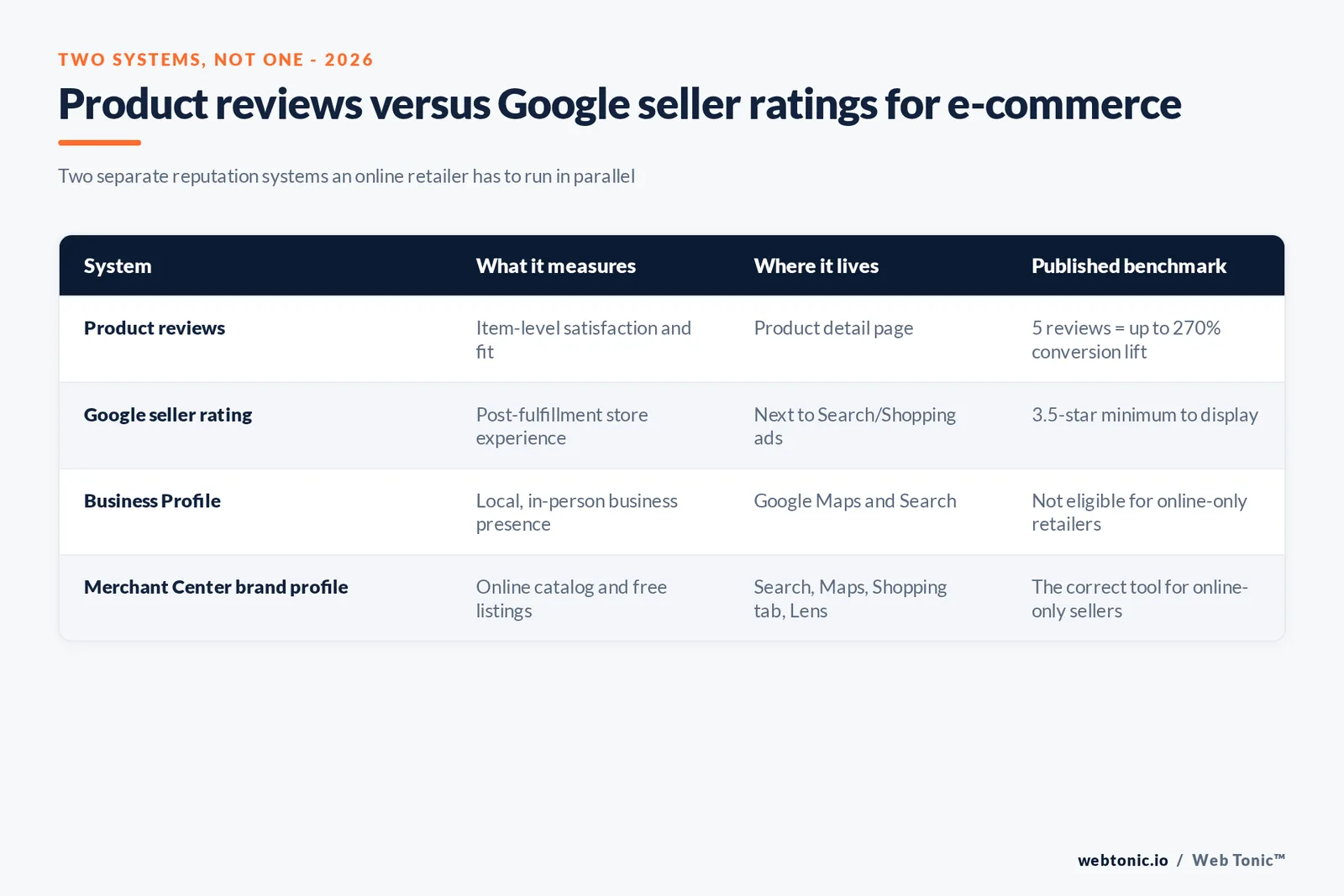
Where a Business Profile is unavailable, Google's Store ratings program is the mechanism that does apply to e-commerce sellers: it aggregates post-fulfillment customer experience - shipping, service, returns - from partner review sites and Google's own users into a rating that can display next to Search and Shopping ads. Google's documentation requires a 3.5-star minimum before the badge shows on text ads, and reports it drives an average 2% click-through improvement on the Search network. That rating measures the retailer as a seller, and is entirely separate from the individual product reviews on each product detail page - a retailer can have excellent product reviews and a weak seller rating, or the reverse, because they draw on different customer experiences and different data sources.
What this means for an e-commerce reputation program
Run two programs, not one. On the product-review side, prioritize getting the first reviews onto new listings quickly - the 270% conversion gain happens early, per Spiegel, not after hundreds of reviews accumulate - and never let a hero SKU sit at zero. On the seller-rating side, register for Google's Store ratings program (via Google Customer Reviews or a supported partner) and treat 3.5 stars as the minimum bar to even display the badge, not a target to aim for. Never attempt to substitute one for the other: product reviews and seller ratings measure different things, appear in different places, and require different remediation when they slip.
Our growth marketing practice builds the review-request cadence into post-purchase flows for e-commerce clients, and our data and analytics practice can separate product-review sentiment from seller-rating sentiment in reporting so neither one masks a problem in the other. If your current setup conflates the two, talk to us about auditing both systems separately.
Third-party marketplace reviews add a third layer
A retailer selling on its own domain and on a marketplace (Amazon, Walmart Marketplace, a Shopify app channel) manages a third reputation surface beyond product reviews and Google seller ratings: the marketplace's own seller-performance metrics, which have their own suspension and enforcement rules independent of Google's. None of the marketplace-specific figures are covered on this page - they deserve their own benchmark treatment - but the same principle applies: do not assume a strong marketplace seller score offsets a weak on-site product-review program, or the reverse, since each platform's algorithm and customer base judges the retailer independently.
| Reputation surface | Owned by | Primary risk if neglected |
|---|---|---|
| On-site product reviews | The retailer's own site | Lower product-page conversion (up to 270% gap) |
| Google seller rating | Google, aggregated from partners | No badge below 3.5 stars, lost ~2% CTR |
| Google Business Profile | Google (physical locations only) | Not applicable to online-only sellers |
| Merchant Center brand profile | Google, for e-commerce sellers | Lost free listing visibility if unclaimed |
| Marketplace seller score | Amazon/Walmart/other marketplace | Suspension risk, separate from Google entirely |
The compliance floor still applies online
The FTC's fake-review rule (16 CFR Part 465) and Endorsement Guides (16 CFR Part 255) apply to e-commerce product reviews exactly as they apply to local business reviews: buying, selling, or incentivizing a review without disclosure is prohibited, and a company-run "independent" review site is barred outright. An e-commerce retailer running its own review-collection program - whether through a native tool or a third-party reviews app - carries the same disclosure obligation as any other business collecting consumer feedback.
Marking reviews up so search engines can read them
Google's own review snippet structured data guidelines require aggregate rating markup to reflect reviews actually collected by or for the specific product, not a site-wide or manufacturer-level score applied to every SKU - a rule the guidelines describe as prohibiting "self-serving" review markup. An e-commerce retailer that marks up every product page with an identical, site-wide rating risks a manual action, independent of anything the FTC enforces; the two compliance regimes (Google's structured data policy and the FTC's consumer protection rules) overlap but are enforced separately and should both be checked before a product-review program launches at scale.
| Compliance layer | What it prohibits | Enforcement path |
|---|---|---|
| FTC 16 CFR 465 | Buying, selling or suppressing fake reviews | FTC investigation and penalties |
| FTC 16 CFR 255 | Undisclosed material connections in endorsements | FTC investigation and penalties |
| Google review snippet policy | Site-wide ratings applied to individual product markup | Manual action, lost rich result |
| Marketplace seller policies | Incentivized or solicited reviews outside program rules | Listing or account suspension |
Frequently Asked Questions
Can a pure online store get a Google Business Profile?
No. Google's own eligibility guidelines state a Business Profile requires in-person contact with customers during stated hours, and explicitly list 'brands, organizations, artists, and other online-only businesses' as ineligible. An online-only retailer is not permitted a Business Profile listing regardless of review volume or revenue - the correct tool for that retailer is a brand profile through Google Merchant Center, not a Business Profile.
What does an online-only retailer use instead of a Business Profile?
Google Merchant Center's brand profile and free local/product listings. Google's own documentation distinguishes the two directly: a Business Profile is for businesses making in-person contact with customers, while a brand profile is for e-commerce retailers selling products online, and a business with both a physical store and an online store is eligible for both simultaneously.
Do product reviews actually change conversion rate, or is that assumed?
It is measured, not assumed. Northwestern University's Spiegel Research Center, partnering with PowerReviews on data from multiple online retailers, found that a product with five reviews converts at up to 270% the rate of the same product with none, and that the conversion lift is larger for higher-priced, higher-consideration items than for low-cost ones.
Does having zero reviews actively hurt a product listing?
The published data says yes. PowerReviews' own June 2025 survey of over 21,000 consumers found only 43% would buy a product listed with zero ratings or reviews, and that 95% of respondents said they regularly read product reviews as part of their shopping journey - meaning the absence of reviews, not just a low rating, is itself a conversion barrier on a product detail page.
What is a Google seller rating and how is it different from a product review?
A seller (store) rating reflects the overall post-purchase experience with the retailer - shipping, service, returns - aggregated from partner review sites and Google users, and can display next to Search and Shopping ads once a merchant qualifies. Google's own Store ratings documentation requires a 3.5-star minimum before the badge displays on text ads, and reports an average 2% click-through lift where it appears. That is separate from, and measured differently than, the individual product reviews shown on a retailer's own product detail pages.
Sources
Northwestern Spiegel Research Center - How Online Reviews Influence Sales
PowerReviews - The Complete Guide to Ratings & Reviews (2025 survey data)
Google Business Profile Help - Business eligibility and ownership guidelines
Google Business Profile Help - About Google Business Profile & brand profile
Google Merchant Center Help - Benefits of free local listings
Google Ads Help - About store ratings
Federal Trade Commission - 16 CFR Part 465, Final Rule
eCFR - 16 CFR Part 255, FTC Endorsement Guides
Google Search Central - Review snippet structured data guidelines