Table of contents
Brand identity is one of the highest-leverage investments in e-commerce — 81% of shoppers are more likely to buy from a recognized brand, even at a higher price point. This roundup compiles the latest 2026 data on how branding impacts e-commerce conversion rates, customer loyalty, and long-term revenue growth.
Key Takeaways
- 67% of shoppers say product quality and value define brand trust, with 63% citing brand reputation and 54% highlighting customer experience
- Consistent visual branding across touchpoints increases perceived trustworthiness by 52%
- 90% of loyalty program members say membership influences repeat purchases from the same e-commerce brand (up from 85% in 2024)
- Professional website design increases trust by 75%, while money-back guarantees boost conversion by 21%
- Branded packaging delivers 400–3,000% ROI through increased repeat purchase rates
- E-commerce branding paired with multi-channel strategies drives 32–541% sales increases for European SMEs
- 72% of consumers say packaging design influences their repurchase decision
E-Commerce Brand Trust Statistics (2026)
Consumer trust in e-commerce brands is built through multiple touchpoints, from product quality to visual brand consistency. The latest research reveals which factors carry the most weight in purchase decisions and how online retailers can prioritize their branding investments accordingly.
| Trust Factor | Consumer Agreement | Conversion Impact |
|---|---|---|
| Product Quality & Value | 67% | Primary purchase driver |
| Brand Reputation | 63% | Repeat purchase catalyst |
| Customer Experience | 54% | Lifetime value multiplier |
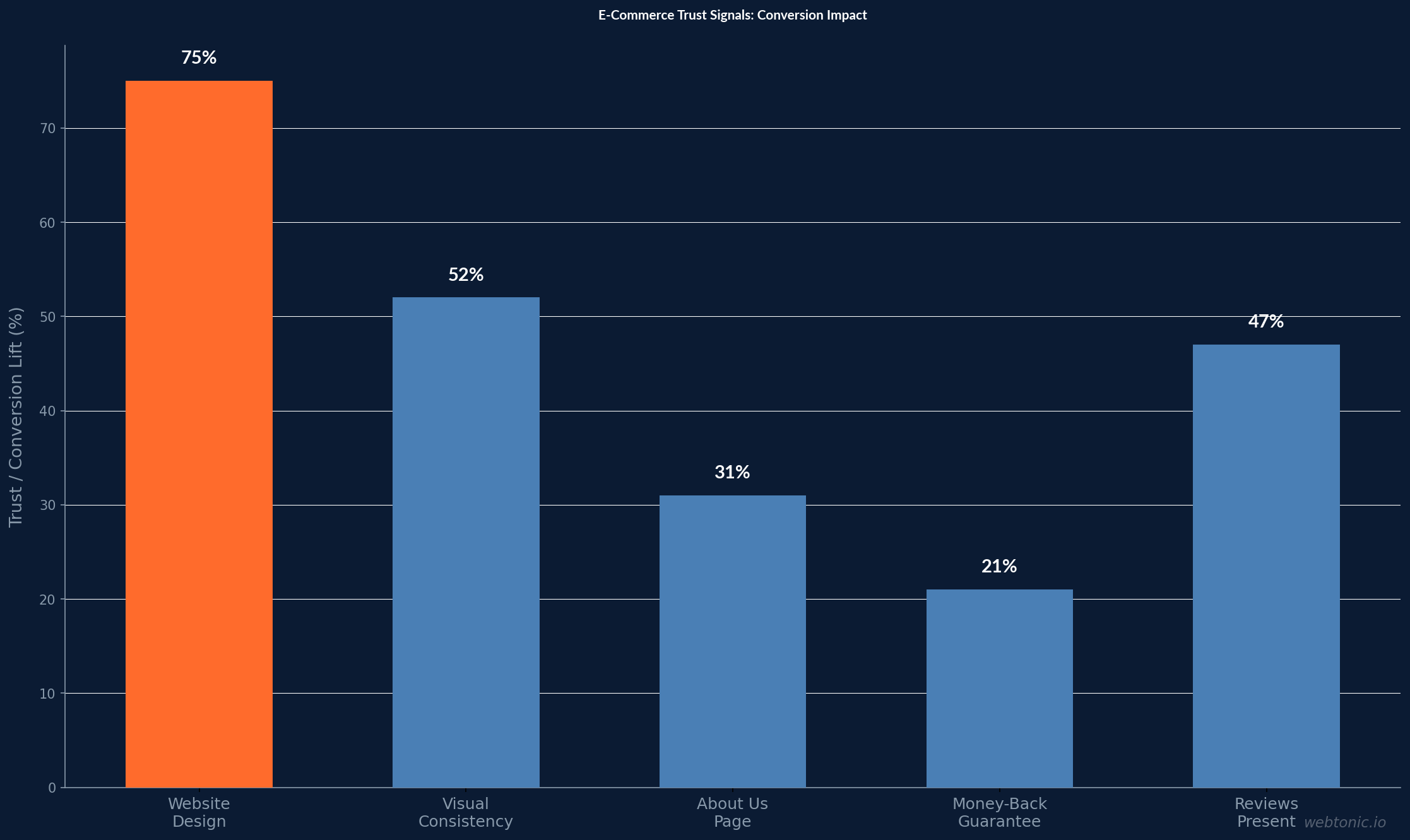
| Professional Website Design | 75% trust increase | +25–40% conversion lift |
| Consistent Visual Branding | 52% trustworthiness lift | Cross-touchpoint recognition |
| Money-Back Guarantees | 21% conversion increase | Risk reduction signal |
| Customer Reviews Visible | 47% expect them | Social proof baseline |
| Detailed About Us Page | 31% trust increase | Brand authenticity signal |
According to BigCommerce, 67% of shoppers define brand trust through product quality and value, making it the single most important branding element. Eevy AI's trust signal research shows that professional website design alone increases trust by 75%, while even simple trust signals like money-back guarantees boost conversion by 21%.
Visual Branding and Conversion Rate Impact
The visual dimension of e-commerce branding has measurable effects on conversion metrics that go far beyond aesthetic preference. Research from PageLens quantifies these effects across different visual branding strategies for online stores, revealing that intentional visual design choices compound into significant revenue differences over time. For e-commerce businesses investing in brand identity, the visual layer represents one of the highest-leverage areas for measurable conversion improvement across all marketing channels.
- Consistent visual branding across images increases perceived trustworthiness by 52% — users trust sites where images look intentionally designed
- UGC (user-generated content) outperforms brand-produced content by a median 19% on conversion, 27% on time-on-page, and 11% on average order value
- Lifestyle imagery in collections boosts overall conversion rate by 16% and collection purchase rate by 80%
- Logo recognition after single exposure reaches 63% of consumers (ZipDo)
- 81% of shoppers prefer recognized brands over unknown alternatives, even at higher prices
- Social media is the top channel for brand discovery, with 77% of consumers preferring to buy from brands they follow
E-Commerce Packaging and DTC Branding Statistics
For direct-to-consumer brands, the unboxing experience is a critical branding touchpoint that directly impacts repeat purchases, organic social sharing, and customer lifetime value. The data shows substantial ROI from strategic packaging investments when properly executed, with leading DTC brands treating packaging as a full marketing channel rather than a logistics requirement.
| Packaging Metric | Statistic | Source |
|---|---|---|
| Packaging Influences Repurchase | 72% of consumers | Gorilla Shipper |
| Premium Packaging → Repeat Purchase | 52% more likely | Dotcom Distribution |
| Unboxing Shared on Social Media | 44% of shoppers | Dotcom Distribution |
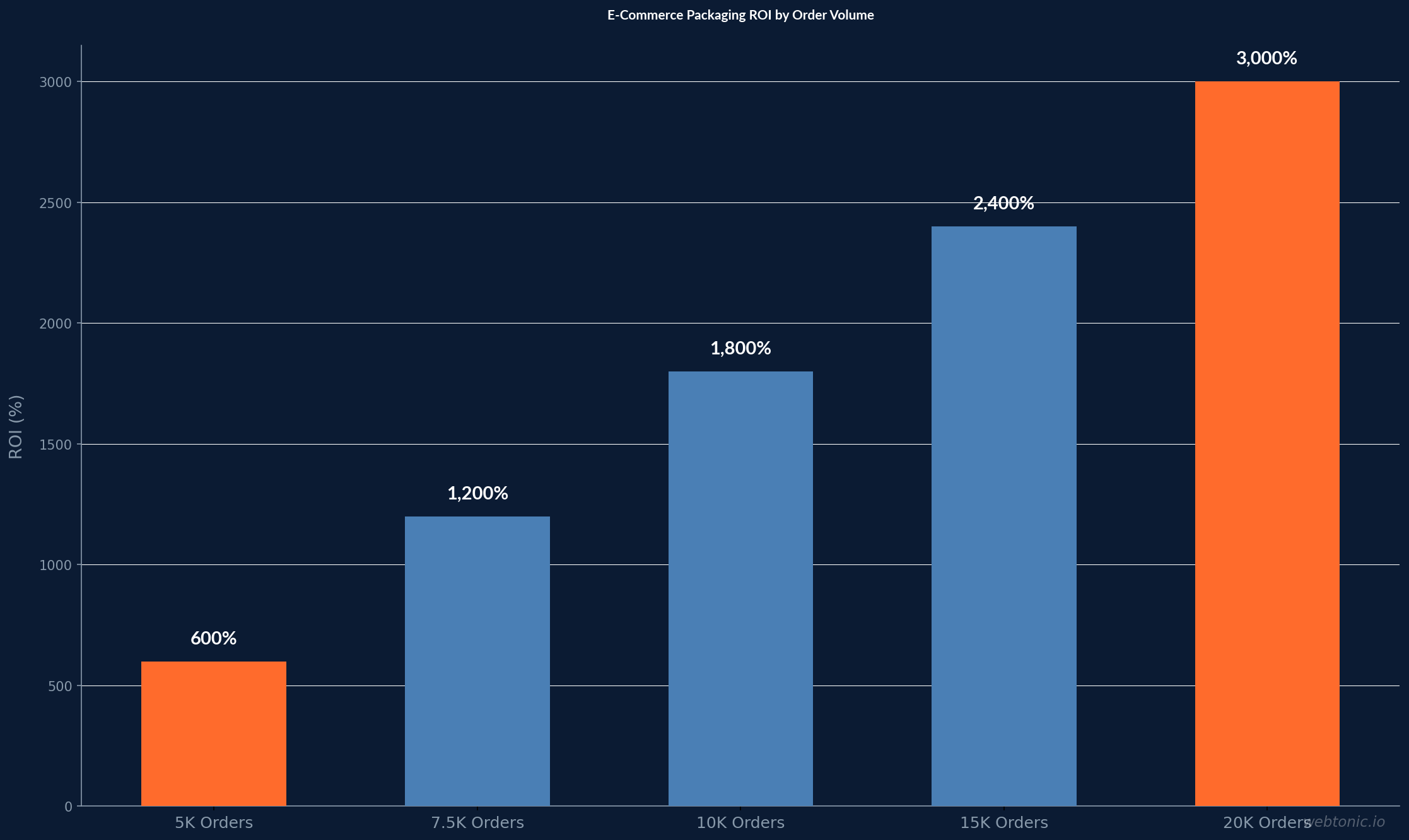
| Strategic Packaging ROI | 400–3,000% | Tenten / Shopify analysis |
| UGC from Gift-Like Packaging | 340% more branded content | Tracksmith case study |
| Avoidable Shipping Cost per Order | $0.50–$3.00 | Gorilla Shipper |
D2C Times reports that package-first creative strategies drive 25% lift in DTC unboxing rates, with brands like Tracksmith generating 340% more user-generated content through their branded packaging approach. For e-commerce businesses with an average order value of $150, strategic packaging investment can grow repeat revenue from $420,000 to $630,000–840,000 annually on a base of 10,000 orders. The wrong packaging choice also has a direct cost impact — avoidable shipping charges alone run $0.50 to $3.00 per order before damage claims and returns even enter the picture, making thoughtful packaging design both a branding and logistics optimization.
Brand Loyalty and Customer Retention in E-Commerce
Brand loyalty in e-commerce is evolving rapidly in 2026, with loyalty program participation and brand recognition driving measurable revenue differences between leading and lagging online retailers. The latest data from LoyaltyLion and TrustedSite reveals both expanding opportunities and growing challenges for e-commerce brands competing for repeat customers in a market where acquisition costs continue to climb.
- 90% of loyalty program members say membership influences repeat purchases from the same e-commerce brand, up from 85% in 2024
- 79% of consumers belong to 1–4 loyalty programs in 2026, versus 70% in 2025
- 68% of consumers say they are loyal to certain brands — a return to pre-2022 levels
- True loyalty declined 5% since 2024, the biggest single-year decline in five years of tracking (SAP Emarsys)
- 67% of consumers believe brands prioritize new customers over existing ones (GetResponse 2026 loyalty report)
- 91% of consumers are willing to share personal preferences for better rewards
- Loyalty programs deliver 4.8× average ROI when properly executed
- 51.5% of total marketing budget now goes to loyalty and CRM on average — the first time this figure crossed 50%
Multi-Channel Branding Performance
The impact of branding multiplies significantly when integrated across channels. Research from Done.lu and Feedvisor demonstrates how e-commerce branding efforts compound when combined with data-driven marketing strategies across multiple platforms. The strongest revenue gains come from brands that coordinate their visual identity, messaging, and customer experience across owned, paid, and earned channels simultaneously.
| Branding Strategy | Revenue Impact | Context |
|---|---|---|
| Branding + Multi-Channel (SEO, Ads) | 32–541% sales increase | European SMEs |
| Consistent Brand Presentation | +33% average revenue | Cross-platform study |
| 78% of Brands Saw Rising Retail Media Costs | CPC increases YoY | Feedvisor 2026 |
| AI-Driven Product Discovery | 61% expect 25% traffic from AI | Feedvisor forecast |
| 88% Concerned About AI Misuse | Trust challenge for brands | TrustedSite 2026 |
| Global E-Commerce Sales | $7.5 trillion (2025) | Quantumrun estimate |
E-Commerce Branding Best Practices From the Data
The statistics point to a clear set of high-impact branding investments for e-commerce businesses looking to differentiate in an increasingly competitive and cost-intensive landscape. Each recommendation below is grounded in the benchmark data presented above, prioritized by measurable conversion and revenue impact.
- Invest in professional website design — the 75% trust increase from polished design outweighs most other single interventions
- Maintain visual consistency across all touchpoints — the 52% trustworthiness lift from consistent branding compounds over time and across channels
- Implement or upgrade loyalty programs — with 90% of members influenced to repurchase and 4.8× ROI potential, this is a baseline requirement
- Treat packaging as a branding channel — 72% of consumers say it influences repurchase, and strategic packaging delivers 400–3,000% ROI
- Leverage UGC alongside brand content — the 19% conversion lift from UGC combined with brand-produced hero imagery creates the optimal content mix
- Display trust signals prominently — customer reviews (47% expect them), money-back guarantees (21% conversion lift), and detailed About pages (31% trust increase)
- Prepare for AI-driven product discovery — 61% of brands expect up to 25% of traffic from AI interfaces by 2027, making brand recognition in AI summaries critical
The consistent theme across all of these data points is that branding investments compound over time. While individual trust signals may produce modest lifts in isolation, the combined effect of professional design, consistent visuals, strategic packaging, and loyalty programs creates a brand moat that reduces customer acquisition costs and increases lifetime value simultaneously.
E-Commerce Trust Challenges and AI Impact (2026)
The rise of AI-generated content and AI-powered shopping interfaces creates both opportunities and challenges for e-commerce branding in 2026. The latest consumer sentiment data reveals that trust dynamics are shifting as AI becomes more embedded in the online shopping experience.
- 88% of shoppers are concerned about AI misuse in online shopping, up slightly from 87% in 2024 (TrustedSite)
- 61% of brands expect up to 25% of product discovery traffic to come from AI-driven interfaces by 2027
- 78% of brands saw increases in retail media costs with rising CPC year-over-year, making organic brand equity more valuable
- 74.8% of brands expect Amazon advertising budgets to increase in 2026, intensifying marketplace competition
- Global e-commerce sales reached $7.5 trillion in 2025, yet many businesses fail to capture growth because their branding is treated as vanity rather than a commercial engine
These trends suggest that building authentic brand equity through consistent visual identity, transparent customer communication, and genuine trust signals will become increasingly important as AI reshapes how consumers discover and evaluate products online. Brands that establish strong recognition before AI-driven shopping becomes dominant will have a significant first-mover advantage in maintaining customer relationships.
Frequently Asked Questions
How much does branding impact e-commerce conversion rates?
Professional website design alone increases trust by 75%, which translates to 25–40% higher conversion rates according to PageLens research. Consistent visual branding across all touchpoints boosts perceived trustworthiness by 52%, and when combined with multi-channel strategies like SEO and paid advertising, some e-commerce businesses report sales increases of 32–541%. The compounding nature of these branding investments means the full revenue impact typically takes 6–12 months to materialize.
What is the ROI of e-commerce packaging as a branding tool?
Strategic branded packaging delivers 400–3,000% ROI according to Shopify analysis. For a business with $150 average order value and 10,000 annual orders, a $20,000–65,000 packaging investment can grow repeat revenue from $420,000 to $630,000–840,000. Additionally, 44% of shoppers share unboxing experiences on social media, creating organic brand amplification that compounds the direct revenue impact through user-generated content and social proof.
Are loyalty programs worth the investment for e-commerce brands?
The data strongly supports loyalty program investment in 2026. 90% of program members say membership influences repeat purchases (up from 85% in 2024), loyalty programs deliver 4.8× average ROI, and 51.5% of total marketing budgets now go to loyalty and CRM initiatives — the first time this figure has crossed 50%. However, 67% of consumers feel brands prioritize new customers over loyal ones, indicating significant room for differentiation through better retention strategies and meaningful rewards programs.
How important is visual consistency in e-commerce branding?
Visual consistency is a top-three branding priority for e-commerce businesses. Consistent branding across images increases trustworthiness by 52%, 63% of consumers can identify a brand logo from a single exposure, and 81% of shoppers prefer recognized brands even at higher price points. The compounding effect of visual consistency — higher first-purchase conversion, better customer retention, lower price sensitivity, and higher referral rates — makes it foundational for long-term e-commerce growth and sustainable competitive advantage.
Sources
bigcommerce.com — ecommerce branding framework
feedvisor.com — 2026 state of brand commerce
eevy.ai — trust signal statistics
zipdo.co — branding statistics
done.lu — ecommerce branding strategies
loyaltylion.com — loyalty in 2026
trustedsite.com — state of ecommerce trust 2026
usepagelens.com — how images affect conversion rates
d2c-times.com — package-first creative
seoprofy.com — branding statistics